


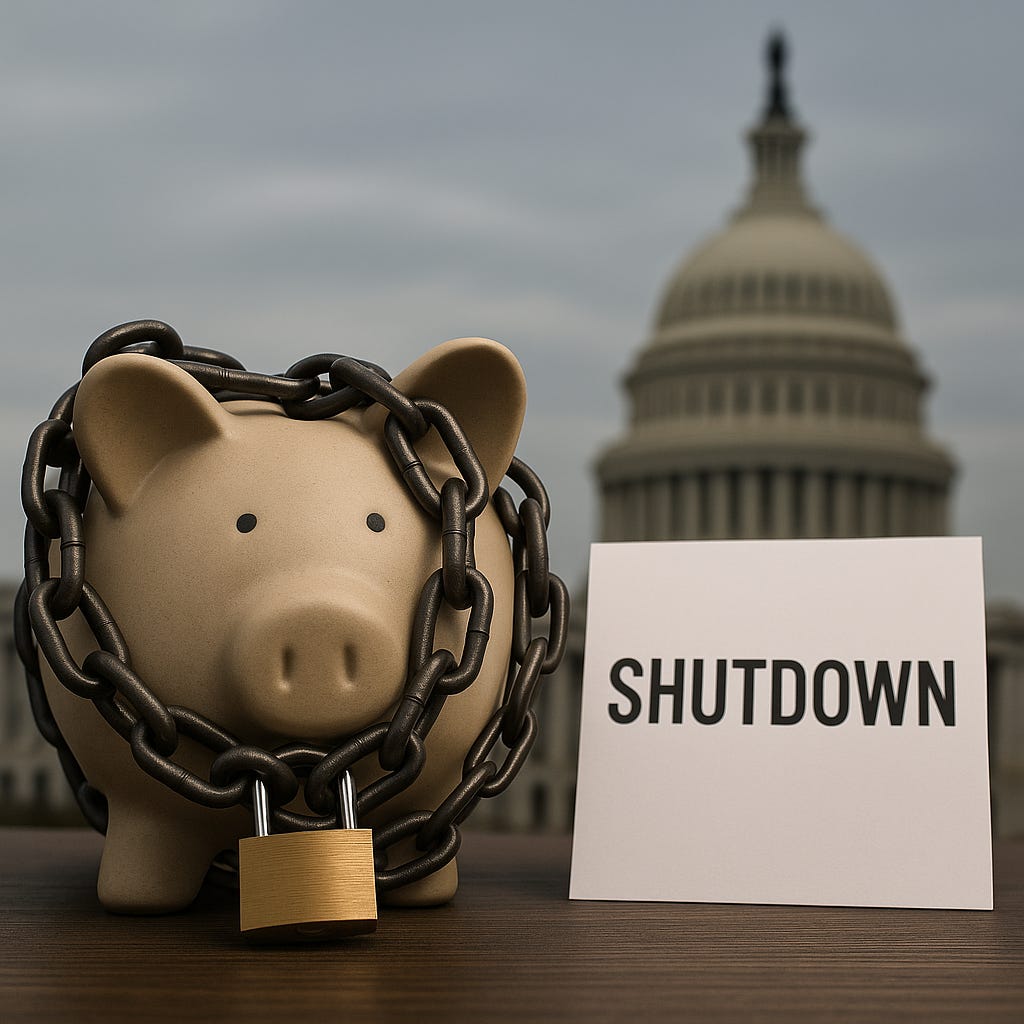
It has now been a full month since the federal government shut down.
In that time, federal workers have gone without pay, food assistance has been frozen for November, and essential services have been paused, all while Congress stages increasingly desperate performances of discipline and blame avoidance.
However, this week, the shutdown became harder to dismiss as “just politics.”
The Congressional Budget Office released its estimate. It calculates that if this shutdown continues into late November, it will cost the U.S. economy up to $14 billion in permanently lost output.
That’s not delayed spending. That’s gone — wages, services, contracts, and economic activity that will never come back.
Because democracy doesn’t defend itself, and neither does your sanity. Subscribe here to keep your eyes open and your sarcasm sharp.
The Damage Is Measurable and Preventable
According to the CBO, the shutdown’s cost could reach $14 billion in permanently lost output if it continues into late November. The report also provides estimates for shorter shutdown periods.
If the shutdown ends early (by late October - so today): ~$7 billion in permanently lost output
If it lasts six weeks (mid-November): ~$11 billion in permanent losses
If it continues through late November: Up to $14 billion in irrecoverable economic damage
These are not total spending reductions, but rather losses in real economic activity that cannot be recovered even if paychecks resume or contracts are restarted.
Here’s what that means in practice, and why the damage is already mounting.
Unworked Hours That Still Cost Money
Federal employees in “non-excepted” roles, from food inspectors to research scientists to grant processors, have been legally barred from doing their jobs for a month. And yet, once the shutdown ends, they’ll receive back pay for every single day they were forced to sit idle.
This isn’t waste by worker choice. It’s government-imposed inefficiency. We’re literally paying people not to serve the public. That’s not just demoralizing. It’s lost productivity that won’t be recovered.
That’s not just their time. There is also what they create or do.
Delayed Benefit Applications That Fuel Local Economies
While existing Social Security and veterans benefits are still being paid, new applications and services are slowed or paused in many cases due to reduced staffing and office closures. That means people who would soon be receiving monthly checks — often for retirement, disability, or survivor benefits — are left in limbo.
These are more than personal delays. They’re macroeconomic drags. Social Security and VA benefits inject billions of dollars into local economies each month, especially in communities with large populations of retirees and veterans. When a new applicant is delayed, their spending is delayed: groceries, prescriptions, utility payments, and rent. That’s money that won’t flow through the economy this month or possibly next.
Canceled Contracts and Halted Projects
Small businesses that rely on federal contracts, such as for maintenance, IT, logistics, and construction, have already seen those contracts paused, delayed, or canceled. Some may not survive the disruption.
Unlike salaried federal employees, contractors often receive no back pay. When a project is canceled due to a shutdown, the revenue disappears, and so do the jobs. That economic activity is permanently lost, and it ripples outward through local economies.
Frozen SNAP Spending
SNAP benefits inject billions into the economy each month. They aren’t just support for individuals> They’re a direct stimulus to local grocery stores, food producers, and distribution networks.
See our recent reporting here:


When those benefits are delayed or stopped, food goes unsold, shelves stay full, and economic demand in low-income communities drops sharply. That reduction in consumer spending won’t be “made up” later. The missed meals don’t come back, and the money doesn’t either.
And here’s the kicker: unless Congress includes explicit language in a continuing resolution, any missed November benefits may not be paid retroactively.
That means the economic damage is not only real, but it could also be permanent.
Tourism and Retail Losses
Shutdowns mean national parks, monuments, museums, and visitor centers are closed. That directly affects the millions of small businesses, such as restaurants, gas stations, and hotels, that rely on federal tourism traffic.
October is peak season in many parks and heritage sites. Every week of shutdown is revenue lost forever, especially in rural and gateway towns that depend on seasonal tourism. These are not “political” businesses. They’re often family-run, operating on thin margins. The business lost during that time cannot be made up.
Stalled Permits, Delayed Tax Enforcement
The federal government isn’t just a spender — it’s a revenue generator. When IRS agents, SBA loan officers, and immigration case workers are furloughed, money stops moving.
Permits can’t be processed. Loans can’t be issued. Taxes can’t be collected. And when these delays pile up, business planning slows, backlogs grow, and trust in the system erodes. The economy doesn’t just stop. It sags under the weight of inefficiency.
And yet, amidst all this loss, one government function continues unfazed.
ICE Got a “Super Check.” SNAP Families Got Silence.
Earlier this month, many ICE agents received what’s been called a “super check”: a single payment covering the shutdown period, overtime, and their regular pay.
That’s because ICE, unlike most federal agencies, had access to multi-year and no-year funds allocated in advance, part of massive enforcement increases passed in earlier legislation, including the One Big Beautiful Bill. These funds don’t expire at the end of the fiscal year. They don’t require new appropriations, and they don’t pause for shutdowns.
In other words, the system made sure immigration enforcement was protected.
Meanwhile, families relying on SNAP, including children, seniors, and working-poor Americans, were told that no benefits will be distributed in November unless Congress acts.
And so far, Congress hasn’t.
And No, Immigrants Aren’t Getting Those Benefits
Let’s clear something up while we are here. Despite what pundits and politicians keep implying, undocumented immigrants do not receive SNAP. They are legally blocked from qualifying.
Even most legal immigrants face long waiting periods, exclusions, or threats of disqualification under “public charge” rules. Many avoid applying altogether out of fear, even when their U.S. citizen children are eligible.
The people who are about to go without food assistance are children born in this country, seniors on fixed incomes, disabled Americans, and working families with low wages.
They’re not undocumented. They’re just unimportant in a system that prioritizes punishment over care.
Why Enforcement Gets a Blank Check and Everyone Else Gets a Shutdown
ICE and Border Patrol being funded while social safety nets are not isn’t just a budgeting quirk. It’s structural and intentional.
Agencies like ICE and CBP are funded under the banner of “national security.” That means they get long-term, protected, flexible budgets that are resilient to shutdowns.
Programs like SNAP, WIC, housing assistance, and research are treated as “discretionary social spending,” which is subject to cuts, delays, and — in a shutdown — suspension.
Because this system sees detaining a migrant as essential. Feeding a hungry child? Optional.
Punishing Immigrants Is More Important Than Feeding Grandma and the Kids
Let’s not overthink it.
The government is paying agents to remove the people who pick our food, while telling the people who rely on food assistance to go hungry.
This isn’t about saving money. It’s about power, priorities, and political messaging.
We’ve built a system where cruelty isn’t just accepted — it’s funded.
And right now, it’s funded better than compassion.
If this hit you, share it. Forward it. And if you’ve got a story about how the shutdown is impacting your work, your community, your family, leave a comment. We’d love to hear it.
Don’t let the bastards sneak anything past you. Subscribe and get your daily dose of rage and receipts delivered fresh, before the spin doctors can scrub it.
Sources:
“Federal shutdown could cost US economy up to $14 billion” — Reuters, October 29, 2025.
“Report: Government shutdown will cost the economy up to $14 billion” — The Washington Post, October 29, 2025.
“US could lose between $7bn and $14bn during shutdown, budget office says” — The Guardian, October 29, 2025.
“ICE agents are getting a ‘super check’ today. Here’s who is and isn’t getting paid as the shutdown drags on.” — Business Insider, October 22, 2025.
“How Sec. Noem Is Paying DHS With Big Beautiful Bill Funds During Shutdown” — Executive Gov, October 22, 2025.
“Trump is creating two classes of federal workers: Paid and unpaid” — The Washington Post, October 22, 2025.

It's like these incompetents don't LIVE HERE with the rest of us PEONS
Trump is not interested in people who might need help. He’s only interested in punishing people who do or say anything he doesn’t like. Put an emotional cripple in charge of the country and that’s going to happen—a lot.