


In a nation where democratic norms are under constant attack, this past week reminded us that the courts, flawed as they may be, are still standing as a firewall against authoritarianism.
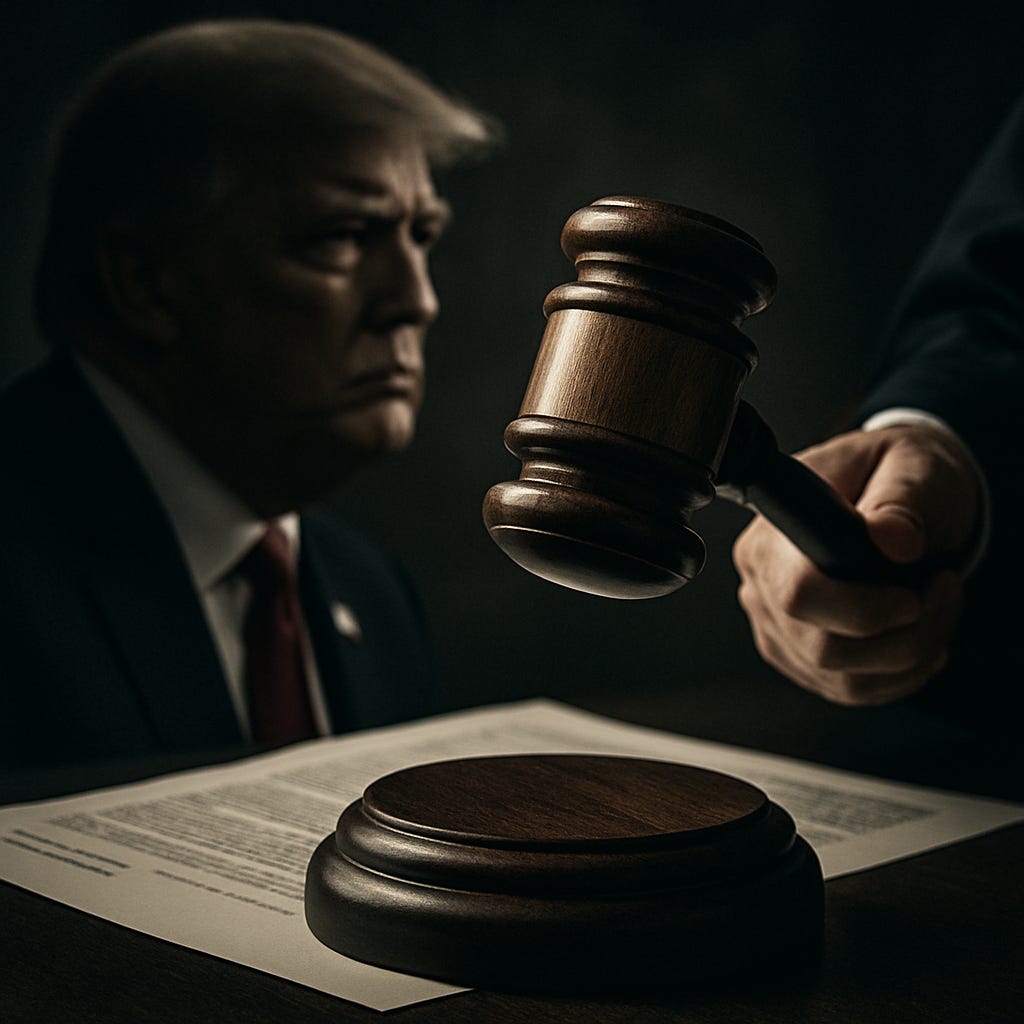
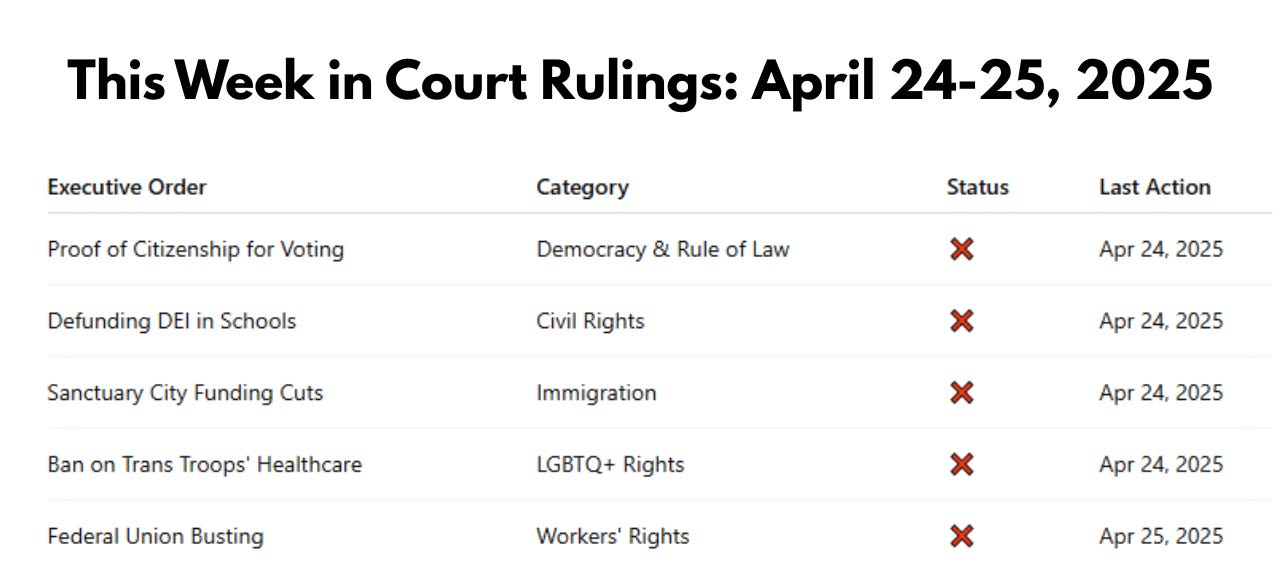
Between April 24th and 25th, federal judges nationwide delivered a series of stunning rebukes to Donald Trump’s most dangerous executive orders. In just two days, rulings rolled in blocking five key orders—each one aimed squarely at dismantling civil rights, silencing marginalized communities, or consolidating power.
Independent News. Just $1/Week.
We just hit 12,000 subscribers—thank you! We’re offering full access to The Coffman Chronicle for just $1 a week ($52/year) to celebrate.
Get exclusive analysis and fearless reporting you won’t find in corporate media.
Support truth. Stay informed.
Trump tried to:
Suppress your vote.
Erase diversity from classrooms.
Punish immigrant-friendly cities.
Deny healthcare to trans troops.
Crush federal workers' unions.
And in just 48 hours, the courts permanently blocked all five of these executive orders, proving that legal resistance is alive and well.
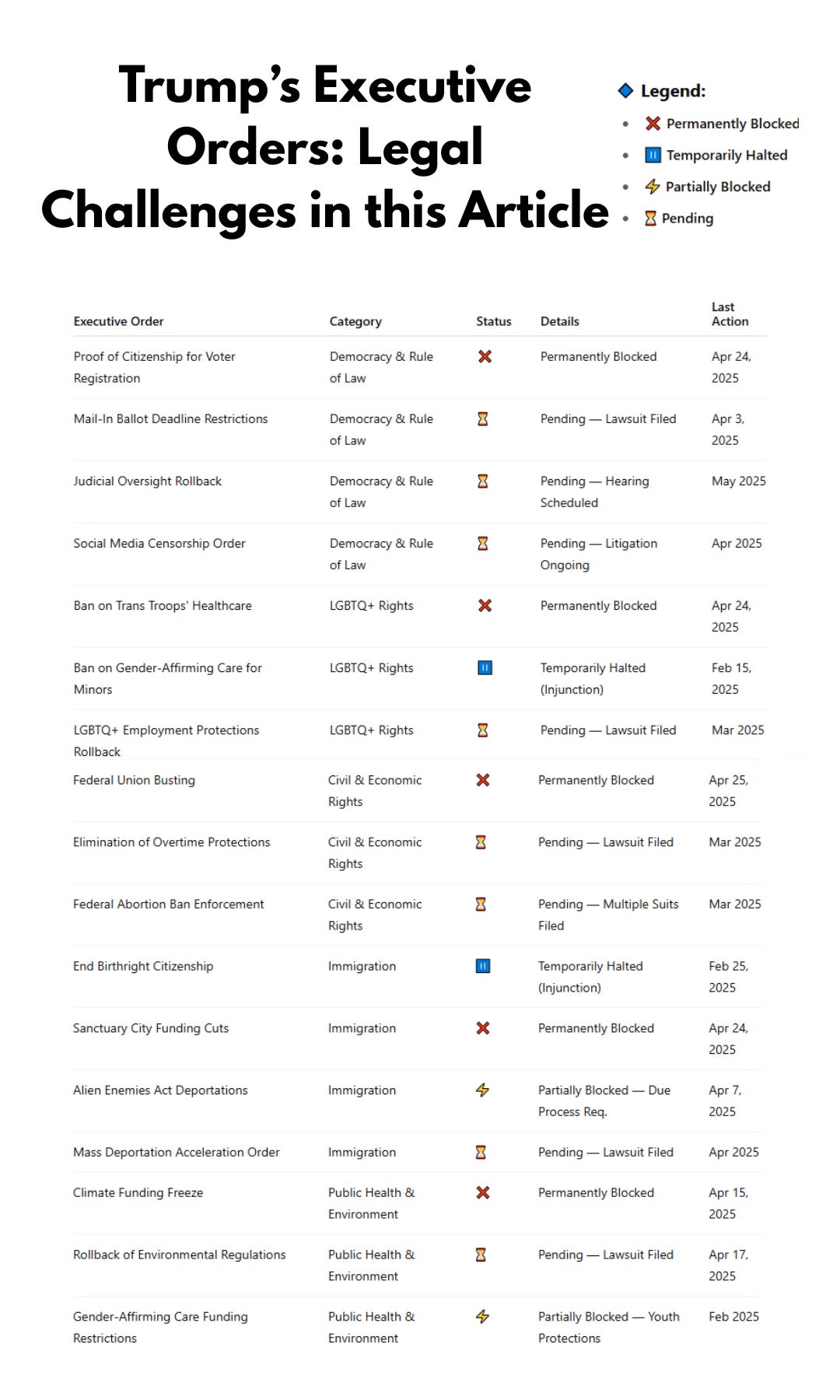
But these victories are only part of a much larger fight. For every executive order struck down, many remain active, either temporarily halted or awaiting judgment. Trump’s strategy is simple: overwhelm the system, enforce what he can, and stall where he must.
These five rulings were victories, but they’re just the tip of the iceberg. Across every major issue—democracy, civil rights, immigration, and more—Trump’s executive orders are still threatening lives and freedoms. Here’s how the fight is unfolding, one battleground at a time.
Democracy & Rule of Law: The First Line of Defense
Trump’s attacks on democracy began with executive orders designed to suppress votes, control information, and weaken judicial independence.
A federal judge blocked Trump’s proof-of-citizenship voter suppression order, halting its enforcement while legal challenges proceed.
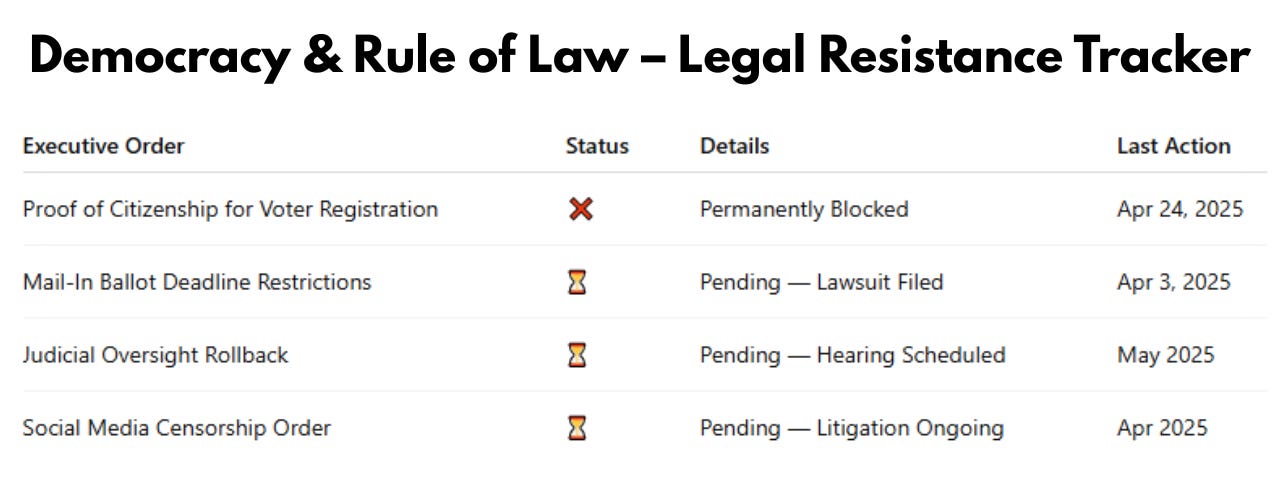
With only one significant order blocked—or at least delayed—the heart of American democracy is still under threat.
While democracy faces these legal battles, Trump’s attacks didn’t stop at the ballot box; they reached into the lives and rights of LGBTQ+ Americans next.
LGBTQ+ Rights: The Courts Push Back, But Threats Remain
The judiciary stood up for transgender troops, permanently blocking Trump’s healthcare ban. But trans youth are protected only by a temporary halt, and LGBTQ+ workplace protections hang in legal limbo.
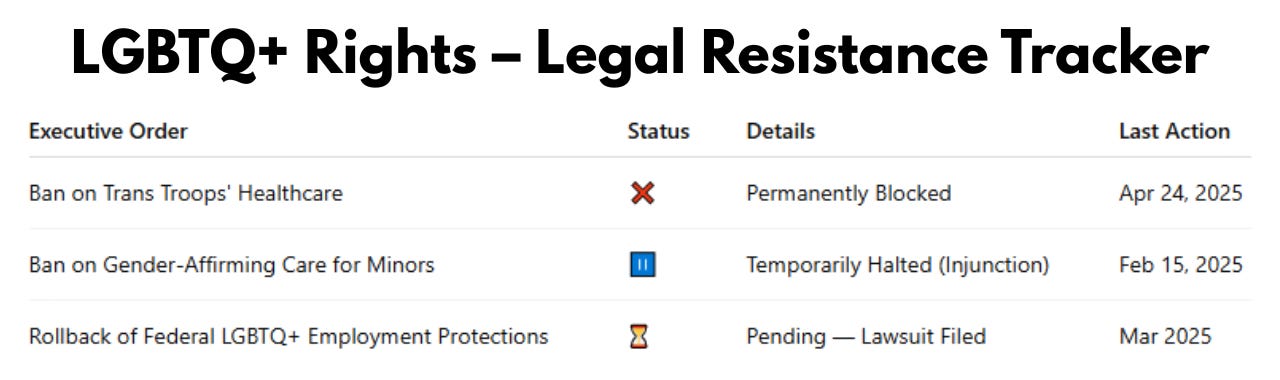
This is more than policy; it’s a fight for survival and dignity.
As LGBTQ+ rights hang in legal limbo, Trump’s agenda moves seamlessly into undermining workers’ rights and controlling reproductive freedom, two pillars of personal and economic autonomy.
Civil & Economic Rights: Protecting Workers and Reproductive Freedom
Trump’s assault on federal unions was shut down by the courts. But attacks on overtime protections and reproductive rights remain pending, threatening both economic justice and bodily autonomy.
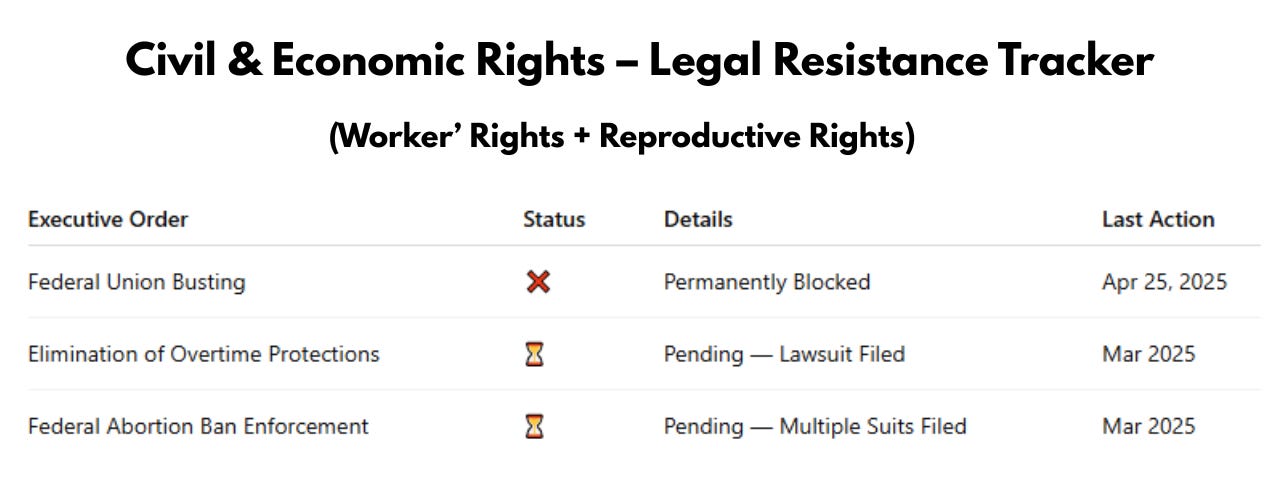
Labor won this round. But the war on workers and women’s rights is far from over.
And while economic justice is under siege, Trump’s long-standing war on immigrants continues to escalate, facing only partial resistance in the courts.
Immigration: Courts Slow the Assault, But the Deportation Machine Rolls On
Sanctuary cities scored a legal victory, but Trump’s attempts to end birthright citizenship, fast-track deportations, and launch mass removal efforts are still alive in courtrooms across the country.
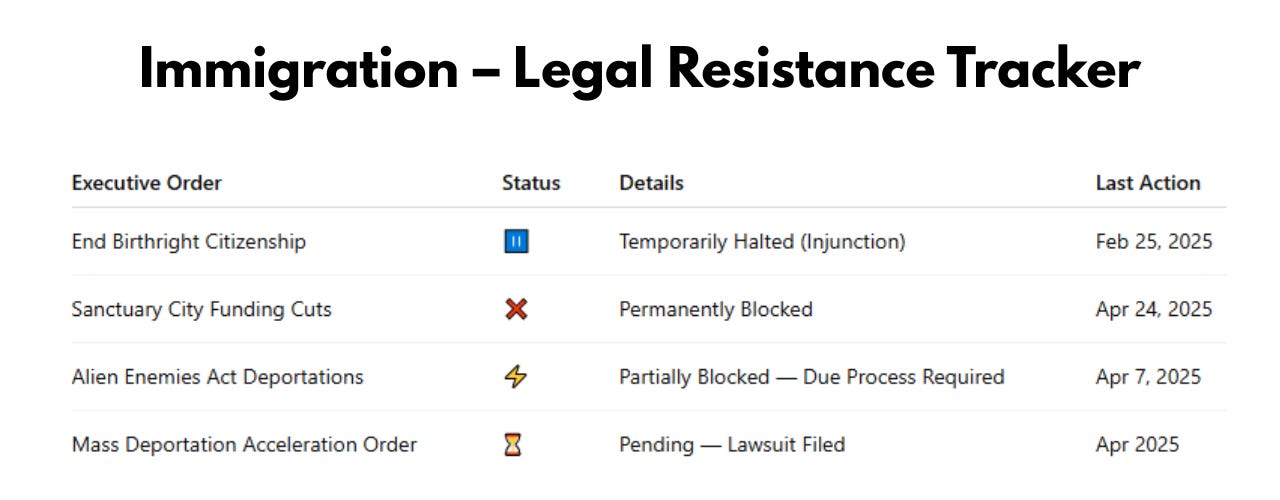
Without continued resistance, these policies could reshape immigration into a tool of fear and exclusion.
Beyond human rights and civil liberties, Trump’s executive power grab extends to the environment and public health, where corporate interests come before people and the planet.
Public Health & Environment: Blocking Corporate Greed, But for How Long?
The courts forced Trump to release frozen climate funds, but environmental rollbacks and healthcare attacks continue to threaten communities and ecosystems.
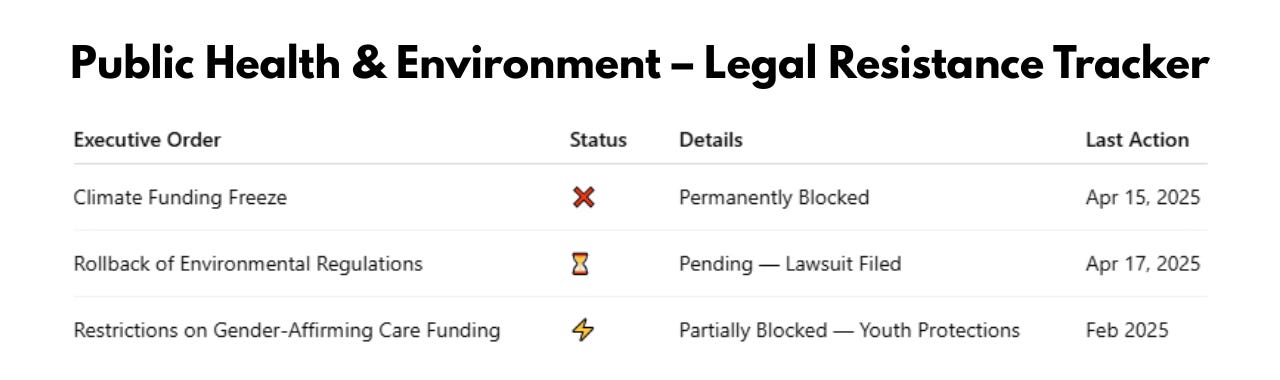
The planet—and public health—can’t wait for slow justice.
The pattern is clear from voting booths to hospital rooms, from courtrooms to the climate crisis. Trump’s executive power reaches every corner of American life, and the courts are the last line of defense.
Why This Matters: The Courts Are Holding the Line, But They Can’t Hold It Alone
Since returning to office, Trump has signed 137 executive orders, of which forty-six are already in court. We’ve covered the most dangerous here, but many more remain in force.
Pending doesn’t mean paused.
Blocked doesn’t mean over.
Trump’s playbook is clear: enforce what he can, delay where he must, and defy when possible.
Here’s What You Can Do:
Support legal defense groups.
Stay informed and loud.
Organize for lasting change.
We’ll keep tracking every ruling, every challenge, and every threat.
Because rights survive when we fight for them.
We just hit 12,000 subscribers—thank you! We’re offering full access to The Coffman Chronicle for just $1 a week ($52/year) to celebrate.
Get exclusive analysis and fearless reporting you won’t find in corporate media.
Bibliography:
"Judge Blocks Trump's Executive Order That Strips Union Rights from Federal Workers." Politico, April 25, 2025.
"US Judge Blocks Trump from Ending Union Bargaining for Many Federal Workers." Reuters, April 25, 2025.
"Judge Blocks Trump Administration from Nixing Collective Bargaining for Most Federal Employees." AP News, April 25, 2025.
"Judge Blocks Portions of Trump Executive Order That..." CBS News, April 24, 2025.
"Trump's Executive Order on Elections Is Partly Blocked by Federal Court." Arizona Mirror, April 24, 2025.
"Judge Pauses Parts of Trump's Sweeping Executive Order on Voting." NPR, April 24, 2025.
"Judge Blocks Trump's Order on Proof of Citizenship to Vote." The Washington Post, April 24, 2025.
"Courts Block Trump's Effort to Prohibit DEI Programs in Schools." The Washington Post, April 24, 2025.
"Federal Judge Blocks Key DEI Executive Order Provisions." The National Law Review, April 25, 2025.
"US Judge Blocks Trump from Withholding Funds from 16 'Sanctuary' Cities, Counties." Reuters, April 24, 2025.
"In Blow for Trump, Pentagon to Resume Health Care for Trans Troops." Them.us, April 25, 2025.
"Trump Asks Supreme Court to Allow Ban on Transgender Members of the Military to Take Effect, for Now." AP News, April 24, 2025.
"State of Washington v. Trump (2025)." Wikipedia, accessed April 25, 2025.
"Executive Order 14159." Wikipedia, accessed April 25, 2025.
"Trump Administration Litigation Tracker." Lawfare, accessed April 25, 2025.
"Trump's Executive Order on Elections Is Partly Blocked - Votebeat." Votebeat, April 24, 2025.
"Judge Orders Nationwide Injunction Against Trump's Birthright Executive Order." Politico, February 5, 2025.
"Trump's Order Curtailing US Birthright Citizenship Blocked by 4th Judge." Reuters, February 13, 2025.
"Trump Administration Appeals Maryland Judge's Ruling Blocking Birthright Citizenship Order."AP News, February 11, 2025.
"Judge Temporarily Blocks Trump's Executive Order Redefining Birthright Citizenship." AP News, January 23, 2025.

👏👏👏One suggestion, please: Court case citation and links! It would be helpful for following status of cases because then a reader can then plug the citations into Google Scholar to track appeals, progress of what happens after a temporary injunction, read the case at any time, see what case and scholarly articles cite the case, etc.
Yes, it would take additional time to get such info but here's my suggestion to make it easy and free: set up a distributed / crowdsourced network to volunteer law students and lawyers that are able to do it: unfortunately, right now as a semi-retired lawyer I personally can't. But frankly, but there are many retired lawyers also, for example that might want to be part of an effort to push back legally against Trump / DOGE.
To protect the integrity of the process, though, all helping MUST sign / pledge NOT to use AI. There are now well-documented court cases where a lawyer or paralegal for the lawyer has used AI to get case citations and AI got it wrong and even made up citations!
So now, there are orders against the lawyers for improper use of AI and new state and local bar rules / task groups against unsupervised AI. AI legal research per the disciplinary / licensing organizations and courts require that a lawyer / law firm not even bother with submitting legal documents to the courts that were the product of AI unless the lawyer and paralegal has actually checked and corrected AI mistakes / flights of fancy. AI must be supervised as if it were a human paralegal and lawyer.
All in all, it would be easier for your purposes and protection --and not to inadvertently mislead anyone -- to have a written agreement with helpers that any citations and links to court orders (and even dockets) cannot be the product of AI research or unsupervised AI research.
(A suitable indemnity agreement would also be involved as would be the lawyers and law students agreement that if they use AI research for the project and it is discovered --whether or not it causes injury' for it is the integrity of your work and project and the helperss' word that is also being protected-- that the offender will be reported to their Bar associations and Supreme Courts / licensing agencies.)
But I assume it would be greatly appreciated by the linked individual or group helpers supplying the citations and even any case updating status to you to be part of any effort to keep the Public and even lawyers and paralegals* as up to date as possible.
* In fact, there are also professional paralegal groups and even law professors that that might also want to be part of a distributed network that would regularly provide you Case citations and links to dockets & cases.
The only possible other downside to the idea that I can think of would be if by the act of publishing the links any copyrights are violated. The remedy for that would be presumably free consultation right upfront during the network [of citation and link helpers] set up process with IP [Intellectual Property] lawyers, professors, bar associations, public interest law firms, etc. advising about how to avoid copy write problems.]
With such additions to your trackers you could become known as a "go to" resource for the latest on the results of legally pushing back against Trump's power and ego-boosting tyrannical Executive Orders.
👏👏👏One suggestion, please: Court case citation and links! It would be helpful for following status of cases because then a reader can then plug the citations into Google Scholar to track appeals, progress of what happens after a temporary injunction, read the case at any time, see what case and scholarly articles cite the case, etc.
Yes, it would take additional time to get such info but here's my suggestion to make it easy and free: set up a distributed / crowdsourced network to volunteer law students and lawyers that are able to do it: unfortunately, right now as a semi-retired lawyer I personally can't. But frankly, but there are many retired lawyers also, for example that might want to be part of an effort to push back legally against Trump / DOGE.
To protect the integrity of the process, though, all helping MUST sign / pledge NOT to use AI. There are now well-documented court cases where a lawyer or paralegal for the lawyer has used AI to get case citations and AI got it wrong and even made up citations!
So now, there are orders against the lawyers for improper use of AI and new state and local bar rules / task groups against unsupervised AI. AI legal research per the disciplinary / licensing organizations and courts require that a lawyer / law firm not even bother with submitting legal documents to the courts that were the product of AI unless the lawyer and paralegal has actually checked and corrected AI mistakes / flights of fancy. AI must be supervised as if it were a human paralegal and lawyer.
All in all, it would be easier for your purposes and protection --and not to inadvertently mislead anyone -- to have a written agreement with helpers that any citations and links to court orders (and even dockets) cannot be the product of AI research or unsupervised AI research.
(A suitable indemnity agreement would also be involved as would be the lawyers and law students agreement that if they use AI research for the project and it is discovered --whether or not it causes injury' for it is the integrity of your work and project and the helperss' word that is also being protected-- that the offender will be reported to their Bar associations and Supreme Courts / licensing agencies.)
But I assume it would be greatly appreciated by the linked individual or group helpers supplying the citations and even any case updating status to you to be part of any effort to keep the Public and even lawyers and paralegals* as up to date as possible.
* In fact, there are also professional paralegal groups and even law professors that that might also want to be part of a distributed network that would regularly provide you Case citations and links to dockets & cases.
The only possible other downside to the idea that I can think of would be if by the act of publishing the links any copyrights are violated. The remedy for that would be presumably free consultation right upfront during the network [of citation and link helpers] set up process with IP [Intellectual Property] lawyers, professors, bar associations, public interest law firms, etc. advising about how to avoid copy write problems.]
With such additions to your trackers you could become known as a "go to" resource for the latest on the results of legally pushing back against Trump's power and ego-boosting tyrannical Executive Orders.