


In less than three weeks, the detention camp in the Everglades hailed by Trump, DeSantis, and DHS Secretary Kristi Noem as a “model” for the nation has become a symbol of cruelty, incompetence, and deception.
Before it was even “built”, Alligator Alcatraz was facing lawsuits from environmental and indigenous groups. Here at the Coffman Chronicle, we sounded the alarm on June 30th, noting that the location and structure would invite insect-borne illness, sanitation issues, and adverse weather dangers.
Still, Trump and others called it a model for future facilities. Until they didn’t.

Stay Informed. Stay Loud.
Subscribe to The Coffman Chronicle for no-BS political analysis, action guides, and weekly truth bombs you won’t get from corporate media.
The Setting
Florida officials chose one of the most ecologically fragile and controversial pieces of land in the United States: a swampy corner of the Everglades, home to endangered species, part of the watershed that sustains South Florida, and sacred to the Miccosukee and Seminole tribes.
The land had already been deemed unsuitable for development decades ago, when a plan to build an airport there was abandoned after engineers concluded the ground was unstable and the ecological damage would be catastrophic.
And yet, in late June of 2025, the state bulldozed ahead, constructing what they called a “temporary” detention facility in under ten days. This was done at the first month of hurricane season, with no meaningful public input, environmental review, or consultation with the tribes whose sacred lands were desecrated in the process.
Florida Governor Ron DeSantis responded to environmental concerns about the site in mid-June, saying:
"There is zero environmental impact. I'm the governor who's poured more money into Everglades restoration than anyone. It isn't permanent. This is temporary. There's no sewer being constructed. Environmental impact is zero."
Those assurances, however, ring hollow now that detainees have described toilets overflowing onto the floors and human waste pooling inside tents, predictable consequences of building a facility without adequate sewage infrastructure.
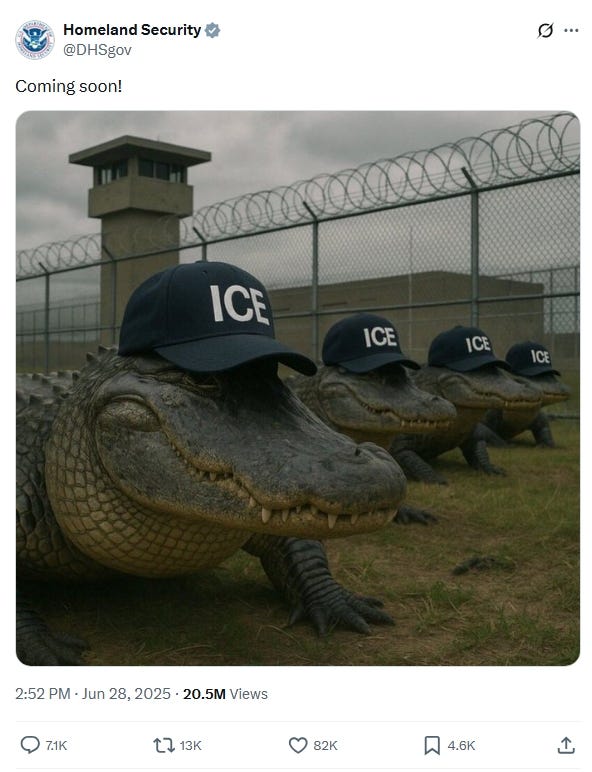
DHS via X
As we reported early this month, officials rushed construction on a site long known to be unsuitable for development, ignoring decades of warnings and environmental laws.
See our previous reporting here:


The Photo‑Op
On July 1, Donald Trump, Ron DeSantis, Pam Bondi, and DHS Secretary Kristi Noem toured the camp for the cameras. They smiled, cut ribbons, and declared the site a model facility that could inspire similar camps around the country.
Noem even cited FEMA funding as proof of its legitimacy and readiness on Instagram that same day.
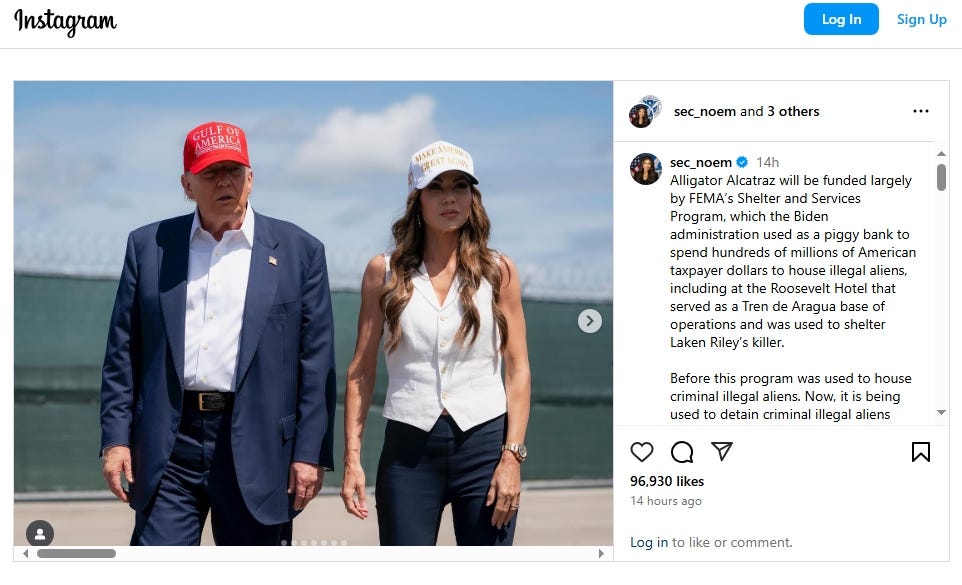
Secretary Noem via Instagram
“We’re surrounded by miles of treacherous swampland and the only way out is, really, deportation. This is an amazing thing that they’ve done here,” Trump said during the tour. A gaggle of gator jokes followed.
But behind the photo‑op, conditions were already unraveling. Lawmakers and advocates were already raising alarms that the tents and infrastructure were insufficient to protect people from the heat, storms, and mosquitoes of the Everglades.
Their visit was pure theater designed to sell the public a lie about the camp’s preparedness and humanity.
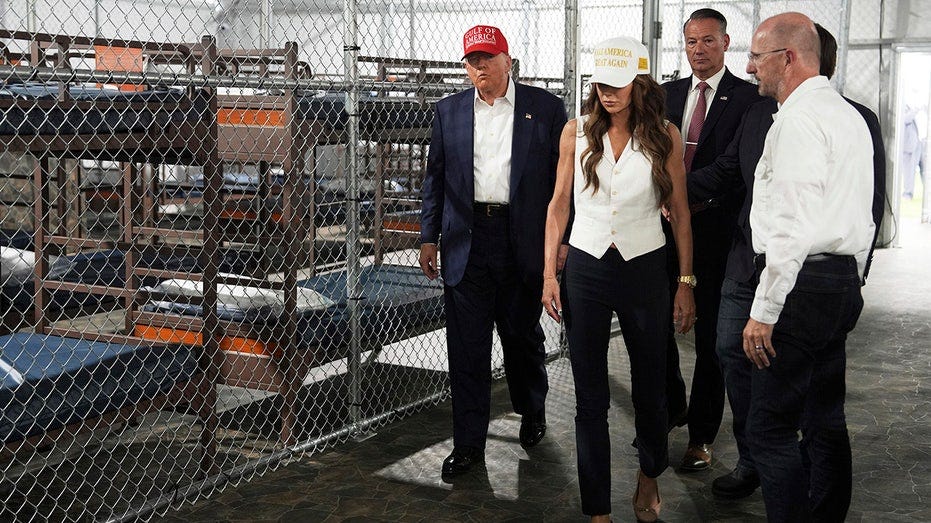
Evan Vucci/AP
Before It Officially Opened
Even as they toured the camp and praised it as ready, signs of failure were already evident. Flooding was documented within 24 hours of the tour, before the first detainees officially arrived.
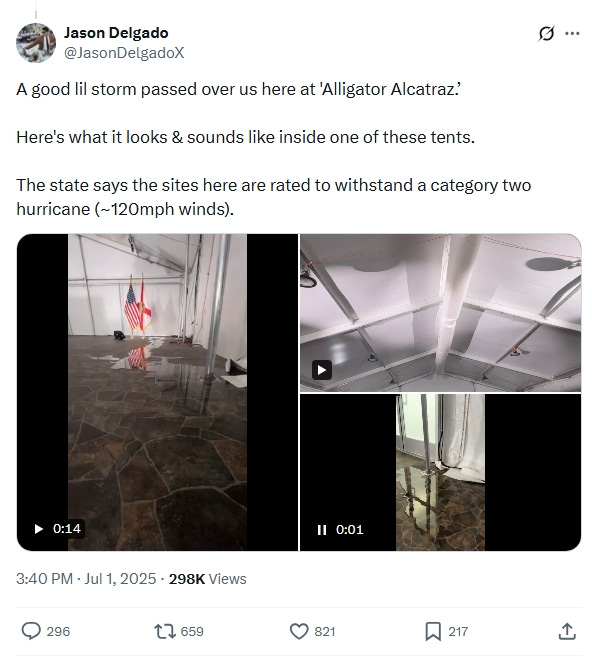
Spectrum News Reporter Jason Delgado via X
Even as officials toured the camp on July 1, or soon thereafter, it was already holding a frightened 15‑year‑old boy named Alexis and a few of his friends before its “official” opening and before other detainees arrived.
According to The Independent, Alexis initially lied about his age when stopped, telling authorities he was an adult because, as his father put it, “It was because of fear.”
For three days, his father, Ignacio, had no idea where his son was, until one of Alexis’s friends, also detained, called from inside the facility to let him know. Ignacio then told his son to admit he was a minor, sent a photo of his birth certificate by text, and urged him to ask guards for permission to use his phone to prove his age. Only then was Alexis transferred to an appropriate juvenile shelter.
Now, as of July 18th, Ignacio is still fighting to reunite with his son, even submitting to a paternity test to satisfy authorities.
The Disavowal
Just 48 hours after the tour, on July 3, Department of Homeland Security (DHS) attorneys filed a court statement explicitly denying that DHS had funded, endorsed, or directed the facility.
This was a stunning reversal of the administration’s messaging during the tour, in which they had loudly praised the camp as a federally supported model and Noem herself posted that the facility was funded “largely by FEMA”. Within two days, under oath, they ran from the very project they had just paraded before the cameras.
It is almost like they knew the poop (literally) was about to hit the (desperately needed) fan.
The Lawsuit
By July 16, less than two weeks after the camp’s opening, the ACLU and Americans for Immigrant Justice filed a federal class‑action lawsuit.
The complaint alleges that detainees are being denied access to legal counsel, subjected to inhumane conditions, and denied due process. Attorneys have been blocked from meeting clients in person. Detainees have been left to navigate the legal system with no meaningful help.
This lawsuit, C.M. v. Noem, explicitly argues that the camp violates detainees’ constitutional rights by denying due process, blocking access to counsel, and subjecting people to cruel and unusual punishment.
Senior ACLU attorney Eunice Cho warned: “The U.S. Constitution does not allow the government to simply lock people away without any ability to communicate with counsel or to petition the court for release…”
Reports of Abuse & Conditions
By July 19, just 18 days after opening, firsthand accounts from detainees, their families, attorneys, journalists, and even lawmakers painted a harrowing portrait of life inside Alligator Alcatraz.
On July 12, a group of Democratic lawmakers, including Reps. Debbie Wasserman Schultz, Darren Soto, Maxwell Frost, Jared Moskowitz, and several state-elected officials toured the facility. In a press release, they reported that they had requested and been invited to the visit after Florida Rep. Ashley Gantt sued DeSantis over a July 3 visit during which she and four other state lawmakers were denied entry on the pretext that it was a federal facility, according to Rep. Frost.
The lawmakers were not allowed to bring phones or cameras during their inspection and were shown only certain areas of the camp under tight supervision. Still, what they saw was enough for Wasserman Schultz to call the facility bluntly: “An internment camp.” She further reported that she brought a handheld thermometer. “In the medical intake area, it was 85 degrees. This is inside the so-called air-conditioned tent.”
After touring the camp, she reported that detainees were crammed into “wall‑to‑wall cages,” forced to drink water from the same sink they used for the toilet, and subjected to suffocating heat. “There are really disturbing, vile conditions and this place needs to be shut the hell down,” she continued.
Most alarmingly, Schultz told reporters, “Another man screamed out that he was poisoned by Clorox in the water, and he was in the hospital for four days. Now, we were told that there was no one who was ever hospitalized overnight, so maybe he was referring to the medical clinic.”
Her description echoed and validated earlier accounts from detainees and family members.
Food: “Worms in the rice”
Gaetano Mirabella Costa and Fernando Artese, two Italian detainees, told The Times (UK) they were “caged like chickens” and described the food as both insufficient and contaminated. Meals reportedly consisted of undercooked rice with visible worms, stale bread, and little else.
Artese told the Tampa Bay Times by phone, “This is a concentration camp. They treat us like criminals — it’s a pursuit of humiliation. We’re all workers and people fighting for our families.” Speaking to Italian paper Corriere della Sera, his daughter said, “Many don’t have medicine and there’s not much food. They can’t sleep at night because the lights are on 24 hours a day. They can’t see the sun, they can’t go outside.”
One Venezuelan detainee told his wife, as reported by The Associated Press, that “they eat once a day and have two minutes to eat. The meals have worms.”
“They left us without food all night. They took a Cuban protester to a punishment cell,” one man said.
Sanitation & Flooding: “Pee and poop on the floor.”
According to The Washington Post and Milwaukee Independent, the camp’s toilets frequently overflowed, flooding the tents with sewage. A Venezuelan detainee’s wife relayed his words: “The toilet overflows and the floor is flooded with pee and poop.”
Following his visit alongside other lawmakers, Rep. Frost told reporters he saw “unhygienic conditions due to toilets not working and feces being spread everywhere.”
Summer rains exacerbated the problem, turning the swampy grounds into standing water. The Italians’ account described the tents as flooded, hot, and teeming with insects — making the interior as hostile as the exterior.
Medical Neglect: “This is not for human beings.”
CBS Miami interviewed Venezuelan detainee Enzo Aspite, who said he was denied his medications and left to suffer in the heat without relief. “This is not for human beings,” he told reporters, describing conditions so harsh that they endangered his health.
The ACLU lawsuit describes how one detainee, who required surgery, was denied prescribed antibiotics, leading to herniation and worsening infection.
Shackling & Punishment: “Locked outside, begging to be let in.”
Several accounts, including one cited by Newsweek, described detainees being shackled unnecessarily during meals, during phone calls, and even during legal proceedings.
Perhaps the most shocking account involved a detainee identified as “Castillo,” who reportedly began a hunger strike to protest conditions. According to reporting by Yahoo News and Gulf Coast News Now, guards punished him by handcuffing him and leaving him outside in the sweltering Everglades heat, where he was swarmed by mosquitoes and left to beg to be let back inside.
Denied Legal Access: “No way to contest detention.”
The lawsuit filed July 16 detailed how detainees were routinely denied access to attorneys. Lawyers were prevented from entering the facility, forced to wait hours, and then shown only select areas. Phone calls, when permitted, were short, monitored, and non-confidential.
As the lawsuit states, detainees “have no way to contest their detention,” leaving them trapped without due process or meaningful recourse.
Blindsided & Ignored: Local Officials Kept in the Dark
In addition to withholding information from the public, Florida officials also appear to have bypassed local agencies and experts entirely when rushing to build Alligator Alcatraz.
According to an Associated Press investigation published on July 18, local officials at the county, environmental, and federal park levels were taken by surprise by the project.
Miami-Dade County regulators stated that they were not consulted or informed, despite the site being within their jurisdiction, on land prone to flooding and protected under state and federal environmental regulations.
Among the 100+emails revealed in the AP’s investigation, Dan Summers, Collier County’s emergency management director, displayed confusion, then outrage. Local emergency management offices confirmed they had no role in planning or approving the camp, despite the clear risk to public health and safety during hurricane season.
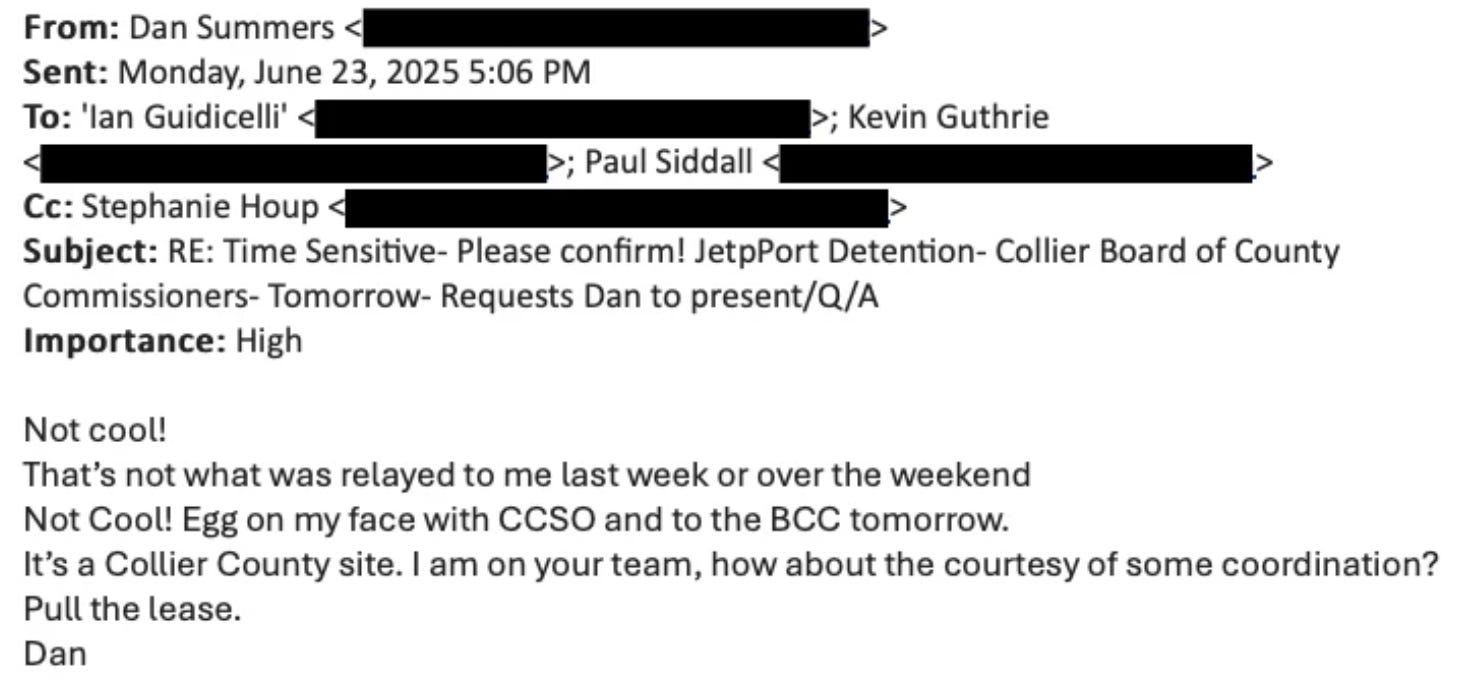
This lack of communication left the camp without meaningful oversight or coordination from the very agencies charged with protecting the land and its people, exemplifying the rushed and reckless nature of the project.
Expanding the Model: Other States & Federal Funding
On July 18, just two days after the ACLU lawsuit was filed, The Independent reported that five Republic-led states are already in talks to replicate the Alligator Alcatraz model. DHS Secretary Kristi Noem confirmed the discussions, signaling that what began as a Florida experiment is being actively promoted as a national template.
Among the most striking endorsements came from South Carolina Representative Nancy Mace, who earlier declared on X July 1st: “We’ve got a swamp and a dream. Let’s talk.” She continued: “South Carolina’s gators are ready. And they’re not big on paperwork.”
Her comments underscore just how enthusiastically some lawmakers are embracing this idea, framing the construction of detention camps in ecologically fragile wetlands as a point of pride rather than shame.
And it is not just lawmakers who are celebrating the site. MAGA faithful have turned the sign at the site into a photo prop, posting in patriotic and Trump gear alongside the highway sign.
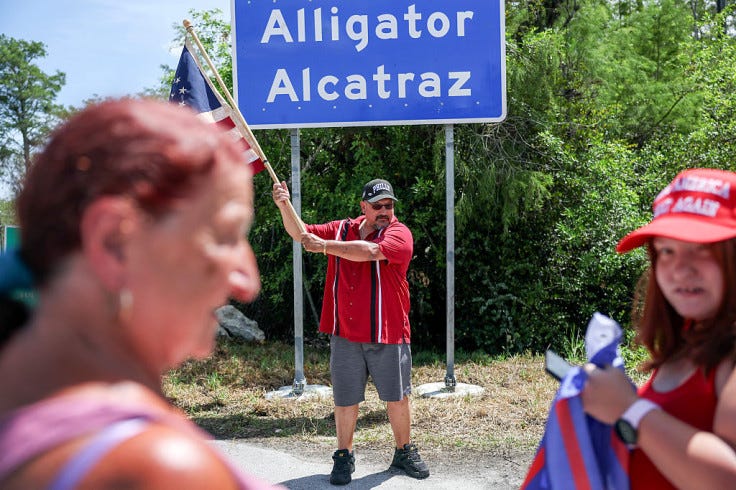
Photo by Joe Raedle/Getty Images
Compounding the concern is the role of FEMA’s Shelter & Services Program (SSP). On July 1, Noem claimed that Florida’s camp would be “funded largely by FEMA’s Shelter & Services Program.” This program was originally designed to help non‑federal organizations temporarily shelter migrants released from DHS custody, not to bankroll punitive detention camps in remote swamps.
FactCheck.org confirmed that Florida has indeed applied for FEMA reimbursement under SSP, making it eligible for such federal funds. This raises profound ethical and legal questions:
If similar camps are built statewide, could taxpayer-funded relief money be repurposed for mass detention?
Are states effectively outsourcing detention to federal funds, side-stepping oversight and constitutional safeguards?
Are facilities that do not meet basic federal standards eligible for SSP funds?
And if SSP funds are used, are facilities subject to federal oversight and responsibility?
Alligator Alcatraz is not just a failure. It is a scandal. It is a humanitarian, legal, and moral catastrophe. More importantly, it is a window into a broader policy of cruelty and indifference toward the most vulnerable.
In classic Trump fashion, it is also Schrödinger’s detention center, both funded by Shelter and Services and not federally funded, both ecologically safe and flooded in sewage, both a model for the nation and, predictably, not his problem.
Within just 18 days, what was called a “model facility” has been exposed as an unconstitutional nightmare. Detainees have been shackled, starved, flooded, denied medication, and punished for protesting their treatment, all on American soil, in full view of the state and federal officials who created it.
It is only through sheer luck — and not through any care or competence — that we are not yet reporting a fatality at Alligator Alcatraz. But unless this site is shut down, investigated, and its victims relocated to humane conditions, that luck will run out.
Within days of the facility opening, immigration attorney Josephine Arroyo said, “These are human beings who have inherent rights, and they have a right to dignity, and they’re violating a lot of their rights by putting them there.”
Those responsible, at both the state and federal levels, must be held accountable.
The site must be closed immediately. We must refuse to let its cruelty become the blueprint for America’s future.
Stay Informed. Stay Loud.
Subscribe to The Coffman Chronicle for no-BS political analysis, action guides, and weekly truth bombs you won’t get from corporate media.
Bibliography:
“Emails show DeSantis administration blindsided county officials with plans for ‘Alligator Alcatraz.’” AP News, July 17, 2025.
“Venezuelan detainee alleges inhumane conditions at Alligator Alcatraz: ‘They have us in a cage like chickens.’” CBS Miami, July 18, 2025.
“A Dedicated FEMA Fund Will Pay for Alligator Alcatraz?” FactCheck.org, July 2, 2025.
“Florida Democratic representatives receive invitation to tour ‘Alligator Alcatraz.’” WPBF West Palm Beach via MSN, July 9, 2025.
“Republicans and Democrats visited ‘Alligator Alcatraz’ for the first time. Here’s what they saw.” Politico, July 12, 2025.
"‘Alligator Alcatraz’ immigrant detention center sparks outcry as DeSantis claims zero environmental impact.” CBS Miami, June 25, 2025.
“Kristi Noem clashes with NBC anchor over 'inhumane' conditions at Alligator Alcatraz in testy exchange.” Fox News via MSN, July 12, 2025.
“Democratic lawmakers describe ‘disturbing, vile’ conditions at Alligator Alcatraz.” Local10.com, July 12, 2025.
“Detainees at Alligator Alcatraz Detail Inhumane Conditions — Ranging from Rotting Food to Open Sewage.” Milwaukee Independent, July 14, 2025.
“A 15-year-old boy with no criminal history ended up at Alligator Alcatraz after rush to fill facility.” The Independent, July 18, 2025.
“Kristi Noem says other unnamed states are in the process of building Alligator Alcatraz-style facilities.” The Independent, July 18, 2025.
“DHS Secretary Noem Says Five Republican States Wish to Copy Florida's 'Alligator Alcatraz', Calls on Democrats to Follow Suit.” The Latin Times, July 15, 2025.
“'Alligator Alcatraz' Floods Within Day of Opening.” Newsweek, July 2, 2025.
“We’re Caged Like Chickens, Say Italians in ‘Alligator Alcatraz’.” The Times (UK), July 21, 2025.
“Inside ‘Alligator Alcatraz,’ Detainees Report Relentless Mosquitoes, Limited Water.” Washington Post, July 16, 2025.
“'Alligator Alcatraz' Detainees Say in New Lawsuit They're Being Denied Access to Their Attorneys.” Yahoo News, July 17, 2025.
All I can say is that I can’t wait for the regime to collapse and for the tribunals to begin…
I have had it. This is intolerable. Noem, Homan and Trump should be prosecuted for crimes against humanity. Between this and the horror in Gaza, which Trump funds with money and arms, I am appalled that congress sits idly by and does nothing. Our government disgusts me.