


The Party of Law and Order
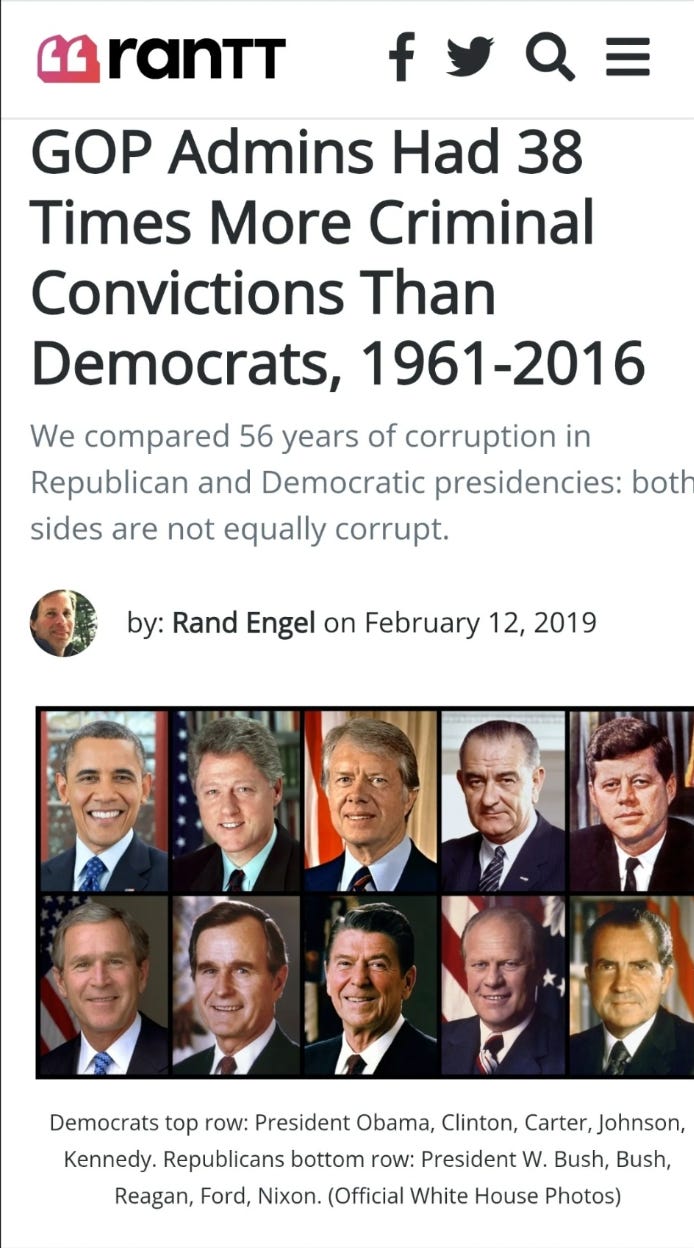
They call themselves the “party of law and order.” They love the optics of blue uniforms, the thump of a gavel, the solemn nod to “respecting the rule of law.” But here’s the reality: when you count up the criminal convictions of their own high-ranking officials, Republican administrations don’t just edge out Democrats. They leave them choking in the dust.
From 1961 to 2016, GOP cabinets, senior advisers, and top appointees have racked up criminal records at a pace that would make a mob boss jealous. Watergate alone saw dozens of Nixon officials indicted, convicted, and in some cases, marched off to prison. Reagan’s years brought Iran-Contra, the HUD scandal, and Operation Ill Wind, sprawling webs of corruption that roped in Cabinet secretaries, White House aides, and defense contractors. George W. Bush’s team managed to fit a surprising amount of corruption into just eight years, from Iraq War contracting fraud to DOJ perjury cases.
And the Democrats? Yes, they’ve had their scandals — nobody’s pretending otherwise — but the scale and frequency are nowhere near the same league. Yet somehow, the “both sides” narrative still gets parroted in debates, headlines, and cable news chatter.
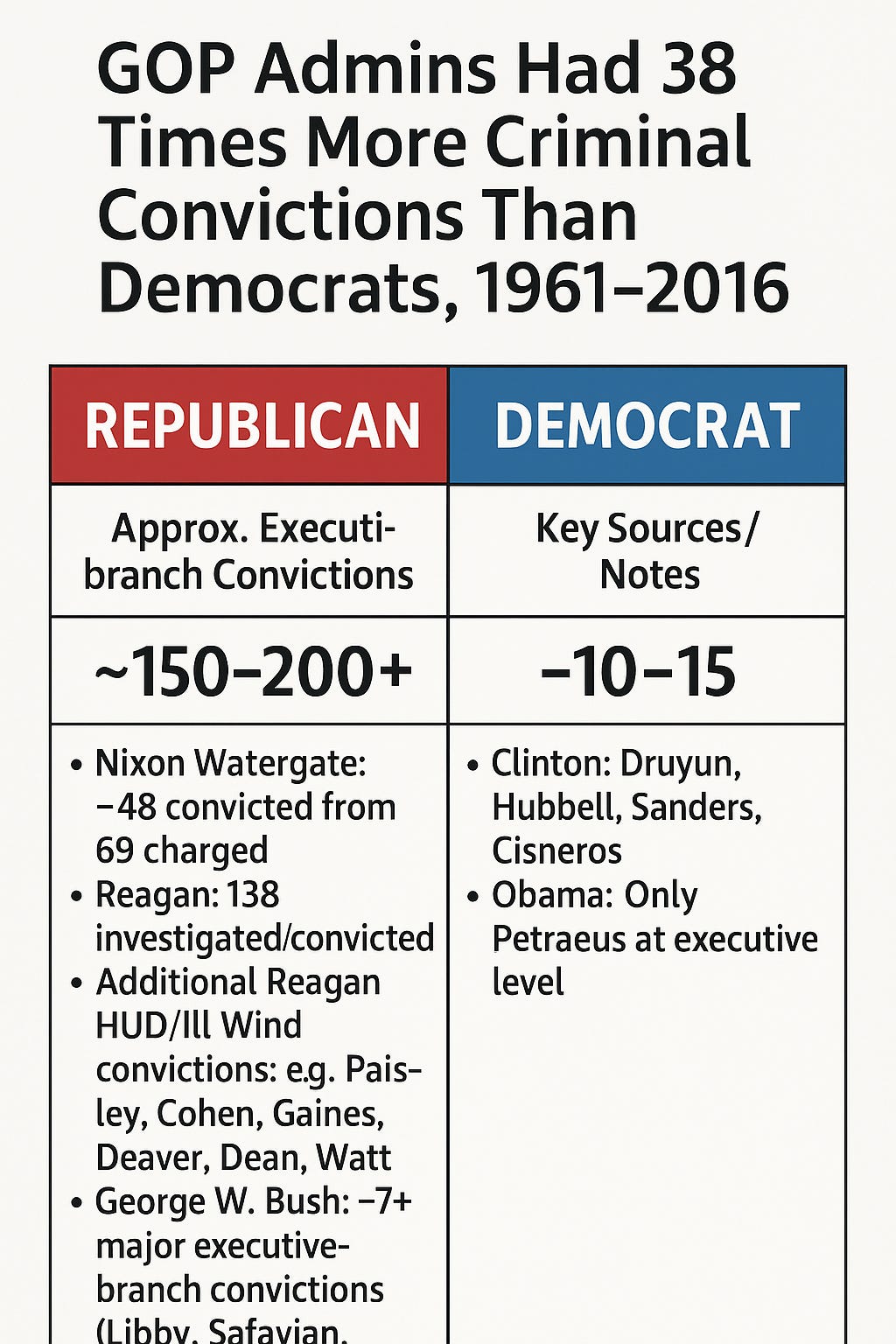
Here’s the scoreboard that should end the “both sides” myth in a single glance:
Republican: ~150–200+ convictions
Democrat: ~10–15 convictions
Stay Informed. Stay Loud.
Subscribe to The Coffman Chronicle for no-BS political analysis, action guides, and daily truth bombs you won’t get from corporate media.
Where the “38×” Claim Comes From
The “Republicans had 38 times more convictions” stat comes from a viral Rantt article that exploded across political social media. While the direction of the claim holds water — Republicans really have produced far more convictions — the exact multiplier is unverified. That’s why I went straight to the records, building an administration-by-administration breakdown from court filings, DOJ press releases, and reputable historical reporting.
Why Counting Convictions Is Messy
To keep the list credible and not just a social media dunk, I used a strict filter:
Only senior executive-branch officials (Cabinet members, deputies, senior aides, WH staff, agency heads) count.
Legislative or judicial branch convictions aren’t included.
Vacated convictions, overturned verdicts, or pardons are still counted if there was an initial conviction because the historical record still shows criminal culpability.
With those rules set, let’s walk through the presidencies, starting with the one that redefined political scandal.
The Rap Sheets
Richard Nixon (R) – 1969–1974
Era context: Vietnam War, rising anti-war protests, and a deeply paranoid White House obsessed with leaks. Nixon ran on restoring order, but left behind the most infamous political scandal in U.S. history.
Watergate: 48 officials charged, 33 convicted. High-profile convictions included:
John Mitchell (Attorney General) – convicted of conspiracy, obstruction, and perjury.
H.R. Haldeman (Chief of Staff) – convicted of conspiracy and obstruction.
John Ehrlichman (Domestic Affairs Advisor) – convicted of perjury, obstruction, and conspiracy.
Other scandals: Milk Fund bribery case, illegal campaign donations from corporate interests.
Nixon’s resignation didn’t save his staff from prison. It cemented “Watergate” as shorthand for political crime.
Ronald Reagan (R) – 1981–1989
Era context: “Morning in America” optimism, Cold War brinkmanship, and a surge of deregulation. Behind the sunny ads: a tangle of covert operations and corruption.
Iran-Contra: Secret arms sales to Iran with profits funneled to Nicaraguan Contras, defying Congress.
14 officials indicted, including National Security Adviser John Poindexter and Defense Secretary Caspar Weinberger.
HUD scandal: Political favoritism in awarding housing contracts; convictions for influence-peddling.
Operation Ill Wind: Defense Department bribery and fraud case in which Pentagon procurement officials took millions from contractors.
Reagan’s folksy charm didn’t prevent an avalanche of convictions. It just helped him dodge more personal blame.
George H.W. Bush (R) – 1989–1993
Era context: End of the Cold War, Gulf War, and economic recession. Bush 41 projected calm competence but carried over scandal baggage from Reagan.
Iran-Contra pardons: Bush pardoned six key figures, cutting off deeper investigation.
Savings & Loan crisis: Deregulation led to fraud and risky loans, with multiple convictions of politically connected executives.
Bush’s use of pardons remains one of the clearest examples of presidential intervention to protect allies from prison.
George W. Bush (R) – 2001–2009
Era context: 9/11, wars in Afghanistan and Iraq, massive homeland security expansion. The administration’s secrecy shielded many scandals, but not all.
Jack Abramoff lobbying scandal: Led to convictions of White House aide David Safavian and Department of Justice official Robert Coughlin.
DOJ politicization: U.S. Attorneys fired for political reasons; perjury and obstruction convictions followed.
Contracting fraud: Multiple officials convicted for corruption tied to Iraq and Afghanistan contracts.
Even with wartime media distraction, the Bush years stacked up a steady flow of convictions.
Jimmy Carter (D) – 1977–1981
Era context: Post-Watergate cleanup, energy crisis, and a president promising honesty.
Record: No senior executive branch criminal convictions.
Carter’s administration was notable for ethics reforms, the opposite of the Nixon/Reagan model.
Bill Clinton (D) – 1993–2001
Era context: Economic boom, partisan warfare, and 24-hour news cycles.
Henry Cisneros (HUD Secretary) – pled guilty to making false statements to the FBI.
Mike Espy (Agriculture Secretary) – indicted but acquitted.
Clinton’s impeachment was political, not criminal. He was never convicted in a court of law.
Barack Obama (D) – 2009–2017
Era context: Great Recession recovery, ACA passage, polarized Congress.
No major Cabinet-level convictions.
Minor scandals (e.g., GSA overspending) led to resignations but not criminal charges.
Patterns You Can’t Ignore
1. Scale
Republican scandals are often sprawling operations that cross multiple agencies. Iran-Contra involved the NSC, CIA, and Pentagon. Democratic scandals tend to be narrower, involving individual misconduct rather than institutional conspiracy.
2. Type
GOP convictions disproportionately involve abuse of power, obstruction, and large-scale fraud. Democratic convictions lean toward personal misconduct or campaign finance violations.
3. Response
Democrats typically push out scandal-tainted officials quickly; Republicans more often rally around them, delay investigations, or issue pardons.
The Narrative Problem
So why do so many Americans believe “both sides are equally corrupt”?
Media false equivalence: News outlets balance every Republican scandal with a Democratic one, regardless of scale.
Branding: The GOP has owned “law and order” messaging since Nixon.
Democratic restraint: Democrats rarely weaponize Republican conviction history in campaigns, missing an easy truth-to-power attack.
The result? GOP officials can be convicted in droves, yet still claim moral high ground, and too many voters let them.
Why This Matters in 2025
As we head into another election cycle, the GOP is still pitching itself as the guardian of American values. But the record shows a consistent pattern of lawbreaking at the highest levels, and a willingness to obstruct justice to protect allies. This isn’t history to be filed away; it’s a warning label for the present.
From Nixon to Bush 43, Republican administrations have stacked up convictions like poker chips, far more than Democrats in the same span. This isn’t partisan spin; it’s decades of public record. The only question left is whether we keep letting the guilty hide behind a myth.
Call to Action
Save the scoreboard.
Post the rap sheets whenever “both sides” comes up.
Share on social media with captions like: “Law and order? The receipts say otherwise.”
Send it to your reps.
Bring it up offline. Facts spread when they’re repeated, not just retweeted.
Stay Informed. Stay Loud.
Subscribe to The Coffman Chronicle for no-BS political analysis, action guides, and daily truth bombs you won’t get from corporate media.
Bibliography:
Levin Center, “Portraits in Oversight: The Watergate Hearings.”
Gerald R. Ford Presidential Library & Museum, “The Watergate Files.”
U.S. Senate, “Select Committee on Presidential Campaign Activities (Watergate).”
Independent Counsel Lawrence E. Walsh, Final Report (index).
Independent Counsel Lawrence E. Walsh, “Summary of Prosecutions.”
Brown University, “Understanding the Iran-Contra Affair: The Pardons.”
American Presidency Project, “Proclamation 6518—Grant of Executive Clemency” (Dec. 24, 1992).
U.S. DOJ, Office of the Pardon Attorney, “Pardons Granted by President George H. W. Bush (1989–1993).”
FBI History, “Operation Illwind (Famous Cases).”
FBI News, “A Byte Out of History: The Lasting Legacy of Operation Illwind.”
U.S. DOJ, Criminal Resource Manual §928, “Procurement Integrity Act” (notes Ill Wind as trigger).
U.S. DOJ, “Former Lobbyist Jack Abramoff Sentenced to 48 Months.”
U.S. DOJ, “Former Interior Deputy Secretary Steven Griles Sentenced to 10 Months.”
U.S. DOJ, “Former GSA Chief of Staff David Safavian Sentenced.”
U.S. DOJ, “Former GSA Chief of Staff David Safavian Convicted…”
U.S. DOJ (Special Counsel), United States v. Lewis Libby (Indictment, Oct. 28, 2005)
PBS NewsHour, “Libby Convicted of Perjury, Obstruction of Justice” (Mar. 6, 2007).
White House Archives, “Statement by the President on Executive Clemency for Lewis Libby” (July 2, 2007).
U.S. DOJ, “Statement on the Criminal Charges Against David Petraeus” (Mar. 3, 2015).
United States v. David Howell Petraeus—Plea Agreement [PDF].
United States v. Deborah Gore Dean, 55 F.3d 640 (D.C. Cir. 1995)
Dean Found Guilty in HUD Fraud (Roanoke Times archive reprint—full text).
UPI Archives, “Watt gets five years probation” (James Watt plea/sentencing).
U.S. Government Publishing Office (GPO), Final Report of the Independent Counsel in re: Alphonso Michael (Mike) Espy
Washington Post, “Espy Acquitted in Gifts Case” (Dec. 2, 1998).
U.S. DOJ, Office of the Pardon Attorney, “Pardons Granted by President William J. Clinton (1993–2001)” (lists Henry G. Cisneros).
Excellent work. Thank you.
For the same time period, how many members of Congress from both parties went on to become lobbyists, corporate CEOs, or otherwise cash in on their government service?