


The headlines have started to blur together, folx.
One Cabinet secretary fired. Another pushed out. Another resigning under an ethics cloud. Members of Congress stepping down or declining reelection after misconduct allegations. Others under investigation. The Epstein files constantly in the news. A House vote against releasing more misconduct records.
It is not strange that we feel like we are seeing a pattern. The question is what kind of pattern it is.
This Community Is Powered by You
What started as a small circle has grown into something much bigger, and it’s all because of readers like you.
Every time you forward this email, post it on socials, or bring someone new into the fold, you’re helping build one of the most passionate, independent political communities out there.
Want to keep the momentum going?
Share this newsletter with someone who should be part of this conversation.
Thank you for being here. It means everything.
A Real Cluster, Not Just a Feeling
There is a temptation to blame the media environment for the sense of overload, but that explanation is too simple. What is happening right now is not just a flood of coverage, but rather a convergence of events.
In the span of a few weeks, multiple Cabinet officials have left their posts under pressure or controversy. At the same time, several members of Congress have either resigned, announced plans to step down, or found themselves under active ethics scrutiny. These are not identical cases, and they do not share a single cause. However, they are arriving in close proximity and across different parts of government.
See our short-take reporting on several of these incidents here:


When events cluster this tightly, they stop feeling like isolated incidents and begin to register as a broader signal. We don’t always sort these stories into neat categories such as sexual misconduct, corruption, or workplace abuse. Instead, we experience them as a single, accumulating story about how power operates.
Why It Feels Even Bigger
The modern media environment amplifies that effect.
News no longer arrives in discrete segments. It appears as a continuous stream, often stripped of context and delivered through the same visual and emotional format. An allegation, a resignation, a confirmed ethics finding, and a developing investigation can all appear side by side, competing for attention in the same feed.
This compression flattens important distinctions. It makes different kinds of stories feel equivalent and simultaneous. It also accelerates the pace at which they are processed, leaving little time for reflection or separation.
However, amplification alone does not explain the moment. The clustering is real. The media is intensifying something that is already happening, not inventing it.
The Trust Crisis Shapes Everything
This moment is landing on top of a deeper and longer-running problem. Public trust in government is near historic lows.
According to the Pew Research Center, only a small share of Americans say they trust the federal government to do what is right most of the time. That number has remained depressed for years, regardless of which party holds power.
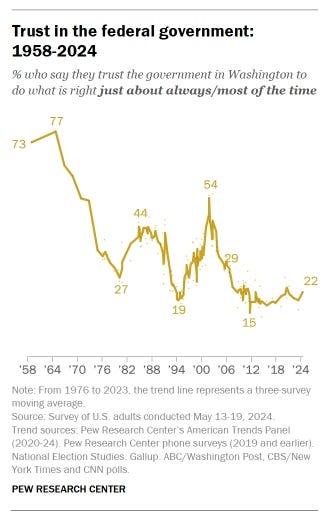
Pew Research Center
Recent CNN polling shows congressional disapproval hovering in the mid-80% range, meaning the overwhelming majority of Americans already view the institution negatively. In that context, a sudden cluster of misconduct allegations and resignations does not feel like a series of exceptions. It feels like confirmation.
After #MeToo: Reform Without Full Transparency
The closest recent parallel to this recent churn is the wave of misconduct cases that swept through Congress during the 2017–2018 #MeToo moment.
That period produced real changes. The complaint process was streamlined, barriers for victims were reduced, and members of Congress became more directly responsible for certain settlements. The system improved in ways that were meaningful for those navigating it.
However, the reforms stopped short of full transparency. Much of the process still operates out of public view, and disclosure often depends on internal decisions rather than automatic release.
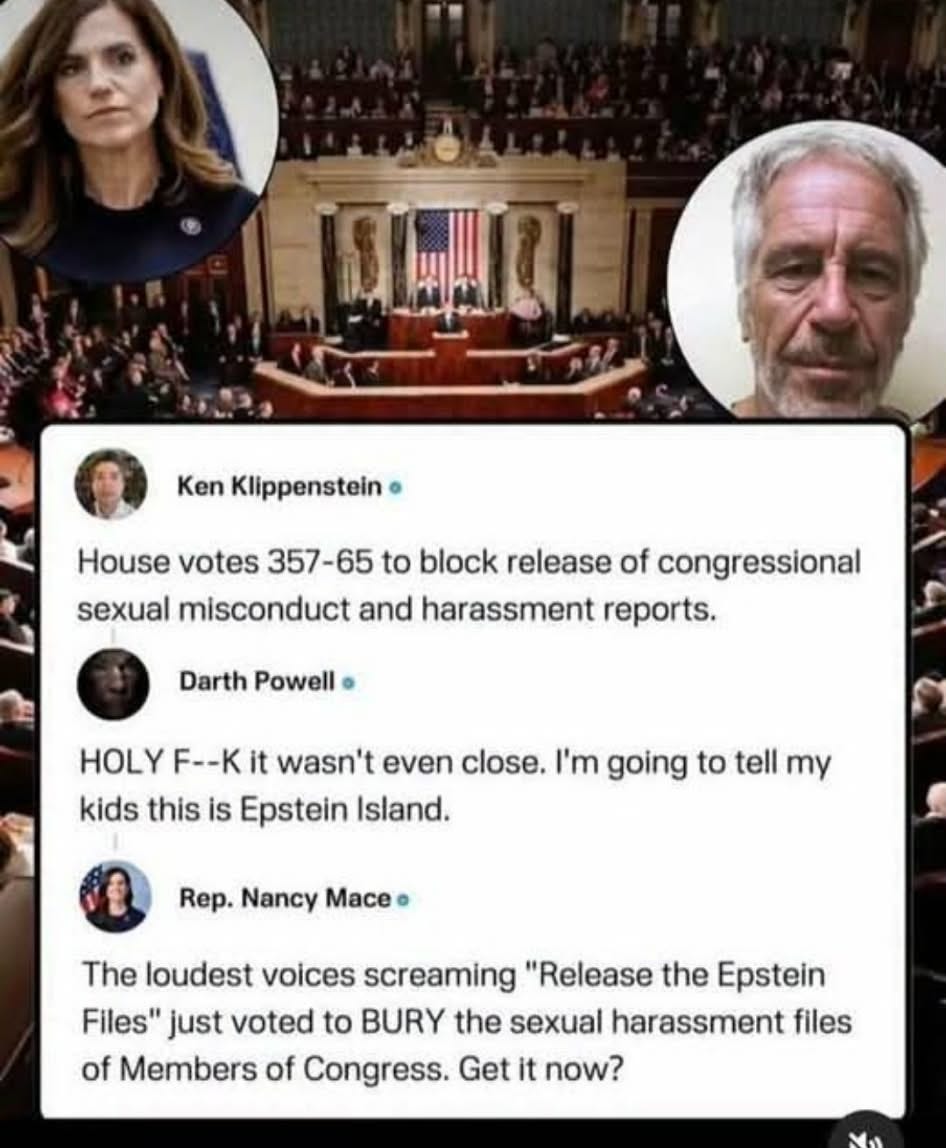
That tension has not disappeared. The recent House vote against broader disclosure of misconduct records is a reminder that institutional self-protection remains a powerful force, even after a major reform cycle.
Oversight Is Stronger but Still Incomplete
There are signs that oversight has become more assertive. Investigations appear to move more quickly, and the House Ethics Committee has taken a more public posture than in the past, encouraging witnesses to come forward and signaling a willingness to act.
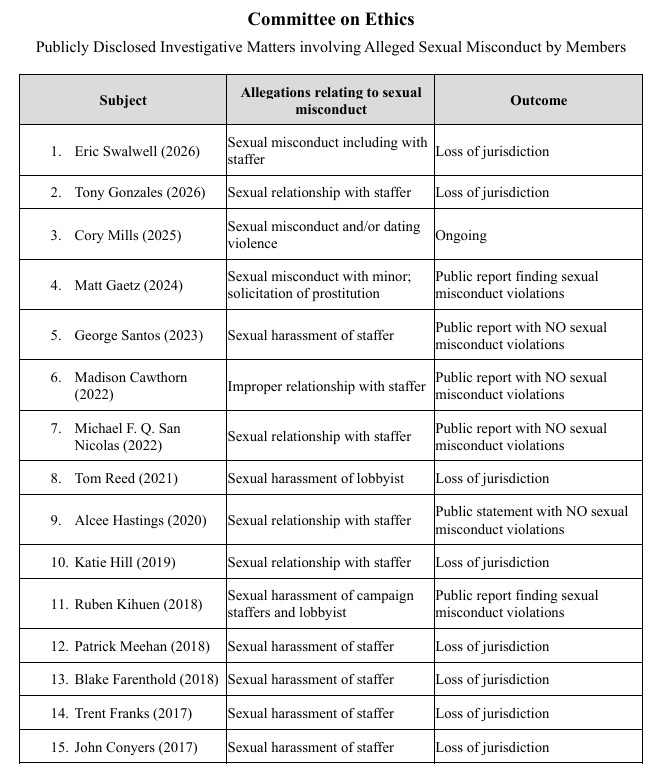
Most recent 15 sexual misconduct/harassment accusations in Congress, per the House Ethics Committee Report
Yet accountability still tends to emerge in bursts rather than as a steady, transparent process. Allegations surface, pressure builds, and action follows. Information is revealed incrementally, and often only after sustained attention.
This pattern suggests that the system is not fully open. It responds, sometimes forcefully, but often reactively.
A Familiar Cycle
Taken together, these dynamics point to a recurring cycle.
Misconduct exists, often partially hidden or compartmentalized. A group of cases becomes visible at roughly the same time. Institutions respond under pressure, and reforms follow. Yet those reforms leave important gaps, especially around transparency. Over time, another wave emerges, revealing both new cases and the limits of the previous fixes.
The current moment fits that pattern. It does not feel entirely new because it is not. It is another iteration of a process that has played out before.
There is also a more specific historical comparison worth noting. Donald Trump’s first term was already defined by unusually high turnover, with some analyses showing that nearly all of his original senior team had been replaced by the end of his first term. His second term has not yet reached that level, but early data suggest that turnover remains far above modern norms and that the recent departures are more tightly clustered.
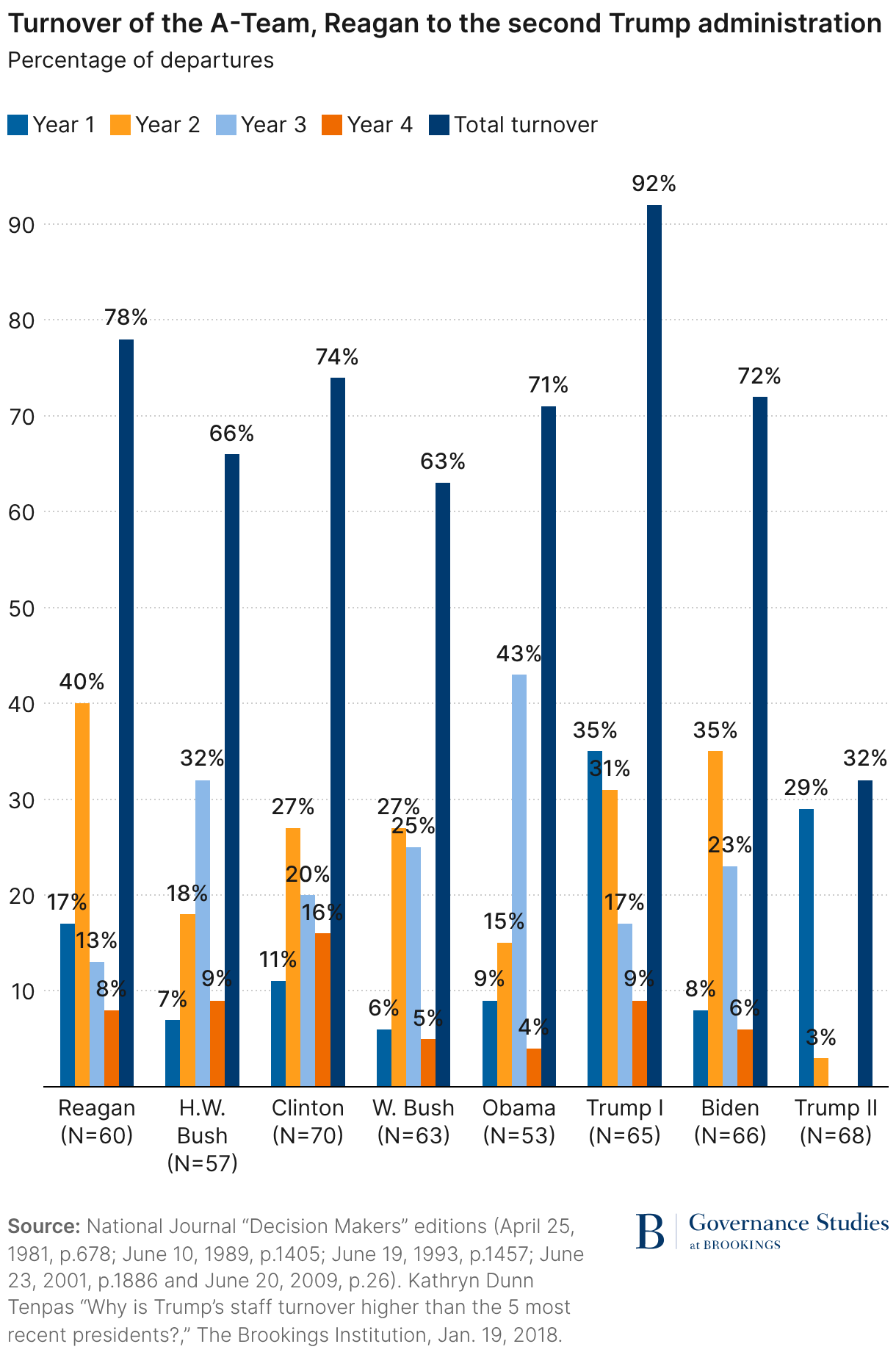
Brookings Turnover report
Trump’s first term normalized chaos at the top of government. His second term is beginning to normalize something else: the convergence of that chaos with recurring ethical and misconduct controversies. The result is not just turnover, but turnover that reinforces the perception of a system that is either unable or unwilling to police itself until forced.
A Competing Narrative From the Elite
At the same time, a very different interpretation is being advanced in elite circles.
Palantir Technologies, led by Alex Karp, has argued in a recent manifesto-style summary that public life is suffering from too much scrutiny. The claim is that leaders are constrained by constant criticism and that excessive oversight undermines effective decision-making.
See our recent article on the manifesto here:

That argument sits uneasily alongside the current moment.
If scrutiny were truly overwhelming, it would be harder to explain why so many cases emerge only after prolonged delay, why accountability often requires sustained public pressure, and why institutions continue to resist broader disclosure of information.
What the present suggests instead is a system in which scrutiny is uneven. It intensifies in moments and recedes in between. It is powerful when it arrives, yet limited in how consistently it is applied.
Exposure, Not Just Misconduct
This leads to a more precise way of understanding what is happening.
The current wave is not simply a surge in wrongdoing, nor is it solely the product of media amplification. It is a period of exposure.
Stronger oversight mechanisms, a media environment that accelerates visibility, and a public more willing to question institutions are all contributing to a situation in which multiple cases surface at once. At the same time, institutional constraints ensure that this exposure remains partial and uneven.
The result is a pattern that feels overwhelming because it is both real and compressed.
What We Are Really Responding To
The unease many of us feel is not just about any single headline. It reflects a broader convergence.
Visible misconduct across different levels of power, incomplete transparency, historically low trust, and a media system that delivers everything simultaneously all combine to create a sense that something deeper is being revealed.
In that environment, the line between isolated incidents and systemic problems becomes harder to draw.
The Bottom Line
This is a real cluster, and it is also a visibility surge.
The United States is not necessarily experiencing more misconduct than at other points in its history. It may be experiencing a moment when more of that misconduct is being forced into the open at once.
That does not make the moment less significant.
When exposure arrives in waves rather than steadily, each wave feels like a crisis. And when trust is already low, each crisis reinforces the belief that accountability depends on pressure rather than principle.
What feels like a sudden flood may, in fact, be a backlog coming into view.
If this piece helped you make sense of the flood of headlines, that’s exactly why we write.
We focus on patterns, context, and the bigger picture behind the daily churn of political news without the noise, the spin, and the assumption that you’re only here for one side of the story.
Subscribe to get clear, grounded analysis delivered straight to your inbox.
Sources:
Chavez-DeRemer steps down as US labor secretary amid misconduct probe, Reuters, April 20, 2026.
Trump fires Pam Bondi as US attorney general, Reuters, April 2, 2026.
Trump fires Kristi Noem as homeland secretary after storm over shootings, spending, Reuters, March 5, 2026.
US Representative Swalwell to quit Congress following sexual misconduct allegations, Reuters, April 13, 2026.
House Ethics panel makes rare request about sexual misconduct, The Washington Post, April 20, 2026.
Statement of the Committee on Ethics Regarding Sexual Misconduct and Workplace Rights, House Committee on Ethics, April 20, 2026.
Publicly Disclosed Investigative Matters involving Alleged Sexual Misconduct by Members, House Committee on Ethics, April 2026.
Roll Call 83 | Bill Number: H. Res. 1100, Office of the Clerk, U.S. House of Representatives, March 4, 2026.
Americans’ trust in federal government and attitudes toward it, Pew Research Center, June 24, 2024.
Klobuchar, Blunt Bipartisan Sexual Harassment Bill is Headed to President’s Desk, Office of Sen. Amy Klobuchar, December 13, 2018.
Tracking turnover in the second Trump administration, Brookings, January 20, 2026, updated through April 15, 2026.
Palantir posts mini-manifesto denouncing inclusivity and ‘regressive’ cultures, TechCrunch, April 19, 2026.
The “unease” people feel about this corruption is that there is no enforcement and hence no level playing field. If I owe money and don’t pay it there is an enforcement measure. If I lie to my friends and neighbors there is a social enforcement mechanism. Accountability is meaningless without enforcement. If I kill somebody there is a trial and a verdict is reached. If I am guilty there is an enforcement mechanism. Trump lies and misleads but there is no enforcement mechanism. ICE kills people, and there is no enforcement mechanism. Thus it is a two tiered system. This is a government by the rich for the rich and apparently that’s what some voters wanted.
This kind of thing is what happens when you have unqualified people, people who have questionable backgrounds, and down right crooks. Then there are the two drunks, Hegseth and Patel. The two of them belong in AA, but that decision has to come from them. Most every one of them are going to do something illegal or unethical, and get themselves in hot water. They may have already done things, like just being in the Epstein files.
You can’t expect the president to know everything, but The Fapweasel has notoriously bad judgement, and he is like a child, choosing people based on things that have nothing to do with doing a good job.
The only person who I don’t think is going to get themselves in serious trouble is Dr. Oz. If he says something about health, it won’t be totally off the wall, but you can’t expect be sure The Fapweasel (Trump) picked him because he is good looking, and has experience being on TV. However, I am not in favor of him. My mom used to say he talked too fast. He became a snake oil salesman, and he is a narcissist, just like his boss, but The Fapweasel (Trump) is worse, and of course, he has dementia, too.
You can’t necessarily know if someone is going to make an investment based on information they got from working in The White-House. Even someone who has an ethical reputation could be tempted. That is why we need laws to protect people from themselves.