


I grew up in a sports family. My brother played multiple sports, following in our father’s athletic footsteps. Dad often umpired Little League Baseball in our small southern town, and when my brother was pitching, both teams knew they had better hit the corner convincingly.
Daddy had a rule about appearances. The best defense against an accusation, he would say, is not to insist that people trust your character, but to remove the opportunity to do the unethical thing.
This Community Is Powered by You
What started as a small circle has grown into something much bigger, and it’s all because of readers like you.
Every time you forward this email, post it on socials, or bring someone new into the fold, you’re helping build one of the most passionate, independent political communities out there.
Want to keep the momentum going?
Share this newsletter with someone who should be part of this conversation.
Thank you for being here. It means everything.
The Call
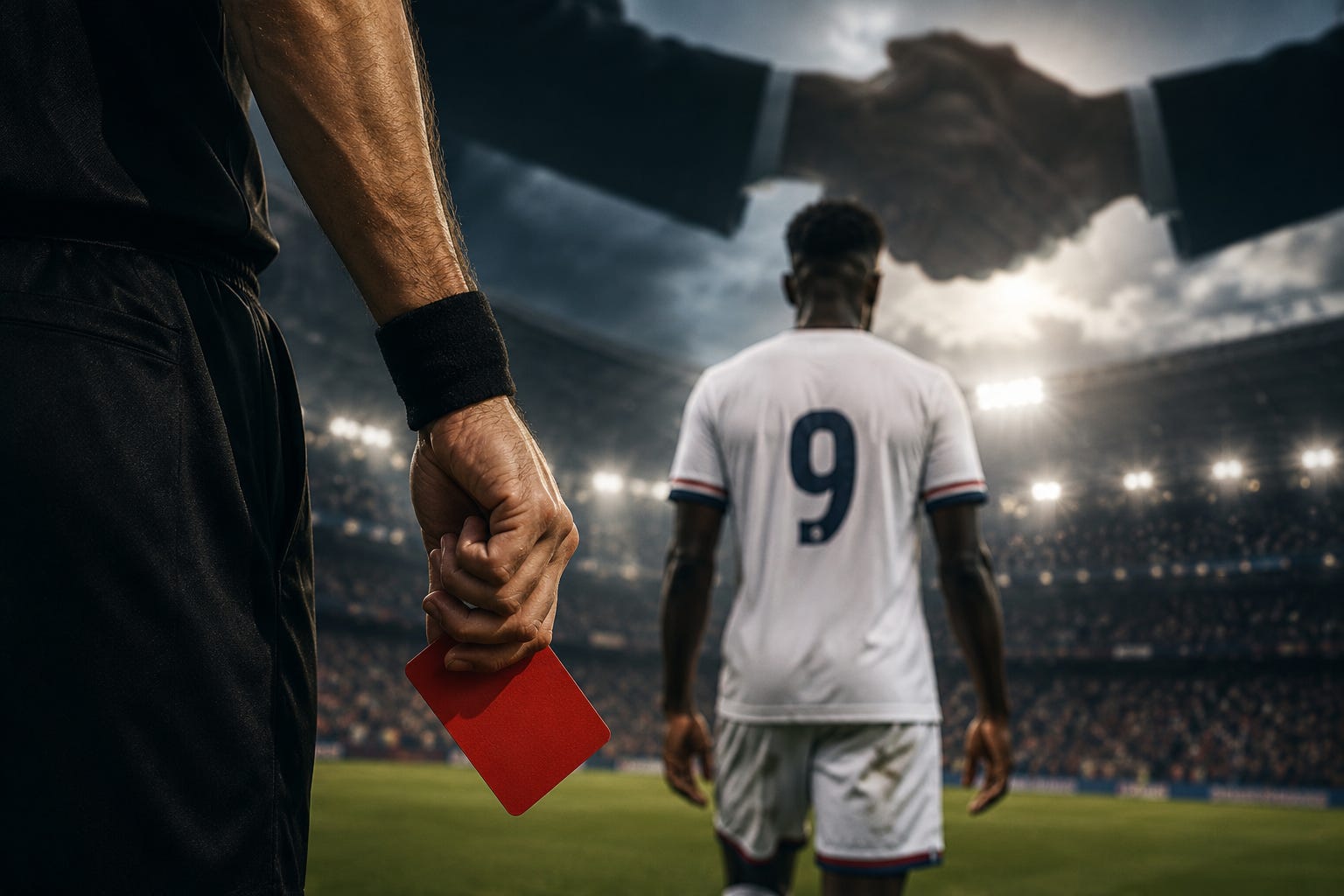
On July 1st, the United States men’s national soccer team defeated Bosnia and Herzegovina 2-0 in the Round of 32 of the 2026 FIFA World Cup. During the match, American striker Folarin Balogun received a direct red card after a challenge on Bosnian defender Tarik Muharemovic.
The decision was reviewed by the video assistant referee (VAR). After review, the referee upheld the red card, and Balogun left the field.
Under the ordinary understanding of FIFA’s disciplinary rules, a direct red card means Balogun would miss the United States’ next match, scheduled for July 6th against Belgium in the Round of 16. It is a knockout match, meaning the winner advances to the quarterfinals and the loser goes home.
President Donald Trump reportedly called FIFA President Gianni Infantino and asked that Balogun’s suspension be reviewed. On July 5th, FIFA announced that its Disciplinary Committee had suspended implementation of the one-match ban and placed Balogun on a one-year probationary period, making him eligible to play against Belgium. Trump later thanked FIFA for correcting what he called a “great injustice.”
Belgium immediately objected, citing FIFA’s and the tournament’s own rules.
The Strike Zone
I grew up in a baseball family, and since it is America’s pastime, I’ll use it to explain. Baseball people understand discretion.
The strike zone is written in the rules, but it is not experienced as a fixed box. It varies by umpire and, necessarily, by the batter standing at the plate. Teams study umpires almost as carefully as they study opponents. If the umpire is willing to call a pitch high and tight, pitchers take advantage of it. If he consistently gives the edge just outside, catchers learn to frame it there. The point is not that every umpire calls the exact same zone, but that both teams understand the zone being called.
Our father’s strike zone was tight when my brother pitched, but it was tight for both pitchers. The difference came in the space where judgment became doubt. If one of my brother’s pitches could reasonably have gone either way, the batter was more likely to get the benefit of it.
Dad would not risk giving his son a strike he could not defend. Once, an opposing coach even commented that one of his own players had actually struck out. Dad had called the pitch a ball.
My brother may not have appreciated the lesson at the time, but he learned it anyway. When his team won, the opposing team knew why it had lost. My brother had pitched better, and his team had played better. There was no favorable strike zone to argue about later and no favor tucked into his back pocket.
FIFA Has Been Here Before
The Fédération Internationale de Football Association, better known as FIFA, does not approach questions of institutional legitimacy with a clean record.
In 2015, American and Swiss authorities pursued a large corruption investigation involving FIFA-linked officials. The scandal helped force a leadership crisis within the organization and contributed to the reform environment that led to Gianni Infantino becoming FIFA president in 2016.
A decade later, questions about FIFA’s leadership, neutrality, and internal accountability have not disappeared. Infantino’s relationship with Trump has become especially visible ahead of this World Cup, including public appearances and criticism of FIFA’s decision to award Trump its inaugural Peace Prize. That relationship had drawn ethics scrutiny long before Balogun’s suspension became an issue.
None of this is to say that Infantino definitely improperly influenced the Balogun decision. However, FIFA knew, before the call was ever made, that this was not neutral ground.
Institutions with histories of scandal do not get to treat appearances as an afterthought. They have to remove opportunities for doubt before the accusation can take root.
Three Rules
The dispute over Balogun’s eligibility rests on three provisions.
Article 66.4 of the FIFA Disciplinary Code says that a sending-off automatically incurs suspension from the subsequent match. Article 10.5 of the 2026 FIFA World Cup regulations says that a player or team official sent off by direct red or second yellow “will automatically be suspended” from the team’s subsequent match. These are the rules Belgium cited as evidence that the decision to allow Balogun to avoid suspension was wrong.
FIFA, however, cited Article 27 of the FIFA Disciplinary Code, which allows a FIFA judicial body to fully or partially suspend implementation of a disciplinary measure and place the person on probation.
This is not the first time Article 27 has been cited in a controversial disciplinary decision. Cristiano Ronaldo received a three-match ban after receiving a red card in Portugal’s match against Ireland in November 2025. He served the automatic next-match suspension in Portugal’s final qualifier against Armenia, a match Portugal won to secure World Cup qualification. FIFA then used Article 27 to suspend the two additional matches under a one-year probation period, allowing Ronaldo to play in the World Cup.
In that case, the automatic sanction remained automatic. Article 27 applied to the additional punishment. The automatic suspension of eligibility for the next game, as promised by both Articles 66.4 and 10.5, remained in effect.
Regardless of how one feels about the Renaldo situation, this is where Balogun’s case appears to differ. FIFA used Article 27 to suspend the automatic next-match consequence itself, during the tournament, before a knockout match, after the president of a host nation reportedly contacted FIFA’s president.
According to the Associated Press, this is likely the first time a red card during a World Cup has not resulted in a suspension since 1962. The historical precedent is not reassuring. At the 1962 World Cup in Chile, Brazil’s Garrincha was sent off in the semifinal and later cleared to play in the final after an appeal reportedly backed by Chilean President Jorge Alessandri. Later accounts alleged that officials had been paid not to give evidence at the disciplinary hearing. Garrincha played in the final, and Brazil won the World Cup. That history does not prove corruption here, but it does show why FIFA should understand that private political intervention in player discipline does not age well.
Perhaps FIFA can defend that reading of the rules. Lawyers may ultimately determine that Article 27 permits exactly this use. However, that does not resolve the governance problem.
Show Us the Zone
Discretion is not the enemy of legitimacy. Unexplained discretion is.
If FIFA has a consistent standard for using Article 27 to suspend automatic red-card bans, it should be able to show it. Teams should know how the matter reaches the Disciplinary Committee, what facts justify relief, whether the review begins automatically or by request, and whether the same consideration is available to every federation and player.
As of now, FIFA has not publicly explained when Balogun’s review began or how the matter reached the Disciplinary Committee. If the committee was already reviewing the case before Trump called Infantino, that chronology impacts the optics. If the review began after the president of a host nation privately appealed to the organization’s president on behalf of his team’s leading scorer, that does too.
This is not an accusation against the committee members, but rather a question about whether FIFA protected judicial independence well enough that no accusation should be necessary.
While two recent Article 27 examples are not enough to establish that FIFA operates a two-tiered disciplinary system, they are adequate to raise a simpler question, especially when one involves one of the most famous players in the history of the sport and the other involves the leading scorer for a host nation whose president personally contacted FIFA’s president.
Would the same be done for everyone else?
The Favor in His Pocket
Balogun did not make the call. Based on the public record, he did not launch a campaign demanding presidential intervention, nor did he place himself at the center of a dispute among FIFA, Belgium, and the United States.
Someone put the favor in his pocket anyway.
That favor carries a cost. If Balogun plays against Belgium and scores, the eligibility decision becomes part of the goal. If he assists, it becomes part of the assist. If the United States wins, the suspension becomes part of the match’s story. His presence alone can change Belgium’s defensive assignments, the United States’ formation, and the substitutions each coach makes as the match unfolds.
It also changes the environment around Balogun himself. Soccer is a contact sport. Hard challenges, accidents, and ordinary bad luck can injure players. If Balogun is hurt during the match, particularly following a questionable challenge, people will ask whether he was targeted.
The decision also risks distorting the team it was meant to help. Soccer is a team sport. Balogun may be the United States’ most productive scorer, but he is still one player. Someone else trained for the role he was expected to miss. His teammates prepared for Belgium under the assumption that the automatic suspension would apply.
When political and institutional power move to restore one player to the field, the rest of the team hears the message too. It suggests that the team may not be enough without him, which is unfair to the player restored and to the players expected to make room for him.
Dad would have despised that. He did not hold the strike zone tightly because he doubted my brother’s ability. He did it because he respected it.
One Match
FIFA gained the availability of one player for one match for one team. In exchange, it cast a shadow over Balogun’s performance, which he did not create.
It complicates the United States team’s result, whatever that result may be. It gives Belgium grounds to object before a knockout match that cannot be meaningfully reconstructed later. If a later review determines that Article 27 was misapplied, no one can replay the match in the version where Balogun did not appear. The tactics, substitutions, defensive assignments, and pressure of the moment would already be gone.
The risk does not stop with one match. FIFA has also complicated future enforcement of its automatic red-card rule. The next player suspended after a direct red card will be entitled to ask why Article 27 is applicable. The next federation will be entitled to ask how to seek the same review. The next team facing a star player unexpectedly restored to the lineup will be entitled to wonder where the strike zone is.
The question FIFA’s lawyers should have asked was not merely whether the rules could be read to permit the decision, but whether the potential consequences were worth it.
The Call That Should Not Exist
The president of the United States is an executive, as is the president of FIFA. FIFA has judicial bodies for disciplinary matters precisely because executives should not become the private appeals process when a powerful person dislikes an outcome.
Trump reportedly believed the red card and suspension were unjust. Presidents can watch soccer, complain about referees, cheer for their national teams, and enjoy the symbolism of a host nation making a deep run during a historic national anniversary. The problem begins when opinion meets access.
A head of state may have official channels to FIFA for security, visas, logistics, ceremony, and public coordination, but none of that requires a private line into a disciplinary matter involving his own national team. The moment the president of a host nation privately argues the case of his team’s leading scorer to the president of the governing body, the information environment changes. Belgium and the referee are not on the call. The judicial body may remain formally independent, but its independence now has to survive the appearance that the person above it was privately lobbied by a politically interested executive.
Perhaps the call changed nothing. FIFA is now asking everyone to trust that it did not.
Dad would never have taken the call, not because he was perfect, but because he held dear a very clear principle. An umpire does not privately speak to the coach or the team’s largest supporter about a disputed call. He does not listen politely, promise neutrality, and then ask everyone else to believe the conversation had no effect, nor does he accept the pressure of the league executive to find in their favor. The point is not to suggest corruption, but that the conversation itself should not exist.
Trust Your Team
FIFA made Balogun eligible. It did not make him necessary. The United States team still has an ethical choice available to it. Its coach can treat the automatic suspension as the standard everyone understood before the extraordinary intervention and leave Balogun out of the Belgium match. That would not concede that the red card was correct, but it would protect the player, the team, and the match from carrying a dispute that FIFA created.
That is unlikely to happen. Many will argue that the game is too important.
There is something particularly sweet about winning at home. The 2026 World Cup is being played during the 250th anniversary of the United States, and a deep American run would carry obvious symbolic power: the host nation, the anniversary, the flags, the crowds, and a team exceeding expectations on one of the world’s largest sporting stages.
Any president would enjoy those optics. However, that symbolism creates more responsibility to stay away from the game’s machinery, not less. Trust the team to do the work. Trust Balogun. Trust his teammates. Let them win, and let them lose, without making them carry a favor they did not earn and may not have wanted.
Our father trusted my brother enough to let him lose. He knew integrity was not proven by telling people to trust him. It was protected before the accusation could ever be made, in the private conversation not taken, the borderline call not claimed, and the opportunity removed before anyone could wonder whether it had been used.
The rule matters most when it hurts your own side. The independent official is the most important when you desperately want a different call. That is what makes the game, the sport, and the institution legitimate. It is also what makes your victories earned and worth celebrating.
As our readers have likely noticed, this article is not about soccer.
The Coffman Chronicle looks beyond the daily outrage to the institutions, patterns, and choices shaping the story underneath. Subscribe to follow the questions that remain after the headline moves on.
Sources:
“Trump intervention sparks World Cup storm as FIFA clears Balogun to face Belgium,” Reuters, July 5, 2026.
“FIFA lifts US star striker Balogun’s red card suspension at World Cup after Trump calls Infantino,” Associated Press, July 5, 2026.
“USMNT’s Folarin Balogun Available for Selection Against Belgium on Monday,” U.S. Soccer, July 5, 2026.
“USA striker Folarin Balogun available for Belgium,” FIFA, July 5, 2026.
“Donald Trump called Gianni Infantino before Fifa’s stunning decision to suspend Folarin Balogun’s World Cup ban, report says,” The Independent, July 5, 2026.
“What is FIFA’s Article 27 that allows Balogun to play after red card?” The Independent, July 6, 2026.
“Cristiano Ronaldo, Folarin Balogun And FIFA Reversing Red-Card Suspension, Explained,” FOX Sports, updated July 5, 2026.
“No World Cup ban for Cristiano Ronaldo after Ireland red,” ESPN, November 25, 2025.
“FIFA Disciplinary Code,” FIFA, September 2025 edition.
“Regulations for the FIFA World Cup 26,” FIFA, 2026 tournament regulations.
“Nine FIFA Officials and Five Corporate Executives Indicted for Racketeering Conspiracy and Corruption,” U.S. Department of Justice, May 27, 2015.
“Norwegian FA confirms support for ethics complaint against FIFA chief Infantino,” Reuters, June 2, 2026.
Another national embarrassment for the United States. Thanks, asshole.
So crooks fix sporting games. Now bow down to the almighty dollar, this has probably been going on a long time in sports.That does not justify fixing games but as soon as you bring in big money the sport is not the game the sport is to make money