


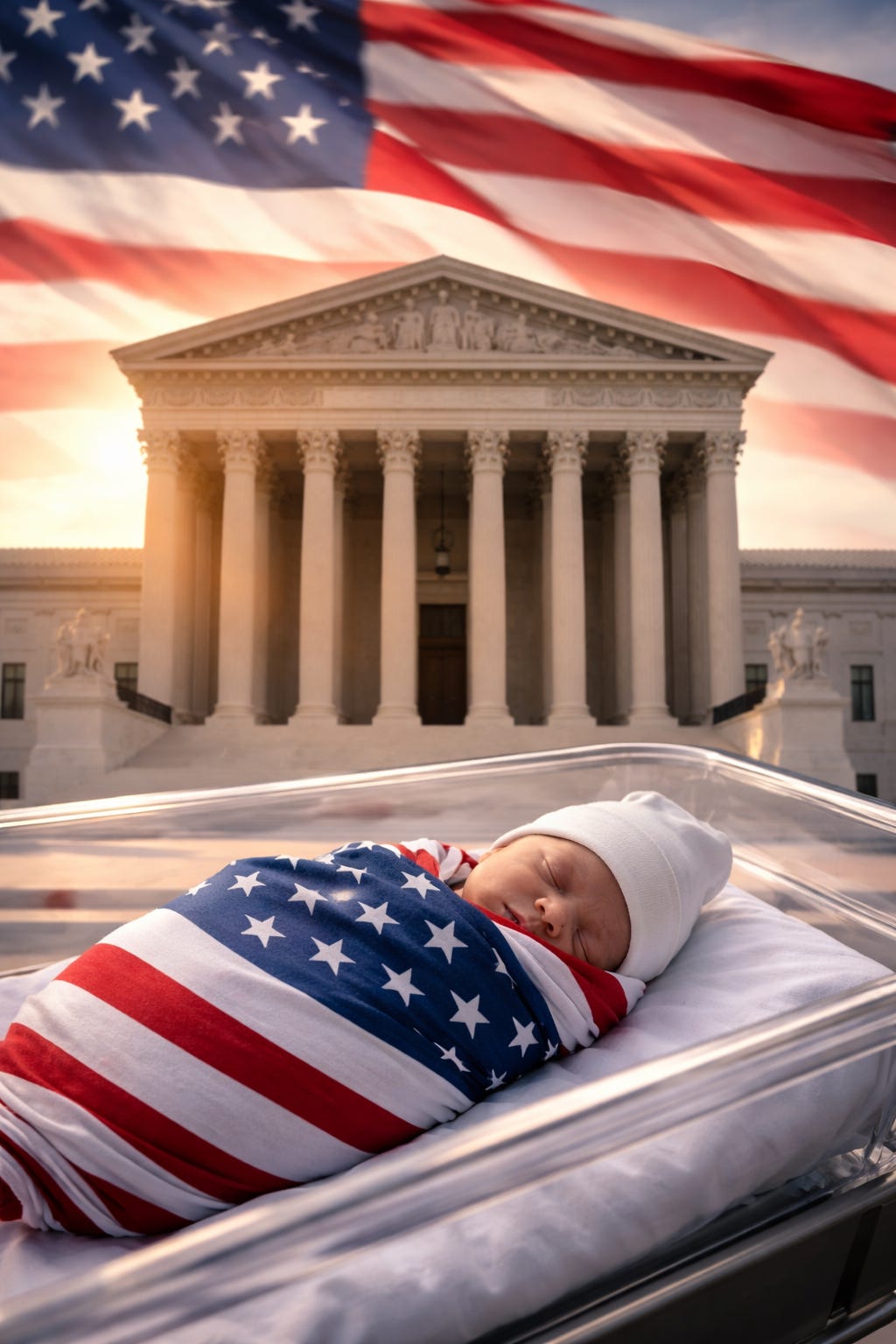
The Supreme Court heard oral arguments on Wednesday, April 1, 2026, in one of the most consequential constitutional cases in decades, a challenge to President Donald Trump’s attempt to restrict birthright citizenship by executive order. The case technically arrived at the Court through a dispute over nationwide injunctions, yet the argument itself told a different story. What unfolded in the courtroom sounded far less like a procedural fight over judicial power and far more like a direct confrontation over the meaning of the 14th Amendment.
This suggests that when the Court eventually issues its decision, it may not look like the narrow, technical ruling many expected months ago. Based on the questions and exchanges during oral arguments, the justices did not appear inclined to hand the government a sweeping victory. If anything, the tone of the hearing pointed in the opposite direction.
This Community Is Powered by You
What started as a small circle has grown into something much bigger, and it’s all because of readers like you.
Every time you forward this email, post it on socials, or bring someone new into the fold, you’re helping build one of the most passionate, independent political communities out there.
Want to keep the momentum going?
Share this newsletter with someone who should be part of this conversation.
Thank you for being here. It means everything.
How We Got Here
The Executive Order and the Injunctions
On January 20, 2025, his first day back in office, President Trump signed an executive order seeking to reinterpret the Citizenship Clause of the 14th Amendment to exclude certain children born in the United States to noncitizen parents. Multiple federal district courts quickly blocked the policy, issuing nationwide injunctions that prevent the government from enforcing it across the country while litigation proceeds.
The administration appealed, arguing not only that the policy was lawful but also that lower courts had overstepped by issuing such broad relief. That procedural question is what formally brought the case to the Supreme Court.
See our previous reporting here:
Note: Articles roll into the archive over time. Become a paid subscriber for full access to our extensive catalog.

The Three Questions at Stake
In theory, the Court could resolve this case narrowly, focusing entirely on nationwide injunctions. In practice, three major questions emerged during oral arguments.
The first is the core constitutional issue of whether the 14th Amendment guarantees birthright citizenship as it has long been understood, particularly under United States v. Wong Kim Ark.
The second is structural. Does a president have the authority to alter that understanding through executive action, or would such a change require Congress or a constitutional amendment?
The third is procedural. Can lower courts block such a policy nationwide while those deeper questions are being resolved?
By the end of the argument, it was clear that the first two questions had taken center stage.
Inside the Courtroom
Roberts, Gorsuch, and the Limits of the Government’s Theory
The most widely shared moment of the day came from Chief Justice John Roberts, who responded to the government’s argument that modern conditions justify revisiting the meaning of the Citizenship Clause. “It’s a new world,” he said, before adding, “It’s the same Constitution.” The line was more than memorable. It reflected a skepticism that contemporary concerns can justify rewriting constitutional meaning.
Justice Neil Gorsuch approached the issue from a different angle. His questioning, including a hypothetical involving Native Americans, probed whether the administration’s domicile theory could produce consistent results. The exercise exposed how difficult it would be to draw stable lines if citizenship depends on parental residence rather than birthplace. In a viral moment, Sauer stumbled over the question of whether Native Americans are citizens by birth, resulting in the chamber erupting in laughter.
Kagan, Jackson, and Barrett Press from Different Directions
Justice Elena Kagan focused on precedent, suggesting that the government’s position departs from long-settled law. Justice Ketanji Brown Jackson emphasized real-world consequences, asking how such a system would operate and what it would mean for children whose status would be uncertain at birth.
Justice Amy Coney Barrett’s questions were more doctrinal. She pressed for a limiting principle grounded in the constitutional text, signaling concern that the government’s theory lacked a clear boundary.
Sotomayor and the Stakes of Precedent
Justice Sonia Sotomayor focused on the broader implications of the government’s theory, pressing how far it could reach if accepted. In one of the more revealing exchanges, she told Solicitor General D. John Sauer that his argument effectively asked the Court to move away from Wong Kim Ark and later precedent recognizing birthright citizenship for children of noncitizens. Sauer rejected that characterization, insisting he was not asking the Court to overrule those decisions, even as he argued they should be read far more narrowly than they have been for generations.
Kavanaugh and the Question of Who Decides
Justice Brett Kavanaugh’s questions pointed toward institutional structure. He repeatedly returned to Congress and the enforcement power granted under Section 5 of the 14th Amendment. At one point, he framed his inquiry explicitly as a separation-of-powers concern, asking whether the challengers’ position left any role for Congress.
That line of questioning suggests a potential path that focuses less on redefining citizenship itself and more on clarifying who has the authority to do so.
Alito and Thomas
Justice Samuel Alito appeared the most receptive to the government’s argument, exploring historical sources and questioning whether the framers of the 14th Amendment anticipated modern immigration patterns. His engagement stood apart from the broader tone of skepticism across the bench.
Justice Clarence Thomas, as is often the case, was difficult to read. His limited questions focused on identifying the underlying principle connecting recognized exceptions to birthright citizenship. Whether that inquiry ultimately supports or undermines the government’s position remains unclear.
The Other Side of the Argument
The Court also heard from Cecilia Wang, representing the challengers. Her argument relied heavily on the text of the 14th Amendment and the longstanding interpretation in Wong Kim Ark. The justices tested her position, particularly on whether her reading leaves any room for Congress and how to account for historical exceptions.
The tone of that questioning was probing but did not carry the same sustained skepticism seen during the government’s presentation. That contrast is notable.
A Historic Presence
President Trump attended the argument during Solicitor General D. John Sauer’s presentation, in what has been widely reported as the first time a sitting president has attended Supreme Court oral arguments. The moment underscored the political and constitutional weight of the case, even as the justices maintained their usual focus on legal argument. Predictably, he left after Sauer’s portion.
What the Argument Revealed
A Case About Citizenship First
Taken as a whole, the argument revealed a Court far more engaged with the substance of citizenship than with the mechanics of nationwide injunctions. Although the case arose from a dispute over judicial power, the justices treated it as a fundamental question of constitutional meaning. Reassuringly, based on the oral arguments, that focus does not seem as fraught as many feared.
Different Justices, Different Concerns
Importantly, the skepticism toward the government’s position did not come from a single direction. Some justices focused on text and precedent. Others emphasized practical consequences or institutional authority. Still others tested whether the theory could be applied consistently.
That range of concerns strengthens the overall impression that the government’s position faces significant headwinds.
The Silence on Injunctions
One of the most striking features of the argument was what did not receive sustained attention. Nationwide injunctions, the procedural vehicle that brought the case to the Court, were largely absent from the central exchanges. That absence may prove as important as anything that was said.
What Comes Next
The Roberts Court has a well-established preference for deciding cases narrowly when possible. That instinct may shape the outcome here.
Based on today’s argument, the most likely decision will focus on the meaning of the 14th Amendment, potentially paired with a clarification that the executive branch cannot unilaterally redefine citizenship. A ruling centered primarily on nationwide injunctions now appears less likely.
A unanimous decision in sweeping terms seems improbable, given the range of concerns expressed. A decision largely in favor of the government also appears unlikely. The more plausible outcome is a narrower ruling that still rejects the administration’s core position.
The Bottom Line
This case arrived at the Supreme Court as a dispute over injunctions. It now appears poised to be decided as something much larger.
The justices were not simply debating the scope of judicial power. They were grappling with the meaning of citizenship itself and who has the power to define it.
Based on the oral arguments on Wednesday, it seems likely that the decision will reflect a reassertion of the 14th Amendment and possibly a separation-of-powers component. While nothing is certain until the decision is published, honestly, the current mood suggests the Supreme Court may actually deliver for the people and the Constitution.
This case isn’t just about doctrine; it’s about who we are as a country. If you want clear, grounded analysis of the Constitution and the Court, subscribe.
Sources:
Reuters, “Supreme Court justices skeptical of Trump order to restrict birthright citizenship”, April 1, 2026.
Reuters, “In historic first, Trump attends Supreme Court arguments”, April 1, 2026.
Associated Press, “Supreme Court seems poised to reject Trump’s birthright citizenship limits as he attends arguments”, April 1, 2026.
The Washington Post, “Supreme Court appears skeptical of Trump’s effort to end birthright citizenship”, April 1, 2026.
The Guardian, “Supreme court justices appear skeptical of move to end birthright citizenship as Trump attends arguments”, April 1, 2026.
The Guardian, “Trump seeks to redefine who gets to be an American with birthright citizenship case”, April 1, 2026.
National Review, “Birthright Citizenship Case Comes to the Supreme Court”, April 1, 2026.
National Review, “Does Congress Have a Say in Birthright Citizenship?”, April 1, 2026.
Fox News, “SCOTUS grills both sides on Trump’s birthright citizenship …”, April 1, 2026.
Fox News, “Supreme Court skeptical of Trump birthright citizenship order, Roberts questions argument in landmark case”, April 1, 2026.
Supreme Court of the United States, Oral Argument Transcript, Trump v. Barbara, April 1, 2026
Why depopulate America? While I have seen a few instances of “birthright tourism” the number is exceedingly small. Two of my relatives did this back during WW II. I don’t see why we are having such a big fuss.
Is it true that the Court could have decided Trump v. Barbara on the issue of nationwide injunctions? I thought that issue was decided separately last year in Trump v. Casa, and this litigation was brought as a class action, which is why the case needed to be resolved on the constitutional (or statutory) question. Is that right?