


In the early hours of March 5, 2026, after a markup that began on March 3, the House Agriculture Committee advanced the Farm, Food, and National Security Act of 2026 by a 34–17 vote. That sent the House farm bill forward and put one of its most controversial provisions on a bigger stage.
Farm bills are sprawling by design. They cover commodity supports, conservation, nutrition programs, rural development, trade, forestry, research, and more. This bill does the same, and the committee’s own materials describe it as spanning all twelve traditional farm bill titles.
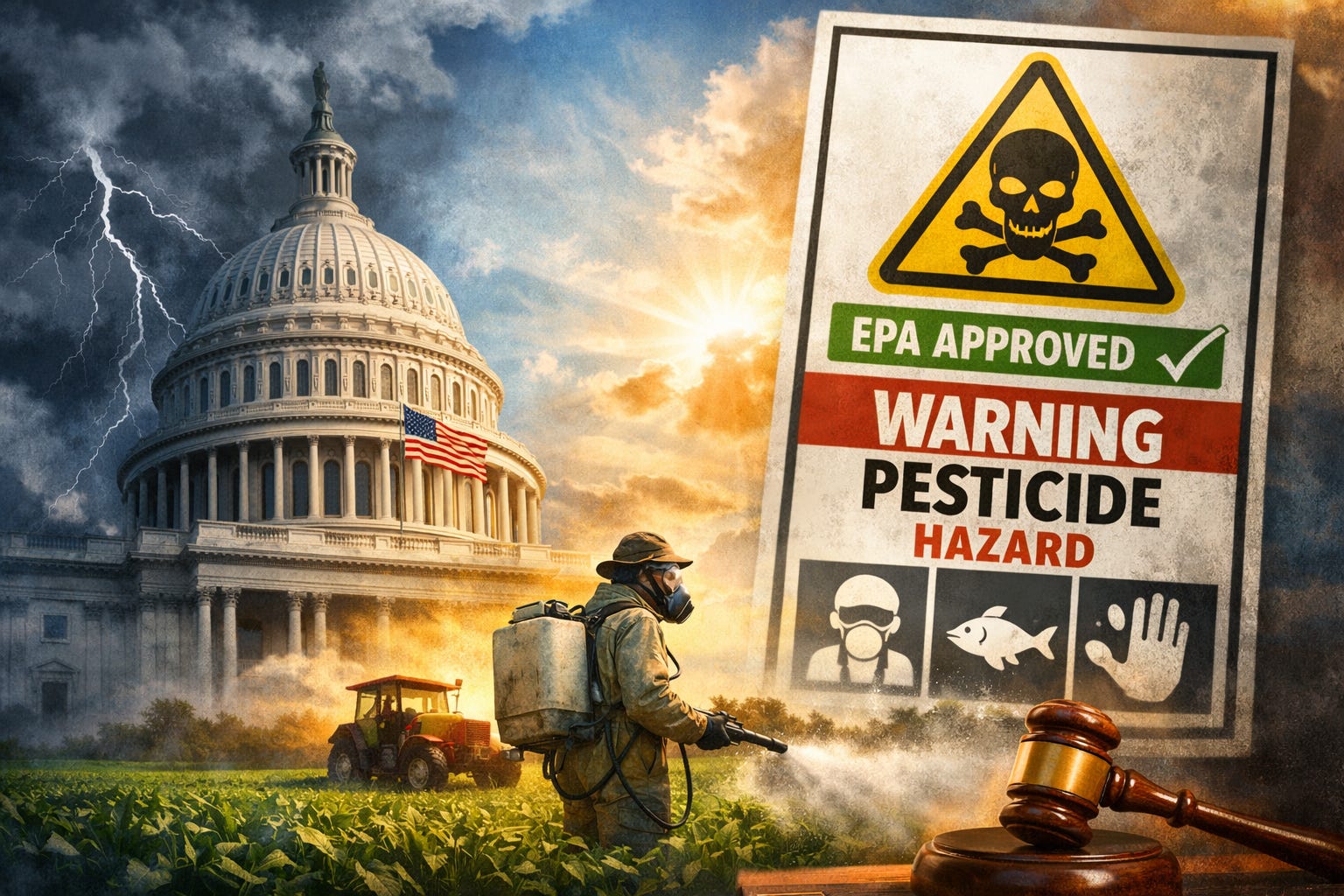
However, buried inside the package is a pesticide-labeling provision that reaches beyond routine farm policy. It would move the country toward a single national rule for pesticide warnings by making the EPA-approved label the controlling standard nationwide. Supporters call that regulatory certainty. Critics see a more dangerous tradeoff.
If Washington wants a single federal answer, consumers are left with a single federal backstop. Whether that is a fair bargain depends on whether the Environmental Protection Agency is strong enough to carry the weight.
This Community Is Powered by You
What started as a small circle has grown into something much bigger, and it’s all because of readers like you.
Every time you forward this email, post it on socials, or bring someone new into the fold, you’re helping build one of the most passionate, independent political communities out there.
Want to keep the momentum going?
Share this newsletter with someone who should be part of this conversation.
Thank you for being here. It means everything.
A national standard can also be a national ceiling
What the bill would do
Pesticides are regulated under the Federal Insecticide, Fungicide, and Rodenticide Act, or FIFRA. Under that law, the EPA reviews pesticides, approves labels, and regulates how these products are sold and used. EPA’s own guidance stresses that pesticide labels are legally enforceable and that “the label is the law.”
The House bill goes further than simply restating that framework. The relevant language says FIFRA’s labeling provision “shall be applied to require uniformity in pesticide labeling nationally,” and it bars any state, instrumentality, political subdivision, or court from directly or indirectly imposing additional or different labeling or packaging requirements, including warning requirements. It also bars them from penalizing or holding an entity liable for failing to comply with such extra requirements, subject to a carveout for certain material violations under FIFRA section 12(a)(2)(M), (Q), or (R) that have actually been penalized under section 14.
That language matters because it does not merely prevent a state from writing its own label rule. It also seeks to curb the use of state law and litigation to force stronger warning language than the EPA has approved. In plain English, it pushes the federal label toward a ceiling rather than a floor. The intended target is clearly California, which for decades has consistently enforced stricter labelling than the EPA.
Why supporters want it
The committee’s own one-pager makes the case plainly. It says Congress needs to “reaffirm EPA’s role as the sole authority for safety findings related to pesticides,” preserve a “science-based national standard,” and avoid a patchwork of conflicting state requirements. The document specifically cites California’s Proposition 65 and divided courts in glyphosate cases as examples of the problem that supporters want Congress to solve.
That is the most sympathetic version of the argument. If a company has gone through EPA review and obtained an approved label, supporters say it should not then have to navigate fifty different warning systems or be sued for failing to include warnings that federal regulators did not require. From that perspective, uniformity is about predictability, not impunity.
What changes from the current system
The present system is federal, but not exclusively so
The United States already has a heavily federalized pesticide regime. EPA reviews the science, approves pesticide labels, and revisits products through registration review. However, the current system still includes outside pressure points. States retain authority under FIFRA section 24(a) and 24(c) to regulate sale and use in important ways, and California’s Proposition 65 has become a major warning regime of its own for chemicals the state says are linked to cancer or reproductive harm. Glyphosate was added to California’s Proposition 65 list effective July 7, 2017.
Litigation has been another pressure point. In the Roundup cases, plaintiffs have argued that the manufacturer failed to warn users of cancer risks even though the EPA did not require a cancer warning. That dispute is now before the Supreme Court in Monsanto Co. v. Durnell, where the justices agreed to decide whether FIFRA preempts a label-based failure-to-warn claim when EPA has not required the warning. Argument is scheduled for April 27, 2026.
That is why the House bill is not just housekeeping. It is an attempt to settle a live dispute over federal preemption in favor of a single national ceiling on warnings.
The Roundup context is impossible to ignore
The politics of this debate are shaped by glyphosate. The EPA continues to say glyphosate is “not likely to be carcinogenic to humans” and says its review found no evidence that glyphosate causes cancer in humans. It reaffirmed this after withdrawing its 2022 interim decision, stating that its underlying scientific findings on glyphosate remained the same.
At the same time, California listed glyphosate under Proposition 65 after the International Agency for Research on Cancer classification, and juries in multiple Roundup cases have found Monsanto liable under state-law failure-to-warn theories. That disconnect is exactly why the labeling fight feels less abstract than supporters would prefer. This is not a debate taking place in a vacuum. It is happening in the middle of an ongoing, highly visible conflict over whether consumers were adequately warned.
The strongest argument for the bill is also its biggest weakness
Uniformity sounds sensible
There is a reason the push for uniform labeling has appeal. Pesticide labels are not casual consumer packaging. They are legal documents that govern use instructions, safety directions, and restrictions. When the EPA approves a label, growers, applicators, and manufacturers rely on it. The committee’s materials argue that conflicting state requirements create confusion and disrupt commerce. That is not a frivolous concern.
A company also has a real fairness argument when federal regulators have reviewed a product, approved the label, and then courts later say the warning should have been stronger anyway. Supporters of the bill believe that kind of system turns scientific regulation into a moving target.
But a federal ceiling only works if the federal regulator is robust enough
The problem is not the idea of national uniformity in itself. The problem is what happens when national uniformity is paired with a regulator that changes significantly with politics.
That point is not theoretical. The EPA’s pesticide posture has shifted over time with changes in administration. In October 2024, it finalized a rule restoring the Application Exclusion Zone protections that had been weakened in the 2020 rule, explicitly saying those 2020 provisions “weakened protections for farmworkers and nearby communities” and should be rescinded. On chlorpyrifos, the EPA revoked all food tolerances in August 2021, then later proposed a narrower rule that would revoke all tolerances except those tied to the eleven remaining registered food and feed crop uses after subsequent court proceedings and agency review.
Those examples show why this matters. If states and courts are pushed aside, then elections matter even more for pesticide warnings because the practical level of protection rises and falls with the administration’s regulatory philosophy. Preemption does not remove politics from the system. It concentrates the effects of politics inside one agency.
What critics are really arguing
This is not just a labels fight
Critics of the provision often say it looks less like neutral streamlining and more like a liability-limiting move. The bill text itself explains why they say that. It does not stop at banning extra state labeling rules. It also forbids courts from penalizing or holding an entity liable for failing to comply with requirements that would demand labeling “in addition to or different from” the EPA-approved label.
That is why the official committee one-pager spends time denying that the language creates a “liability shield.” The committee says that description is a “severe mischaracterization,” insists bad actors can still be held liable, and says the provision is narrowly focused on preserving the EPA’s role as the sole authority for safety findings reflected through the final label. However, the need to rebut the “liability shield” criticism in the committee’s own materials tells you how central that issue is to the fight.
California is part of the story for a reason
California is especially relevant here because it shows how a large state can influence national behavior without Congress acting first. Proposition 65 requires businesses to provide warnings for significant exposures to listed chemicals, and because California is such a large market, companies often choose nationwide compliance rather than California-only packaging. Glyphosate’s Proposition 65 listing is one of the examples supporters cite as evidence of a state regime colliding with EPA’s judgment.
Supporters see that as one state effectively dictating national policy. Critics see it as exactly the sort of outside pressure that matters when the federal government lags or takes a narrower view of risk. That is the federalism dispute in a nutshell.
If Congress wants EPA to stand alone, EPA has to be stronger
The bill can accommodate a stricter EPA, but it does not create one
One point is important to get right. The House language does not permanently freeze today’s warnings in place. The committee’s one-pager explicitly says the provision does not affect EPA’s ability to evaluate and respond to new information and does not prohibit EPA from taking action if warranted. So, in theory, a future EPA could require stronger warnings nationwide, and the bill would accommodate that just as readily as it accommodates a weaker EPA.
However, that is exactly the problem. The provision assumes the agency at the center of the system will be responsive, independent, and strong enough to deserve exclusive power. It does nothing by itself to make that true.
A stronger EPA is the missing condition
If Congress wants to make EPA-approved labels the last word, then consumer protection depends much more heavily on the EPA’s scientific rigor, speed, and independence. The agency would need to be faster in revisiting products when science changes, more insulated from political and industry pressure, and well-resourced enough to conduct meaningful review and enforcement. The EPA’s own materials say the label reflects extensive evaluation and that the agency must review new scientific findings and pull products if they no longer meet safety standards. The issue is not whether the EPA has legal authority. It is whether the institution is robust enough, across administrations, to justify cutting off other safeguards.
See our previous reporting on the gutting of the EPA here:
Note: Articles foll into the archive over time. Become a paid subscriber for full access to our extensive catalog.


That is the real test for consumers. A stronger national ceiling can only be defended if the national regulator is strong enough to deserve it. As the last decade has shown, it currently is not, particularly in the current anti-science, anti-intellectualism policies of this administration.
The real question behind the pesticide-labeling fight
The fight over this farm bill provision is often presented as a technical dispute about labels. It is bigger than that.
If Congress wants one national standard for pesticide warnings, that is a choice it can make. However, it should be honest about the bargain it is striking. It would be asking the public to trust the EPA more, while removing some of the state and judicial pressure that now exists when people believe the federal government has not gone far enough.
That arrangement could work under a strong, independent, precautionary EPA. It works much less well under an agency that is politically variable, slow to react, or too deferential to industry. The House bill, as written, is therefore not just a debate about uniformity. It is a debate over whether Congress is comfortable making the EPA the final line of defense for consumers without first ensuring the agency is strong enough to do the job.
If you value clear-eyed analysis of the policies shaping our economy, environment, and democracy, subscribe to the newsletter. We aim to explain what’s actually happening and why it matters.
Sources:
“Chairman Thompson Commends Bipartisan Passage of Farm, Food, and National Security Act of 2026”, March 5, 2026 — House Committee on Agriculture
“Farm Bill” — House Committee on Agriculture Republicans
“H.R. ll” (Farm, Food, and National Security Act of 2026 bill text; see Sec. 10205, “Uniformity of pesticide labeling requirements”), February 13, 2026 — House Committee on Agriculture
“Background Under the Federal Insecticide, Fungicide, and Rodenticide Act (FIFRA)” (committee one-pager on labeling uniformity), 2026 — House Committee on Agriculture
“Monsanto Company v. Durnell” — SCOTUSblog
“Supreme Court announces cases it will hear at term’s end”, February 11, 2026 — SCOTUSblog
“Glyphosate” — U.S. Environmental Protection Agency
“EPA Finalizes Rule to Protect Farmworkers, Families, and Communities from Pesticide Exposures”, October 2, 2024 — U.S. Environmental Protection Agency
“Glyphosate Listed Effective July 7, 2017 as Known to the State of California to Cause Cancer”, July 7, 2017 — California Office of Environmental Health Hazard Assessment
“Introduction to Pesticide Labels” — U.S. Environmental Protection Agency
When did the EPA loose its ability to PROTECT?
Our government is poisoning human and wildlife. The EPA and Zeldin are pro-poison because it favors billionaires and huge corporations. I guess in this administration, it’s official: in EVERY context, money is more important than life - human lives, nonhuman lives and a natural ecosystem. Outrageous, disgraceful, CRIMINAL.