


In the wealthiest nation in human history, people are dying because they can’t afford to live. The United States spends $886 billion a year on defense, subsidizing war machines and overseas bases, while tens of millions of Americans can’t afford a trip to the doctor. We don’t lack the money to provide healthcare. We lack the political will.
Over 65 million people in this country are either uninsured or underinsured. Every year, more than 60,000 people die from preventable deaths, and half a million families are pushed into bankruptcy because they got sick at the wrong time. Meanwhile, CEOs of insurance giants rake in eight-figure bonuses for denying care. Our hospitals close in rural counties while contractors cash checks for weapons that may never be used.
This isn’t a glitch in the system. It is the system, one designed to enrich the few while the many are left to choose between groceries and chemotherapy. Politicians call this “freedom.” But what kind of freedom bankrupts you for breaking a leg? What kind of freedom lets a child die because their parents couldn’t afford insulin?
The truth is ugly: healthcare isn’t denied because it’s unaffordable. It’s denied because it’s profitable, and our government protects that profit as if it were a national treasure.
This article will expose the rot at the root of America’s refusal to treat healthcare as a human right and name the names of those who benefit from every denial of care.
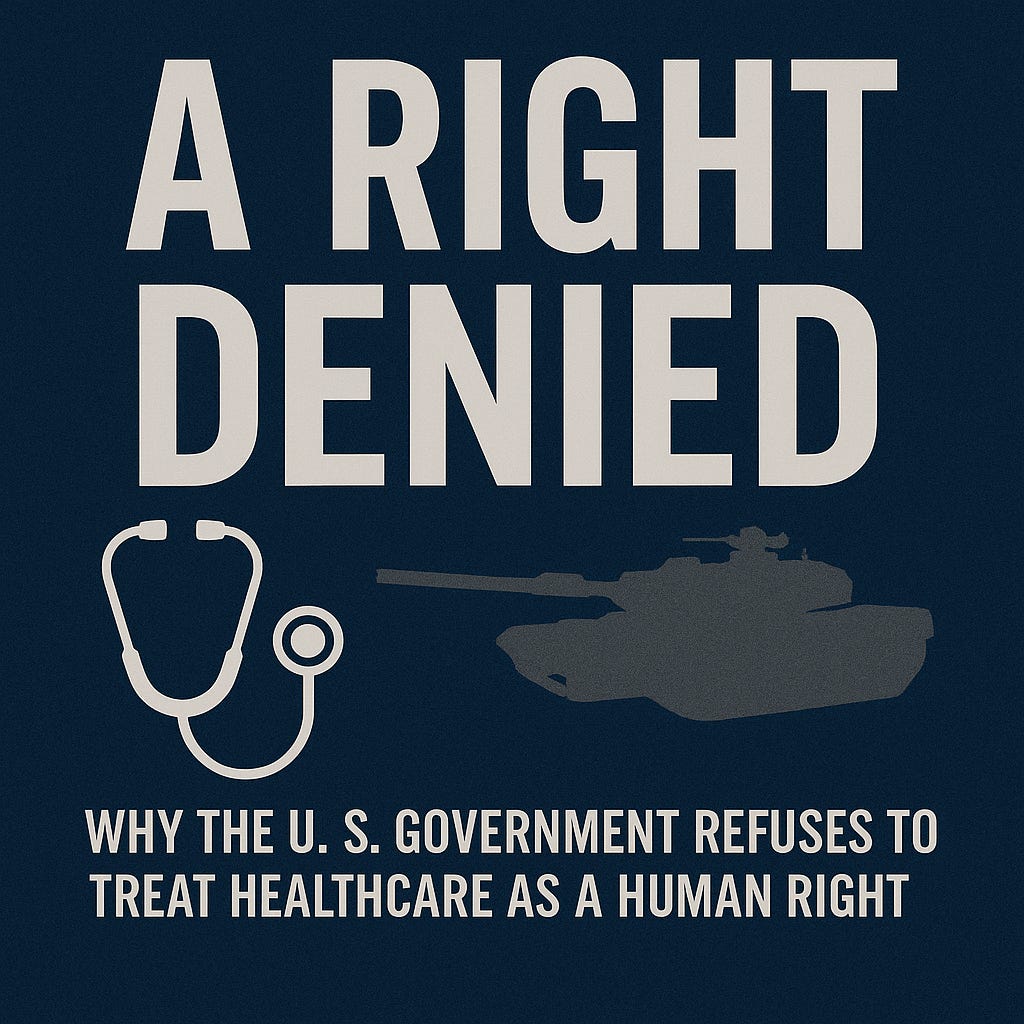
The Human Toll
We discuss “healthcare access” as if it were a data point. However, behind every gap in coverage is someone’s mother, someone’s child, or someone’s neighbor gasping through an asthma attack they couldn’t afford to treat. These aren’t isolated tragedies. They’re the predictable outcome of a system built to exclude.
Tens of thousands of Americans die every year, not from rare diseases, but from treatable conditions made lethal by delay. A woman postpones her mammogram because she can’t pay the out-of-pocket fee. A father hesitates to take his son to the ER for a high fever, hoping it breaks on its own. A diabetic teen tries to stretch insulin over an extra week, and never wakes up.
And for those who live, survival often comes at the cost of everything else. Medical debt is the number one cause of personal bankruptcy in this country. Even insured families can be overwhelmed by high deductibles and unexpected bills. One ambulance ride can wipe out a month’s wages. Hospitals sue patients, seize their wages, and place liens on their homes, not out of malice, but as a routine policy.
In rural America, the only hospital may already be gone. Over 150 rural hospitals have closed since 2005, rendering what should be a basic right—access to emergency care—a matter of chance.
Millions now turn to GoFundMe in desperation, not because they failed, but because the system did. They aren’t asking for miracles. They’re asking to live.
“I didn’t think I’d survive cancer, but I definitely didn’t expect to survive and lose everything because of it.”
—Tonya Ingram, patient advocate and poet
In America, that’s still too much to ask.
And yet, we’re told the system is too expensive to fix. But that’s a lie we can’t afford.
The Money Is There
We already spend more on healthcare than any other country, over $4.9 trillion in 2023, and still leave millions behind. The truth is that providing free healthcare to every uninsured and underinsured American would cost between $300 billion and $500 billion annually. That’s less than 11% of what we already spend.
We don’t even need to raise taxes to do it. We could fully fund care by reallocating a portion of the $886 billion defense budget. That money currently pays for over 800 overseas military bases, no-bid contracts, and weapons systems that the Pentagon didn’t even request.
The Pentagon has failed multiple consecutive audits. No one knows where the money went. No one is punished.
“We’ve normalized trillions in military spending, but universal healthcare is always called a fantasy. What does that say about our priorities?”
—Dr. Abdul El-Sayed
We’ve reported on the Department of Defense’s creative math before. See that article here:

A modest shift—just 34% to 56% of the defense budget—could fund comprehensive healthcare for every American who can’t afford it. That’s not utopia. That’s arithmetic.
Does that sound extreme? Consider this:

So if it’s not about cost, we have to ask: who’s stopping it and why?
Why the Government Won’t Do It
If America has the money and the need, then why are people still dying for lack of care?
This system isn’t failing. It’s succeeding at what it was built to do: protect wealth, preserve power, and punish the vulnerable.
Corporate Capture
Let’s stop calling it “lobbying.” This is legalized bribery. The healthcare industry spends over $700 million a year buying influence in Congress, writing the rules that let them deny treatment, inflate prices, and bankrupt families.
Insurance CEOs earn millions by withholding care. Pharma giants jack up prices on insulin and cancer drugs with no consequence. Hospitals send collection agents after grieving families while executives build glass towers.
Politicians don’t represent you. They represent the people who fund their campaigns and promise them board seats.
This isn’t compromise. It’s corruption.
Ideological Obstruction
America is the only wealthy nation that lets its people die for being poor, and somehow calls that “freedom.”
We’ve been fed a decades-long lie: that public healthcare is “socialism,” while private profiteering is “freedom.” But what kind of freedom is it when you can’t afford to survive?
We’ve normalized a system where billion-dollar corporations get to play God, deciding who lives, who suffers, and who dies.
This isn’t small government. It’s a brutal government, one that works just fine if you’re rich, and leaves the rest to fend for themselves.
And what happens when some believe they should determine who deserves help? See our reporting here:

Racism and Class Control
The refusal to guarantee healthcare isn’t colorblind. It never was.
Universal healthcare has been deliberately blocked in America, not because it’s unworkable, but because it would mean Black, Brown, poor, and immigrant Americans getting equal care. That terrifies the same forces that fought to keep segregated schools and unequal pay.
Healthcare is used as a form of punishment: a way to remind marginalized communities where they stand in the social hierarchy.
“Medicaid expansion would have saved thousands of lives in the South. Blocking it wasn’t about budgets—it was about control.”
—Jamila Taylor, Director of Health Policy, The Century Foundation
In America, your health is determined not by your humanity, but by your wallet, your zip code, and the color of your skin.
Systemic Gridlock
Let’s drop the pretense of “political dysfunction.” This isn’t gridlock; it’s design.
The filibuster wasn’t built to protect democracy. It was built to block civil rights. Gerrymandering doesn’t empower voters. It lets politicians pick who counts.
And the courts? They’ve handed corporations speech, personhood, and veto power over your future, while stripping away your right to bodily autonomy and basic care.
We live in a system that works perfectly for the people it was built to serve. And it’s not you.
Meanwhile, the rest of the world proves every day that a better way is not only possible, it’s already reality.
Global Proof: Universal Healthcare Works
Every other major industrialized nation treats healthcare as a human right. It doesn’t just work, it works better, cheaper, and fairer than what we have here.
France covers all citizens, including those with mental health needs and home visits. The UK’s NHS offers care free at the point of service. In Canada, no one pays a dime to be rescued by an ambulance. In Germany, even private insurers must comply with strict affordability standards, and everyone is covered.
Not only do they provide this, but they also spend far less per person than we do.
We spend more than $4.9 trillion annually on healthcare, which is double the amount spent per capita by countries like France and Canada. Yet, we have lower life expectancy, higher infant mortality, and worse chronic disease outcomes.
We’re not asking for miracles. We’re asking for what the rest of the world already has: a healthcare system that values people over profit.
What National Security Really Means
We fund a nearly trillion-dollar defense budget under the banner of “security.” But what kind of security is it when you can’t afford antibiotics, when cancer means foreclosure, and when a broken bone breaks the bank?
The real threats to American lives aren’t coming from foreign militaries. They’re coming from untreated illness, unaffordable care, and a system that lets you die quietly.
COVID-19. Diabetes. Suicide. Addiction. These kill more Americans than any terrorist ever has.
If a foreign nation denied us medicine and let 60,000 people die, we’d call it an attack. When our own government does it, we call it “policy.”
Real security is knowing a hospital stay won’t ruin your family. Real patriotism is fighting for a country where everyone has the right to live.
A Budget That Reflects Our Values
We live in a nation where the government spends nearly a trillion dollars on war, but tells its own people to beg online for insulin, where survival is a privilege for the insured, and where illness is treated like a moral failure.
This isn’t a healthcare crisis. It’s a political choice, and it’s killing us.
We’re told budgets reflect values. So what does it say when we fund bombs over bandages? When billionaires get tax cuts while children die from tooth infections?
It says this system isn’t broken. It’s working exactly as intended, for the powerful.
Here’s what you can do:
Call Congress. Right now. Demand a healthcare system that treats life as a right, not a luxury. Demand a budget that reflects the will of the people, not the greed of donors.
U.S. Capitol Switchboard: (202) 224-3121
Sample Script:
“I’m calling to demand that my representative support universal healthcare funded by a reallocation of the defense budget. We don’t need more missiles; we need medicine. We don’t need more tanks; we need treatment. Stop funding war while Americans die from preventable illness.”
The choice is simple. War or wellness. Apathy or action. Profit or people.
This country won’t change because it should. It’ll change because we demand it.
We just hit 14,000 subscribers—thank you!
Get exclusive access for just $1/week or $52 a year.
Get exclusive analysis and fearless reporting you won’t find in corporate media.
Bibliography:
Centers for Medicare & Medicaid Services. “National Health Expenditure Data.” CMS.gov, 2024.
Deng, Jireh. "Tonya Ingram, an Inspiring L.A. Poet and ‘Lupus Warrior,’ Died Waiting for a Kidney." Los Angeles Times, January 23, 2023.
Democracy Now. "Dr. Abdul El-Sayed: Communities Enduring Racism & Poverty Will Suffer Most from COVID-19." Democracy Now!, March 31, 2020.
Taylor, Jamila. "Racism, Inequality, and Health Care for African Americans." The Century Foundation, December 19, 2019.
Bailey, Zinzi D., et al. "Systemic and Structural Racism: Definitions, Examples, Health Damages, and Approaches to Dismantling." Health Affairs, vol. 41, no. 2, 2022.
OpenSecrets.org. “Health: Lobbying, 2023.”
KFF (Kaiser Family Foundation). “Key Facts About the Uninsured Population.” October 25, 2023.
I would require that any member of congress at age 65 and over go on Medicare. Their present plan dwarfs Medicare and other private plans.
„Medical debt is the number one cause of personal bankruptcy in this country.“
This is so sad.
This is what people do to each other !