


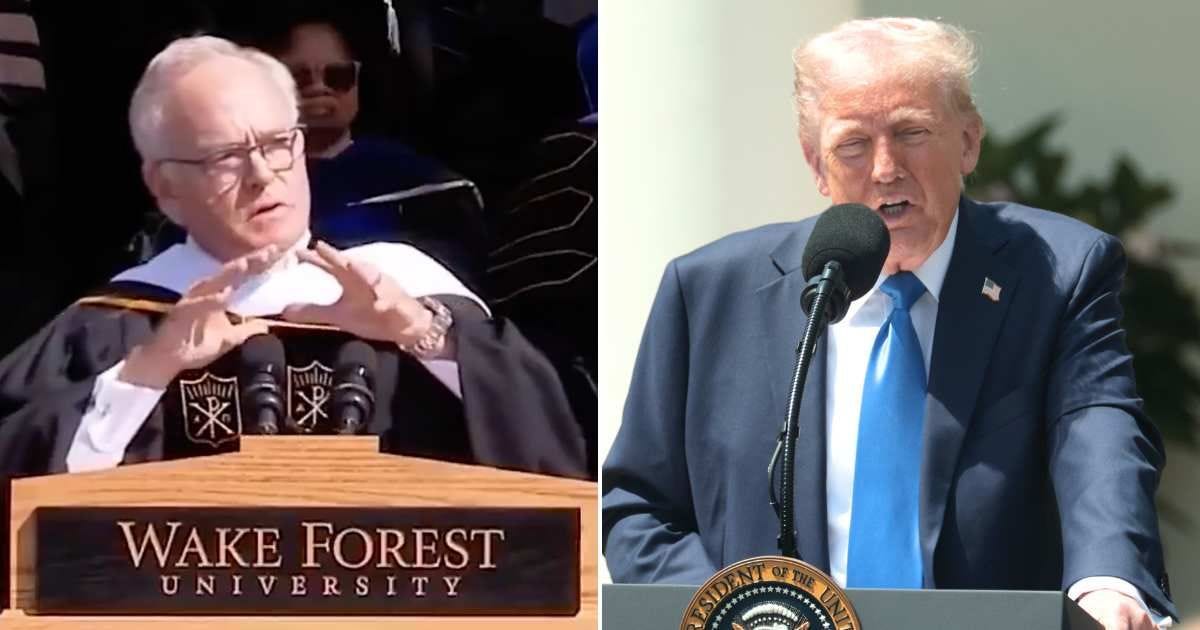
In the span of one week, two high-profile figures—President Donald Trump and veteran journalist Scott Pelley—took the podium at two prestigious institutions: West Point and Wake Forest. On paper, these were just commencement addresses. But in reality, they were declarations of contrasting blueprints for America’s future.
One speech called on young people to protect democracy. The other warned about trophy wives and condemned diversity. Each offered a vision, not just of leadership, but of what kind of country we are, and what kind we are becoming.
We just hit 14,000 subscribers—thank you!
Get exclusive access for just $1/week or $52 a year.
Get exclusive analysis and fearless reporting you won’t find in corporate media.
The Speakers Behind the Speeches
The power of a commencement address often hinges on who is speaking as much as what is said. These aren't just any two public figures.
Scott Pelley is a longtime correspondent for 60 Minutes and former anchor of the CBS Evening News. Known for his measured, fact-driven journalism, Pelley has spent decades reporting from war zones, disaster sites, and the halls of power. He isn’t a celebrity pundit or partisan flamethrower. His reputation rests on clarity, seriousness, and moral conviction. When he speaks about threats to democracy, he does so with the weight of a career spent defending truth.
Donald Trump, by contrast, is not only a political figure but a symbol of a particular style of power. As the 45th and now 47th president, Trump is unmatched in his ability to dominate public discourse. His communication style—brash, unscripted, deeply personal—is both his brand and his strategy. When he delivers a commencement address, it’s less about the graduates and more about reinforcing a vision of loyalty, grievance, and cultural warfare.
These weren’t just two speakers. They were two proxies for the struggle over America’s identity.
Pelley has long sounded the alarm about democratic backsliding and disinformation, including during Trump’s first term. As anchor of the CBS Evening News, he fact-checked the former president in real time, once opening a broadcast with, “It has been a busy day for presidential statements divorced from reality.” His Wake Forest speech was not a departure. It was a continuation of a journalist’s lifelong commitment to defending the truth. Trump, meanwhile, has spent years framing journalists like Pelley as enemies of the people, making this rhetorical face-off all the more potent.
The Journalist’s Challenge to Graduates
Scott Pelley’s speech at Wake Forest was not an applause line-filled celebration. It was a warning. Delivered in calm, deliberate tones, it urged students to understand the stakes of their time, not just in terms of their careers, but also in terms of their citizenship.
“Freedom of speech is under attack,” Pelley told the graduates. “Journalism is under attack. Universities are under attack. The rule of law is under attack.” These weren’t abstract concerns; they echoed the very patterns we’ve reported on in recent months, from political efforts to intimidate the press to the systematic dismantling of academic and civic institutions.
You can find some of our coverage on these issues here.
Note: This article is more than 45 days old and now lives in our archive. Consider becoming a paid subscriber for all of our nearly 600 articles, exclusive content, and occasional early access.


He referenced Orwellian manipulation of language and the demonization of “diversity, equity, and inclusion,” not as a passing trend but as a calculated effort to sow ignorance and fear, a tactic we’ve detailed in our reporting on the weaponization of language and truth in modern authoritarian playbooks.
The speech was a call not just for awareness, but for action. Graduates were tasked with being “fierce defenders of democracy,” a phrase that elevated the ceremony beyond personal achievement into a civic moment.
Critics on the right accused Pelley of hijacking a solemn occasion for political grandstanding. But defenders saw it differently: a truth-teller using a rare public moment to challenge young people to live up to the values their diplomas represent.
See our post about his speech here:

The President’s Performance at West Point
Where Pelley offered a call to civic responsibility, President Donald Trump’s commencement speech at West Point was a spectacle in self-reference and political grievance. What could have been a moment to honor military service and inspire leadership instead resembled a rally complete with culture war rhetoric, bizarre anecdotes, and warnings about trophy wives.
Trump used the occasion not primarily to congratulate the graduating cadets, but to air his familiar grievances: that he has been treated worse than Al Capone, that diversity and inclusion programs are weakening the military, and that America must return to “real values.” He lamented that the military had become too focused on “social experiments,” a veiled jab at DEI initiatives, and warned that under his watch, it would be restored to “pure” strength.
More jarring were his personal tangents. At one point, Trump shared the story of real estate developer William Levitt, cautioning the cadets against marrying trophy wives. The metaphor was unclear, the relevance nonexistent. Like much of the speech, it centered not on the future of the graduates, but on Trump’s own worldview.
This isn’t to say the president didn’t speak to American greatness. He did, but it was a selective greatness. His America is one of enemies and purity tests, where loyalty matters more than leadership, and where the military is not a national institution but a political one.
Critics called it unpresidential and inappropriate. Supporters, predictably, saw it as Trump being Trump — unapologetic, aggressive, and “real.” However, what is undeniable is that the speech was a deliberate departure from tradition. At a moment meant to celebrate unity and service, Trump doubled down on division and self-promotion.
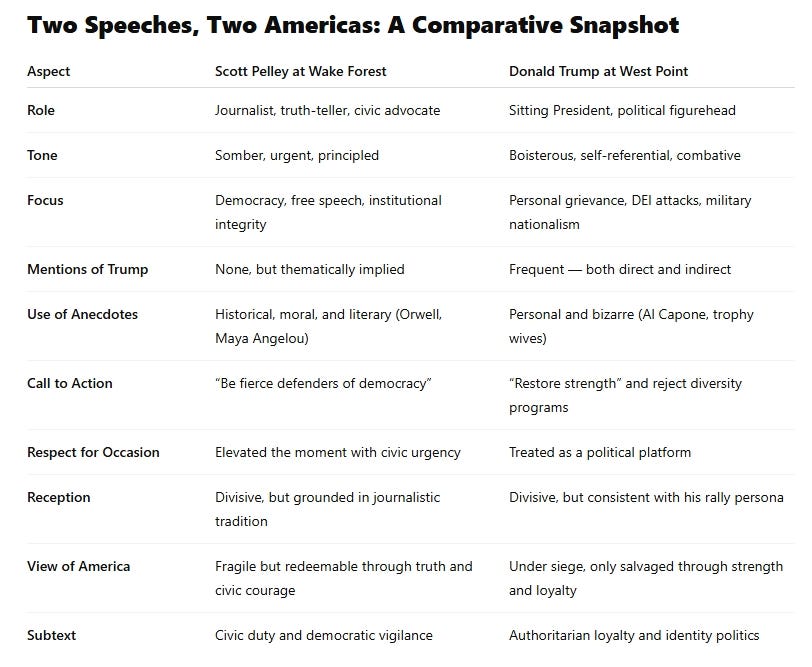
Two Speeches, Two Americas: A Comparative Snapshot
The Meaning Behind the Moment
Commencement speeches are rituals, part celebration, part instruction. They inform graduates about the kind of world they’re inheriting and the kind of citizens they should become. However, in 2025, they also revealed what kind of country we are.
Scott Pelley’s address was a call to repair. He spoke of democratic decay, institutional betrayal, and the need for young people to act as defenders of truth. He didn’t scold or posture; he held up a mirror and asked: Are you prepared to do something about what you see?
Donald Trump’s speech, on the other hand, was a call to retreat into grievance, into loyalty tests, and into a version of America that fears change more than corruption. He didn’t ask graduates to lead; he asked them to remember his hardships, his enemies, and his worldview.
These speeches weren’t just divergent in tone or topic; they were also distinct in their approach. They reflected two fundamentally different philosophies:
One rooted in civic engagement, shared responsibility, and democratic endurance.
The other rooted in cultural division, personal vindication, and institutional suspicion.
In many ways, they represent the stakes of our political and cultural moment. What kind of America do we want to inherit, and what kind of Americans are we training our graduates to be?
What Kind of Message?
Commencements are supposed to be about beginnings, fresh starts, bold futures. But in these two speeches, we got something deeper: a referendum on who we are and what we believe.
Scott Pelley asked graduates to rise to the defense of democracy. Donald Trump asked them to remember who their enemies are. One pointed to institutions worth saving. The other warned of a country worth fearing.
So now we ask: If your child were graduating this spring, which speech would you want them to hear? A call to serve something larger than themselves or a rallying cry to stay loyal to one man’s fight?
The choice between those two visions isn’t just rhetorical. It’s generational. It’s political. It’s moral.
And it’s ours to make.
We just hit 14,000 subscribers—thank you!
Get exclusive access for just $1/week or $52 a year.
Get exclusive analysis and fearless reporting you won’t find in corporate media.
Bibliography:
“Award-winning CBS journalist Scott Pelley to deliver 2025 commencement address.” Wake Forest News, March 5, 2025.
“‘Angry, Unhinged’: MAGA Explodes Over Scott Pelley’s Wake Forest Speech Slamming Trump’s DEI Crackdown and Quoting Maya Angelou.” Atlanta Black Star, May 26, 2025.
“MAGA Erupts Over ‘60 Minutes’ Scott Pelley’s Viral Warnings About Trump.” The Daily Beast, May 21, 2025.
“CBS correspondent Scott Pelley hits Trump for suing journalists 'for nothing' in fiery commencement speech.” Fox News, May 25, 2025.
“’60 Minutes’ Anchor Scott Pelley Ripped for ‘Angry, Unhinged’ Commencement Speech Criticizing Trump.” New York Post, May 26, 2025.
“Trump Warns West Point Grads About ‘Trophy Wives’ and DEI, Compares Himself to Al Capone.” Politico, May 24, 2025.
“Rule of Law Takes Center Stage at Law School Commencements.” Reuters, May 21, 2025.
“Trump Takes Credit for ‘Most Powerful Army World Has Known’ During West Point Speech: ‘I Rebuilt the Military’.” Time Magazine, May 24, 2025.
“Trump gives rambling speech about trophy wives, golf and the ‘great late’ Al Capone in politically-charged West Point address” The Independent, May 24, 2025.

My son will graduate from the Naval War College soon. I hope he hears a call to stand for democracy. Regardless, he is already doing that.
Why are some people still fascinated by T.? Is he "real" while he lies and pretends to tell the truth?