


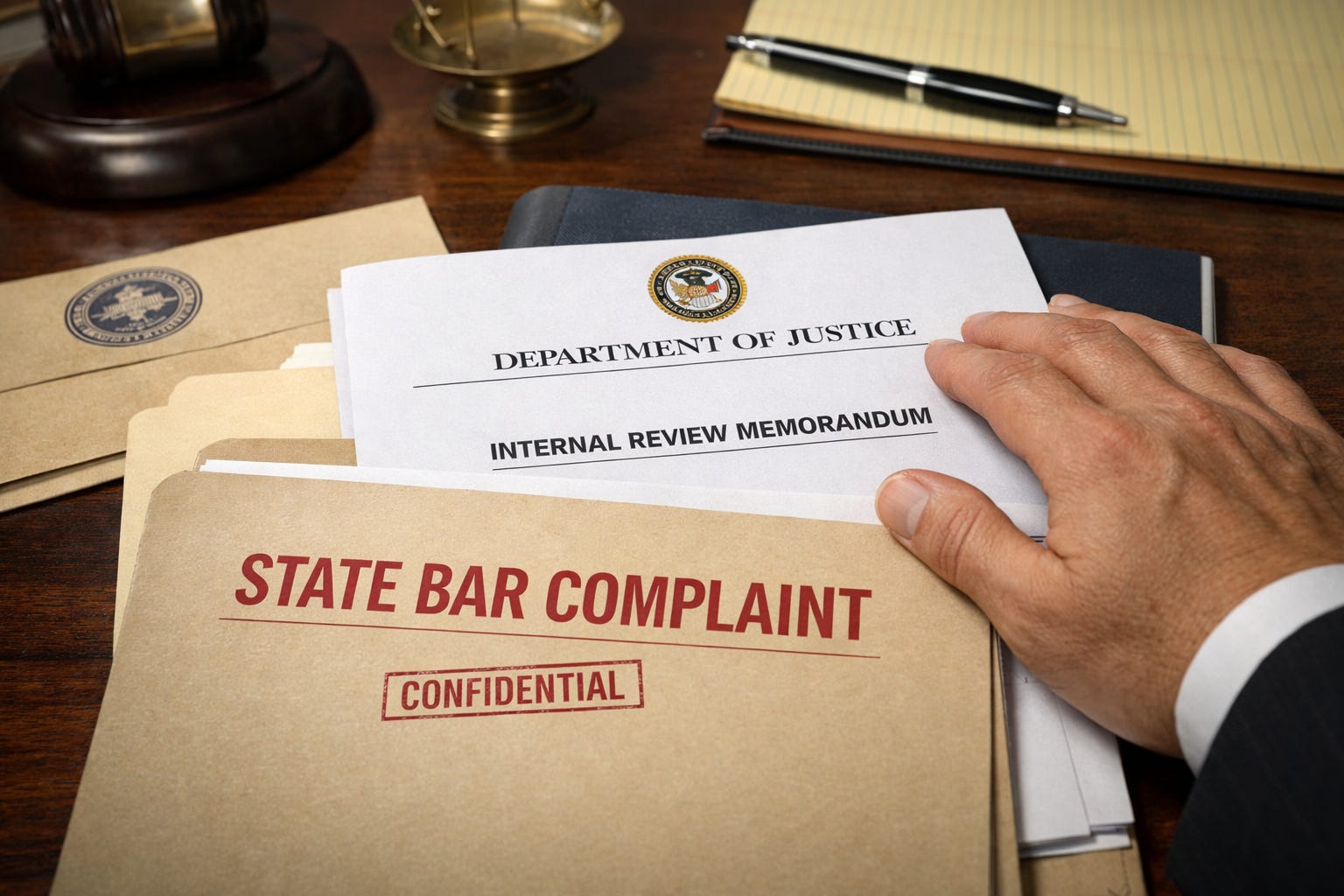
The Justice Department wants more control over misconduct complaints against its own lawyers. Under a proposed ethics rule, DOJ would review those complaints first and ask state bar authorities to wait while it conducts its own internal process. DOJ says the change is needed because bar complaints can be weaponized for political purposes. Critics, including 20 Democratic state attorneys general, say the real effect would be to weaken one of the few outside checks on federal lawyers and put DOJ attorneys on a different accountability track from everyone else.
The proposal does not have to erase an investigation to weaken it. It only has to make outside watchdogs wait while DOJ decides how much scrutiny its own lawyers should face, and when. That is not just a procedural change. It is a fight over who controls accountability.
This Community Is Powered by You
What started as a small circle has grown into something much bigger, and it’s all because of readers like you.
Every time you forward this email, post it on socials, or bring someone new into the fold, you’re helping build one of the most passionate, independent political communities out there.
Want to keep the momentum going?
Share this newsletter with someone who should be part of this conversation.
Thank you for being here. It means everything.
What the rule actually does
The proposed rule would establish a formal internal review process for state bar complaints and other allegations of misconduct against current and former DOJ lawyers. Before a state disciplinary authority could move forward with investigative steps that require the lawyer’s participation or access to nonpublic DOJ information, the department would step in, review the complaint itself, and ask the state bar to pause its work while that review happens.
DOJ says this is a procedural safeguard, not immunity. Under the proposal, state bars could still resume or begin their own investigations after DOJ finishes its internal review. But that framing leaves out the real shift: DOJ would control the opening stage of the process, the pace of that process, and the flow of nonpublic information during it.
In plain English, the department wants outside watchdogs to stand down while it first examines complaints against its own lawyers. That may sound technical, but timing can shape outcomes. A complaint need not be formally dismissed to lose its force. It only has to be slowed, routed inward, and placed on a timetable set by the institution under scrutiny. The Justice Department is not openly claiming its lawyers should be exempt from discipline. It is asking for the power to decide when outside accountability begins.
What this would do to a state’s ability to check federal power
The deeper issue here is federalism. States cannot supervise the Justice Department itself, but they can regulate the lawyers licensed in their jurisdictions. That makes state bar discipline one of the few outside tools states still have to check misconduct by federal attorneys. If DOJ can step in first and tell state regulators to wait, that state authority still exists on paper, but it becomes weaker in practice.
That is why state attorneys general have objected so sharply. Reuters reported that 20 Democratic state attorneys general argued the proposal would infringe on states’ authority to regulate attorney conduct within their jurisdictions. The New York City Bar likewise argued that the proposal conflicts with the McDade Amendment and is unlawful and contrary to the public interest.
What this rule threatens is not just attorney discipline, but one of the few ways states can still check federal power. The state still has formal authority. The federal government just gets more influence over when that scrutiny begins and how much room it has to work.
What the DOJ says it is trying to solve
DOJ says the proposal is meant to protect its lawyers from ethics complaints filed for political reasons rather than genuine misconduct. The department argues that federal attorneys handling controversial matters can become targets of campaigns designed to punish aggressive representation of the government, and that those complaints can chill lawyers from doing their jobs. Reuters reported that DOJ framed the rule as a response to the “weaponization” of bar complaints against current and former department attorneys.
That argument is not frivolous. In a polarized country, it is easy to imagine bad-faith complaints being used as another political weapon. But even if that risk is real, the solution still matters. The question is whether the answer to politicized complaints should be a stronger independent review, or a system that lets the department being accused step in first and ask outside regulators to wait. The proposed rule takes the second path.
A rule can be sold as protection against abuse and still function as a shield against accountability. Critics argue that is exactly the danger here: not that DOJ is openly claiming immunity for its lawyers, but that it is building a process that gives the institution more control over timing and conditions before outside scrutiny fully begins. The New York City Bar called the proposal unlawful and contrary to the public interest, while Reuters reported that state attorneys general warned it would place DOJ lawyers on a different track from everyone else.
Why critics say this would put DOJ lawyers on a different track from everyone else
The sharpest criticism of the proposal is also the simplest: it would treat DOJ lawyers differently from every other attorney licensed by a state bar. Ordinary lawyers accused of ethical misconduct do not get to ask their employer to step in first, review the complaint internally, and tell outside regulators to wait. DOJ lawyers would. That is why California Attorney General Rob Bonta said the policy would effectively place DOJ attorneys “above the law,” and why a coalition of 20 Democratic state attorneys general argued it would let the department shield its own employees from accountability.
Congress passed the McDade Amendment to make clear that DOJ attorneys are subject to state ethics rules to the same extent and in the same manner as other lawyers. The New York City Bar argues that this proposal runs counter to that principle by requiring state disciplinary bodies to defer to the DOJ’s internal review. So the problem, critics say, is not merely delay. It is the creation of a separate accountability process for the government’s own lawyers, even though Congress moved in the opposite direction.
That is what makes this more than a narrow legal ethics fight. A justice system cannot ask the public to trust equal accountability while building a special track for the government lawyers who wield federal power. DOJ may call the rule a safeguard against abusive complaints, but critics see something more familiar: an institution under pressure trying to slow, soften, and make outside scrutiny easier to manage.
It may not erase cases, but it could still weaken them
The proposal does not appear to let the DOJ reopen completed state bar cases or simply make them disappear. Therefore, the strongest version of this argument is also the most accurate one. The danger here is not obvious immunity on paper. It is a system that can slow, shape, and soften outside scrutiny before it fully begins.
Delay can become its own form of protection. A complaint does not have to be formally dismissed to lose force. It can be paused, routed through an internal process first, and forced to wait while the institution under scrutiny decides what information moves, when participation happens, and how long outside regulators are expected to stand down. By the time an outside disciplinary body resumes its work, momentum may already be gone.
That is why this fight is not really about whether DOJ can wave a wand and erase misconduct cases. It is about whether the department can build enough procedural control around those cases to make accountability slower, narrower, and easier to manage. Sometimes the cleanest way to weaken scrutiny is not to kill it, but to make it wait.
Download a FREE Pocket Constitution NOW →

Why this matters now
This proposal is not surfacing in a vacuum. Reuters reported that it comes as current and former DOJ lawyers face active ethics scrutiny, including complaints tied to immigration litigation and other high-stakes matters. That timing matters because it makes the proposal feel less like neutral housekeeping and more like a live fight over who gets to shape accountability when it becomes politically dangerous.
That does not prove the rule was written to protect any one lawyer. But it does help explain why critics see it as part of a larger pattern. When outside scrutiny intensifies, institutions rarely describe their response as an effort to weaken oversight. They describe it as a procedural fix, a fairness measure, or a guardrail against abuse. The language changes. The effect can still be the same: more internal control, more delay, and less independent pressure.
DOJ says it wants protection from weaponized complaints. Maybe that problem is real. But the structure of the solution still matters. This proposal would move the first phase of scrutiny inward, tell outside regulators to wait, and give the institution under review more say over timing, information, and process. That is not a small administrative adjustment. It is a shift in who controls accountability.
And when the department charged with enforcing the law seeks greater control over misconduct complaints against its own lawyers, the public should be skeptical. Equal accountability cannot survive if the people wielding federal power get their own lane, their own timing, and their own chance to manage scrutiny before anyone else can act.
Support Independent Media: The Coffman Chronicle
This is the kind of story powerful institutions hope people will ignore because it sounds technical right up until the consequences become real. The Coffman Chronicle exists to make those patterns visible. If you value that kind of independent journalism, and you can afford to support it, please consider becoming a paid subscriber.
Sources:
“Review of State Bar Complaints and Allegations Against Department of Justice Attorneys.” Federal Register, March 5, 2026.
“Democratic-Led States Say New Ethics Policy Would Put DOJ ‘Above the Law.’” Reuters, April 7, 2026.
New York City Bar Association. “Comment on the Department of Justice’s Proposed Rule Regarding State Bar Complaints Against DOJ Attorneys.” April 4, 2026.
“28 U.S.C. § 530B - Ethical Standards for Attorneys for the Government.” GovInfo. Accessed April 8, 2026.
We have to remember what I’ve said about Trump since before the election “the pig oinks in opposites”. So when we hear that he does not want the law weaponized against his justice department he really means that he will weaponize his justice department. There he gets to waste taxpayer dollars on his revenge tour. We cannot tolerate Trump in office or even in our country.
Remove the independent watchdogs and replace them with internal watchdogs.
Isn't that what all dictatorships do?