


The fatal shooting of Joan Sebastian Guerrero during an Immigration and Customs Enforcement (ICE) operation in Maine has become the latest incident to highlight the risks surrounding federal immigration enforcement. Guerrero was not the individual the agents had been seeking, according to Homeland Security Secretary Markwayne Mullin, and multiple investigations are now underway into the circumstances surrounding the shooting.
The incident arrives amid mounting scrutiny of the nation’s immigration system following a series of deaths during enforcement operations, record deaths in ICE detention, and ongoing questions about medical care, transparency, and oversight. Together, those incidents demand a bolder question that extends well beyond Maine. Has Congress matched federal immigration enforcement with equally robust systems of accountability?
This Community Is Powered by You
What started as a small circle has grown into something much bigger, and it’s all because of readers like you.
Every time you forward this email, post it on socials, or bring someone new into the fold, you’re helping build one of the most passionate, independent political communities out there.
Want to keep the momentum going?
Share this newsletter with someone who should be part of this conversation.
Thank you for being here. It means everything.
What Happened in Maine
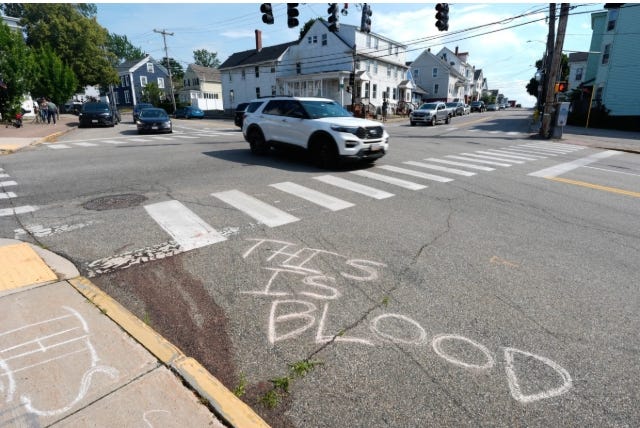
An ICE operation in Biddeford, Maine, is under investigation after a federal officer fatally shot Joan Sebastian Guerrero, a 26-year-old Colombian man, during an attempted enforcement action Monday.
According to the Department of Homeland Security, federal agents were conducting surveillance at a residence connected to an individual with a final order of removal. Officials said the shooting victim left the residence in a vehicle and attempted to flee. Homeland Security Secretary Markwayne Mullin told Maine Senator Angus King that the officer fired after perceiving the vehicle as a threat.
Immigration advocates said Guerrero was authorized to work in the United States and had been issued a Social Security number; DHS had not publicly confirmed his immigration status.
That account quickly became more complicated. Mullin also told King that Guerrero was not the individual the agents had been seeking. King later said DHS had initially provided him with incorrect information regarding whether the victim had been the target of the operation.
A witness who spoke with reporters described hearing the wounded driver say, “I tried to stop,” after the shooting. Security camera footage released publicly captures portions of the encounter, including the vehicle’s movement and the law enforcement response, though it does not conclusively establish the precise sequence of events immediately surrounding the shooting. The incident was not recorded by body-worn cameras as the ICE officers involved in the operation were reportedly not equipped with them.
AP Photo/Robert F. Bukaty
Multiple investigations are now underway, with the Maine Attorney General’s Office leading the state’s investigation into the use of deadly force, while the FBI and the Department of Homeland Security’s Office of Inspector General are conducting parallel federal reviews. The officer involved has been placed on administrative leave pending those investigations.
The Risks Begin During Enforcement
The investigations in Maine will determine whether the officer’s actions were justified under the circumstances, but regardless of that outcome, the shooting fits into a broader pattern that has emerged during the Trump administration’s expanded immigration enforcement campaign. Recent operations have resulted in fatalities involving intended enforcement subjects, individuals who were not the focus of the operation, and even U.S. citizens.
The Biddeford shooting illustrates one category of risk. According to Homeland Security Secretary Markwayne Mullin, Guerrero was not the individual the agents had been attempting to locate. Questions surrounding mistaken identity or unintended involvement have surfaced in other recent operations as well.
Other incidents have highlighted a different concern. The deaths of Minnesota residents Renée Good and Alex Pretti, both U.S. citizens, shifted public attention beyond immigration enforcement itself and toward the potential impact such operations can have on family members, bystanders, neighbors, and others who become caught up in rapidly evolving encounters. Those cases also prompted disputes over transparency after Minnesota prosecutors said key evidence remained in federal custody for months before it was ultimately transferred to state investigators.
Not every enforcement-related death involves the use of force by officers. California farmworker Jaime Alanis died after falling from the roof of a greenhouse while attempting to evade an immigration raid. His death was an example of another reality of large-scale enforcement operations. The foreseeable risks extend beyond direct physical confrontations and can include panic, flight, and other dangerous reactions. According to sources, Alanis was not the subject of that raid but was instead an unintended victim.
Viewed together, these examples demonstrate that immigration enforcement operations carry a range of foreseeable risks extending well beyond the individual named on an arrest or removal warrant.
Government Responsibility Does Not End With the Raid
Not every encounter with immigration officials results in prolonged detention or formal removal proceedings. Many people are questioned, temporarily held, or released after officers determine they are not subject to immigration enforcement. While those decisions may bring an enforcement operation to a close, they do not necessarily end the government’s responsibility to ensure a release is carried out safely.
The death of Nurul Amin Shah Alam is a useful example. Alam, a 56-year-old Rohingya refugee living legally in the United States, was transferred to U.S. Border Patrol for immigration questioning after his release from a county jail in New York. Border Patrol determined he was not subject to removal and released him later that evening at a Tim Hortons several miles from his home.
Alam was legally blind, spoke limited English, and was unfamiliar with the area where he was left. Only the restaurant’s drive-through was still open at the time. His family was not notified of his release, nor was his attorney. Five days later, he was found dead, with the medical examiner concluding that hypothermia and dehydration contributed to his death and classified the manner of death as homicide, a medical determination indicating that another person’s actions or omissions contributed to the fatal outcome rather than a finding of criminal liability.
Border Patrol claims that Alam accepted a courtesy ride and chose where he wished to be dropped off. His family, attorney, and local officials have disputed that, arguing that his visual impairment and other vulnerabilities made such a release inherently unsafe.
Cases such as this raise a crucial institutional question. Once the government assumes responsibility for an individual’s safety, when does that responsibility end?
Detention Brings the Government’s Greatest Responsibility
Immigration detention represents the point at which the federal government’s responsibility is at its highest. Unlike an enforcement operation that unfolds over minutes or a brief period of questioning, detention places virtually every aspect of a person’s daily welfare under government control. Medical care, medications, food, sanitation, housing, safety, and emergency response all become the responsibility of the agency operating the facility, whether directly or through a federal contractor.
Recent data suggest that this stage of the immigration system deserves particular scrutiny.
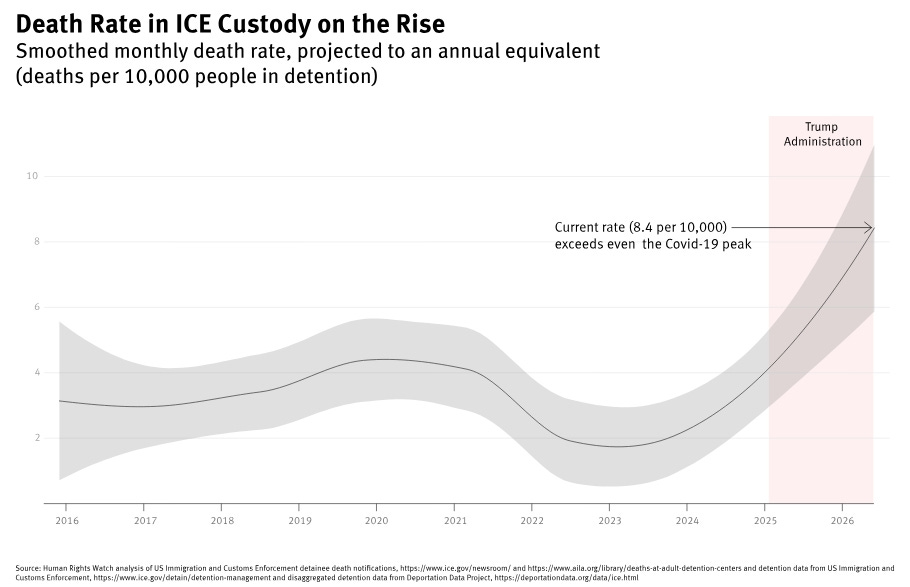
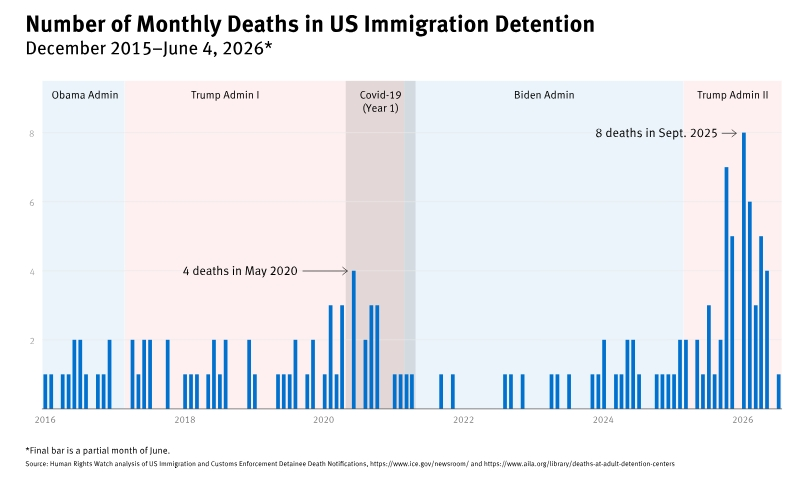
Reuters reported that at least 31 people died in ICE custody during 2025, the highest annual total in roughly two decades. An independent analysis by Human Rights Watch and Physicians for Human Rights later concluded that 52 people had died in ICE custody during the administration’s first 500 days. Although the detained population also increased substantially during that period, both Reuters and the advocacy organizations concluded that deaths rose faster than the population itself, resulting in a significantly higher mortality rate rather than simply a higher number of deaths. Therefore, this is not simply a matter of scale.
Graphic © 2026 Human Rights Watch
Those figures align with years of concerns raised by the Government Accountability Office (GAO). Over the past two decades, GAO has repeatedly identified shortcomings in detention medical care, facility inspections, contractor oversight, performance measurement, and the department’s ability to determine whether facilities consistently meet detention standards. More recently, GAO found that ICE’s own inspection programs continued to identify thousands of deficiencies across detention facilities, yet lacked adequate performance measures to determine whether those inspections were actually improving conditions.
Graphic © 2026 Human Rights Watch
This is not to imply that all deaths are preventable or that every detention center is violating human rights. Individuals enter ICE custody with a wide range of medical conditions, and some deaths will occur despite appropriate care. The question is whether the systems designed to identify preventable failures are functioning as intended.
Each death may be unique, but the patterns that emerge across dozens of deaths are what reveal whether a system is improving, remaining stagnant, or moving in the wrong direction. Based on the most current reporting, the answer is that something is very wrong.
When Does Government Responsibility End?
The government’s duty of care changes when a person is released from custody, but it does not necessarily disappear the moment they leave a detention facility. Decisions about where, when, and under what circumstances someone is released can have significant consequences, particularly when officials know an individual faces serious medical, psychological, or physical challenges.
The death of Daphy Michel is an important example. Michel, a Haitian asylum seeker who reportedly struggled with severe mental illness, was released from ICE detention near Pittsburgh in February 2026. Three days later, she was found dead at a bus shelter. The medical examiner ruled that she died from hypothermia and classified the manner of death as homicide. Her family argued that ICE released her without adequate support given her condition, while DHS maintained that she was provided her belongings, a charged cellphone, and access to transportation. The question is whether access is the same as capacity.
The competing accounts surrounding Michel’s death mirror a broader policy debate. Immigration officials cannot reasonably be expected to prevent every tragedy that occurs after someone leaves federal custody. Accidents, crimes committed by third parties, and unrelated medical emergencies fall outside the government’s control. The more difficult question arises when the manner of release itself may have contributed to a foreseeable risk.
That question has become more difficult to answer in recent months. Until this year, ICE policy required the agency to review certain deaths occurring within 30 days after an individual’s release from custody. The department ended that requirement beginning June 2nd, meaning deaths occurring shortly after release are no longer routinely tracked through the same internal review process.
The change does not prove that releases have become less safe, that any individual death could have been prevented, or that bad faith may be at work. However, it reduces the information available to policymakers examining whether release practices place medically or otherwise vulnerable individuals at unnecessary risk.
Who Watches the System?
Each stage of the immigration process carries its own responsibilities, from the execution of an enforcement operation to the decision to release someone from custody. Determining whether those responsibilities are being met falls to a network of oversight bodies operating both inside and outside the Department of Homeland Security.
The department’s Office of Inspector General investigates allegations of waste, fraud, abuse, and misconduct across DHS. The Office of the Immigration Detention Ombudsman reviews complaints and detention conditions, while internal professional responsibility offices investigate employee misconduct. Outside the executive branch, the GAO evaluates agency performance and reports its findings to Congress. State and local prosecutors may also conduct independent investigations when deaths occur within their jurisdictions.
Those institutions do not all serve the same purpose, nor do they necessarily communicate well with one another. Some investigate individual incidents. Others evaluate policies, inspect facilities, review complaints, or identify systemic weaknesses. Together, they are intended to provide multiple layers of accountability over a system that exercises extraordinary authority over people’s liberty and, at times, their lives.
The oversight system has been an under-discussed part of the public debate. Immigration-specific oversight offices within DHS have experienced significant staffing reductions in recent months, largely due to administrative actions. Disputes over congressional access to detention facilities, delays in providing evidence to outside investigators, and the incomplete deployment of body-worn cameras have each prompted questions about whether existing oversight mechanisms are keeping pace with the expansion of immigration enforcement.
These developments do not establish that the system is failing, but they do raise the question: If oversight mechanisms become less transparent, less accessible, or less capable of identifying patterns over time, do policymakers and the public have fewer tools available to determine whether problems are isolated or symptomatic of broader institutional failures?
The Article I Question
The deaths and controversies surrounding immigration enforcement ultimately raise a question that extends beyond any single administration or agency. Immigration enforcement is an executive function, yet the system within which it operates was created, funded, and continues to be shaped — or not— by Congress.
Since the creation of the Department of Homeland Security in 2002, Congress has repeatedly received warnings from its own oversight bodies. The GAO reports have identified recurring concerns involving detention medical care, facility inspections, contractor oversight, and performance measurement. Inspectors general, congressional hearings, litigation, and independent investigations have documented additional concerns. At the same time, Congress has continued to appropriate funding for an expanding immigration enforcement system while periodically debating how much oversight should accompany that expansion.
This issue isn’t an immigration policy question. It is an oversight question.
Independent inspections, transparent reporting, mortality reviews, body-worn cameras, and meaningful access for investigators are not admissions of misconduct. They are safeguards designed to identify problems before they become systemic, to distinguish isolated tragedies from institutional failures, and to preserve public confidence in agencies entrusted with extraordinary authority. When an agency is entrusted with the lives of individuals, the level of oversight required multiples.
Guerrero’s death and those that have come before will be the subject of investigative findings, but the broader question raised by these incidents will not end when those investigations conclude. The ongoing systemic weaknesses and the lack of transparency and oversight within the agencies will persist until they are meaningfully addressed.
Congress possesses the constitutional authority to determine how federal immigration enforcement is organized, funded, and overseen. They had the ability to install reasonable measures when it was created, and have retained that power as each new GAO report and incident has demonstrated ongoing concerns. The safeguards surrounding one of the federal government’s most significant exercises of coercive power have evolved alongside the authority Congress has chosen to grant it. They possess the power to reform the system they fund in our name.
That is ultimately the central issue illustrated by the events in Maine and by all previous incidents. The story is not only about a single encounter on a single day. Each incident is a tragedy. The story is about a system exercising extraordinary power over human lives that is not subject to oversight that is equally extraordinary.
If you value thoughtful, evidence-based analysis that looks beyond the headlines, consider subscribing to our publication. We examine the constitutional questions, institutional decisions, and long-term trends that shape American government—one story at a time. Your support helps us continue producing independent reporting and commentary grounded in facts, context, and principle.
Sources:
“ICE officer who fatally shot driver in Maine was ‘fearing for public safety,’ agency says,” Associated Press, July 13, 2026.
“Feds turn over evidence in Renee Good and Alex Pretti killings to Minnesota after months of delay,” Associated Press, July 13, 2026.
“California farmworker who fell from greenhouse roof during chaotic ICE raid dies,” Associated Press, July 13, 2025.
“A nearly blind refugee is found dead after Border Patrol agents dropped him off at a Buffalo doughnut shop,” Associated Press, February 27, 2026.
“Death of a refugee left at a Buffalo doughnut shop by Border Patrol is ruled a homicide,” Associated Press, April 1, 2026.
“Death rate in ICE immigrant detention centers more than doubles under Trump, Reuters analysis finds,” Reuters, June 17, 2026.
“Deaths in ICE Custody Surge Under Trump,” Human Rights Watch, June 25, 2026.
“Dying in Detention: Rising Deaths in an Expanding US Immigration Detention System,” Human Rights Watch, June 25, 2026.
“Immigration Detention: DHS Should Define Goals and Measures to Assess Facility Inspection Programs,” U.S. Government Accountability Office, May 21, 2025.
“Death of Haitian immigrant ruled a homicide. ICE denies responsibility,” Pittsburgh’s Public Source, June 12, 2026.
“ICE will no longer report deaths of detainees who have recently been released from custody,” Associated Press, June 5, 2026.
“ICE Directive 11003.6: Notification, Review, and Reporting Requirements for Detainee Deaths,” U.S. Immigration and Customs Enforcement, February 27, 2025.
“Trump moved to cut funding for ICE body cameras, pared back oversight,” Reuters, January 25, 2026.
“DHS was granted $20M for body cameras. ICE agents in fatal Houston shooting had none,” Associated Press, July 10, 2026.
It's obvious too any objective observer that the government employs thugs who are given authority as ICE officers, who are given no training, and who have no oversight and no consequences for bad or wrongful behavior. Americans are killed or at risk of being killed because our government has become irresponsible under Trump and his vassals.