


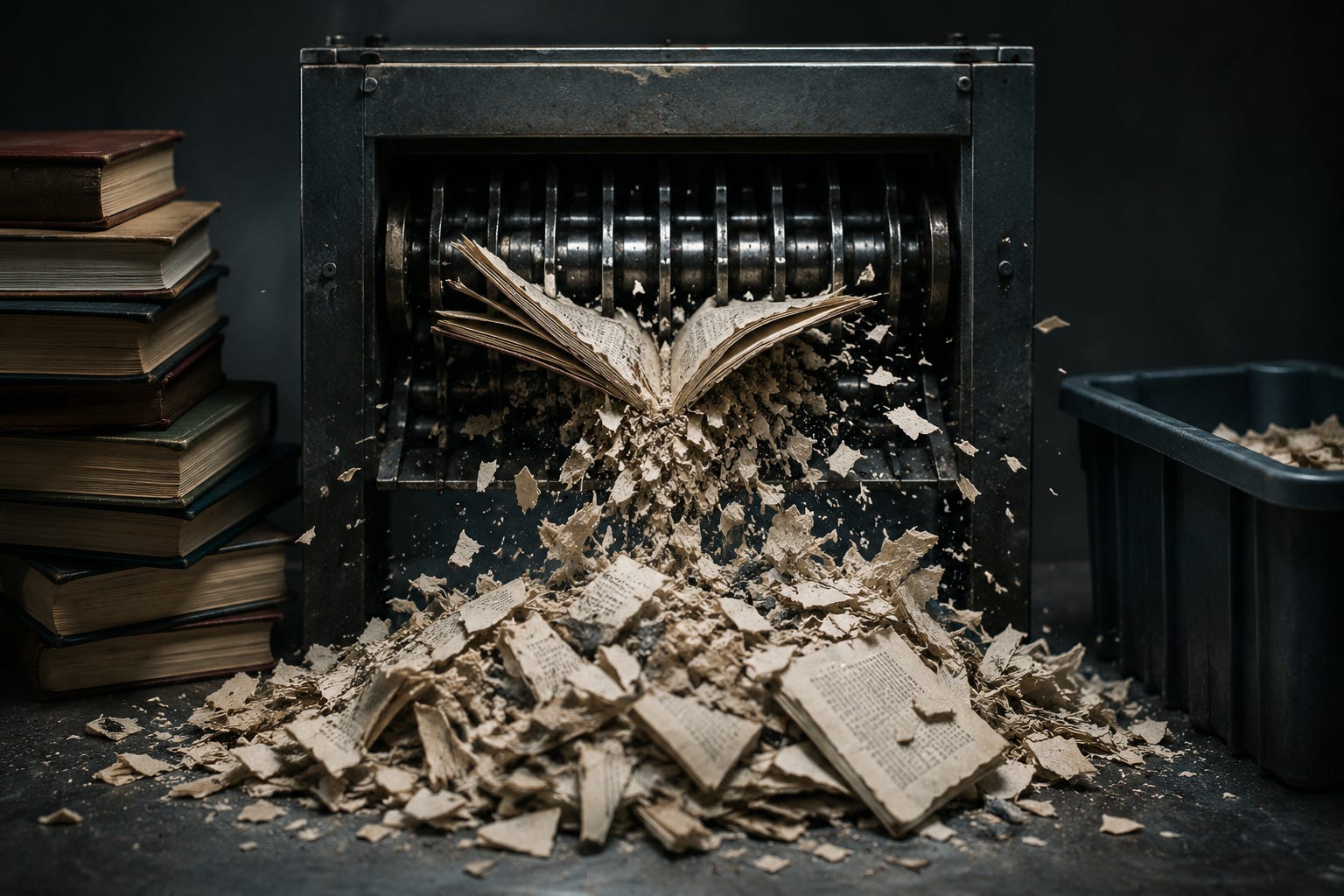
Artificial intelligence companies have come under renewed scrutiny in recently after reports revealed that millions of physical books were purchased, cut apart, scanned for AI training, and then discarded. The images are startling, but ultimately distract from the bigger issue. The Anthropic case was settled last year, but the more recent headlines come from booksellers who report mass purchases they suspect are tied to AI.
The important debate is not about paper and bindings, but instead intellectual property. Companies purchased physical copies they legally owned, then used the creative work inside those books to build commercial artificial intelligence systems. Courts are only beginning to answer whether those uses require permission, fall under fair use, or represent something copyright law was never designed to address.
Regardless of the final legal answer, artificial intelligence is forcing us to reconsider what intellectual property actually protects when creative work can be consumed at industrial scale.
This Community Is Powered by You
What started as a small circle has grown into something much bigger, and it’s all because of readers like you.
Every time you forward this email, post it on socials, or bring someone new into the fold, you’re helping build one of the most passionate, independent political communities out there.
Want to keep the momentum going?
Share this newsletter with someone who should be part of this conversation.
Thank you for being here. It means everything.
Reports From the Secondhand Book Market
The renewed attention did not begin with Anthropic, but with booksellers. Over the past several months, antiquarian and secondhand booksellers in Europe have reported an unusual pattern of bulk orders for seemingly unrelated titles. Many of the requests arrived as long lists of International Standard Book Numbers (ISBN), rather than searches by subject, author, or publisher. The books ranged from academic texts and technical manuals to out-of-print nonfiction and foreign-language works. Dealers said the purchases did not make sense for collectors or traditional resellers.
Some booksellers believe the books are ultimately being acquired for artificial intelligence training, where they will be scanned and discarded. Others are less certain, noting that there is currently no public evidence identifying the purchasers or proving that every order is connected to AI companies. Even among antiquarian booksellers, opinions differ on how widespread the practice may be.
Those reports are significant not because they prove an expanded practice exists, but because they resemble one that has already been documented in court. They provide the context for why the Anthropic litigation has returned to public attention and why questions about copyright and intellectual property remain unresolved.
The Anthropic Case
The latest debate stems largely from court records in Bartz v. Anthropic, a copyright lawsuit filed by a group of authors against Anthropic, the company behind the Claude family of artificial intelligence models.
According to evidence presented in the case, Anthropic began building a vast library of books to train its models. The company initially acquired millions of digital books from online collections that allegedly contained unauthorized copies. It later shifted to purchasing millions of physical books, removing their bindings, separating the pages, and scanning them into a searchable digital collection. Once scanned, the paper copies were discarded or destroyed.
The scanning and eventual destruction were not the legal issue before the court. It became the symbol of a much larger one. The authors argued that Anthropic had copied their works without permission in order to create a commercial product. Anthropic responded that the use was transformative and therefore protected under the doctrine of fair use.
In June 2025, U.S. District Judge William Alsup ruled that Anthropic’s use of lawfully acquired books to train its models qualified as fair use under the facts presented in that case. He also concluded that replacing a purchased physical copy with a single internal digital copy did not violate copyright when the original paper copy was destroyed.
The court, however, reached a very different conclusion regarding Anthropic’s acquisition of pirated digital books, allowing those claims to continue. That portion of the case was later settled through a multibillion-dollar settlement covering hundreds of thousands of copyrighted works.
The ruling answered some questions, but not all, and certainly not to the satisfaction of authors, publishers, and readers. Additionally, it was a federal district court decision rather than a nationwide precedent, and numerous lawsuits involving authors, artists, publishers, and news organizations remain active. The broader legal boundaries surrounding artificial intelligence training are still largely undefined.
The United States Copyright Office has also declined to declare all artificial intelligence training either lawful or unlawful. Its 2025 report concluded that some training uses may qualify as fair use, while others may not, particularly when companies use large quantities of expressive material for commercial systems that could affect existing or developing licensing markets.
Ownership Is Not Copyright
One reason the case has generated so much confusion is that it involves two different kinds of ownership.
When you purchase a book, you own that particular physical copy. You may lend it, donate it, resell it or, in most circumstances, destroy it. Those rights belong to the owner of the object itself. The ownership is related to the physical item alone.
Copyright is something different. It protects the author’s original expression rather than the paper on which it is printed. Buying a novel does not transfer ownership of the story any more than buying an album transfers ownership of the music itself. The creator retains exclusive rights over reproduction and other protected uses unless those rights are licensed, transferred, or limited by law.
Artificial intelligence training sits at the intersection of those two ideas. A language model cannot learn from a printed book without first converting that book into data. That process requires copying the work. The central legal question is therefore not whether copies were made, but whether those copies are excused because the resulting use is sufficiently transformative to qualify as fair use.
The destruction of the books has captured public attention while copyright remains the real issue. The paper copies belonged to Anthropic. The intellectual property embedded within them remained the authors’. Or did it?
A Question of Scale
Copyright law has always recognized that creativity builds upon what came before it. A novelist reads other novels. A musician studies earlier compositions. A historian consults hundreds of books before writing another one. Influence is not infringement, and copyright has never attempted to prohibit people from learning.
Artificial intelligence changes the discussion because of scale. A person might spend a lifetime reading several thousand books. A commercial artificial intelligence system can analyze millions of works in a comparatively short period, extracting patterns of language, structure, style, and information that become part of a product offered to millions of users.
That does not necessarily mean the system stores or reproduces individual books, but it does mean the commercial value of the model depends in part on the accumulated value of an extraordinary amount of human creative work.
Copyright law developed in a world where infringement generally involved copying individual works. Artificial intelligence asks a different question. Can a company lawfully extract value from millions of copyrighted works at once in order to build an entirely new commercial product? Is it copyright infringement if AI generates the “new” work heavily influenced by a copyright-protected work? What responsibility do companies have to affirmatively and actively inform publishers and purchasers that the work was generated by AI? If a large language model scans the entire canon of an entire writer, and then produces a work that mirrors the language, themes, style, and key characteristics, is that work protected by copyright under intellectual property rules?
The courts are only now beginning to answer it, and so far, the answers are not encouraging.
The Cost of Uncertainty
One reason this debate has become so contentious is that the technology has advanced far more quickly than the law. Artificial intelligence companies built increasingly sophisticated systems while courts were still deciding how existing copyright law applied. Authors, publishers, and artists responded through litigation because there was no established licensing framework for training models at that scale. The result is that fundamental questions are now being answered after the technology has already become part of everyday life.
Should creators have the right to license their work for artificial intelligence training? Should they be compensated when their intellectual property contributes to commercial systems? Should they be able to refuse altogether? If training qualifies as fair use in some circumstances but not others, where should those lines be drawn?
These are not simply legal questions. They are economic ones. They determine how value flows between creators and the companies building the next generation of artificial intelligence.
Legislation has always been largely reactive. New technologies emerge, courts interpret existing laws, and lawmakers respond, or don’t, once it is clear that firm guardrails are needed. It is, by design, slow, sometimes— especially when it comes to technology— disturbingly so. Artificial intelligence is moving so quickly that this familiar pattern has become impossible to ignore.
While those debates continue, the burden shifts elsewhere. Authors must decide whether to pursue costly litigation. Publishers are developing their own standards for disclosure and licensing. Educational institutions, museums, and libraries are beginning to draft local policies for technologies that remain legally unsettled.
None of those institutions created the problem, yet each is being asked to navigate questions that might have been addressed more consistently had the legal framework evolved alongside the technology.
Looking Beyond the Headlines
The images of books being cut apart are powerful because they reduce a complicated legal dispute to something everyone immediately understands. Watching books destroyed feels wrong.
The greater challenge, however, is not what happened to the paper, but what happens when intellectual property becomes raw material for technologies capable of creating enormous value before society has reached an understanding of the rules governing its use.
Every major technological shift has forced the law to revisit old assumptions about ownership, creativity, and innovation. Artificial intelligence is simply the latest chapter in that history, but its pace is making the divide particularly striking.
Whether the courts ultimately conclude that large-scale AI training falls within fair use, requires licensing, or demands an entirely new legal framework, the conversation has already moved beyond one company’s scanning project. It now asks a much broader question about the future of creative ownership in an age when human expression can be analyzed, learned from, and transformed on a scale never before possible.
The questions raised by artificial intelligence are not going away, and neither are the conversations surrounding history, public policy, and the institutions that preserve our shared knowledge. If you value reporting that explores those issues with context rather than sound bites, consider subscribing to The Coffman Chronicle.
Independent journalism makes these conversations possible. Thank you for reading.
Sources:
“Anthropic Wins Key US Ruling on AI Training in Authors’ Copyright Lawsuit,” Reuters, June 24, 2025.
“Anthropic Destroyed Millions of Print Books to Build Its AI Models,” Ars Technica, June 26, 2025.
“Anthropic Agrees to Pay $1.5 Billion to Settle Author Class Action,” Reuters, September 5, 2025.
“Inside an AI Start-Up’s Plan to Scan and Dispose of Millions of Books,” The Washington Post, January 27, 2026.
“US Judge Approves Anthropic’s $1.5 Billion Settlement of Copyright Lawsuit,” Reuters, July 20, 2026.
“Rare Book Dealers Fear Tech Firms Are Destroying Obscure Editions to Train AI Models,” NL Times, June 25, 2026.
“AI Companies Are Reportedly Shredding Millions of Books After Using Them to Train AI Models,” Tom’s Hardware, July 28, 2026.
“AI Companies Are Anonymously Buying and Destroying Millions of Books Through Middleman Services to Avoid Headlines About AI Companies Buying and Destroying Millions of Books,” PC Gamer, July 28, 2026.
“Claude, ChatGPT: AI Labs Buy, Scan, Shred Millions of Rare Books,” news.com.au, July 27, 2026.
AI. Is a disruptive technology. IMO it was implemented without any foresight.
Actions have real world consequences.
We are being forced into so many uncharted territories without being able to give opinions about how these things affect our lives. There are no safety rules or considerations.
These billionaires are only it for themselves, there are not really interested in doing good for the good of humanity. Most of them outright disdain most of humanity but their own selves.
All of their AI efforts that are coming from self-centered unregulated motivations have a very evilish feel to it.
Elon musk aided by trump is a good example of the evil, in how his polital and personal ambition to self deal and protect himself from legal liability and use the camaflouge of cutting "waste and fraud" at the expense of and without even a thought or recognization of how it could and has hurt millions of starving or sick children across the world and even cause many deaths as well.
It is really entirely disgusting and evil.
Supervillain billionaires are really getting a bad and horrific name and they truly deserve it.