


For nearly two and a half centuries, the American system of government has relied on an unspoken understanding: that the people entrusted with power would wield it responsibly. The Constitution provided a framework of checks and balances, but its true strength lay not in its parchment barriers alone. It rested on the willingness of ambitious men and women to restrain themselves, to honor the dignity of their office, to respect the process, and to leave certain lines uncrossed for the sake of the republic.
But what happens when that understanding collapses?
This month, the Senate and the Department of Justice find themselves in a familiar but newly fraught conflict: how to staff the ranks of federal prosecutors, the U.S. Attorneys who carry out the law in America’s 93 judicial districts. This isn’t the first time the Senate has resisted an administration’s nominees, nor the first time the executive has tested the limits of its power to install loyalists. Yet the stakes feel different now.
What we’re watching isn’t just a dispute over personnel. It’s a test of the entire system, to see whether the rules still matter when players no longer feel bound by them, and of whether a minority party can still utilize the tools it has left to hold the line against overreach.
Stay Informed. Stay Loud.
Subscribe to The Coffman Chronicle for no-BS political analysis, action guides, and weekly truth bombs you won’t get from corporate media.
The Habba Case
Alina Habba’s brief and turbulent tenure as acting U.S. Attorney for the District of New Jersey illustrates just how far the system’s unwritten rules have eroded, and how the Senate’s remaining tools are being tested to their limits.
Appointment
On March 24, 2025, Attorney General Pam Bondi appointed Habba as interim U.S. Attorney, invoking the Attorney General’s authority to fill vacancies for up to 120 days. Habba, a former Trump defense lawyer with no prior prosecutorial experience, immediately drew criticism for politicizing the office. In the months that followed, she launched high-profile investigations against New Jersey Democrats, including Newark’s mayor and a sitting member of Congress, moves widely seen as politically motivated. She also announced an “Election Integrity Task Force,” a partisan initiative in a role that had long been understood as nonpartisan in practice.
Nomination & Panel Decision
On July 1, 2025, President Trump formally nominated Habba to serve as U.S. Attorney on a permanent basis, sending her name to the Senate for confirmation. But her interim term expired on July 21, 2025, as prescribed by law. With no Senate-confirmed successor in place, a panel of federal judges exercised their statutory authority under 28 U.S.C. § 546 to appoint her deputy, Desiree Leigh Grace, as acting U.S. Attorney. Grace, a career prosecutor and the office’s First Assistant, was widely regarded as a competent, neutral caretaker who could maintain the office's stability until the Senate acted.
Deputy Attorney General, Todd Blance, also a former Trump lawyer, posted on social media shortly after the news broke. “Their rush reveals what this was always about: a left-wing agenda, not the rule of law. When judges act like activists, they undermine confidence in our justice.”
Retaliation
Within hours — on July 22, 2025 — Bondi fired Grace, calling the judges “politically minded” and accusing them of undermining the president’s authority. “This Department of Justice does not tolerate rogue judges,” Bondi later said on social media. The Department of Justice argued, dubiously, that Habba’s nomination entitled her to remain in the role until the Senate acted, despite the statute’s clear language and decades of precedent.
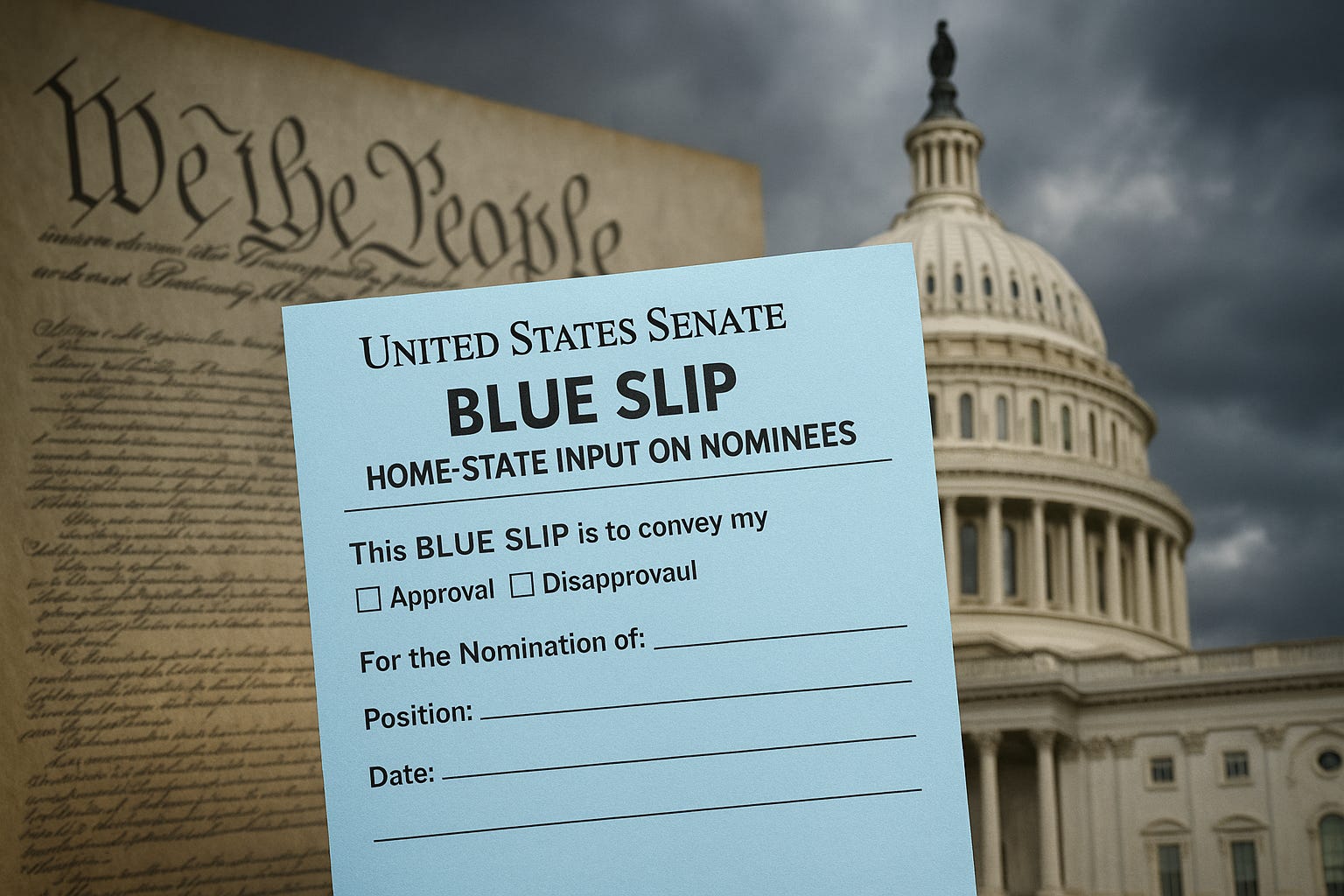
As of this writing, more than three weeks after her formal nomination, Habba remains unconfirmed. New Jersey’s Democratic senators, Cory Booker and Andy Kim, have refused to support her, invoking the Senate’s tradition of “blue slips” to block home-state nominees they find unacceptable. Without their support, the nomination has gone nowhere, and the administration has instead chosen to defy the process outright, rather than name a more qualified and confirmable candidate.
What could have been an ordinary political fight over a nominee has instead become something larger: a test of whether the Department of Justice can be bent entirely to partisan ends, and whether the courts and the Senate still have the will to resist.
Not Just Habba: A Pattern
Alina Habba’s stalled nomination is part of a broader pattern in which the Senate is exercising its power to block unqualified, partisan loyalists nominated by the Trump–Bondi Justice Department. What is happening in New Jersey is not unique; it’s one skirmish in a larger struggle over whether loyalty or merit will govern appointments to the nation’s most critical legal offices.
Ed Martin: The Partisan in D.C.
In Washington, D.C., Trump nominated Ed Martin, a former Missouri Republican operative and frequent guest on Russian state media, to lead the U.S. Attorney’s Office. Martin had no federal prosecutorial experience and was an outspoken election denier. His nomination provoked bipartisan skepticism, with even some Republicans questioning his suitability for a role that demands independence and discretion. Amid mounting opposition, his nomination was quietly withdrawn.
Senator Dick Durbin expressed his thoughts about the withdrawal in a statement soon after. “Mr. Martin’s record made it clear that he does not have the temperament or judgment to be entrusted with the power and responsibility of being U.S. Attorney for the District of Columbia. I’m relieved to see that his nomination will be withdrawn by the White House.”
Daniel Rosen: The Novice in Minnesota
In Minnesota, Daniel Rosen’s nomination remains stalled. Rosen is a civil litigation attorney with no experience in criminal prosecution, and critics have highlighted his lack of basic qualifications to oversee the state’s most serious federal cases. His nomination has lingered in committee, another casualty of concerns over qualifications. David Schultz, a professor of political science and law at Hamline University in St. Paul, summed up the concerns with his statement, “Generally, you’re looking for people with more of a prosecutorial background. I can’t think of any situation where you would need an eminent domain expert in that office.”
Jason Reding Quiñones: The Patronage Pick in Florida
In the Southern District of Florida, Jason Reding Quiñones’s nomination has been held up by Senate Democrats, who invoked the blue-slip tradition. Their objections center on his political ties and a sense that he was selected for patronage rather than for prosecutorial skill. His nomination remains blocked in committee.
Emil Bove: The Judge Without Integrity?
Perhaps the most dramatic fight has been over Emil Bove, nominated to the U.S. Court of Appeals for the Third Circuit. Bove’s record has sparked extraordinary opposition: more than 900 former DOJ attorneys and 76 former federal and state judges signed letters urging the Senate to reject him, warning that his confirmation would disgrace the bench and undermine confidence in the rule of law.
Whistleblower allegations that Bove encouraged staff to defy court orders and targeted political opponents while at DOJ have only deepened concerns. On July 17, 2025, Senate Republicans advanced his nomination out of committee, despite a Democratic walkout, and were determined to force the nomination forward despite warnings from colleagues, former prosecutors, and judges alike. With a narrow procedural vote on July 22 clearing the way for debate, Bove’s nomination now awaits a final up‑or‑down vote on the Senate floor.
See our previous reporting regarding Emil Bove and other judicial nominees here:

Taken together, these fights reveal a pattern: an administration that prizes loyalty over competence and a Senate minority, finally, willing to use its procedural tools to resist. Habba’s story is not the exception. It is emblematic of how far the struggle over justice has moved from quiet professionalism to open partisan warfare.
Historical Context
If today’s Senate Democrats appear newly assertive in blocking unqualified or partisan nominees, it is worth remembering where they learned the playbook.
During Barack Obama’s second term, after Republicans won the Senate in the 2014 midterms, they used every procedural tool at their disposal to block his nominees — judicial, executive, and prosecutorial alike. They withheld blue slips, refused to schedule hearings, and even declined to hold votes on nominees who did get hearings. Dozens of Obama’s lower-court nominees languished indefinitely.
Most famously, in 2016, Senate Majority Leader Mitch McConnell refused to even consider Obama’s Supreme Court nominee, Merrick Garland, leaving the seat vacant for nearly a year so it could be filled by a Republican president. At the time, McConnell called this not obstruction but constitutional duty, boasting that he was “the grim reaper” for Democratic priorities.
In the years since, Republicans have normalized the use of these hardball tactics, treating them as the rightful spoils of political power rather than a breach of decorum. Today, when Democrats use the same tools to resist nominees like Habba or Bove, Republicans cry foul, but the precedent is their own.
It turns out that the Constitution’s checks and balances still work, but they work only if both sides are willing to play the same game by the same rules. What we’re seeing now is not a breakdown of norms so much as Democrats finally deciding to stop unilaterally disarming.
See our reporting from this spring about Congress undermining and attacking judical independence here:
Note: This article is more than 45 days old and now lives in the archive. Consider becoming a paid subscriber for full acess to all 800+ of our articles plus exclusive perks.

The Problem With the System
What the Habba saga and the broader pattern of Trump’s nominations reveal is not just partisan hypocrisy but a deeper weakness in the system itself.
For more than two centuries, the American constitutional order has endured not solely because of its laws, but also because of the willingness of those in power to adhere to unwritten norms. Presidents refrained from openly politicizing prosecutors and inspectors general not because they couldn’t, but because the public, the press, and their own sense of duty restrained them. The system worked because those in office chose to honor its spirit as well as its letter.
But over time, Congress has steadily ceded its authority to the executive, deferring to presidential power in areas from war-making to surveillance to law enforcement. That imbalance has been compounded by the rise of rigid two-party polarization, which has made lawmakers more loyal to their party’s president than to the institutional integrity of Congress or the rule of law.
We’ve reported extensively on the worrying trend of Congress ceding power. See some of that here:

And so, the system, as currently constructed, offers little more than soft expectations, such as respect for the process, the dignity of office, and a fear of public shame. When those expectations are abandoned, when the president and his party see no value in restraint and no downside in abuse, there are precious few hard barriers left to stop them.
This is not simply about Trump, Bondi, or even Habba. It is about whether the mechanisms of accountability we inherited, designed for a time when shame and honor constrained ambition, can still hold in an era when they no longer do.
Conclusion
For nearly 250 years, the American system has endured because those entrusted with power — however imperfectly — have chosen to exercise it with some restraint. The Constitution has endured through crises not because it is self-enforcing, but because generations of leaders and citizens believed it was worth respecting.
But respect cannot be assumed. What the Habba nomination and the larger fight over Trump’s picks reveal is how fragile the system becomes when those in power no longer care about its norms, and when their allies in Congress refuse to hold them to account. The Constitution offers checks and balances, but it cannot defend itself when no one is willing to defend it.
The good news is that the tools are still there. The Senate still has the power to block unfit nominees. The courts still have the authority to enforce the law. The people still have the ability to demand better. But those tools only matter if someone is willing to pick them up and use them, even if doing so means playing by the same hardball rules the other side wrote.
If politics is a game, then fairness means everyone plays by the same rules. Democrats are correct to stop unilaterally disarming, have the right to use the blue slips and procedural holds, and should subject Republicans to the same public scrutiny that the GOP has used for years. What remains to be seen is whether we — voters, lawmakers, and citizens alike — still care enough to make the game worth playing at all.
The system has carried us this far. Whether it can carry us farther is not just up to its design, but to us.
What You Can Do
The system only works if we demand it does. Here are steps you can take right now to defend the integrity of our justice system, and to make sure the Senate does its job:
Contact Your Senators
Call the U.S. Capitol switchboard at (202) 224‑3121, ask to speak to your senators, and tell them:
“Do not confirm unqualified, partisan nominees. Use every tool — blue slips, holds, votes — to defend the integrity of our courts and the DOJ.”
Your voice reminds them that voters are watching.
Support Watchdogs & Advocates
Donate to and amplify the work of independent watchdogs and grassroots organizations that fight for accountability and fair courts, such as:
Protect Democracy
Brennan Center for Justice
American Constitution Society
Democracy Forward
They monitor nominations, investigate misconduct, and lobby for reforms.
Push for Reforms
Support and advocate for concrete changes to make the system stronger:
✅ Fixed, staggered terms for U.S. Attorneys to reduce political purges.
✅ Merit-based, bipartisan selection panels to vet nominees.
✅ Stronger protections for whistleblowers who expose abuses.
✅ Laws clarifying that court‑appointed U.S. Attorneys cannot be removed without cause.
✅ Transparency requirements for nominees’ qualifications and conflicts of interest.
Inform your representatives that you expect these reforms to be included in any future DOJ or judicial legislation.
Share & Stay Informed
Knowledge spreads power. Share this article, talk to your networks, and keep the pressure on your elected officials to respect the Constitution — and their own dignity.
If politics is a game, it’s time to play it like it matters.
Stay Informed. Stay Loud.
Subscribe to The Coffman Chronicle for no-BS political analysis, action guides, and weekly truth bombs you won’t get from corporate media.
Bibliography:
Politico. “Judges oust Trump ally Alina Habba as New Jersey’s top prosecutor.” July 22, 2025.
Associated Press. “Trump administration fights to keep ex‑Trump lawyer Alina Habba as New Jersey federal prosecutor.” July 22, 2025.
The Daily Beast. “Trump Lawyer Gets Replaced as U.S. Attorney by Her Assistant.” July 22, 2025.
Axios. “DOJ fires newly appointed N.J. prosecutor who replaced Trump ally Habba.” July 22, 2025.
Axios. “Dozens of judges call Emil Bove unfit for bench in letter to Senate.” July 15, 2025.
Daily Beast. “Democrats Storm Out of Vote on Trump's Judicial Nominee Emil Bove.” July 17, 2025.
Guardian. “Emil Bove judge confirmation moves step closer despite Democratic walkout.” July 17, 2025.
Minnesota Reformer. “Trump’s U.S. attorney pick for Minnesota has never been a prosecutor.” May 13, 2025.
Reuters. “Hundreds of DOJ alumni warn Senate against Trump’s appellate judge nominee Emil Bove.” July 16, 2025.
Reuters. “Democrats release texts, emails to support claims Trump nominee urged defiance of courts.” July 10, 2025.
St. Louis Public Radio. “Trump pulls plug on former Missourian Ed Martin’s nomination as D.C.’s U.S. attorney.” May 8, 2025.
Time. “Opinion: The Democrats’ Logic Is Upside-Down on Judicial Confirmations.” September 2017.
Washington Post. “Senate considering nomination of ex-Trump defense lawyer Emil Bove for lifetime appointment to appeals court.” July 17, 2025.
Washington Post. “GOP senators voice doubts over Trump D.C. U.S. attorney nominee Martin.” May 1, 2025.
Washington Post. “Some of Trump’s loyalty-first picks for prosecutors draw opposition from senators who can block them.” April 16, 2025.
Brennan Center for Justice. “Blues for the Judiciary.” July 2012.
Brookings Institution. “Blue Slips and Judicial Nominations in the Senate.” June 16, 2015.

The Justices are wrong. The senators are right.