


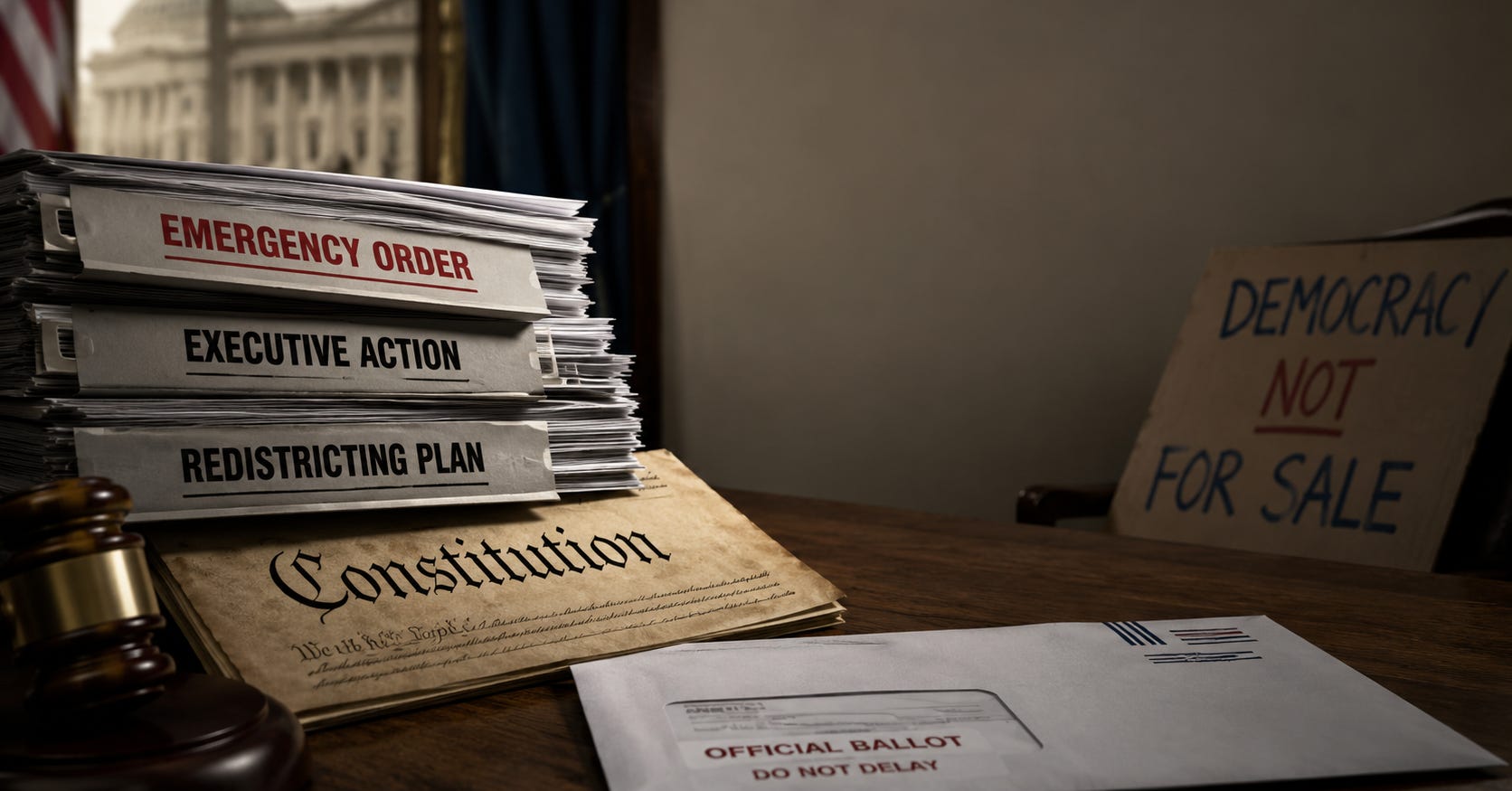
Maybe the political system is running the way it was designed, not because the system is healthy or because the damage is acceptable, and not because anyone should look at this moment and say the guardrails are holding on their own. That would be too easy and wrong.
The better way to understand it is that the American system was never designed to be quiet when power overreaches. It was designed to resist. Congress, the courts, the states, voters, and the public were not supposed to sit silently while authority gathered in one place. They were supposed to push back when power pushed too far.
That does not make the system perfect. It never was. It was born with exclusions, contradictions, and compromises that have haunted the country from the beginning. However, within that flawed structure lies a basic recognition: power will test every boundary it is allowed to.
So when the country looks chaotic, the question is not always whether the system has failed. Sometimes, the more important question is whether the restraints built into the system are finally being forced into motion. Lawsuits, protests, court battles, voting-rights fights, local resistance, public backlash, and independent reporting are not signs of calm democracy. They are signs of a constitutional stress test happening in real time.
However, the system does not repair itself by magic. The Constitution does not defend itself. It gives the people tools. Democracy survives only when those tools are used.
This Community Is Powered by You
What started as a small circle has grown into something much bigger, and it’s all because of readers like you.
Every time you forward this email, post it on socials, or bring someone new into the fold, you’re helping build one of the most passionate, independent political communities out there.
Want to keep the momentum going?
Share this newsletter with someone who should be part of this conversation.
Thank you for being here. It means everything.
The Founders Built Friction Because They Expected Power to Overreach
The American system was not built on the assumption that power would behave itself. It was built on the opposite assumption. The constitutional structure recognizes that power accumulates, seeks shortcuts, protects itself, and turns temporary authority into permanent advantage if no one stops it.
That is why authority was divided instead of placed in one set of hands. Congress writes the laws. The president executes them. Courts resolve legal disputes and check unlawful action. States retain powers of their own. Elections give voters a way to remove leaders who abuse office. Those pieces were not meant to operate in perfect harmony. They were meant to collide when one part of the system tried to dominate the rest.
That collision is not a design flaw. It is the design.
The framers did not create a perfect democracy. The original system tolerated slavery, excluded women, restricted the franchise, and built compromises that still shape American power today. Any honest defense of constitutional government has to admit that from the beginning. Yet the central insight still matters. Unchecked power is dangerous, and a republic cannot survive if authority flows only in one direction.
That is why constitutional friction is essential. Oversight is not obstruction. Accountability is not persecution. Court review is not an attack on democracy. Public protest is not automatically chaos. A state challenging federal overreach is not necessarily defying the system. In many cases, these are the mechanisms that make constitutional government real.
The danger begins when powerful people convince the public that resistance itself is the problem. They call oversight harassment and accountability revenge. They call courts illegitimate when courts rule against them. They call protest disorder when it challenges their authority, and elections unfair when voters reject them.
The goal is not simply to win a political fight. The goal is to train the country to see constitutional resistance as instability.
However, resistance to unchecked power is not instability. It is the warning system.
The Crisis Begins When Power Tests the Guardrails
A constitutional stress test does not begin when people resist power. It begins when power decides the limits no longer apply.
That is the pattern underneath so much of the current political instability. The fight is not only over policy. It is over whether Congress matters when the executive branch wants to move alone. It is over whether courts matter when their rulings become inconvenient. It is over whether voters matter when maps can be drawn, districts can be manipulated, and election rules can be shaped to protect those already in office.
The danger is not simply that one leader overreaches. The danger is that overreach becomes the governing model.
That is how constitutional systems weaken—not all at once, and not always through a single dramatic break with the past. More often, it happens through repeated pressure against the same weak spots. Emergency powers become routine. Executive orders become substitutes for legislation. Oversight is treated as disloyalty, and public records become harder to obtain. Independent agencies are brought under tighter political control. Courts are attacked when they interfere. Election systems are redesigned to make voters less threatening to power.
Each move can be explained away as temporary, technical, or necessary. Together, they form a larger pattern: authority trying to make itself harder to challenge.
That is the real crisis, not the existence of friction, but the attempt to remove it.
A court case is no longer just a court case. It becomes a fight over whether the law can still restrain the powerful. A redistricting battle is no longer just a map dispute. It becomes a war over whether voters choose their representatives or representatives choose their voters. A congressional investigation is no longer just oversight. It becomes a struggle over whether the first branch of government still has the courage to act like it.
When powerful actors bypass constitutional restraints, they are not streamlining democracy. They are hollowing it out. When the public pushes back, that pushback should not be mistaken for the source of the chaos.
The chaos comes from power testing the guardrails. The repair begins when the guardrails push back.
Correction Does Not Look Clean While It Is Happening
When a political system tries to correct itself in real time, it does not look calm. It is messy, loud, uneven, and often frightening. It looks like lawsuits filed at the last minute, judges issuing emergency orders, state officials challenging federal action, voters arguing over maps and ballots, citizens marching in the streets, and politicians insisting nothing is wrong.
That mess can be disorienting. It can make people feel as though the whole structure is coming apart. In some ways, parts of it are. Old assumptions are breaking, old loyalties are shifting, and old arrangements are being exposed as weaker than they looked.
But not every sign of conflict is a sign of collapse. Sometimes conflict is what happens when the public finally stops allowing power to move without resistance.
A constitutional repair does not look like a machine quietly fixing itself in the background. Sometimes, it looks like people forcing jammed gears to move again.
Authoritarians and their allies often depend on exhaustion. They want the public to look at the noise and conclude that resistance is the problem. They want people to confuse accountability with instability. They want voters to believe the country would be more peaceful if everyone stopped objecting, suing, protesting, asking questions, and demanding that power explain itself.
However, silence is not stability. Silence is often what power wants right before it finishes closing the door.
Correction is not rescue. Rescue implies someone else is coming to fix it. Correction means the public is forcing the system to respond. It is slower, harder, and less satisfying than the fantasy of one hero, one ruling, one election, or one institution setting everything right.
But constitutional government was never meant to depend on a single savior. It was supposed to depend on competing sources of authority, public accountability, and citizens who understood that democracy is not something they watch from the sidelines.
The danger is real. The damage is real. The stress test is real. Importantly, the resistance is real, too.
The People Being Divided Are Starting to Compare Notes
One of the oldest tricks in American politics is convincing people who are being hurt by the same system that they are enemies of each other.
Poor rural white communities are told their problems come from cities. Poor urban minority communities are told that rural voters are the whole problem. Workers are told immigrants are the threat. Small towns are told civil rights are a threat to their way of life. Cities are told rural America is unreachable. Everyone is handed a different scapegoat, and almost no one is encouraged to ask who benefits.
That is not accidental. Division is a governing strategy.
When people are divided along racial, geographic, cultural, religious, and party lines, they are easier to manage and to distract. They are easier to convince that the real fight is horizontal, against their neighbors, rather than vertical, against the systems that extract from them.
A family in a rural county losing its hospital and a family in an urban neighborhood losing access to care may be living in different political worlds, but the consequences can look painfully similar. Fewer services. Longer drives. Lower wages. Weaker schools. Predatory debt. Fewer political choices. More politicians who show up during campaign season and disappear when governing begins.
That is why this moment must be understood as more than a partisan argument.
If the public is going to force the system back toward accountability, people have to see how they have been separated from others facing the same machinery. That does not mean the country magically becomes unified nor that deep disagreements disappear. Some disagreements are real. Some are moral. Some are constitutional. Some are not easily resolved.
But there is a difference between disagreement and manipulation. There is a difference between people arguing honestly over values and powerful interests using those arguments to hide the economic and political extraction happening beneath the surface.
A politics built on division needs people to believe their neighbor is the threat. A politics built on accountability asks a harder question: why do so many different communities keep ending up with the same broken promises?
Did their hospital stay open? Did their wages rise? Did their schools improve? Did their town get investment? Did their rights become more secure? Did their representative become more responsive? Did the people who promised to fight for them actually deliver, or did they simply give them someone else to blame?
Once people start comparing notes, the divide-and-rule strategy gets weaker.
The correction begins when people stop accepting the divisions as natural. The question is no longer only, “Which side are you on?” The question becomes, “Who has been using your side to keep you from seeing the whole system?”
Institutions Will Not Save Themselves
This is where the comforting version of the argument has to end.
It is tempting to say the system is correcting itself and leave the story there. It is comforting to look at lawsuits, protests, court rulings, organizing, public backlash, and state-level resistance and conclude that the machinery is working on its own.
However, that is not how constitutional government works. The machinery only moves because people move it. Institutions respond only when pressure reaches them. The system only bends back toward accountability when enough people force the issue.
Courts do not act unless cases are brought. Congress does not reclaim power unless voters demand representation instead of performance. State officials do not resist federal overreach unless there is a political cost for surrendering. The press does not expose corruption unless reporters, editors, independent outlets, creators, and citizens keep digging. Even elections do not function as a form of accountability if voters are discouraged, misled, divided, suppressed, or convinced that nothing they do matters.
That is why the phrase “the system is working” can be dangerous if it becomes an excuse for passivity.
The system is not a parent coming to rescue the country. It is a set of tools. Those tools can be sharpened or neglected. They can be used or abandoned. They can be protected or captured.
This is the part authoritarians understand better than many ordinary citizens. They know institutions are not magic. They know courts can be packed, agencies can be hollowed out, oversight can be ignored, legislatures can be intimidated, local offices can be captured, and public trust can be poisoned. They know that if enough people stop believing the system can work, they can make that disbelief come true.
That is why cynicism becomes useful to power. When people decide that every institution is already lost, they withdraw. When they withdraw, the institutions become easier to take. When institutions become easier to take, the people who wanted them weakened point to the damage as proof that democracy was never worth defending in the first place.
The answer requires the opposite impulse.
It requires people to use flawed institutions without pretending those institutions are pure. It requires voters to participate even when the choices are imperfect. It requires communities to organize locally even when national politics feels overwhelming. It requires courts to be challenged, Congress to be pressured, records to be requested, public meetings to be attended, state offices to be watched, and officials to be reminded that constitutional power does not belong to them personally.
The Constitution is not self-executing. It provides the framework. The public has to provide the force.
Democracy survives when people stop waiting for the system to save them and start acting like they are part of the system.
Independent Media Is Part of the Democratic Feedback Loop
A system cannot respond to what the public cannot see.
That is why independent media matters in a moment like this. That is not because independent outlets are perfect or because every creator, writer, streamer, or small publication automatically gets the story right. Rather, it is because a democracy under stress needs more than official statements, campaign spin, and legacy news segments that treat every constitutional fight like another episode of partisan theater.
It needs people willing to connect the dots.
One of the biggest failures in modern political coverage is the habit of treating each abuse of power as a separate event. A court fight is covered as a court fight. A voting-rights dispute is covered as a map dispute. An executive order is covered as a policy story. A protest is covered as a crowd-size question. A congressional failure is covered as another round of dysfunction. Each story gets its own little box, its own news cycle, and then the country is rushed along to the next outrage before anyone asks what pattern is forming.
That approach benefits power. Power does not need every story buried. Sometimes it only needs every story to be isolated.
Independent media can interrupt that process. At its best, it does not just report that something happened. It asks what the event reveals about power. It asks whether the same pattern is appearing in courts, agencies, elections, statehouses, media ownership, corporate influence, and executive authority. It asks whether the fight is really about one policy dispute or about who gets to make decisions without being challenged.
Democracy depends on public understanding. People cannot organize against a pattern they have not been shown. They cannot defend constitutional limits if every attack on those limits is presented as a normal political disagreement. They cannot see the stress test if the coverage keeps pretending the alarms are background noise.
Independent journalism, podcasts, newsletters, livestreams, local reporters, legal analysts, community organizers, and citizen watchdogs can keep stories alive after the national press moves on. They can notice when a local issue is part of a national strategy. They can preserve context and bring receipts. They can explain why a dry procedural change can become a kitchen-table consequence. They can give people language for what they are already feeling.
A public that can name the problem is harder to manipulate.
Independent media does not replace institutions. It helps activate them. It can drive attention toward lawsuits, hearings, public records, local elections, state legislation, organizing campaigns, and constitutional conflicts that would otherwise be buried under spectacle.
The correction requires visibility. Visibility creates pressure. Pressure forces response. A constitutional system cannot repair what remains hidden.
The Real Question Is Whether the Public Can Force the Correction in Time
The system has correction mechanisms. That part is not really in doubt.
There are courts, elections, state governments, local offices, congressional committees, public records laws, journalists, watchdogs, organizers, lawyers, voters, protest movements, and communities capable of resisting when power goes too far.
The harder question is whether those mechanisms can be activated quickly enough, broadly enough, and forcefully enough to matter before unchecked power disables them.
That is the danger of this moment. Authoritarian politics does not always destroy democracy in one dramatic act. Often, it works by exhausting the people who would defend democracy. It floods the zone with conflict. It creates so many scandals, court fights, threats, investigations, firings, rule changes, and abuses that the public loses the ability to distinguish between ordinary politics and democratic erosion. Everything starts to feel like noise. Everything starts to feel normal because everything is always on fire.
That exhaustion is not accidental. It is part of the strategy.
When people are overwhelmed, they withdraw. When they withdraw, power faces less resistance. When power faces less resistance, it pushes farther. The line moves. The public adjusts. The machinery bends a little more.
That is why real-time correction requires more than outrage. Outrage can start the process, but it cannot sustain it on its own. Sustained pressure requires organization, attention, repetition, and discipline. It requires people to vote in local elections, attend public meetings, support independent journalism, challenge unlawful policies, protect vulnerable communities, organize neighbors, and refuse to let major abuses disappear after one news cycle.
None of that feels dramatic enough for the scale of the crisis, yet that is how democratic systems are actually defended.
The people trying to concentrate power depend on the public believing that only national politics matters. That keeps everyone focused on the presidency, the Supreme Court, and Congress while local offices, state legislatures, election boards, school boards, zoning boards, and county commissions become easier to capture.
Constitutional repair does not only happen at the top. It happens wherever power touches people’s lives.
The question is not whether the system has tools. It does. The question is whether enough people still believe those tools are worth using.
Cynicism can become a quiet form of surrender. When people say voting does not matter, organizing does not matter, journalism does not matter, courts do not matter, protest does not matter, and local politics does not matter, they may think they are being realistic. However, that kind of realism clears the field for concentrated power.
The repair only works if people refuse to clear the field.
That does not require pretending the system is fair. It does not require pretending the courts are pure, Congress is brave, the media is healthy, elections are untouched, or institutions are immune from corruption. It requires something more difficult: using flawed tools because the alternative is letting the people who want unchecked power become the only ones willing to use them.
This is what a constitutional stress test demands— not blind faith, not despair, but pressure.
The System Is Not Fine. It Is Fighting for Air.
The system is not fine.
Saying the political system may be trying to correct itself is not the same as saying the system is healthy. It is not the same as saying the damage is temporary, acceptable, or guaranteed to be repaired.
A stress test is not proof of strength. It is a test of whether strength remains.
And right now, the test is severe. Power is pushing against the limits. Public trust is strained. Institutions are weaker than they should be. Courts are carrying questions Congress should have answered. State governments are becoming battlegrounds for rights that should already be secure. Voters are being asked to defend a system that too often feels distant, captured, or deliberately confusing. Communities are being divided while the people benefiting from that division call the anger politics.
However, the presence of resistance still matters.
The lawsuits matter. The protests matter. The local elections matter. The independent media matters. The public meetings matter. The state fights matter. The people comparing notes across old divisions matter. Every act of pressure matters because democracy does not survive through theory. It survives through use.
That is the point of this moment. The system was designed with friction because power was expected to overreach, but friction only works if people are willing to create it. Checks and balances are not museum pieces. Rights are not decorations. Oversight is not optional. Representation is not supposed to be a ritual where the public votes and then disappears until the next campaign.
The country is not watching a clean repair. It is watching a fight over whether repair is still possible.
That fight will not be won by pretending the system is stronger than it is. It will not be won by waiting for one court, one election, one official, one party, or one institution to save the country on its own. It will be won, if it is won, by people understanding that democracy is not something outside them.
They are not merely observers of the constitutional system. They are part of its enforcement mechanism. That is what a constitutional stress test looks like— not a guarantee that democracy survives, but a demand that the people decide whether it does.
Support Independent Media
If this piece helped you see the pattern more clearly, consider becoming a paid subscriber to Coffman Chronicle.
Our job is to connect the dots, follow the pressure points, and explain how decisions made in courtrooms, statehouses, agencies, and back rooms show up in ordinary people’s lives.
We do not have billionaire owners, corporate sponsors, or party bosses telling us what to cover. We have readers.
If you can afford it, becoming a paid subscriber helps keep this work going. It supports the reporting, analysis, and independent voice needed in a moment when democracy does not need spectators. It needs people paying attention.
Sources:
“Executive Power.” Brennan Center for Justice.
“Redistricting.” Brennan Center for Justice.
“Freedom of Information Act Statute.” FOIA.gov.
“United States: Freedom in the World 2026 Country Report.” Freedom House, 2026.
“Congressional Oversight and Investigations.” Congressional Research Service, December 3, 2024.
“Federalist No. 51: The Structure of the Government Must Furnish the Proper Checks and Balances Between the Different Departments.” The Avalon Project, Yale Law School. Originally published February 8, 1788.
“Gerrymandering Explained.” Brennan Center for Justice, August 10, 2021.
“The Bill of Rights: A Transcription.” National Archives.
“The Constitution: What Does It Say?” National Archives.
Democracy Report 2026: Unraveling the Democratic Era? Gothenburg: V-Dem Institute, University of Gothenburg, 2026.
Constitution of the United States. Constitution Annotated, Library of Congress.
“Separation of Powers and Checks and Balances.” Constitution Annotated, Library of Congress.
You hit two points right on . First we are in a constitutional crisis. Second we the people will have to forcibly remove Trump’s entire corrupt administration, he will not leave voluntarily.
I keep saying it, and more people need to say it as well - General Strike, starting now and continuing until things improve dramatically, and maybe keep improving while we're at it.