


On Sunday, March 22, readers of The New York Times encountered something unusual. A full-page ad invoked the Fourth Amendment and called for the release of a majority of people held in immigration detention who have no criminal conviction, while insisting on due process for those who remain. It also called for the return of those deported to third-party countries. The name at the bottom was even more striking: Christy Walton, an heir to the Walmart fortune, a figure better known for discretion than declaration.
The ad was arresting on its own terms. It was direct, constitutional in tone, and signed. It did not hide behind an organization or a foundation. It asked to be read not just as an argument, but as a statement of identity.
It was also easy to overread.
In the days since, a familiar narrative has taken shape. If even someone like Walton is speaking out, the argument goes, something fundamental must be shifting. The implication is that an elite consensus is cracking, that the politics of immigration enforcement have reached a new phase.
That reading is tempting. It is also too simple.
Walton’s intervention is best understood not as a turning point, but as a moment within a larger and still unsettled story. To see that clearly, it helps to step back and look at what else has been happening this month.

This Community Is Powered by You
What started as a small circle has grown into something much bigger, and it’s all because of readers like you.
Every time you forward this email, post it on socials, or bring someone new into the fold, you’re helping build one of the most passionate, independent political communities out there.
Want to keep the momentum going?
Share this newsletter with someone who should be part of this conversation.
Thank you for being here. It means everything.
The Mid-March Sequence
By the time Walton’s ad appeared, March had already produced a dense cluster of legal decisions, reporting, and policy fights around immigration detention and due process. None of them, taken alone, defines the moment. Together, they sketch a system under visible strain.
March 16: Deportation Policy Reinstated
On March 16, a federal appeals court lifted a lower-court block on the administration’s policy allowing rapid deportation to third countries. The policy permits migrants to be removed to countries other than their own without a full opportunity to argue that they might face harm there.
At issue is a basic procedural question. Do migrants have a meaningful opportunity to raise safety concerns before being deported to an unfamiliar place? The appeals court’s decision did not end that debate. It allowed the policy to proceed while litigation continues, meaning the underlying legal question remains unresolved.
March 19: Deaths in ICE Custody
Three days later, Reuters reported that at least 13 immigrants had died in Immigration and Customs Enforcement custody from January through early March 2026. The figure followed 32 deaths in 2025, the highest annual total in two decades.
Deaths in custody are not new. What matters is the accumulation and the timing. The report brought renewed attention to conditions inside detention facilities at the same moment courts were debating how broadly detention powers could be used.
March 22: Walton’s Ad
Walton’s ad landed in that context. It did not introduce new data or a new legal argument. It reframed an existing debate in constitutional terms, emphasizing due process, the distinction between civil immigration violations and criminal convictions, and the legality of third-country deportations.
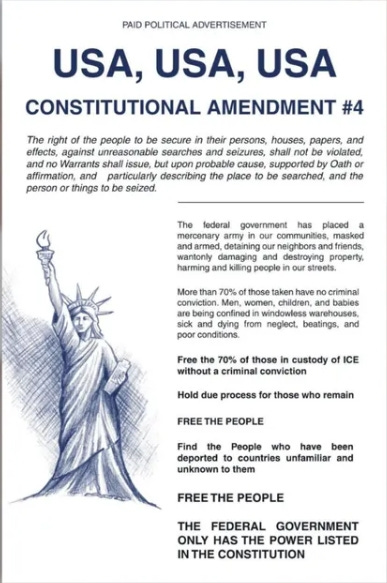
The decision to sign the ad matters as much as the content. Wealthy donors often fund advocacy quietly. Public identification, especially on a politically volatile issue, carries different risks and signals a different intent.
March 23: Bond Hearings and Refugee Detention
On March 23, two developments pointed in different directions.
First, reporting showed that immigration court bond hearings had dropped sharply in February. A bond hearing is the process by which a detained person can ask a judge for release while their case proceeds. Fewer hearings mean fewer opportunities to challenge detention.
Second, a federal judge blocked the administration from detaining thousands of refugees under a new policy. The ruling suggested that, at least in some contexts, courts are willing to push back on expanded detention authority.
Neither development settles the broader question. One restricts procedural access. The other restores it, at least temporarily, and in a specific category of cases.
March 24: Supreme Court Arguments
On March 24, the Supreme Court heard arguments in a case concerning asylum processing at the border. At question is whether the government can turn asylum seekers away at ports of entry without allowing them to formally apply for protection.
Oral arguments are not decisions, yet they offer a preview of the Court’s thinking. Reporting suggested that a majority of justices may be inclined to side with the administration. A final ruling will come later, and it will likely shape how much access migrants have to the asylum system before they are ever detained.
March 25: Appellate Reinforcement of Detention Policy
On March 25, another federal appeals court upheld the administration’s policy of mandatory detention without bond for certain groups of migrants. The decision applied across multiple states and reinforced the government’s position in an ongoing legal fight.
As with other rulings, this does not end the matter. Appeals, further challenges, and conflicting decisions across circuits remain possible.
A System Under Legal Stress
Taken together, these developments tell a more complicated story than any single headline can capture. Courts are not moving in one direction. They are moving in several, often at once.
Some rulings expand executive authority. Others constrain it. Some decisions increase access to due process. Others limit it. Many are interim steps that leave the underlying legal questions unresolved.
This pattern is not unusual for the American judicial system. It reflects how large constitutional disputes unfold. Cases begin in different jurisdictions, produce different outcomes, and move through appeals at different speeds. The result is a period of overlap and contradiction before any broader direction becomes clear.
The scale of the current litigation underscores that point. A Reuters investigation in mid-February found that federal courts had already ruled more than 4,400 times that ICE unlawfully detained individuals, while detainees had filed more than 20,000 habeas petitions challenging their detention. A habeas petition is a legal action that allows someone to contest the legality of their imprisonment. The volume of these cases indicates a system under sustained challenge, not a single dispute moving toward resolution.
Where Walton Fits
Against that backdrop, Walton’s ad reads differently.
It is not evidence of a unified elite awakening. It does not signal that a broad class of wealthy or corporate actors has shifted its stance. It is one intervention from one person whose background makes it unexpected.
That unexpected quality is what gives it weight. Walton is not a Hollywood figure or a professional activist. She comes from a family associated with discretion and institutional caution. Public, signed statements on controversial policy questions are not the norm in that world.
Walton’s intervention is also unusual given what is publicly known about her prior political activity. With the notable exception of her 2025 “No Kings” ad, her political footprint has been more financial than rhetorical, appearing largely through donations to the Lincoln Project and other PACs and campaigns rather than through signed public statements under her own name.
The content of her message also matters. She did not frame her argument in economic terms or in terms of policy efficiency. She framed it in constitutional language, focusing on due process, the treatment of people without criminal convictions, and third-country deportations. That choice aligns her intervention with the legal questions currently moving through the courts.
Yet the limits are just as important as the signal. One ad does not create a trend. It does not resolve the legal conflicts playing out across multiple jurisdictions. It does not predict how courts will ultimately rule.
Motion, Not Resolution
It is tempting, in moments like this, to search for a turning point, a decisive case, a definitive ruling, or a symbolic act that clarifies the direction of events. March has not yet offered that clarity.
What it has offered instead is motion.
Courts are issuing rulings, only to see those rulings narrowed, stayed, or appealed. Policies are being implemented, challenged, and partially blocked. Data on detention conditions is surfacing alongside legal arguments about the scope of government authority. Public voices, including unlikely ones, are entering the conversation.
None of these elements, on its own or in combination, amounts to a final answer. The Supreme Court has yet to rule on the asylum case it just heard. Lower court decisions remain subject to appeal. New cases are being filed even as older ones work their way through the system.
That is what it looks like when a policy area becomes a sustained legal battleground.
Walton’s ad is part of that picture. It reflects a moment in which the questions surrounding detention and due process have become visible enough to draw in voices that might otherwise remain quiet. It does not define the outcome of those questions.
For readers trying to make sense of this moment, the most useful posture is a restrained one. Pay attention to the sequence of developments. Notice how different institutions respond. Watch how cases move through the courts.
Just do not mistake motion for resolution.
If you’re looking for coverage that pays attention without mistaking motion for resolution, subscribe for more.
Sources:
“Walmart heiress Christy Walton took out anti-ICE ad in New York Times,” Snopes, March 25, 2026.
“Billionaire Christy Walton Appears To Take Out Ad Calling For ICE To Release 70% Of Detainees,” Forbes, March 22, 2026.
“Walmart heiress Christy Walton Is The Only Billionaire Still Donating To The Lincoln Project,” Forbes, December 16, 2021.
“Walmart heiress Christy Walton paid for NYT anti-Trump ‘No Kings’ protest ad,” Snopes, June 11, 2025.
“US appeals court lifts block on Trump policy allowing fast third-country deportations,” Reuters, March 16, 2026.
“Trump policy allowing swift deportations to alternate countries rejected by US judge,” Reuters, February 25, 2026.
“Thirteen people died in US immigration custody this year, agency says,” Reuters, March 19, 2026.
“Immigration court bond hearings plummet amid Trump detention policy, analysis finds,” Reuters, March 23, 2026.
“US judge blocks Trump administration from detaining thousands of refugees,” Reuters, March 23, 2026.
“Supreme Court justices lean toward Trump in asylum-processing case,” Reuters, March 24, 2026.
“Court appears likely to side with Trump administration on rights of asylum seekers,” SCOTUSblog, March 24, 2026.
“Second US appeals court upholds Trump’s immigration detention policy,” Reuters, March 25, 2026.
“Courts have ruled 4,400 times that ICE jailed people illegally. It hasn’t stopped,” Reuters, February 14, 2026.
“Trump’s immigration agenda fuels surge in court cases, US judiciary data shows,” Reuters, March 3, 2026.
Why doesn’t she pay her employees a living wage?