


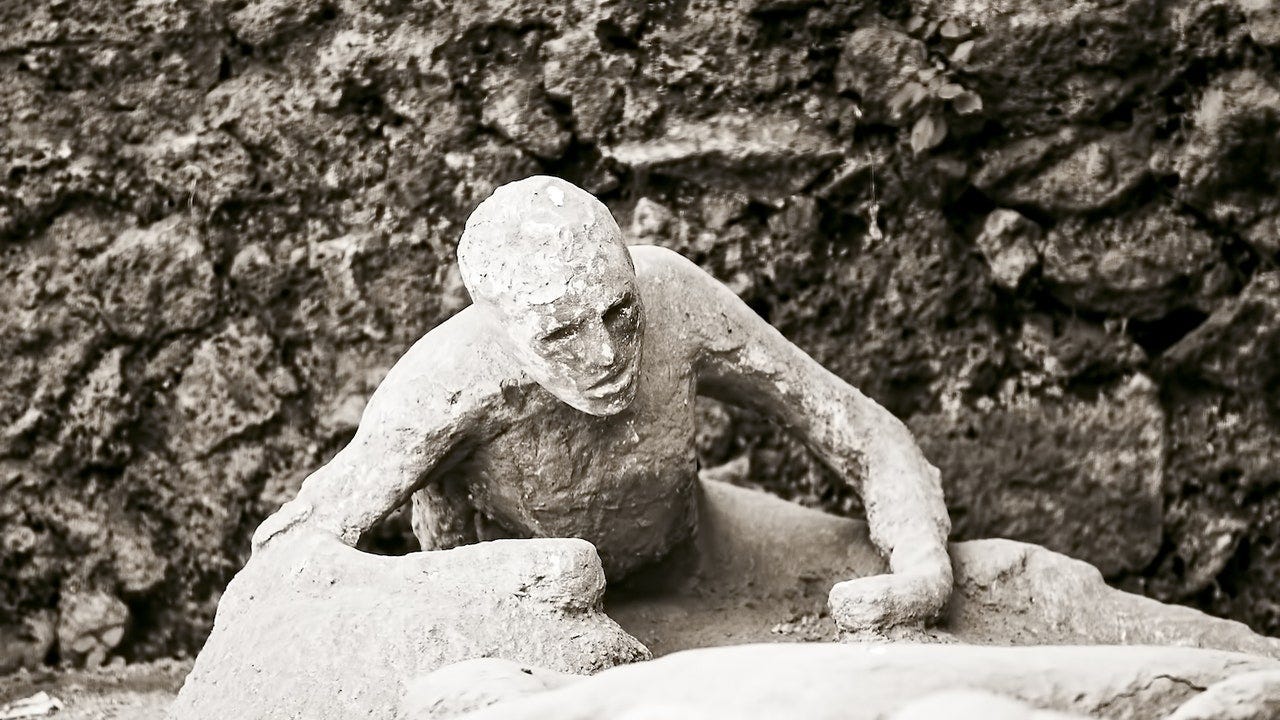
For nearly 2,000 years, Pompeii has preserved victims in their final moments. Now artificial intelligence is changing how the dead may be seen again.
According to AP and Reuters, archaeologists used AI for the first time to digitally reconstruct the face of a man killed in the AD 79 eruption while apparently trying to shield himself from falling volcanic debris.
The breakthrough is stirring attention because it is not just about one face. It signals a broader shift in Pompeii exploration, where excavations increasingly rely on robotics, imaging and AI to interpret ruins once studied only by hand.
Subscribe free for daily political analysis they won’t broadcast. Join 110K+ readers →
Researchers say the victim was found with coins, a lamp and a terracotta mortar, details adding drama to the reconstruction. But the deeper story may be what comes next. Pompeii has long produced stunning discoveries, from plaster casts to hidden villas. Now digital archaeology may reopen ancient mysteries in ways traditional excavation never could.
With AI already helping rebuild frescoes and analyze fragments, Pompeii’s next major discoveries may come as much from algorithms as from digging.
Download a FREE Pocket Constitution NOW →
