


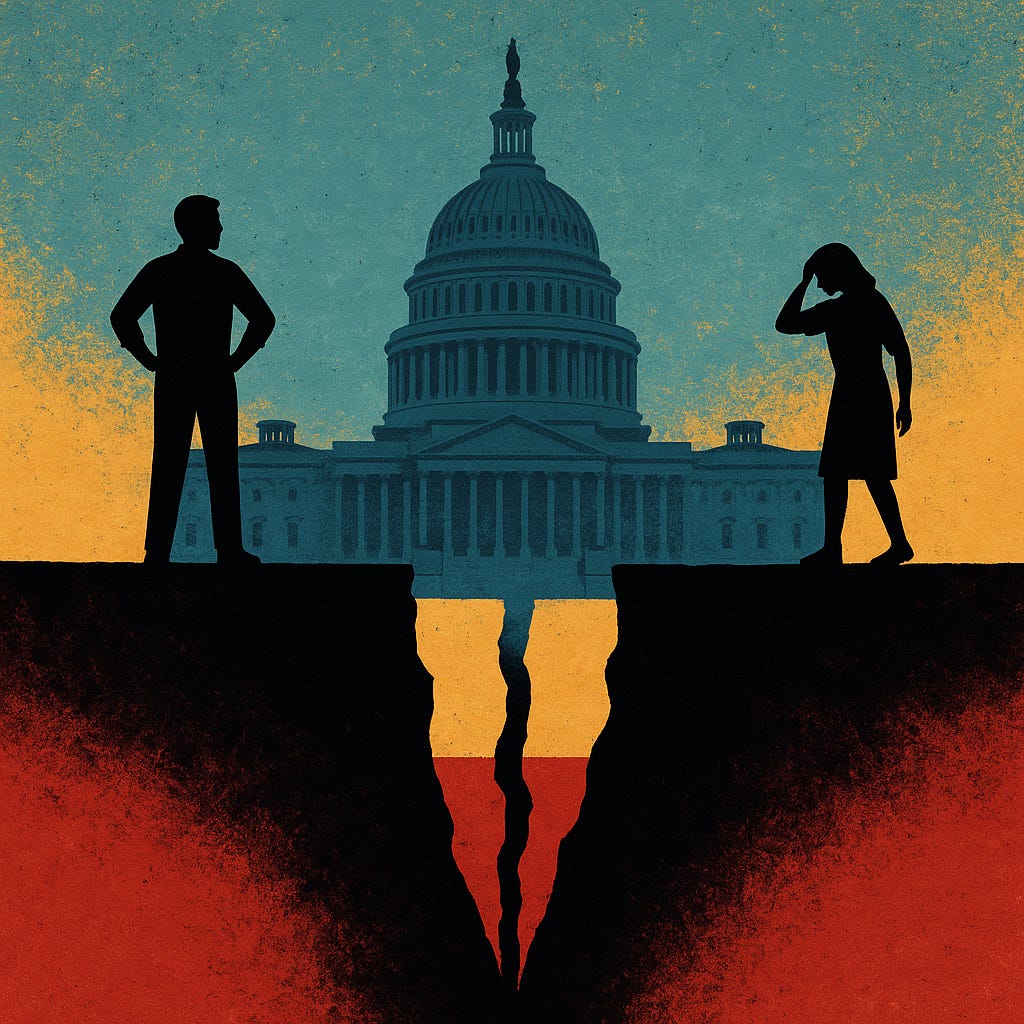
On October 1, 2025, the federal government shut its doors. Congress failed to pass appropriations bills or even a temporary continuing resolution, forcing hundreds of thousands of federal workers to stay home without pay. National parks are closed. Small business loans are frozen. Families who rely on programs like WIC and Head Start were told their benefits might vanish within weeks if the shutdown drags on.
Lawmakers in Washington framed it as a fight over fiscal responsibility. In reality, it was the same ideological battle that has defined budget politics for years: Republicans pressing for deep domestic cuts in the name of austerity, Democrats holding the line for basic social programs. The failure to bridge that divide leaves the nation without a budget and ordinary Americans in the crossfire.
We just hit 20,000 subscribers, 1,000 articles, and 1,000 podcast episodes. To celebrate, paid subscriptions are 20% off for two weeks only. That’s just $64/year—less than $1.25 a week.
State Standoffs and Local Strain
Pennsylvania has been grappling with its own version of this crisis since July 1, when the state exceeded its constitutional budget deadline. Governor Josh Shapiro insisted that “education is a moral responsibility” as he fought for increased public school funding, while Republican lawmakers demanded expanded private school vouchers. The result was a stalemate. Four months later, the state still has no budget in place.
The consequences are mounting. Counties that rely on state dollars for their basic operations have been forced to draw down their reserves or borrow. At least six are considering lines of credit. Dauphin County has already lost $300,000 in interest income by tapping into its rainy-day funds. York County reports that it is missing approximately $3 million every month in federal pass-through money, in addition to the frozen state dollars. Without resolution, officials warn, cuts to mental health services, child welfare programs, and local safety nets will deepen.
In late September, State Treasurer Stacy Garrity stepped in, announcing a $500 million short-term loan program for counties and for Head Start and pre-K providers left in the lurch. The loans carry a 4.5% interest rate and must be repaid within 15 days after a state budget is enacted. Senate Republicans quickly said they would propose forgiving the interest to ease the burden on counties forced to borrow just to keep operating.
The loans may soften the blow, but they are no substitute for a functioning budget. Local governments are left scrambling, weighing furloughs, service cuts, or new debt to cover obligations the state has failed to meet.
Pennsylvania is not alone. In Michigan, lawmakers also missed their deadline, and on September 30, Governor Gretchen Whitmer signed a continuation budget to prevent a shutdown of state services. “We cannot play politics with people’s lives,” she said as she moved to guarantee paychecks for state employees and maintain basic operations. But her action only bought time; the larger fights remain unresolved.
Taken together, these crises make clear that budget dysfunction is not confined to Washington. It is spreading through the states, with the same partisan divides at the root.
Austerity vs. Social Spending: The Real Divide
On the surface, these battles are about dollars and cents. Beneath that surface, they are about ideology.
Republicans at both state and federal levels cast their approach as fiscal discipline—tightening belts, restraining taxes, forcing “efficiency.” But in practice, it is austerity: shrinking government’s role in education, healthcare, housing, and infrastructure, while leaving individuals, families, and charities to fill the gaps. Democrats counter that public services are not extras but essentials, investments in the collective good that cannot be abandoned without eroding the very foundation of opportunity.
Every budget is, therefore, more than a spending plan. It is a moral document. A line-item for school vouchers instead of classrooms, a rescission of food assistance instead of a transit upgrade, a corporate tax cut instead of expanded healthcare—these choices reveal more clearly than rhetoric who leaders believe government should serve.
See our recent reporting:

The Consequences of Delay and Cuts
The fallout is immediate and far-reaching. In Pennsylvania, schools consider hiring freezes, while counties brace for cuts to senior centers, children’s programs, and addiction services. In Washington, the shutdown has halted research projects, stalled federal aid to small towns, and left workers uncertain of their next paycheck.
The burden falls hardest on those with the least. Federal employees living paycheck to paycheck have no cushion when pay is suspended. Parents who lose childcare or nutrition assistance have few alternatives. Low-income families and rural counties, which are more dependent on public funding, are the least able to withstand the disruption.
Austerity also relies on a dangerous assumption: that corporations and families will fill the gaps. But in today’s economy—where stable jobs with benefits are increasingly rare, and corporations maximize profits by cutting rather than investing—there is no such safety net. Without public support, the result is predictable: preventable illness, widening poverty, rising crimes of desperation, and communities stretched beyond their limits.
The Pattern We’ve Seen Before
None of this is new. History is full of elites who believed their privilege was permanent, their system unshakable. In the 1780s, French nobles dismissed bread riots as the grumbling of peasants. In early 20th-century Russia, the czarist regime ignored the desperation of workers and soldiers until revolution swept them away. In austerity-era Greece, deep cuts imposed after 2008 hollowed out healthcare, pensions, and services, leaving scars that persist to this day.
The pattern is clear: when governments serve the interests of elites while leaving the masses in despair, societies reach breaking points.
Every empire thinks it is the exception. None of them were.
What makes this moment especially dangerous is the union of disconnection from lived reality and short-term thinking. Politicians talk as if one job with benefits can still support a family. Corporations prioritize quarterly profits over long-term stability. Together, these forces squeeze the public without acknowledging that the pressure cannot hold forever. Anger builds, trust collapses, and history tells us what comes next.
The Core Question
All of this leads to the central issue: what is the purpose of government, and who does it serve?
If government exists to serve the people, budgets will reflect investments in schools, healthcare, transportation, and housing. If it exists to serve corporations, budgets will privilege tax breaks, deregulation, and privatization. If it exists to serve elites, austerity for the many and privilege for the few will be the guiding principle.
Budgets expose these choices. They are the clearest mirror of the government’s true priorities.
The Answer Tells You Everything
Every time a budget is written or left unwritten, the public should ask: Who does this serve?
If the immediate answer is not the people, then the policy is a confession. It tells you who the policymakers are, who they represent, and what they believe government should be.
That is not democracy. It is something else entirely.
And once you know the answer, you know everything that follows.
Stay Informed. Stay Loud.
Subscribe to The Coffman Chronicle for no-BS political analysis, action guides, and daily truth bombs you won’t get from corporate media.
Sources:
“Governor Whitmer Signs Continuation Budget to Continue Government Services for Michiganders as Legislature Finalizes Budget Bills” — Michigan.gov, Oct. 1, 2025
“Michigan Legislature passes eight day continuation budget, votes expected Thursday” — Michigan Advance, Oct. 1, 2025
“Michigan officials miss budget deadline but pass bill to stop shutdown” — Bridge Michigan, Oct. 1, 2025
“With no end to budget impasse in sight, Pa. school districts and counties warn of program cuts” — PennCapital-Star, Sep. 29, 2025
“Pennsylvania educators demand state budget passage; lawmakers respond to claims” — WGAL, Aug. 26, 2025
“Pennsylvania’s Budget Impasse Causes Funding Headaches for Public School Administrators” — Bucks County Beacon, Aug. 18, 2025
“Nearly two months into stalemate, Shapiro says a budget is close—really this time” — PennCapital-Star, Aug. 25, 2025
“Pennsylvania agencies warn of mounting damage as state budget stalemate drags on” — WHYY, Oct. 2025

A budget is a moral document - the one currently before Congress as proposed by the President suggests that the already rich and the very powerful are morally superior to the 99% and thus, deserve all the benefits.