


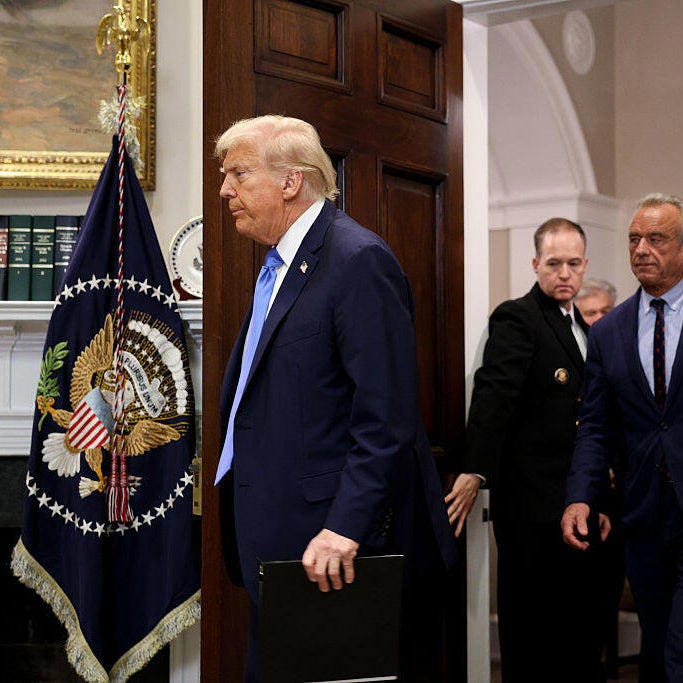
It starts, as it often does, with a press conference— a podium, a seal, and a statement broadcast across the nation with the full authority of the United States presidency behind it.
This week, the White House suggested that acetaminophen — the most common over-the-counter pain reliever in America — may be linked to autism when taken during pregnancy. In the same breath, the President promoted a drug called leucovorin as a promising new treatment for children already diagnosed. The announcement was framed as concern, action, and a breakthrough.
It was none of those things.
It was power speaking without proof. The consequences are not theoretical. They are immediate, intimate, and irreversible.
© Francis Chung / Politico / Bloomberg via Getty Images
We just hit 20,000 subscribers, 1,000 articles, and 1,000 podcast episodes. To celebrate, paid subscriptions are 20% off for two weeks only. That’s just $64/year—less than $1.25 a week.
Most people won’t read past the headline
They’ll see “Tylenol linked to autism” and close the tab.
They won’t see the scientific caveats. They won’t know the data is early, inconclusive, and contested by major medical bodies. They won’t hear the quiet clarifications from pediatricians, obstetricians, or neuroscientists trying to keep up with the ripple effects of a political announcement dressed in the language of health.
They’ll just hear it once and carry it forever.
Trump Pushes Falsehood: Tylenol Doesn’t Cause Autism

Today at the White House, Donald Trump stunned the medical world with a sweeping claim: “Taking Tylenol is, uh, not good. I’ll say it. It’s not good.”
And for millions of mothers across the country, that headline lands like a punch to the gut, because for decades, doctors told them acetaminophen was the safe choice. It was the one thing they could take when everything else was off-limits— a fever reducer, a relief for pregnancy migraines, and a way to sleep when the back pain got too loud.
So they took it, trusting their doctor, the label, and the system.
Now they are left to wonder if they harmed their child.
We’ve been here before
Countless families experienced this in the seventies and eighties. Birth defects with no immediate cause were immediately linked to potential alcohol or drug use during pregnancy. Mothers were shamed, never certain what they did, if anything, to cause their child’s medical issues.
It wasn’t until decades later that many learned that exposure to Agent Orange by military veterans may be linked. It was a lifetime before the now-documented pattern of birth defects in the children of veterans who came home from Vietnam carrying invisible damage in their blood was acknowledged.
However, there is still no definitive proof. There never will be. It doesn’t undo the trauma of being blamed by a system that didn’t yet have the evidence. It doesn’t remove the sting of sidelong glances, whispers, and judging eyes. It also didn’t pay the medical bills or undo the childhood trauma of surgeries or of being different.
That’s the legacy we’re repeating now. This time, it’s mothers of autistic children who are being made to carry the weight of a political statement masquerading as science.
This isn’t about leucovorin either
Leucovorin may help a small subset of children with specific neurological markers. That’s what early studies suggest. It is not approved by the FDA for use in autism. It is not a cure. It is not a treatment for the full spectrum.
Most importantly, it is not ready to be promoted from the White House.
Science is slow because it is careful. It is supposed to be. Announcing a treatment before the research is settled doesn’t accelerate care. It undermines trust.
But that’s exactly what happened this week. While the headlines shouted about a potential cause and a possible treatment, what was actually being offered to families was a false sense of certainty.

The real story is the megaphone
What matters most here isn’t whether the Tylenol link is eventually proven or disproven. It isn’t whether leucovorin gets approved next year or rejected next decade.
What matters is that the President of the United States used the most powerful platform in the country to speak about a complex medical condition as though it were politically settled.
He didn’t just introduce an idea. He issued a verdict. And he’s done it before. Remember COVID, when his words alone convinced millions to take ivermectin?
He spoke in a way that will shape public opinion, legal action, and personal guilt long before science can catch up.
That’s what happens when the White House speaks. It doesn’t echo. It transforms.
Some damage never gets reversed
There will be lawsuits. There will be think pieces and panel debates. But most of the people affected won’t be in the courtroom or on cable news. They’ll be at home, raising a child, managing therapies, navigating IEPs, fighting insurance claims, and trying not to drown in guilt.
Many will now do all of that while wondering: Did I cause this?
That’s the wound this moment leaves behind.
It is not necessarily because the science was wrong, but because the platform was misused, because the burden of proof wasn’t met, and the consequences fell on the people with the least power to push back.
We cannot afford to speak this way about autism
Autism is not a scandal to be solved, a headline to be weaponized, or a condition to be condemned. It is not a punchline, a curse, or a tragedy. It is a spectrum of neurodiversity that includes millions of people, each with their own unique challenges, gifts, and truths.
What autistic individuals and their families need isn’t premature biomedical speculation. It’s support, inclusion, and funding for services, education, and long-term care.
They need a government that listens more than it lectures, that funds what helps now, not just what might help someday.
And above all, they need leaders who understand that when you speak from that podium, you are not just narrating policy. You are shaping lives.
See our previous reporting here:
Autism Isn’t New. Our Understanding Is
·Later this month, the U.S. Department of Health and Human Services is expected to release a report alleging that prenatal use of Tylenol may be linked to autism. The report, championed by HHS Secretary Robert F. Kennedy Jr., will also reportedly examine folate deficiency and recommend folinic acid as a potential treatment for autism symptoms.
Note: These articles are more than 45 days old and now live in our archive. Consider becoming a paid subscriber for exclusive perks including full access to all of our 1000+ articles.


If it’s not enough for a courtroom, it’s not enough for the podium
That should be the standard, not because we can’t talk about uncertainty, but because we must treat uncertainty with care, caution, humility, and with an awareness that the words we use — especially from positions of power — live longer and cut deeper than we ever intend.
This wasn’t about Tylenol.
It was about power speaking without proof and leaving the consequences for everyone else to carry.
Stay Informed. Stay Loud.
Subscribe to The Coffman Chronicle for no-BS political analysis, action guides, and daily truth bombs you won’t get from corporate media.
Sources:
“FACT: Evidence Suggests Link Between Acetaminophen, Autism” — The White House (Press Release, Sept 22, 2025)
“Autism Announcement Fact Sheet” — U.S. Department of Health & Human Services HHS.gov (Sept 22, 2025)
“FDA Takes Action to Make a Treatment Available for Autism Symptoms” — U.S. Food and Drug Administration (Sept 22, 2025)
“FDA Responds to Evidence of Possible Association Between Autism and Acetaminophen Use During Pregnancy” — U.S. Food and Drug Administration (Sept 22, 2025)
“Trump links autism to Tylenol and vaccines, claims not backed by science” — Reuters (Sept 23, 2025)
“Trump and RFK Jr. make autism announcement as Tylenol maker and medical experts push back” — CBS News (Sept 22, 2025)
“STAT: FDA moves to allow leucovorin as treatment for autism …” — STAT (Sept 22, 2025)
“ASF Statement on White House Announcement on Autism” — Autism Science Foundation (Sept 22, 2025)
“APA Statement on White House Announcement on Autism” — American Psychiatric Association
“Fact‑checking President Donald Trump’s claims about autism” — ABC News (Sept 23, 2025)
“World experts reject Trump’s claims about Tylenol, autism link” — CBS News (Sept 23, 2025)

Thinking scientifically is uncommon in America. It's a critical and skeptical approach that was developed in Europe and adopted by scientists in the the US. A large percentage of Americans weren't instructed to think this way and conspiracies are a more amusing approach.
Thanks for speaking with level-headed fidelity.