


Editor’s note: It is Banned Book Week, and you know what that means! Yes, more reporting on literacy, censorship, libraries, and freedom of speech. If you’ve followed us for a while, you know we are passionate about these topics. So slip a bookmark into your current read (no dog-ears, you filthy animals), and let’s talk books.
Each fall, Banned Books Week offers us the chance to look at the shelves and ask what’s missing and why. This year, that question feels heavier than ever.
PEN America’s newly released report confirms what many librarians, educators, and students have already seen firsthand: the censorship movement isn’t slowing. It’s scaling. Over the 2024–25 school year, PEN tracked 6,870 documented instances of books being banned or restricted in U.S. public schools, most often targeting titles by or about LGBTQ+ people, Black and brown communities, women, and other historically marginalized groups.
The justifications vary. Some bans cite “sensitive material.” Others claim a need to “protect children.” But look closely, and you’ll see that the stories being stripped away are almost always the ones that make a young reader feel seen in a world that often wants them invisible.
It’s easy to get caught in the back-and-forth over specific titles or scenes, but there’s a deeper truth we need to face: while the headlines rage about what’s being removed, far too little attention is being paid to the harm of what’s never offered in the first place.
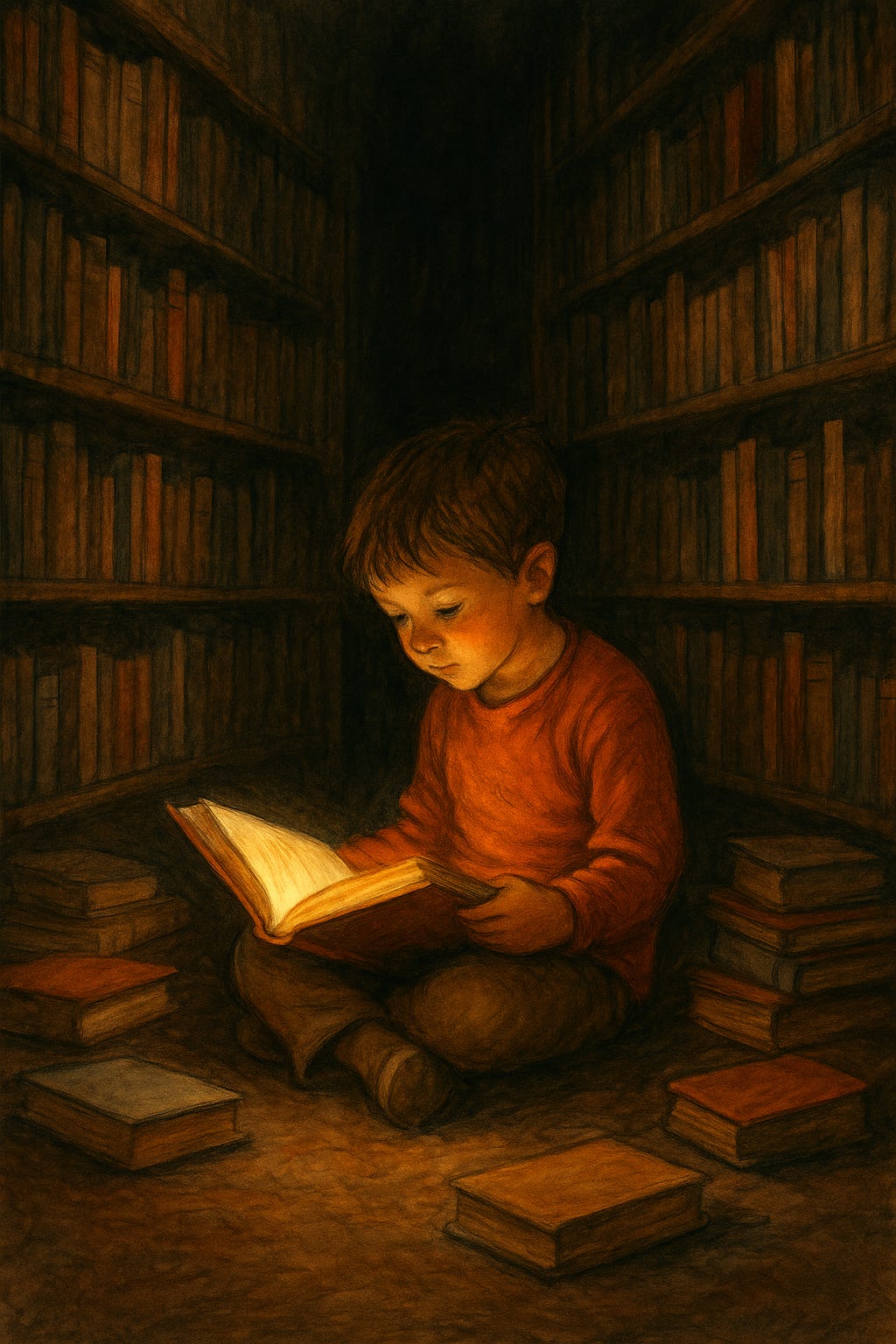
The Story Doesn’t Have to End Here
If you’re still with us, you probably believe in stories. We’re here to keep telling them.
Subscribe to stay in the fight, and join us for the next chapter.
The Real Crisis: When Children Don’t Read at All
We are not just fighting censorship. We’re watching a slow-motion collapse of reading itself.
In 2023, only two percent of American adults reported reading with a child on a given day. That means no storytimes, no bedtime stories and snuggles, and no laptime with characters. Meanwhile, reading for pleasure among all age groups has declined significantly over the past two decades. Time spent with books has been displaced by screens, stress, and cultural shifts. According to studies, nearly a quarter of American adults now say they didn’t read a single book last year.
When you combine the disappearance of shared reading rituals at home with the rise of book bans in schools and libraries, the result is not just lost access. It’s lost literacy. And what happens when citizens are functionally illiterate?
Early Access Shapes Everything
Here’s what decades of research tell us. Children who grow up with books in the home, even a modest number, begin life with a profound academic advantage.
They arrive at school with stronger vocabularies, better language processing, deeper background knowledge, and higher reading readiness. They’re more likely to read for pleasure, more likely to succeed academically, and more likely to remain engaged learners.
It’s not magic. It’s exposure.
Children who are read to regularly hear thousands — even millions — more words than their peers. However, it’s not just the quantity of words that matters. It’s the quality, the variety, the rarity, and the complexity. Books offer language that children simply don’t encounter in everyday conversation, and that language builds the scaffolding for future comprehension, critical thinking, and academic success.
When that exposure is missing — when books are absent or seen only as assignments — the gap begins. And over time, that gap compounds.
By the time a child reaches sixth grade, repeated summers without access to books or reading encouragement can result in a two-year academic delay compared to peers who read consistently. The impact begins early. In some communities, children enter school having been read to only rarely, if at all. In others, the average child owns dozens of books by the time they reach kindergarten. One child arrives ready. The other starts a race already behind.
And make no mistake, that gap isn’t just hard to close. In many cases, it never is. One of the single biggest predictors of academic success is access to books in early childhood, but it is never too late to encourage literacy.
We Are Already Seeing the Consequences
If you want proof that these dynamics aren’t just theoretical, look at the data. National reading performance has declined sharply in recent years. In 2024, both fourth- and eighth-grade reading scores declined again, continuing a downward trend that began before the pandemic but was exacerbated by it.
Among high school seniors, more than 30 percent now test below basic in reading. That’s not just a statistic. That’s a generation struggling to make sense of the written world around them, from college applications to ballot measures to job training materials.
The scaffolding that supports a lifetime of reading starts long before formal schooling, and when we fail to offer books — or worse, when we actively take them away — we are complicit in weakening that foundation.
Between the Lines: A Generation Unprepared
When reading falls, everything else begins to slip. Literacy isn’t just about passing English class. It’s the foundation for navigating life.
We’re talking about job readiness, about understanding contracts, safety protocols, and workplace communication. It is about interpreting news headlines, ballots, civic documents, and health information, as well as acquiring the ability to learn new skills in a rapidly changing economy.
Children who never build fluency — who are denied books, or who grow up believing reading is a punishment instead of a gateway — don’t just struggle on tests. They struggle to read job postings, to challenge unfair leases, and to discern between fact and manipulation.
We say we’re preparing them for the future, but when we gut libraries and shrink their reading world, we’re really just shrinking their future and our own, and maybe that is the point.
What the Censors Are Really Taking
The loudest voices in the book-banning movement say they’re protecting children. From what? From reality? From success?
What they’re really doing is making sure some children never have the chance to feel seen, to feel safe, or to feel like they belong in a story.
They’re terrified a child might read that different people exist, and that they’re just as valid.
I’m terrified that a child might never see themselves in a book at all, that they’ll walk through years of school without ever feeling that electric moment of recognition, that they’ll never learn that stories can be safe places — places where they’re not alone, not strange, not wrong.
For many, books are the escape hatch. When it is impossible to change where you are, you can open a book, meet people you never would’ve encountered in real life, and visit places you may never have the means to see. Books allow you to witness lives, loves, and losses that teach more than any lecture ever could.
Reading doesn’t just make people smarter. It makes dreams possible.
That’s what they’re trying to ban.
If You Truly Care About Children…
Then give them the books.
Don’t just defend stories because they’re award-winning or canonical. Defend them because they save lives. Because for some kids, the book they find at school or the library may be the only window they ever get.
When you limit access, you don’t just deny information. You deny empathy. You deny hope. You deny the chance to grow into a world that feels bigger than the one they were born into.
So yes, think of the children, but think bigger. Think braver.
Let them read. This world desperately needs more readers, more literate people who can see and understand beyond the headlines.
Stay Informed. Stay Loud.
Subscribe to The Coffman Chronicle for no-BS political analysis, action guides, and daily truth bombs you won’t get from corporate media.
Sources:
PEN America Index of School Book Bans 2024‑2025. New York: PEN America
“The Normalization of Book Banning.” Report. New York: PEN America
“Explore Results for the 2024 NAEP Reading Assessment.” U.S. National Center for Education Statistics, Nations Report Card
“Reading Scores Fall to New Low on NAEP, Fueled by Declines for Struggling Students.” Education Week, January 2025.
“The Nation’s Report Card: Long-Term Trends in Reading and Mathematics Achievement.” National Center for Education Statistics
Beyond the Shelves: Banned in the USA 2023–24. New York: PEN America
Cover to Cover: An Analysis of Titles Banned in the 2023–24 School Year. New York: PEN America
“Book Ban Reports.” PEN America
“Book Ban Data.” American Library Association
“Reading in 2024: Ten Takeaways from the 2024 NAEP Results.” nagb.gov
Green, Clarence, & Keogh, Kathleen. “Vocabulary exposure to children is enhanced by using both informational and narrative picture books for read‑alouds: A comparative modelling study using data science methods.” Journal of Research in Reading. 2024. ResearchGate
“Home Libraries.” Scholastic Education
Weisleder, Adriana, and Anne Fernald. “Talking to children matters: Early language experience strengthens processing and vocabulary.” PLOS ONE / PMC. 2013.
Hamilton, L. G., et al. “The Home Literacy Environment as a Predictor of the Early Literacy and Language Development of Children.” PLoS ONE / PMC. 2016.
Garden, Paige D. “Vocabulary Instruction in the Early Grades.” ERIC. 2022.
Hadley, Elizabeth B., et al. “Building Semantic Networks: The Impact of a Vocabulary Intervention on Preschoolers’ Depth of Word Knowledge.” Reading Research Quarterly. 2018. templeinfantlab.com
“Books Make a Difference: A Study of Access to Literacy.” ResearchGate
This is a great article!!!
I grew up in a family with lots of books, Dad being and English professor, Mom a librarian. I have a small house with bookshelves in every room except the bathroom. It’s an addiction of mine. Currently working through the works of Louise Erdrich and other indigenous writers. Of course I was raised long before computers were popular—‘50’s and ‘60’s. People who don’t read don’t know what they’re missing: escaping from present reality into the past, into the future, into the imagination, into what makes or made some of our well-known folks (RBG,Lewis, for example) tick. I still have the copies of my mother’s Now We Are Six, my copies of the Pooh books with my crayon marks there, Mom’s copy of Alice in Wonderland; my third copies of Tolkien’s trilogy and over 2 bookcases of sci-fi. Reading is both a pleasure and an escape, and if you have young ones, reading to them can be an exercise of bonding with them they aren’t going to forget. If you have to hold a computer in your hands, there are many books online. To me, and I agree that in this I may seem old-fashioned (an old hippie), books are an escape, information, a learning tool, humor and more. And in these days, some good fantasy and escapism is needed!