


President Donald Trump’s decision Monday to sharply reduce the boundaries of Bears Ears and Grand Staircase-Escalante National Monuments has reignited one of the nation’s longest-running public lands disputes.
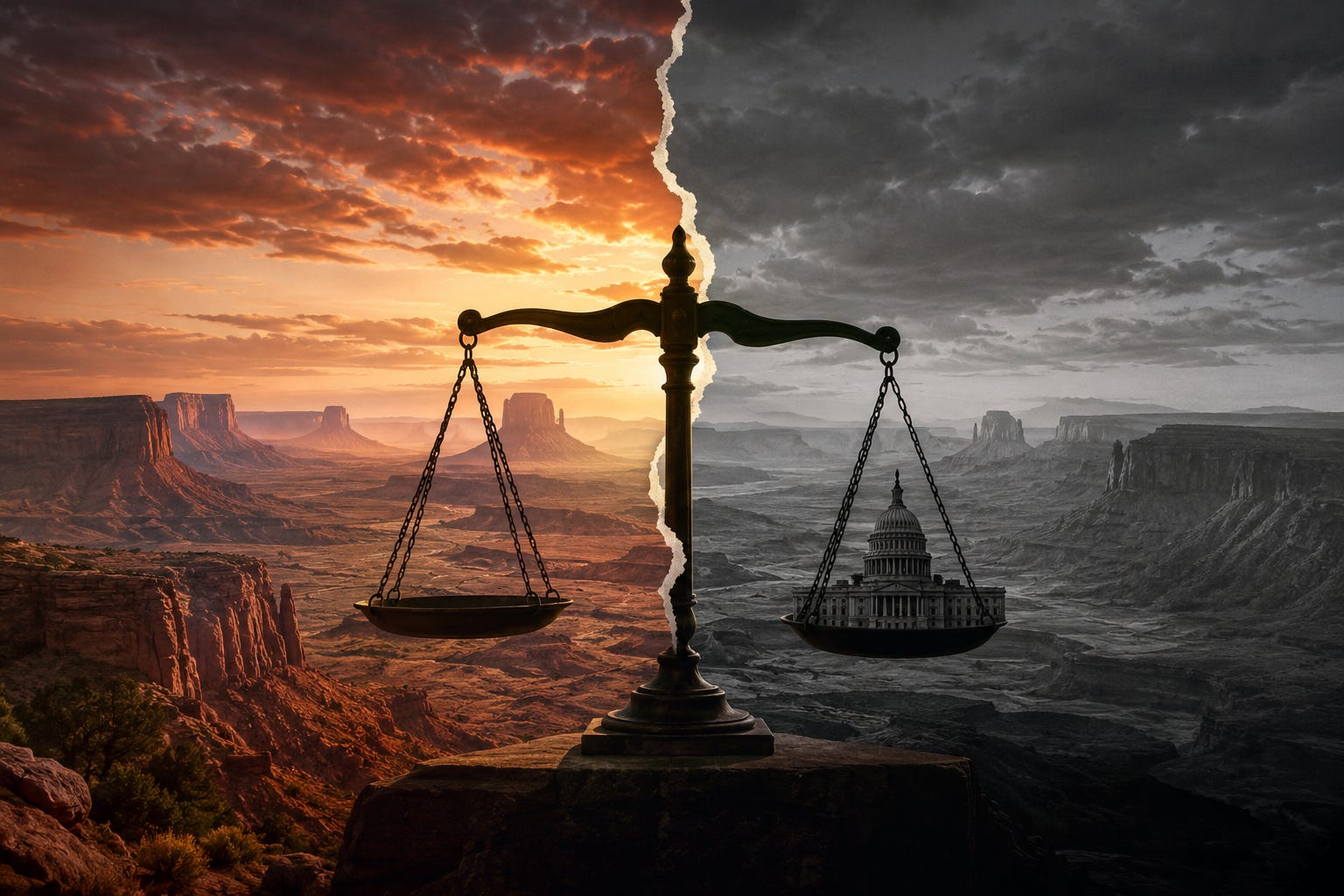
The immediate debate centers on Utah, but the larger story reaches much further. Nearly a decade after the first modern attempt to substantially reduce certain national monuments, the country still lacks a definitive answer to the fundamental question: Does a president have the authority not only to create a national monument but also to significantly reduce or revoke one created by a predecessor? Neither Congress nor the courts has settled that question.
That uncertainty is significant for reasons extending well beyond public lands. It illustrates a recurring constitutional pattern in which unresolved questions of delegated executive authority become national policy before the representative branches establish durable rules. National monuments are the latest example, but they are far from the only ones.
This Community Is Powered by You
What started as a small circle has grown into something much bigger, and it’s all because of readers like you.
Every time you forward this email, post it on socials, or bring someone new into the fold, you’re helping build one of the most passionate, independent political communities out there.
Want to keep the momentum going?
Share this newsletter with someone who should be part of this conversation.
Thank you for being here. It means everything.
What Happened Monday?
On Monday, July 13, 2026, President Trump signed proclamations reducing the boundaries of both Bears Ears National Monument, established by Obama in 2016, and Grand Staircase-Escalante National Monument, established by Clinton in 1996, both located in Utah. The administration stated that previous designations had reserved substantially more land than necessary to protect the historic, archaeological, scientific, and cultural objects identified in the original monument proclamations.
The new boundaries reduce Bears Ears from approximately 1.36 million acres to about 121,000 acres, a reduction of roughly 91%. Grand Staircase-Escalante would shrink from roughly 1.87 million acres to approximately 181,500 acres, a reduction of about 90%. The affected acreage generally remains federal land, but it is managed under the general federal land management laws rather than under the additional protections of a national monument. This could, for example, open it up to extraction. The White House described the action as restoring sensible land management while maintaining protection for significant cultural and historical sites.
However, tribal nations, conservation organizations, and many archaeologists argue that the reductions remove protections from interconnected cultural landscapes rather than isolated sites. They contend that the monuments were established only after years of research, consultation, and advocacy involving federal agencies, tribal governments, scientists, historians, and other stakeholders. In their view, reducing the boundaries creates unnecessary risk to resources whose full historical, archaeological, and cultural significance may never be completely known.
Legal challenges are expected, and will almost certainly revisit the same unresolved statutory question that has lingered for years.
What the Law Actually Says
Congress enacted the Antiquities Act in 1906 to allow presidents to protect federally owned lands containing historic landmarks, prehistoric structures, and other objects of historic or scientific interest. Unlike a national park, which generally requires an act of Congress, a national monument may be established by presidential proclamation under this law.
The statute directs the president to reserve “the smallest area compatible with the proper care and management” of the protected objects. That language is important. A monument designation is not intended to be an arbitrary reservation of public land. Instead, it represents a presidential determination that a particular area is necessary to protect the identified resources.
While the Antiquities Act expressly authorizes the president to create national monuments, it does not expressly state whether a president may substantially reduce or revoke one. That silence has become the center of today’s legal dispute.
Supporters of broad presidential authority argue that the power to create necessarily includes the power to modify. Opponents respond that executive officials possess only the authority Congress delegates, and Congress never expressly delegated the power to substantially reduce or abolish an existing monument.
The Question That Never Received an Answer
The current controversy did not begin this week. Presidents occasionally adjusted monument boundaries during the early twentieth century, with President John F. Kennedy making the last such reduction in 1963. More than 50 years have passed without another presidential attempt to substantially reduce an existing national monument.
During that period, Congress enacted the Federal Land Policy and Management Act of 1976, a comprehensive overhaul of federal public land management. The law reorganized the authority of the Secretary of the Interior and expressly prohibited the Secretary from modifying or revoking national monument withdrawals. Legislative history accompanying the Act indicated that Congress intended to reserve authority to modify monuments to itself. The enacted statutory language, however, never explicitly addressed whether the President retained any implied authority under the Antiquities Act.
That ambiguity remained largely dormant until 2017, when President Trump dramatically reduced the boundaries of Bears Ears and Grand Staircase-Escalante. That action was substantial, but not to the extent of the current reduction. Lawsuits immediately challenged those actions, arguing that the Antiquities Act authorizes the creation of monuments but not their reduction.
Before the courts could definitively resolve that question, President Joe Biden restored the monuments to their previous boundaries when he took office in 2021. The practical controversy disappeared, but the legal question did not. Congress likewise declined to amend the Antiquities Act to clarify its intent.
Monday’s proclamations, therefore, do not present a new constitutional question. They reopen one that neither the legislative nor the judicial branch has conclusively answered.
Why This Matters Beyond Utah
A presidential proclamation changing monument boundaries takes effect immediately. Litigation challenging that action may take years to reach a final resolution, if it ever does. During that period, the legal status of the affected land has already changed.
The purpose of a national monument designation is to protect identified historic, cultural, scientific, or natural resources. It accomplishes that purpose by placing those lands within a legal framework intended to reduce the risk that those resources will be adversely affected. When more than 90% of a monument’s protected acreage is removed, the legal assessment of acceptable risk changes.
While this does not mean adverse impacts will occur, it does mean the potential for damage begins once the legal protections change. If a court later concludes the reductions exceeded presidential authority, or if a future administration restores the original boundaries, some consequences may not be fully reversible. A restored boundary cannot restore an archaeological context, a sacred landscape, or historical resources that were altered while legal protections were absent.
Questions naturally follow. What has changed since the original designation to justify such a substantial reduction? Who participated in determining the new boundaries? What evidence demonstrates that the original determination regarding the “smallest area compatible” was materially wrong? What safeguards exist to ensure the purposes of the original designation remain protected?
A Pattern That Extends Beyond Public Lands
This is not just a dispute over public lands. This is another example of a failure to address whether recurring constitutional ambiguities should be resolved through legislation or through successive exercises of executive power.
Questions surrounding executive orders, military action under the War Powers Resolution, emergency declarations, tariff authority, immigration policy, and administrative agencies frequently follow a similar path. Congress enacts a statute that delegates authority or fails to clarify authority. Ambiguities emerge over time. Presidents of both parties test the boundaries. While courts may review individual disputes when appropriate, Congress often leaves the underlying statutory question unresolved.
Each individual controversy appears narrow, but taken together, they reveal a broader and increasingly familiar institutional pattern.
Precedent gradually accumulates. What begins as an unsettled interpretation becomes an accepted practice. Future administrations cite earlier administrations, and the practical scope of executive authority expands not because Congress affirmatively chose that outcome, but because Congress never revisited the governing statute after the ambiguity became apparent.
Constitutional Maintenance
Constitutions establish institutions. Legislatures maintain them.
The Framers created a system of separated powers, checks and balances, and representative government. Those principles cannot preserve themselves indefinitely. Experience exposes ambiguities that could not have been anticipated generations earlier. Congress retains both the authority and, we would argue, the responsibility to clarify the laws it has written when repeated disputes demonstrate that reasonable people can no longer agree on their meaning.
Congress has several legitimate options here. It could expressly reserve substantial monument reductions to itself. It could expressly authorize presidential reductions while establishing meaningful procedural safeguards, independent review, consultation requirements, or congressional oversight proportionate to the magnitude of the proposed change. It could adopt another framework entirely.
What Congress should not do is leave the question unresolved while successive administrations continue testing the outer boundaries of statutory silence.
Representative democracy does not promise that every citizen will receive the outcome they prefer, but it does promise something equally important. Citizens should have confidence that significant national decisions are made through transparent, representative institutions operating under clear and consistently applied rules.
That requires Congress to consciously and intentionally write clear legislation and amend when necessary to address ambiguity. That is the difference between being governed by command and being governed by command.
If you value commentary that goes beyond the daily headlines to examine the systems, institutions, and constitutional principles that shape American government, consider subscribing to our publication.
We don’t ask only what happened. We ask why it happened, what it reveals about our republic, and whether the rules governing our institutions remain clear, representative, and worthy of the public’s trust.
Join us as we continue exploring the ideas, debates, and constitutional questions that will shape the future of representative democracy.
Sources:
“Fact Sheet: President Donald J. Trump Modifies Two National Monuments, Restoring Sensible Land Management,” The White House, July 13, 2026.
“Trump slashes the size of two Utah national monuments,” Reuters, July 13, 2026.
“Trump reduces size of 2 national monuments in Utah as Republicans reshape land management,” The Associated Press, July 13, 2026; updated July 14, 2026.
“Modifying the Bears Ears National Monument,” The White House, July 13, 2026.
“Modifying the Grand Staircase-Escalante National Monument,” The White House, July 13, 2026.
“54 U.S.C. § 320301: National monuments,” Office of the Law Revision Counsel, U.S. House of Representatives, current United States Code.
“How to Research Antiquities Act National Monuments,” National Park Service, March 30, 2023.
“National Monuments and the Antiquities Act,” Congressional Research Service, February 11, 2025.
“Antiquities Act: Scope of Authority for Modification of National Monuments,” Congressional Research Service, November 14, 2016.
“The Antiquities Act: History, Current Litigation, and Considerations for the 116th Congress,” Congressional Research Service, May 15, 2019.
“Revocation of Prior Monument Designations,” Office of Legal Counsel, U.S. Department of Justice, May 27, 2025.
“Federal Land Policy and Management Act of 1976,” U.S. Government Publishing Office, enacted October 21, 1976; statutory compilation updated through December 27, 2022.
“Public Law 94-579: Federal Land Policy and Management Act of 1976,” U.S. Statutes at Large, October 21, 1976.
“Presidents Lack the Authority to Abolish or Diminish National Monuments,” Virginia Law Review Online, June 9, 2017.
“Bears Ears National Monument,” Federal Register, signed October 8, 2021; published October 15, 2021.
“Grand Staircase-Escalante National Monument,” Federal Register, signed October 8, 2021; published October 15, 2021.
“Protecting Bears Ears National Monument,” Native American Rights Fund, updated through 2024.
“Court dismisses challenge to Biden’s restoration of Utah monuments shrunk by Trump,” The Associated Press, August 11, 2023.
“What to know about Trump’s order shrinking the size of 2 national monuments in Utah,” The Associated Press, July 13, 2026.
“National Monuments and the Antiquities Act,” Congressional Research Service, November 14, 2016.
My heart is so sad that the trump government is wanting to destroy the public lands and monuments. This is such an important part of what makes America, America.
I hope we can find enough congressmen who also care about this, regardless of party, to overcome it and fix the issues that have allowed this to be a possibility that a rogue president can do to our country.
It's devastating to me along with the horrific cruelty towards our immigrants, we all must find a way to stop all of this.
What the Fapweasel (Trump) is doing is disgusting. He is ruining the natural beauty of our country, and he is destroying Native American sacred places which is like digging up a cemetery to drill for oil. These places should be left pretty much in their natural state. They should only do things that protect visitors’ safety and make it easy for them to walk and hike in the area without getting lost or seriously injured. What they are trying to do now is like the old song, “they paved paradise and put up a parking lot,” only worse because they want to drill for oil and mine for uranium, which damages the environment besides destroying these natural spaces.