


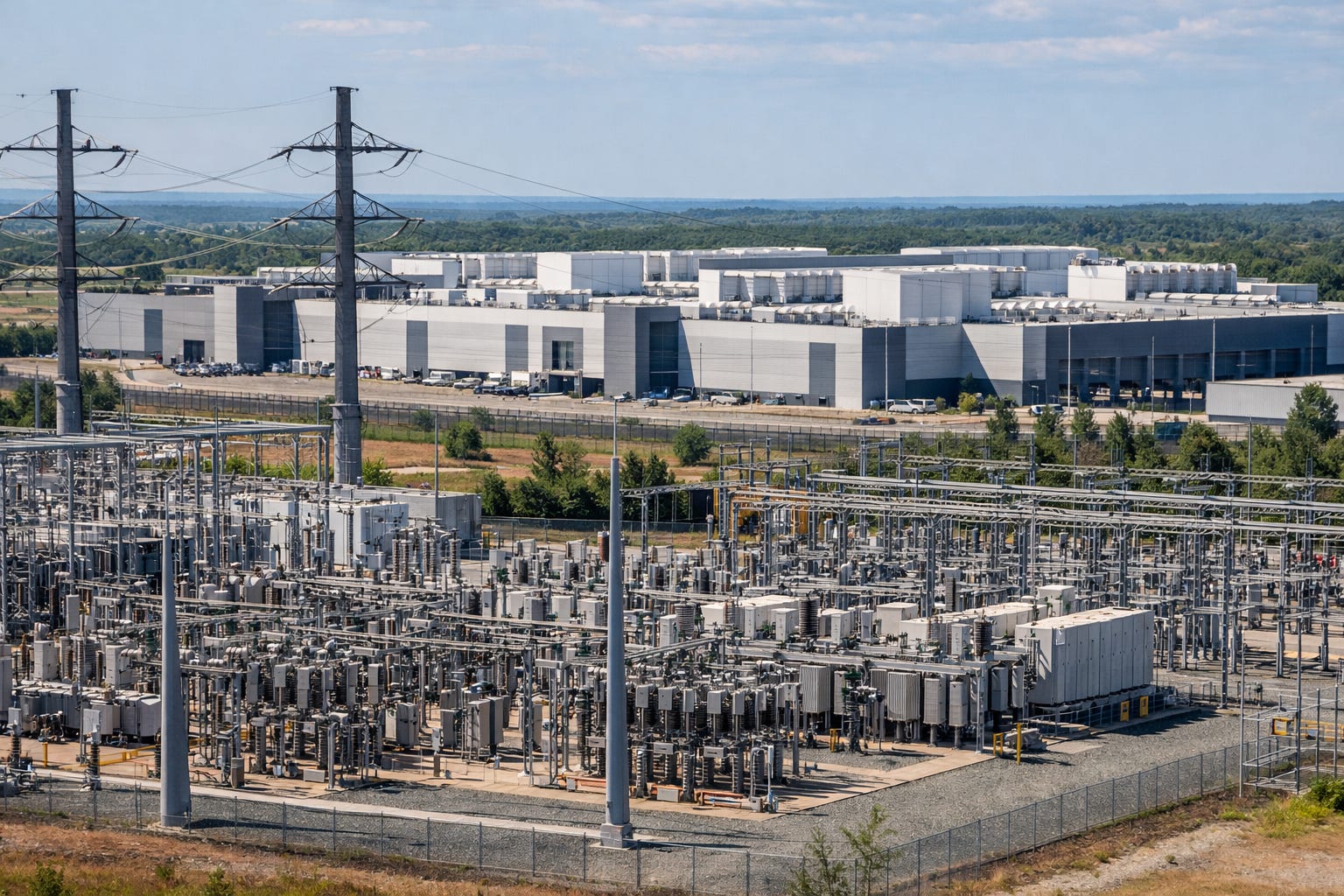
Large data centers are no longer speculative projects on the horizon. They are being proposed, approved, and constructed at a pace that is reshaping regional power grids, water systems, and local land use across the country. The debate often centers on whether this expansion is inevitable, as if the only question left is how quickly it should happen.
That framing obscures the more important issue. The environmental damage associated with large-scale computing is not an unavoidable consequence of technology itself. It is the result of decisions made or avoided before permits are signed and construction begins.
If communities are going to host facilities that consume as much electricity as small cities and operate around the clock, responsibility cannot be treated as an afterthought. It must be defined clearly, evaluated publicly, and required as a condition of approval. Promises about future sustainability reports or voluntary offsets are not substitutes for binding standards that shape how a project is built and how it operates.
This is not an argument against innovation or economic development. It is an argument for clarity about what responsible development requires at the scale now being proposed. If we are serious about minimizing environmental harm, then we should be able to describe, in advance and in detail, the standards every large data center must meet before the first shovel touches the ground.
This is a continuation of our previous reporting. See the earlier installments here:
Note: Articles roll into our archive over time. Become a paid subscriber for unlimted access to our extensive archive.
The Clean Option Nobody Mentions
·When Elon Musk recently announced the mega merger of his SpaceX and xAi entities to build data centers in space, experts weighed in immediately. The idea of launching solar-powered AI data centers into orbit sounds futuristic, but it quietly expose…


Not anti-technology, but pro-accountability
What follows is not a wish list. It is a blueprint for the conditions that must be met before permission is granted.
This Community Is Powered by You
What started as a small circle has grown into something much bigger, and it’s all because of readers like you.
Every time you forward this email, post it on socials, or bring someone new into the fold, you’re helping build one of the most passionate, independent political communities out there.
Want to keep the momentum going?
Share this newsletter with someone who should be part of this conversation.
Thank you for being here. It means everything.
Location Is the First Environmental Decision
The most consequential environmental decision about a data center is made before any equipment is ordered or any cooling system is designed. It is the decision about where to place it. Location determines the carbon intensity of electricity, the strain on water resources, the efficiency of cooling, and whether the surrounding grid will absorb the load without fossil expansion.
Clean grids before cheap land
A responsible approval process would begin with a clean grid threshold. If the regional electricity mix is heavily dependent on fossil fuels and the addition of a large new load is likely to trigger new gas generation, that site should not qualify without binding mitigation. Siting a facility on a carbon-intensive grid and promising to offset emissions later does not reduce real-time impacts on the system.
Water stress is a disqualifier, not a footnote
Water availability must be treated with equal seriousness. Projects proposed in water-stressed basins or drought-prone regions should face heightened scrutiny or rejection if they would compete directly with municipal or agricultural demand for cooling. Average annual water figures are insufficient. Decision-makers should require peak and worst-case demand projections under extreme heat conditions before approval is granted.
Climate and transmission matter
Climate suitability also matters. Cooler regions allow for more frequent use of outside air and high-efficiency cooling, which reduces both electricity and water consumption. Approving a large data center in a hot climate that requires intensive evaporative cooling for much of the year is a choice that locks in higher resource use from the outset.
Transmission capacity must be demonstrated before permits are signed. Utilities should be required to show that the grid can serve the new load without emergency fossil additions or rate shocks to existing customers. If substantial upgrades are necessary, those costs and timelines must be transparent and incorporated into the approval record.
Siting is often treated as a matter of land availability and tax incentives. In reality, it is the foundation of environmental impact. If a project begins in the wrong place, no amount of post hoc mitigation can fully undo that initial decision.
Power Must Match Reality, Not Annual Accounting
Electricity is the defining environmental variable for a large data center. These facilities operate continuously, and their impact on emissions and grid stability depends not only on how much power they use, but on when and how that power is generated.
Hourly matching, not yearly math
Many projects rely on annual renewable energy accounting to support sustainability claims. Under that model, a facility can purchase renewable energy credits or enter long-term contracts that offset its yearly consumption on paper, even if it draws fossil-heavy power during peak demand hours. This accounting approach may satisfy voluntary corporate goals, but it does not prevent real-time strain on the grid or reduce marginal fossil generation when it matters most.
A responsible approval standard would require hourly or near-hourly matching between consumption and clean energy supply. If a data center cannot demonstrate access to low-carbon electricity during peak periods, it should be required to procure firm clean power, storage capacity, or other mechanisms that prevent it from increasing fossil dispatch during grid stress.
No silent fossil expansion
Utilities should also be required to disclose the marginal generation impact of serving the facility. It is not enough to state that a region’s average electricity mix is trending cleaner. Regulators must understand whether the next megawatt-hour demanded by the project will be met by wind, nuclear, hydro, storage, or natural gas.
If serving the facility requires the construction of new fossil capacity, that fact must be explicit in the approval process. Either the project must fund equivalent clean capacity that is operational before or alongside its load, or the approval should be reconsidered.
Responsible energy procurement is not a matter of corporate branding. It is a matter of physical grid behavior. Before permits are signed, developers should be required to demonstrate that their electricity demand will align with clean generation in real time, not only in annual summaries.
Cooling Systems Must Compete With Physics, Not Households
Cooling is often presented as a technical detail, but it is one of the most direct ways a data center can compete with surrounding communities for resources. Large facilities generate continuous heat, and the method used to remove that heat determines both electricity demand and water consumption.
Peak demand, not average consumption
A responsible approval process would require full disclosure of peak and worst-case water demand before permits are granted. Average annual figures do not capture the strain imposed during extreme heat events, when cooling loads spike, and water systems are already under stress. Regulators should require modeling that reflects high-temperature scenarios and drought conditions.
Enforceable water caps
Water Use Effectiveness, or WUE, should be publicly reported and incorporated into permit conditions. If a facility’s cooling design depends heavily on evaporative systems in a region that experiences periodic water shortages, approval should be contingent on enforceable limits or alternative designs. Closed-loop systems and advanced liquid cooling approaches should be evaluated as baseline options rather than optional upgrades.
Cooling choices must also account for cumulative impact. A single facility may appear manageable in isolation, but clusters of large data centers can amplify water withdrawals, straining aquifers and surface water systems. Approval processes should require cumulative impact analysis where multiple facilities are proposed within the same watershed.
Drought triggers should be written into operating conditions. If regional water supplies fall below defined thresholds, facilities should be required to reduce water-intensive cooling operations or shift to alternative systems. Cooling systems must compete with physical limits, not household needs.
Waste Heat Is Infrastructure, Not Exhaust
Large data centers convert nearly all of the electricity they consume into heat. That heat is usually treated as a problem to be expelled into the atmosphere, but at a sufficient scale, it becomes an energy resource that can be captured and reused.
Evaluate reuse before construction
A responsible approval process would require a formal heat reuse feasibility assessment. Developers should evaluate whether nearby residential districts, industrial facilities, campuses, or district heating systems could realistically absorb waste heat. This assessment should be documented in the public record before permits are granted.
If reuse is technically viable, integration should not be optional. Binding commitments to connect to district systems or industrial partners should be incorporated into approval conditions.
Heat reuse does not eliminate energy intensity, but it can materially reduce total regional emissions by displacing other heating sources. Before permits are signed, decision-makers should know whether a facility will function solely as a consumer of regional resources or also as a contributor to shared infrastructure.
Grid Partnership Must Be a Condition of Operation
Large data centers function as industrial infrastructure with power demands comparable to those of small cities. That scale carries obligations that should be defined before operation begins.
Mandatory demand response and storage
A responsible approval framework would require mandatory participation in demand-response programs. Facilities with flexible workloads should reduce or shift non-essential computing during grid emergencies. On-site energy storage should be evaluated as a baseline expectation to reduce reliance on diesel generators and limit sudden spikes in grid demand.
Transparent backup limits
Backup generation deserves explicit limits. Permits should specify maximum allowable operating hours and require public reporting. Curtailment commitments should be established in advance so that large facilities reduce consumption during grid emergencies rather than forcing utilities to compensate with fossil dispatch.
Before the first server is powered on, regulators should know that the facility will behave as a cooperative element of the grid, not as an isolated consumer insulated from broader consequences.
Binding Limits, Not Voluntary Sustainability Reports
Environmental responsibility does not survive expansion unless it is written into enforceable conditions. Voluntary sustainability pledges do not create legal obligations that persist under pressure.
Conditions that survive expansion
Water use caps, emissions limits, cooling requirements, demand-response participation, and reporting obligations should be explicit conditions of operation. Expansion triggers should require additional review if load or water demand exceeds the scope originally evaluated.
Public reporting must be structured and consistent. Enforcement mechanisms and penalties must be defined in advance so that noncompliance is not treated as a negotiation.
Binding limits ensure that responsibility remains aligned with operation over the long term. Without them, responsibility remains optional.
Permission Is Leverage
The moment of greatest influence in any large infrastructure project is before permits are signed. Once a data center is built, its power demand becomes embedded in the grid, its cooling systems become integrated into local water infrastructure, and its expansion becomes easier to justify than its restraint.
The standards outlined here are not theoretical. They reflect existing technology and the physical realities of electricity, water, and heat. They do not prevent development. They define the terms under which development can proceed without quietly transferring environmental and financial risk onto surrounding communities.
Communities cannot control global computing demand. They can control the conditions under which large facilities operate within their borders. That control exists only at the point of approval.
The choice is not between innovation and protection. It is between conditional approval and automatic approval. If a project cannot meet clear environmental standards before construction begins, the responsible answer is not to negotiate them later. It is to withhold permission until it can.
Permission is leverage. Once it is given without conditions, it rarely returns.
Support Independent Media
If this piece made one thing clear, it is that the most important environmental decisions happen before anyone is paying attention. That kind of reporting does not come from press releases or ribbon cuttings. It comes from digging into what should be required, not just what is promised.
The Coffman Chronicle is fully reader-supported, so it can keep asking those questions before the permits are signed.
If you value reporting that turns process into leverage and clarity into accountability, consider becoming a paid subscriber. Your support keeps this work independent and built to last.
Support independent media and become a paid subscriber if you have the means.
Sources:
Electricity 2024 — International Energy Agency, January 24, 2024.
Energy and AI — International Energy Agency, April 10, 2025.
Best Practices Guide for Energy-Efficient Data Center Design — U.S. Department of Energy, 2024.
Water Usage in Data Centers: Understanding and Reducing Risk — Uptime Institute Journal, June 17, 2016.
Drained by Data: The Cumulative Impact of Data Centers on Regional Water Stress. Ceres, September 23, 2025.
Long-Term Reliability Assessment. NERC.
Data centers and crypto. They both have the same kind of effect on the environment.
The billionaire techno-bro-ligarchy has been behind all of it.
On average, each of the current 5,400 Data Centers in the US consumes 50MW of electricity, produced primarily by fossil fuel burning electric plants, and generates 4.1 X 10 to the 7th BTUs per day, so a total from all 5,400 of 2.2 X 10 to the 11th. And the number of these suicidal Data Centers is predicted to double over the next 4 yrs. As Jeff Goodell describes in his must read "The Heat Will Kill Us First", we are already producing/trapping (CO2) the heat energy equivalent of 8-11 Hiroshima nuclear bomb blasts PER SECOND, where each one releases the heat energy equivalent of 15 Kt of TNT, or 6.3 X 10 to the 13th J. So far we have been spared from bursting into flames by 1.2 trillion tons of melting global ice (each pound absorbs 144 BTUs) and 321 million cubic miles of rapidly heating oceans. NOAA's "surface analysis" weather map online today is showing Atlantic Ocean temps in the 60's and by summer it will be higher, worldwide. This hydrological cycle is our AC and it's already strained to the breaking point as we continue to listen to a madman in DC and burn 8 B tons of coal annually, along with 100 M barrels of oil DAILY. So, adding another 2.2 X 10 to the 11th BTUs per DAY. may not look like much but Our Dear Mother Earth has had Her fill of our greed, human overpopulation, and overconsumption. Still want to bring another innocent life into this dying world, only to suffer and perish from all of the consequences of climate collapse? Hmmmm? Have a blessed day.