


For more than 50 years, Big Oil has known exactly what its business model would cost the planet. Exxon’s scientists warned of global warming in the 1970s. Chevron, Shell, and BP all had the data. They didn’t just predict climate change; they mapped it out in detail.
And then they buried it.
Instead of leading the transition to cleaner energy, they chose profit over responsibility. They poured billions into disinformation, lobbying, and political manipulation, convincing the public that climate science was "uncertain," delaying action for decades, and ensuring their grip on power stayed firm.
Now, as wildfires rage, coastlines flood, and the world shifts toward renewable energy, these same companies aren’t adapting. They’re cashing out. They're propping up their outdated business model by demanding more public land, fewer regulations, and endless political favors.
This isn’t about energy security. It’s not about jobs. It’s about squeezing every last drop of profit from a system they knew was doomed, and making the public pay for it.
Big Oil’s crisis isn’t accidental. It’s the result of a half-century con, and they’re still running it.
Independent News. Just $1/Week.
We just hit 12,000 subscribers—thank you! To celebrate, we’re offering full access to The Coffman Chronicle for just $1 a week ($52/year).
Get exclusive analysis and fearless reporting you won’t find in corporate media.
Support truth. Stay informed.
Section I: What They Knew & When They Lied
In 1977, senior scientists at Exxon delivered a clear warning to company executives: burning fossil fuels would heat the planet, melt glaciers, raise sea levels, and trigger dramatic climate shifts within decades. By 1982, Exxon’s internal models accurately predicted the rise in global temperatures we’re experiencing today.
They knew. Not suspected. Not theorized. Knew.
But instead of sounding the alarm, Exxon made a choice, the same choice that would define Big Oil for generations. They shut down open research, buried their findings, and launched a campaign to manufacture doubt where none existed.
They weren’t alone for long. By the mid-1980s, Chevron, Shell, and BP had conducted similar internal studies, reaching the same conclusion: their business was fueling a global crisis. Like Exxon, they opted to protect profits across the planet, quietly aligning through trade groups like the American Petroleum Institute (API) to coordinate a message of “uncertainty.”
By 1989, Exxon’s commitment to denial was on full display— not just in boardrooms but across pristine waters.
When the Exxon Valdez ran aground off Alaska’s Prince William Sound, it wasn’t just an environmental catastrophe but a corporate reckoning. Exxon could have chosen that moment to change course, to acknowledge the risks of fossil fuel dependency, and lead a new era of responsibility.
Instead, they lawyered up, fought cleanup costs, downplayed the damage, and doubled down on business as usual.
The spill was eventually cleaned, but Exxon’s denial and deflection business model remained firmly in place.
And as the oil washed ashore in Alaska, Big Oil’s decades-long campaign to muddy the waters of climate science was just getting started.
Section II: The Cost of Doing (Big Oil’s) Business
For Big Oil, environmental disasters aren’t anomalies; they’re the cost of doing business. And it’s never the companies that pay that cost.
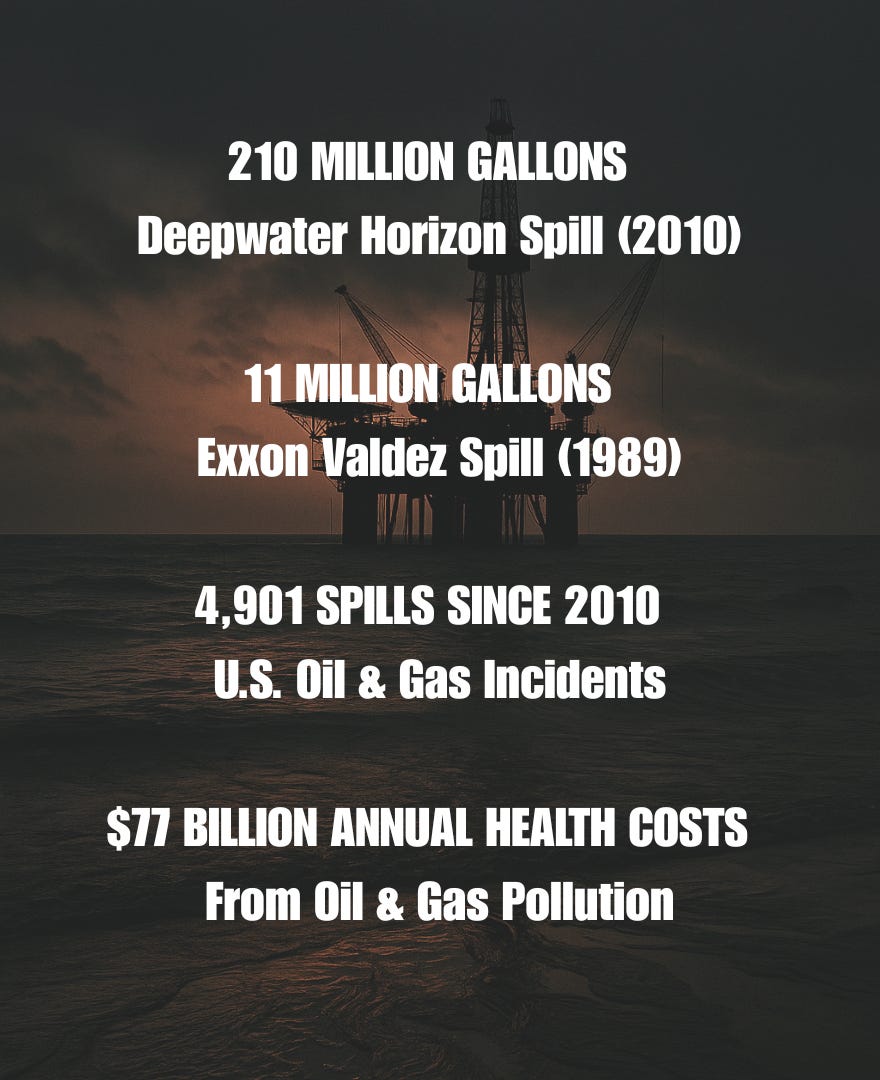
Perhaps the most iconic for many was in 1989, when the world watched in horror as 11 million gallons of crude oil spilled from the Exxon Valdez, coating Alaska’s coastline in toxic black sludge. Televisions worldwide were filled with unsettling images of ducks caked in crude, as dedicated environmentalists used Dawn to clean wildlife washed ashore. Local fisheries collapsed, and entire ecosystems were poisoned. Some still haven’t recovered.
Two decades later, BP showed that the industry had learned nothing. The Deepwater Horizon explosion in 2010 dumped 210 million gallons of oil into the Gulf of Mexico, killing marine life, devastating coastal economies, and creating a slick so massive it was visible from space.
But those are just the disasters that made headlines.
Between 2010 and 2022 alone, there were 4,901 reported oil and gas spills across the U.S., an average of one spill every day. Pipelines leak, tankers rupture, rigs fail, and refineries pollute, leaving communities with poisoned water, toxic air, and shattered livelihoods.
And while Big Oil executives collect bonuses, Americans absorb more than just environmental damage. The health costs from oil and gas pollution in the U.S. exceed $77 billion yearly, paid in hospital bills, respiratory diseases, and lives shortened by exposure to toxins the industry shrugs off as collateral damage.
These aren’t accidents. They’re inevitabilities, written into a business model that values profit over prevention, denial over accountability.
For decades, Big Oil has spilled, polluted, and poisoned with impunity, knowing full well that cleanup efforts would be minimal, fines would be negotiated down, and the true cost would be pushed onto ecosystems and everyday people.
While coastlines were blackened and airways clogged with toxins, these companies were already working behind the scenes to ensure they could keep operating the same way, protected not by safety protocols but by political influence.
Read our most recent reporting on the groups pulling political strings here:

Section III: Follow the Money. Lobbying, Laws, and Lies
Big Oil didn’t survive half a century of scientific consensus by accident. It survived because it paid to delay reality, and there’s no shortage of politicians, think tanks, and lobbyists willing to sell the truth for the right price.
The blueprint was written in 1998, when the American Petroleum Institute (API) drafted its now-infamous "Victory Memo." The goal was clear:
“Victory will be achieved when average citizens ‘understand’ (recognize) uncertainties in climate science.”
There were no uncertainties, only a strategy to manufacture them. API coordinated with Exxon, Chevron, Shell, BP, and a web of so-called think tanks like the Heartland Institute, Cato Institute, and Competitive Enterprise Institute. Their mission: flood the media, schools, and politics with doubt, stall regulations, and keep fossil fuel profits flowing.
And it worked.
While scientists warned of rising seas and burning forests, Big Oil funneled billions into Washington. In just the last election cycle, oil and gas interests spent over $140 million on lobbying, and that’s not counting the dark money routed through PACs and front groups.
Some politicians became household names not for serving the public, but for serving the fossil fuel industry:
Senator Joe Manchin (WV) — Big Oil’s most reliable vote.
Senators Ted Cruz & John Cornyn (TX) — Champions of deregulation.
Senator Mitch McConnell (KY) — Fossil fuel loyalty, filibustered into law.
Rep. Kevin McCarthy (CA) — Green talk, black gold backing.
Senator James Inhofe (OK) — Climate denier-in-chief.
As public awareness grew and outright denial became harder to sell, the strategy shifted. Climate change wasn’t a "hoax" anymore. It became a "challenge" solvable by fantasy technologies and rebranded fossil fuels.
This is greenwashing, not progress.
Behind every wind turbine in a commercial is a boardroom expanding drilling operations. The message may have changed, but the mission never did: delay, distract, and drill.
We’ve covered this administration’s attacks on the EPA previously. For more information, consider these articles:
Note: These articles are more than 45 days old and now live in the archive. Consider becoming a paid subscribe for the full 450+ article archive, exclusive content, and occasional early access.


Section IV: The Business Model of Refusing to Adapt
Big Oil had every opportunity for decades to lead the transition to cleaner energy. They had the science, the capital, and half a century of warning. They could have led and profited from the transition. They could have been the heroes.
Instead, they doubled down on drilling, lobbying, and squeezing profits from a business model they knew was unsustainable.
Despite earning record profits, these companies still cry poverty anytime regulations threaten their bottom line or markets shift toward renewables:
$20 billion/year in U.S. subsidies.
Millions of idle federal acres held hostage.
Exxon’s $56 billion profit in 2022, while demanding more drilling rights.
When asked about green energy, they point to token projects and hollow promises, while less than 5% of their spending touches actual renewables.
Big Oil isn’t being forced out by a hostile market. It’s clinging to a dying monopoly and demanding taxpayers keep it alive.
Some states are trying to hold oil companies accountable. See our reporting here:
Note: This article is now in the archive as well. Please consider becoming a paid subscriber for access.

Conclusion: We Don’t Owe Them a Damn Thing
Big Oil’s story isn’t one of survival. It’s a story of sabotage.
They sabotaged the science.
They sabotaged the truth.
And now, they’re sabotaging the future.
For over 50 years, these companies knew exactly where their business model would lead. They had every chance to adapt, to innovate, to lead the world into a cleaner, more sustainable era. Instead, they chose denial, disinformation, and profit at any cost.
Now, as the world faces the consequences they predicted—and hid—they’re holding out their hands. Not in apology. Not in accountability. But for more.
More public land.
More subsidies.
More time to keep extracting, polluting, and lying because they refuse to face the reality they helped create.
Let’s be clear:
We don’t owe Big Oil our forests, coastlines, or public lands.
We don’t owe them tax breaks, deregulation, or political protection.
We don’t owe them patience, sympathy, or trust.
What we owe—to ourselves, to future generations, and the planet—is to finally call this what it is:
Not a struggling industry.
Not an essential service.
But a con—decades in the making, fueled by greed, and long overdue for its end.
And the sooner we stop subsidizing their survival, the sooner we can start building something better without them.
We just hit 12,000 subscribers—thank you! We’re offering full access to The Coffman Chronicle for just $1 a week ($52/year) to celebrate.
Get exclusive analysis and fearless reporting you won’t find in corporate media.
Bibliography:
Banerjee, Neela, Lisa Song, and David Hasemyer. "Exxon: The Road Not Taken." Inside Climate News, September 16, 2015.
Carrington, Damian. "Revealed: The Oil Lobby’s $10m Plan to Stop Climate Action." The Guardian, July 19, 2021.
History.com Editors. "Exxon Valdez Oil Spill." History.com, March 23, 2021.
National Commission on the BP Deepwater Horizon Oil Spill. Deep Water: The Gulf Oil Disaster and the Future of Offshore Drilling. January 2011.
OpenSecrets. "Oil & Gas: Top Contributors to Federal Candidates, Parties, and Outside Groups." OpenSecrets.org, 2024.
Visual Capitalist. "Mapped: Oil and Gas Spills in the U.S. Since 2010." VisualCapitalist.com, October 13, 2022.
U.S. Environmental Protection Agency. "Understanding Oil Spills and Oil Spill Response." EPA.gov, December 1999.
"Energy giants spent $1bn on climate lobbying, PR since Paris: watchdog." Phys.org, March 22, 2019.
Brulle, Robert J. "Institutionalizing Delay: Foundation Funding and the Creation of U.S. Climate Change Counter-Movement Organizations." Climatic Change, December 2013.
The rare earth's....
Read recently that the Department of the Interior's plan is to be renamed as the Department of Land and Minerals. Of course the plan is to rape our public lands of their natural resources, likely first the Bureau of Land Management (BLM) lands then the National Parks and National Monuments. The Forest Service under the Trump admin USDA has announced plans to cut down far more forests than required that will actually increase forest fire risks, all while Park Service, Forest Service, and fire fighter staff is reduced. Legal notice to pursue development on public lands has just been reduced to 28 days that will essentially avoid all legal ability to review and delay and with the intent to halt these rape and plunder projects. I hope that the strongest environmental justice NGO's can fight these egregious acts. Please donate to EarthJustice, NRDC and others like them if you are able to do so in this battle for our lands.