

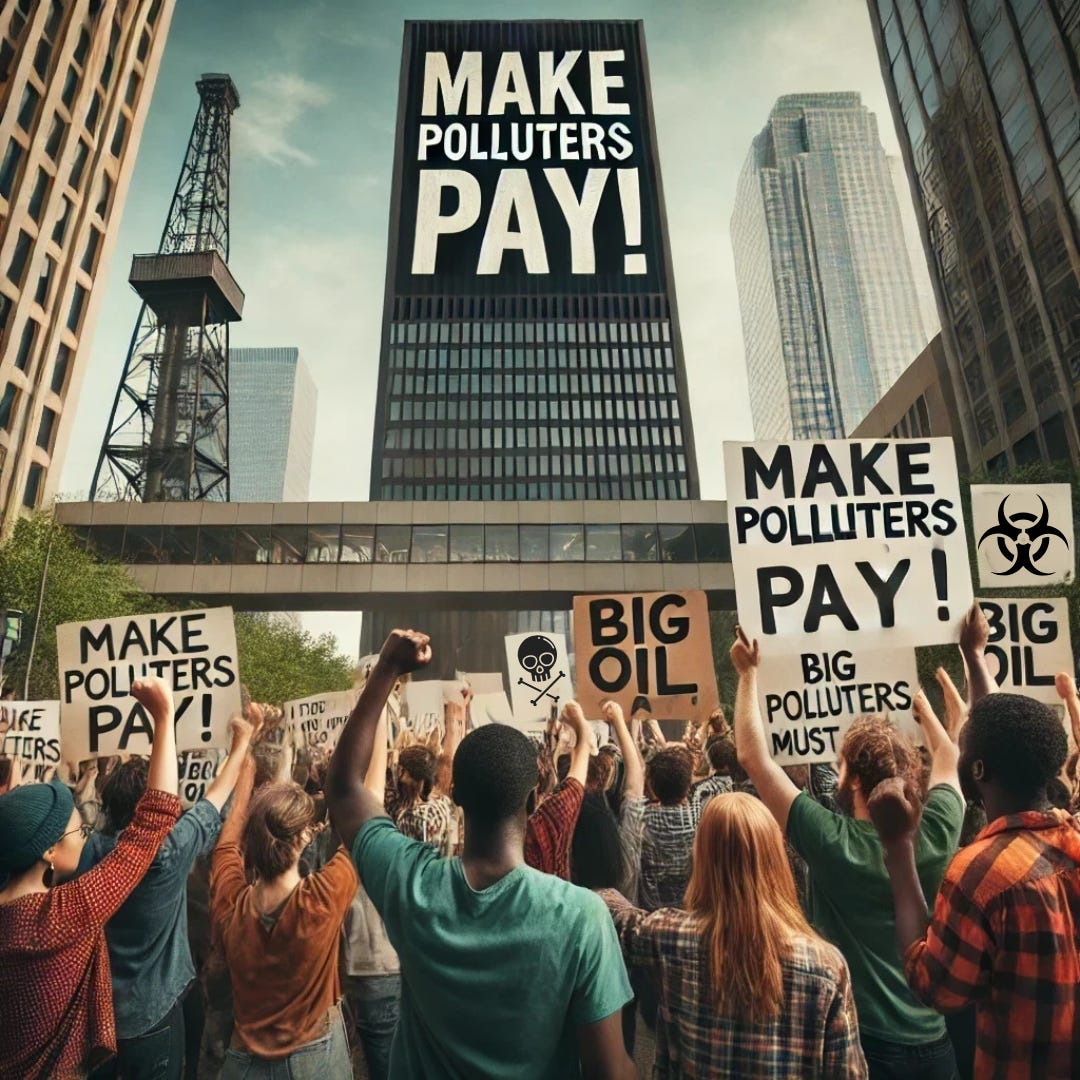
Climate change isn’t a distant threat—it’s here, now, and wreaking havoc. While Congress remains gridlocked and federal courts weaken climate protections, states like Vermont, New York, and California are taking matters into their own hands. Their message is clear: taxpayers shouldn’t foot the bill for climate disasters while fossil fuel corporations rake in record profits.
The Coffman Chronicle is powered by YOU—no billionaires, no corporate overlords. Help us expose the BS, deliver sharp insights, and keep you informed.
You can fuel the fight and join the movement for just $8 a month or $80 a year.
Not ready to subscribe? No worries, chaos loves company, and you're always welcome.
California’s Bold Move
California’s Polluters Pay Climate Superfund Act (SB 684/AB 1243) is the latest in a wave of state-led climate accountability measures. This bill would force companies that emitted over 1 billion metric tons of greenhouse gases between 1990 and 2024 to pay fees that fund wildfire prevention, disaster response, and clean energy initiatives, especially in communities hardest hit by climate change.
California isn’t alone. Vermont and New York have passed similar laws, and Maryland and Massachusetts are considering their own versions. These efforts aren’t just about climate policy—they’re a fight for justice. The fossil fuel industry has spent decades shifting the costs of pollution onto the public. These laws aim to reverse that, making polluters pay their fair share.
Why States Are Taking Matters Into Their Own Hands
For years, the federal government has failed to take bold climate action. But under Trump’s second term, the situation has gone from bad to worse—federal climate protections are being dismantled at an alarming pace.
Trump has gutted Biden’s clean energy policies, weakening incentives for wind, solar, and electric vehicles under the Inflation Reduction Act.
The administration has ramped up drilling and expanded oil and gas leases on public lands and in the Arctic, further fueling the climate crisis under Drill, Baby, Drill.
The EPA has been defunded and weakened, making it harder to regulate pollution or enforce existing climate laws.
Trump’s Supreme Court appointees have solidified a conservative majority, making it more difficult for federal agencies to enact climate regulations.
With Congress controlled by fossil fuel allies and the courts undermining climate action, states have no choice but to act on their own.
A State-Led Climate Rebellion?
If these climate superfund laws succeed, they could force fossil fuel companies to pay up despite Trump’s federal rollbacks. If struck down, however, they could reinforce the notion that Big Oil is untouchable at every level of government.
Either way, states aren’t waiting for Washington anymore. They can’t afford to.
Big Oil’s Legal Battle Against Accountability
Predictably, Big Oil isn’t backing down. The American Petroleum Institute (API) and the U.S. Chamber of Commerce have sued Vermont, claiming its law unfairly targets out-of-state companies. Meanwhile, New York’s $75 billion Climate Change Superfund Act faces a lawsuit led by 22 Republican attorneys general, arguing that penalizing past emissions is unconstitutional.
The outcome of these legal fights is critical. If these laws hold, they could set a national precedent for climate accountability. If struck down, they risk emboldening fossil fuel companies to continue polluting without consequences.
The True Cost of Federal Inaction
With federal climate action stalled, states are stepping in for three key reasons:
Climate disasters are escalating. Wildfires in California, record floods in Vermont, and billion-dollar hurricanes on the East Coast devastated communities in 2024.
The financial burden is unsustainable. Climate disasters cost the U.S. hundreds of billions annually—costs that taxpayers, not polluters, overwhelmingly bear.
Environmental justice is long overdue. Low-income communities and communities of color bear the brunt of pollution, and these laws prioritize funds for those most affected.
For decades, Big Oil has privatized profits while socializing the costs of climate destruction. These state-led initiatives could finally flip the script.
The Growing Climate Justice Movement
Critics claim these laws could raise energy prices or harm the economy. However, studies show the opposite: holding polluters financially accountable incentivizes cleaner technologies, accelerates the transition to renewable energy, and ultimately saves taxpayers billions in climate disaster recovery costs.
Momentum is building. Lawmakers in Maryland, Massachusetts, and other states are considering their own climate superfund laws. If enough states take action, pressure on the federal government to follow suit will be impossible to ignore.
What Comes Next?
California’s proposal faces fierce opposition from industry lobbyists. The lawsuits against Vermont and New York could set legal precedents that define the future of climate accountability. The stakes couldn’t be higher.
Will these bold efforts survive corporate pushback, or will Big Oil escape responsibility again? The answer depends on us. Public support, grassroots activism, and voter pressure will ensure these laws not only pass but also hold fossil fuel giants accountable.
One thing is clear: states aren’t waiting for Washington anymore. And this could be the beginning of a national reckoning for corporate polluters.
Bibliography
California Legislative Information. (2025). SB 684/AB 1243 – Polluters Pay Climate Superfund Act. https://legiscan.com/CA/text/SB684/id/3137202
New York State Senate. (2024). Climate Change Adaptation Cost Recovery Program. https://www.nysenate.gov/legislation/bills/2023/S2129
Center for Biological Diversity. (2025). Lawmakers Introduce California Bill to Make Polluters Pay for Climate Damage. https://biologicaldiversity.org/w/news/press-releases/lawmakers-introduce-california-bill-to-make-polluters-pay-for-climate-damage-2025-02-19/
Greenpeace USA. (2025). Greenpeace USA Supports the Polluters Pay Climate Superfund Act in California. https://www.greenpeace.org/usa/greenpeace-usa-supports-the-polluters-pay-climate-superfund-act-in-california/
Food & Water Watch. (2025). Food & Water Watch Applauds Introduction of Groundbreaking Climate Superfund Bill in California. https://www.foodandwaterwatch.org/2025/02/21/food-water-watch-applauds-introduction-of-groundbreaking-climate-superfund-bill-in-california/
Reuters. (2025). Analysis: As Trump Slashes Climate Action, Can States and Cities Pick Up the Slack? https://www.reuters.com/sustainability/boards-policy-regulation/analysis-trump-slashes-climate-action-can-states-cities-pick-up-slack-2025-02-27/
Vox. (2025). Trump's EPA Wants to Undo the Roe v. Wade of Climate Policy. https://www.vox.com/climate/401845/epa-climate-lee-zeldin-endangerment-finding
The Guardian. (2025). All the Executive Orders Trump Has Signed So Far. https://www.theguardian.com/us-news/2025/jan/29/donald-trump-executive-orders-signed-list
Associated Press. (2025). After a Month of Trump's Pro-Oil and Gas Moves, Dems Target His Energy Emergency. https://apnews.com/article/960ceedcd9d55d2a658b5c6b270ee632
Georgetown Environmental Law Review. (2025). States v. Trump: The Second-Term Climate Fight Fast Becoming a Constitutional Crisis. https://www.law.georgetown.edu/environmental-law-review/blog/states-v-trump-the-second-term-climate-fight-fast-becoming-a-constitutional-crisis/