

Buried in the Process: How One Committee Quietly Rewrote America’s Professional Class
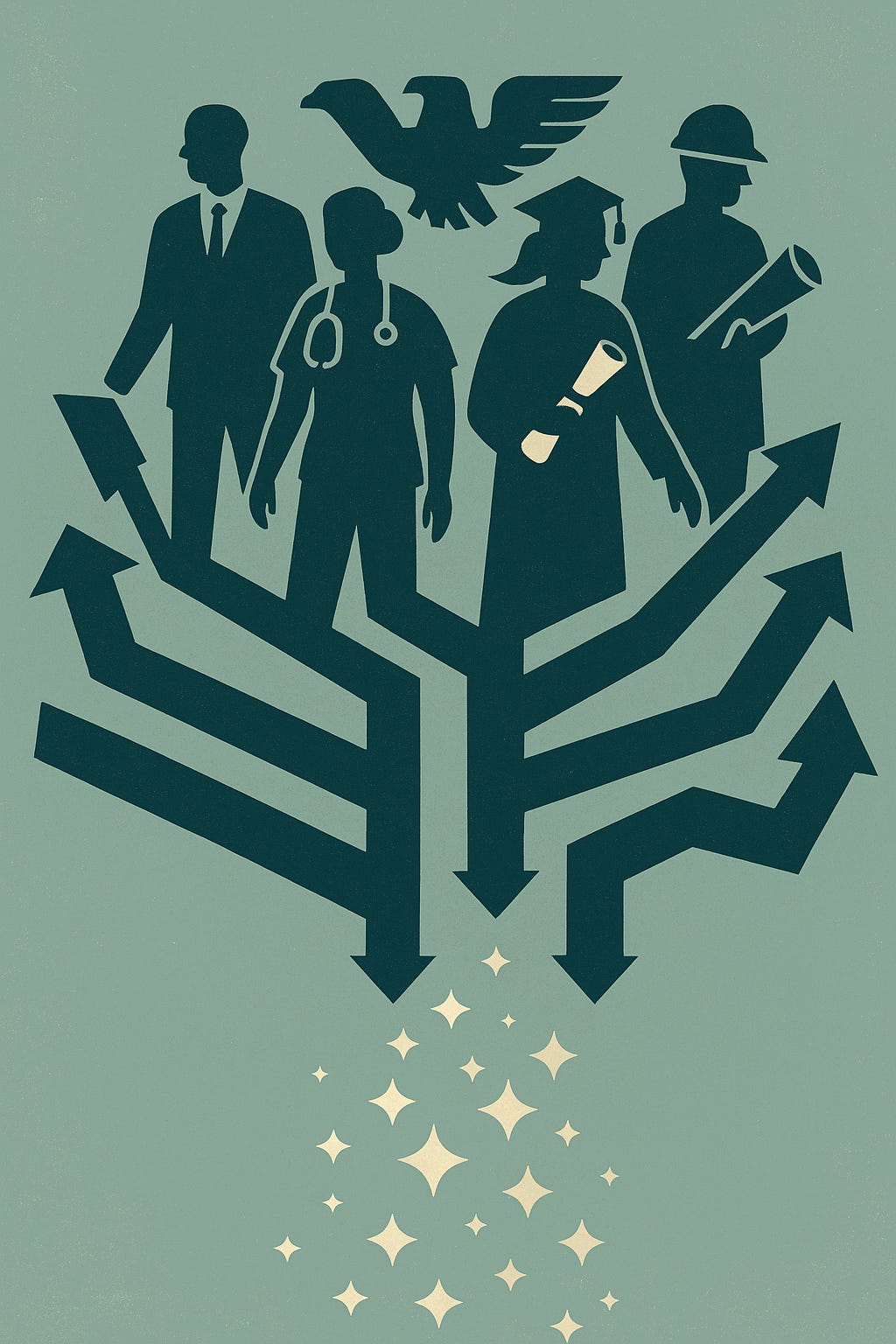
When loan access collapses, the pipeline collapses. And when the pipeline collapses, so does everything else.

Yesterday, we told you about the Department of Education's redefinition of professional degrees and how it impacts care professions. Today, we will discuss why this is catastrophic for all workers and Americans.
To recap, when the One Big Beautiful Bill passed in July, almost no one thought too much of the RISE Committee’s mandate. It looked like bureaucratic housekeeping, just a line item buried in a thousand-page document.
Earlier this month, as the results of the Committee’s meetings were finally announced, it became clear that the change isn’t a tweak. It’s a time bomb.
This new definition of “professional degree” protects only a tiny cluster of high-prestige fields, while every other discipline falls into a risk category where loan access can be restricted or eliminated altogether. You read that right. Every other degree category that is not explicitly cited also falls under the lower loan cap.
But wait. There’s more. Alarmingly, it has now been revealed that under the wage-based accountability rules also in the bill, entire programs can lose eligibility if their graduates don’t earn more than local non-degree workers.
That standard alone endangers nearly every graduate degree in the United States. As states and localities have begun to raise the minimum wage, degreed job wages have remained stagnant, and many fall well below that threshold, especially during the first five years of employment.
The worst part is that the fallout isn’t theoretical. It’s predictable.
Want to Know Your Rights?
Download a free digital copy of the U.S. Constitution—the same document Trump is trying to bulldoze. Learn exactly what he’s breaking… and how to fight back.
65,000+ strong — and counting.
This Early Black Friday, become a paid subscriber for just $1 a week and help us keep the truth alive.
Join The Coffman Chronicle — $1/Week Early Access
A Policy That Alters Every Workforce Pipeline
America is already struggling to staff its essential professions.
Schools can’t hire teachers. Hospitals can’t retain nurses. Public health departments have never recovered from the pandemic. Social work agencies are drowning. Laboratories are short-staffed. STEM industries can’t recruit enough graduates. Businesses can’t fill analyst and accounting roles.
Why? These fields require extensive training, licensure, and advanced degrees, and traditionally do not pay well, especially early in one's career. Many also include months, if not years, of unpaid or low-paid internships, practicums, clinicals, and so forth before the experience and education requirements are met.
These shortages aren’t mild. Many are existential. These are stressful, demanding jobs with high burnout, turnover, and aging workforces.
Now imagine making it harder, or impossible, for ordinary students to access the degrees these fields require. Imagine programs shrinking, closing, or being labeled “failure risks” simply because a region pays poorly or because public-sector wages haven’t kept pace with inflation for 30 years.
This isn’t belt-tightening. It’s a structural collapse.
Who Will Fill the Gap?
Working- and middle-class students rely on federal loans. If those loans evaporate, the pipeline evaporates with them. People don’t suddenly pivot to protected elite fields like law or medicine. They leave higher education entirely.
And the wealthy? They do not staff society. They rarely go into teaching, social work, lab science, librarianship, public health, or the vast majority of clinical support roles. Even if they wanted to, there aren’t enough of them.
The result is simple: You lose the workers who make a modern society function.
And once they are gone, no amount of money or prestige conjures them back.
This Makes America Weaker Fast
In fact, Trump himself has already admitted that the United States is not producing enough educated workers to sustain its economy. In a Fox News interview with Laura Ingraham in early November, he pushed back hard when she suggested America had “plenty of talented people,” negating his rationale for seeking more student visas from nations such as China. His response was blunt: “No you don’t.” He went further, insisting the country needs to “bring in talent” because “you don’t have certain talents” domestically.
It was a rare moment of unfiltered honesty, and a direct contradiction of the loan rules his own administration was already implementing. If the United States already “doesn’t have certain talents” before the OBBB rules go into effect, then gutting access to graduate education is not just incoherent. It is self-sabotage. The policy ensures the country produces even fewer trained workers, making his statement not just a critique, but a self-fulfilling prophecy.
The United States was already falling behind. This accelerates the slide, and rather than addressing the need for better-educated, better-trained American workers, his solution is to reverse course on student visas.
A country that cuts off its own talent supply has chosen decline.
There Are No Winners
This begs the question. Why do this? Why now? If we are already educationally behind other nations, why make degrees harder to attain? Who wins?
It is easy to see who loses.
Students lose access to degrees.
Universities lose enrollment and funding.
States lose their professional workforce.
Hospitals lose nurses and clinical staff.
Schools lose teachers and counselors.
Corporations lose analysts, scientists, and technicians.
Families lose essential services.
The wealthy lose access to the labor they depend on.
The economy loses its engine.
So who wins?
For a very limited period, those who already hold a degree and the few who manage to earn one will be in high demand. However, eventually, the workload will be entirely too much, and the system will collapse.
There is no beneficiary, only consequences, for Americans.
The Group That Should Be Screaming Loudest
Corporations rely on the very workers this policy endangers. They need accountants, analysts, lab techs, mid-level managers, engineers, data specialists, public health strategists, and business graduates. They need an uninterrupted flow of talent to sustain innovation, meet compliance requirements, and keep operations running.
This change sabotages their supply chain.
Once the pipeline dries up, corporations face two options:
Radically increase wages to compete for the few remaining trained workers.
Pay out of pocket for the training and credentialing that universities used to provide.
Both scenarios cut into profits, the one thing corporations reliably fight to protect, and looming beneath those two expensive options is the third, even worse possibility. Soon, there may simply not be enough trained workers at all.
While the C-suite continues to bring home obscene packages, shareholders enjoy record profits, and tax policies have ensured generous tax loopholes, they do so on the backs of the labor of their underpaid skilled workers.
Corporations should be screaming. Instead, many haven’t even realized what’s about to hit them.
This Is Structural Self-Harm Disguised as Policy
You don’t need an economics degree to see the consequences. I sussed it out in less than an hour. Anyone who actually lives in this economy sees it instantly. Cutting off access to the degrees that staff your entire society doesn’t strengthen anything. It erodes everything.
A country that cannot train its own workforce cannot grow. A society that cannot replenish its essential professions cannot endure. A nation that undermines its own talent pipeline chooses decline.
And this policy — once implemented — does exactly that.
What Now?
This policy is not fully implemented yet. Several key elements still require federal rulemaking, and that means there is a window to act. Here are the most effective steps you can take:
1. Prepare to Submit a Public Comment (Early 2026)
The Department of Education is expected to open a public comment period in early 2026. When it does, speak up. Tell them how this policy will harm your field, your workforce pipeline, and your community. Public comments have real power in shaping the final rules.
2. Contact Your Professional Association
If you work in a field with a professional association, ask them to issue a formal statement and prepare their own comment. Organizations have leverage. They need to use it.
3. Ask Your Employer for Support
Your employer is likely affected by this as well. If they rely on skilled workers, ask them to use their voice to raise the alarm.
4. Call Your Elected Officials
Urge your representatives to pursue legislation to revise or repeal the RISE loan definitions and wage-based program tests, or, at a minimum, to delay implementation until real workforce-impact studies are conducted. Give them a specific ask. It makes your call matter.
And as always, talk about this with your family, friends, peers, and circles. Share reporting on this story. Ask questions. Demand answers.
Don’t let the bastards sneak anything past you. Subscribe and get your daily dose of rage and receipts delivered fresh, before the spin doctors can scrub it.
Sources:
“You Have Questions; We Have Answers: Making Sense of the Student Loan Changes from OBBBA’s RISE Committee”, National Association of Student Financial Aid Administrators (NASFAA), Nov 20, 2025.
“Proposal to Implement Loan Caps Threatens Access to Professional Degree Programs”, Association of American Universities (AAU), Nov 14, 2025.
“Five Take-Aways From the Department of Education’s Student Loan Rulemaking”, New America, Nov 17, 2025.
“U.S. Department of Education Concludes Negotiated Rulemaking Session to Implement One Big Beautiful Bill Act’s Loan Provisions”, U.S. Department of Education, Nov 6, 2025.
“New RISE Neg Reg Issue Papers Reveal Revised Definition of Professional Student”, NASFAA, Nov 3, 2025.
“Nursing programs lose professional degree status, threatening federal loan access”, WKYT, Nov 21, 2025.
“ED Reaches Consensus on Federal Student Loan Limits, Professional Programs”, Whiteboard Advisors, Nov 10, 2025.
Oh bloody hell...your analysis is spot on.
The most catastrophic consequence from our perspective is the attack on medicine/health, given our projections of the massive public health crisis that's already underway.
There’s already a nursing shortage, if loans are going to become difficult to get, because nurses aren’t “professionals” it’s going to get tougher. Treatments are going to get delayed, there will be an increase in med errors because of being rushed, assessments will be missed, IV’s not monitored, catheters not changed, need I go on?? These are LIVES we are talking about. One of the most rewarding parts of nursing is the personal parts, the acknowledgement of patient fears and reassurance, basic listening, interpretation and explanation of MD orders to make them understandable, comforting patients with terminal diagnoses and helping families understand what is happening to their loved ones and how they can help. Nurses must have ongoing education to keep their licenses, more for certification in specific areas. I became an RN over 40 years ago after 10 years in the mental health field, retired from being a home health psychiatric nurse about 4 years ago. If you notice, most of those fields labeled not professional are traditionally women’s professions. Teachers are another one —my brother is a high school history teacher who has the courage ( and is in a district that encourages this) to teach civics. He has a license which he has to keep up with ongoing education. And for those who say teachers get the summer off—they earned it, studies have shown they work more hours in that 9 month period than others who work full time year round. Do you want your kids taught by people who don’t have this level of dedication and love for this profession? Do you want to be cared for by a nurse who isn’t valued for the lives they help save and the comfort they bring to many? Trump is just a nasty human being, that’s all. What goes around comes around. Wait till he has to wait after ringing the call button…