


Nearly a decade ago, a small-town clerk became the face of a national controversy when she refused to issue marriage licenses to same-sex couples following the Obergefell v. Hodges decision. Her name was Kim Davis, and whether you remember her as a religious hero or a public servant gone rogue, she’s back in the headlines.
This time, it’s not viral news footage. It’s not a courthouse standoff. It’s a quiet but high-stakes moment: a pending petition before the U.S. Supreme Court. On November 7, 2025, the justices will decide in private conference whether to hear her case.
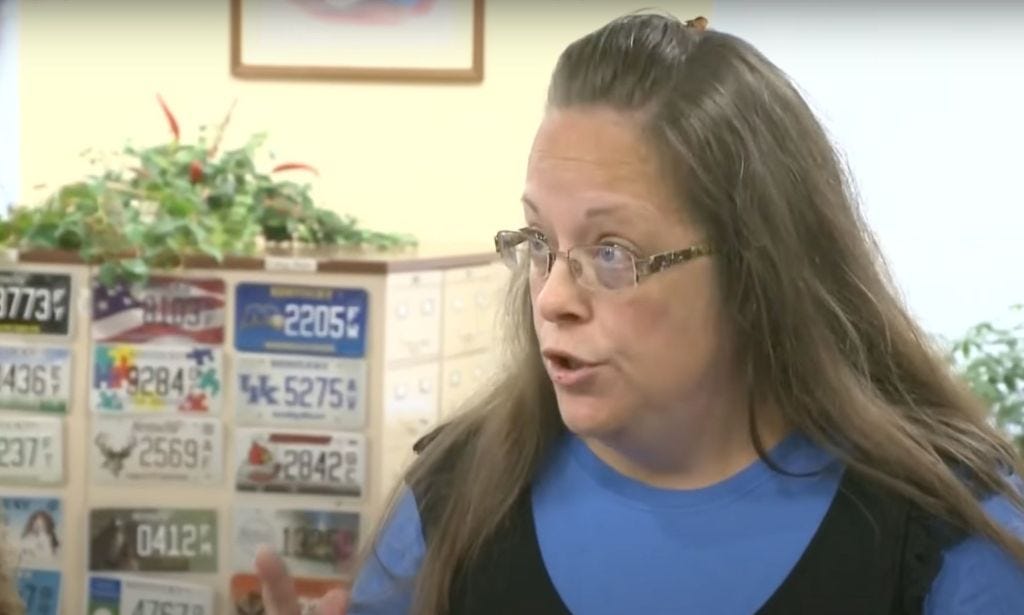
She’s baaackkkkk
Because democracy doesn’t defend itself, and neither does your sanity. Subscribe here to keep your eyes open and your sarcasm sharp.
What This Case Actually Is and What It Isn’t
Let’s be clear: this case doesn’t automatically mean the Supreme Court is reconsidering Obergefell v. Hodges. The petition comes to the Court as a question of whether Davis, acting in her official role, can be held personally liable for refusing to follow the law.
However, Davis herself is asking the Court to go further. In her petition, she calls on the justices to overturn Obergefell entirely, claiming the ruling had “no basis in the Constitution.” She portrays herself as a martyr of religious freedom. Her legal team calls this “the first time an American public official has been jailed for following his or her religious convictions in direct defiance of a civil‑rights‑based court order” — a claim that reflects their narrative, even if civil‑rights history includes other instances of imprisonment for resisting court‑mandated desegregation or voting‑rights enforcement
Whether or not the Court takes up that part of the case remains to be seen. However, the ask is there, and that makes this case more than a quiet procedural dispute. It’s a potential vehicle for re-opening a civil rights question many believed was settled.
Legal experts do not believe it is likely that the court will consider Obergefell, and the inclusion of this in the petition is likely an effort by Davis to be seen as a one-woman savior for “marriage sanctity”. Is it a risk? Yes, especially with this court. However, it is more likely that they will deny the petition altogether or only take up the personal challenge.
That means that what Davis is challenging is her personal accountability. She wants the Supreme Court to find that she should not be held liable for violating the constitutional rights of same-sex couples, because her refusal to issue marriage licenses was based on her religious beliefs.
She lost in lower courts and was ordered to pay damages. Now she’s asking for a ruling that would shield her — and by extension, other public servants — from similar consequences in the future.
Why This Matters and Where the Real Danger Lies
At first glance, this may seem like a narrow case: one county clerk, one refusal, one decade-old headline. However, beneath it lies a much broader and more dangerous question: can a public official refuse to perform the core duties of their job and block others from doing so, simply by citing religious belief?
That’s exactly what Kim Davis did. She didn’t just recuse herself from issuing marriage licenses. She ordered her entire office to stop issuing any marriage licenses at all. Her deputies, some of whom were willing to comply with the law, were prohibited from doing so under her authority. It wasn’t just about her conscience. It was about enforcing that conscience onto others.
This is where the religious exemption argument begins to unravel.
Religious freedom is about what you choose to believe and how you live your life. It is not a license to deny others their rights, and it certainly does not extend to restricting your colleagues from fulfilling their lawful duties. Davis wasn’t being asked to bless or condone a marriage she didn’t agree with. She was being asked to apply the law — a secular checklist — to two people who met the requirements.
What she did instead was convert a public office into a gatekeeping tool for private theology. And if the Supreme Court grants her request for immunity, they risk creating a dangerous precedent, one where personal religious belief becomes a shield against accountability, even when it results in the denial of civil rights.
That’s the real risk: a court-sanctioned loophole that lets public officials turn legal obligations into personal choices, leaving your civil rights at the mercy of someone else’s beliefs.
What About the Cake?
Some people may compare this to the Masterpiece Cakeshop case, the one where a baker refused to make a cake for a same-sex wedding. However you may feel about that situation, the legal difference couldn’t be clearer.
That was a private business. It was controversial, yes, but governed by market consequences, not constitutional obligations. Consumers have the option of going somewhere else. Public pressure may influence a baker’s decision or not, but the consequences are economic, not constitutional
Kim Davis was — and is — a public official. She is a civil servant, acting as a representative of the state. She is paid with taxpayer dollars. That comes with a very different responsibility: to serve the public fairly, regardless of personal beliefs. There are no other outlets from which to obtain a marriage license.
A cake is not a civil right. A marriage license is.
When you deny someone access to a state-issued license, you’re not making a personal choice. You’re denying their access to equal protection under the law.
A Dangerous Precedent: The Future of Religious Exemptions in Public Jobs
If Davis prevails, it won’t just protect her from paying damages. It could reshape the way civil rights are enforced or ignored.
Imagine:
A county clerk refusing to issue a marriage license to an interracial couple.
A public-school counselor declining to support a Muslim student being bullied.
A police officer ignoring harassment against a woman wearing a hijab.
A social worker turning away a pregnant teen seeking state assistance.
A housing officer declining to process an application because the applicant has a non-English name or speaks limited English.
A public librarian denying access to books about civil rights or reproductive health.
A DMV employee refusing to update a trans person’s gender marker.
If personal belief becomes a blanket exemption from duty, then the rule of law becomes subjective, and civil rights become optional. The people tasked with upholding the system would instead become gatekeepers of morality, and that is incompatible with a constitutional democracy.
Don’t Take the Job If You Won’t Do the Job
Here’s the simplest truth in all of this: If your personal beliefs make it impossible to do the job, the answer is not to keep the job and refuse to perform it. The answer is to step aside.
Kim Davis had — and still has — every right to her faith. What she doesn’t have is the right to redefine a government office around that faith.
We don’t need fearmongering to explain why this matters. We need clarity, and clarity begins with understanding that public service is not about personal approval. It’s about upholding equal rights under the law.
Pay attention to what the Court does. Whether they hear this case or not, the underlying question — who gets to define justice in a pluralistic democracy — is one we all have to answer.
Don’t let the bastards sneak anything past you. Subscribe and get your daily dose of rage and receipts delivered fresh, before the spin doctors can scrub it.
Sources
“Supreme Court Sets Date to Consider Same‑Sex Marriage Case” — Newsweek.
“Will the Supreme Court revisit its ruling on same‑sex marriage?” — SCOTUSblog
“Supreme Court formally asked to overturn landmark same‑sex marriage ruling” — ABC News
“Petition filed at Supreme Court seeks overturn of landmark same‑sex marriage ruling” — Catholic Review
“Kim Davis asks Sixth Circuit to reverse damages for denying marriage license to gay couple” — Courthouse News
“Ermold v. Davis, No. 24‑5524 (6th Cir. 2025)” — Justia
“Kentucky clerk who refused to issue same‑sex marriage licenses … sees opening to overturn Obergefell” — Courthouse News
“Why the Supreme Court is Highly Unlikely to Overturn Obergefell in the Kim Davis Case” — Reason.com

She should not do the job if she objects to same sex marriage, no one is forcing her to, I would sack her for refusing to do her job! 🤷♀️🤷♀️🤷♀️🤐🤬😖🤦♀️🤦♀️🤦♀️
This woman is dangerous to us all!