


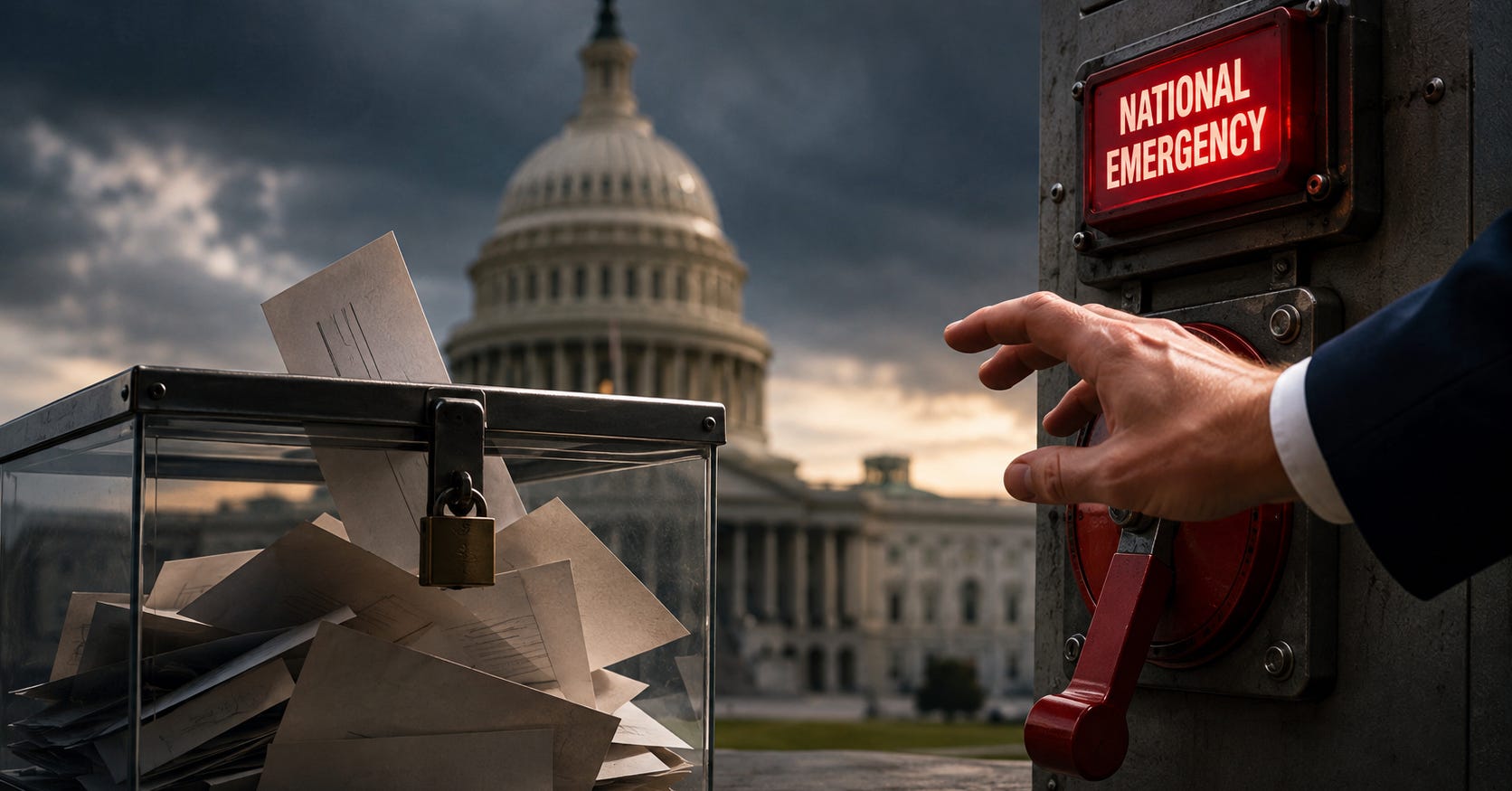
An Emergency Is Not a Legislature
There is a moment in every argument over presidential power when the policy itself begins to obscure the more important question. The country starts debating whether the president’s proposal is wise, popular, or necessary. Supporters defend the goal. Opponents attack the consequences. Television panels divide into familiar camps. Before long, everyone is arguing over what should happen, and almost nobody is asking the question that comes first in a constitutional republic: Who has the power to make it happen?
That question is becoming especially important as President Donald Trump and his allies continue pressing for changes to the rules governing American elections. The latest suggestion did not originate with Trump, and he did not announce any intention to cancel an election. During an interview, host Wayne Allyn Root proposed something narrower but constitutionally significant: declaring a national security emergency and using it to impose election rules that Congress had not enacted.
Trump did not commit to doing it, nor did he rule it out. Instead, his answer was: “Stranger things have happened.” Some of the election changes under discussion may be popular. Some may be controversial. Congress may eventually enact some of them. States may adopt others. However, there is a line the argument cannot cross simply because the president believes the policy is urgent.
A president does not acquire Congress’s power because Congress failed to give him what he wanted, and calling the disagreement an emergency does not make Congress disappear.
This Community Is Powered by You
What started as a small circle has grown into something much bigger, and it’s all because of readers like you.
Every time you forward this email, post it on socials, or bring someone new into the fold, you’re helping build one of the most passionate, independent political communities out there.
Want to keep the momentum going?
Share this newsletter with someone who should be part of this conversation.
Thank you for being here. It means everything.
The Policy Question Is Not the Constitutional Question
There are legitimate arguments over voter identification, proof-of-citizenship requirements, and mail voting. Some Americans see stronger identification requirements as basic safeguards while others believe additional documentation can burden lawful voters without solving problems large enough to justify the cost. Mail voting produces the same divide: supporters emphasize access and convenience while critics see vulnerabilities they believe deserve tighter limits.
Those arguments belong in American politics. They belong in state legislatures, congressional hearings, and campaigns where candidates must defend their positions to voters. What they cannot do is answer the constitutional question for us.
A policy does not become presidential merely because the president strongly supports it. Resistance from Congress does not transform executive preference into executive authority.
If someone believes a particular election rule is essential to protecting the vote, procedural objections can begin to sound like excuses for inaction, but constitutional government is built precisely for moments when those in power believe the need is obvious.
The Constitution does not guarantee that every good idea becomes law. Instead, it creates a process for deciding which ideas receive the force of law and which do not. A president may demand legislation, pressure lawmakers, and tell the country Congress is failing. He may even be right, but frustration is not a transfer of power.
The Constitution Already Assigned the Job
The Constitution did not leave federal elections floating in a pool of unclaimed government power. For elections to the House and Senate, Article I gives state legislatures the initial responsibility for prescribing the “Times, Places and Manner” of holding those elections. It then gives Congress authority to make or alter those regulations by law.
That authority is substantial. Congress has used it to establish national rules involving registration and election administration, and the Supreme Court has recognized that congressional election law can override conflicting state regulations within Congress’s constitutional sphere.
The Elections Clause does not answer every voting question. Voter qualifications are governed elsewhere in the Constitution, and presidential elections are subject to additional constitutional and statutory rules. However, that complexity reinforces the broader point: election authority has already been distributed among institutions.
The Constitution does not grant the president general authority to rewrite election rules whenever the president concludes that the existing ones are inadequate. Congress is therefore not simply another interested party in this argument. Where federal election rules fall within its constitutional authority, Congress is the institution empowered to debate them, enact them, amend them, or refuse them. A president may believe Congress is moving too slowly or that the states are getting it wrong. Neither belief redraws the constitutional map.
The Constitution already distributed the power. An emergency declaration does not change that.
An Emergency Declaration Is Not a Blank Check
A president can declare a national emergency, but that does not mean the declaration itself confers all the powers the president might want afterward. Under the National Emergencies Act, when a president declares an emergency and intends to exercise statutory emergency powers, federal law requires the president to identify the provisions of law under which those powers will be exercised.
That is the crucial element. The declaration identifies the emergency. Congress supplies the statutory authority. Therefore, if an administration attempted to use an emergency declaration to impose substantive election rules, the first question should not be whether the president can describe the situation as an emergency, but rather what law gives him the power to do this.
If Congress enacted a statute authorizing the action, then the dispute turns to what that statute permits and whether the president remained within its boundaries. If Congress did not grant the authority, declaring an emergency cannot manufacture the missing delegation.
There is also an important difference between an emergency that interferes with the implementation of existing election law and an emergency declaration used to create election law that Congress never passed. A hurricane may destroy polling places. A cyberattack may cripple registration systems. Violence may make normal administration impossible. Those circumstances may require extraordinary administrative tools, and Congress can write for them.
However, preserving an election under existing law is different from using an emergency to impose a policy the legislative process did not enact. Emergency authority is delegated power, not self-created power.
Congressional Inaction Is Not Presidential Power
This is where the danger becomes easiest to see. Suppose a president asks Congress to enact a national election rule. Congress can pass it, reject it, amend it, or refuse to vote. Every outcome may be frustrating. Some may even be irresponsible. None transfers Congress’s legislative power to the president.
Otherwise, consider the rule we would be creating. If Congress passes the president’s proposal, the president gets the policy he wants. If Congress refuses, the president declares an emergency and gets substantially the same policy anyway.
Congress would retain meaningful authority only when it said yes. Its no would become temporary, its silence would become permission, and its resistance would become the justification for bypassing it.
That is not divided government. That is executive power waiting for the legislature to become inconvenient.
Presidents are allowed to lose legislative fights. The constitutional system assumes they sometimes will. A president can return with a narrower bill, bargain, appeal to the public, or campaign against lawmakers who blocked him. He may believe Congress failed the country. He may be correct. However, failure by one branch does not enlarge the jurisdiction of another.
That principle reaches far beyond election law. If presidential authority expands whenever Congress refuses to act, then immigration, guns, energy, healthcare, taxes, and almost anything else can be recast as an emergency whenever the legislative process produces the wrong answer.
Congressional inaction is not presidential power. The president’s inability to obtain a law cannot become the emergency that allows him to govern as though Congress had passed it. That is not Constitutional representative democracy.
The Courts Are Already Testing the Boundary
This is not entirely theoretical. Trump has already issued an executive order directing federal agencies to make significant changes to election administration, including measures related to mail ballots and citizenship verification. Those actions have produced litigation in federal courts.
In one challenge brought by 23 states and the District of Columbia, a federal district court blocked portions of the order, and the First Circuit refused in July to stay the injunction pending the appeal. The appellate court was considering standing and ripeness arguments at that stage, not resolving every constitutional question raised by the order.
In another challenge, the D.C. Circuit observed that the Constitution gives the president no express authority over the conduct of elections while considering a case involving substantial proposed changes to election procedures. The court nevertheless declined preliminary relief on procedural and timing grounds.
This highlights why the courts alone cannot be the sole source of relief. Courts should enforce constitutional boundaries when proper cases reach them, but lawsuits are a poor substitute for Congress clearly defining those boundaries in the first place.
A republic cannot make federal judges the permanent maintenance crew for every ambiguity lawmakers leave behind. Congress has the power to write the fence.
Congress Cannot Complain About a Loophole It Refuses to Close
Congress has granted presidents emergency powers for generations because genuine emergencies sometimes demand speed. Some delegation is necessary, but delegated power creates obligations on both sides. Presidents must remain within the authority Congress actually granted, and Congress must maintain the statutes through which that authority flows.
Too often, the second obligation disappears. Lawmakers condemn executive overreach, hold hearings, issue statements, and wait for judges to decide whether a president crossed a line. Then the controversy fades while the underlying ambiguity remains available to the next administration.
That is not stewardship. If Congress believes emergency law might plausibly be stretched far enough to let a president alter substantive election rules without new legislation, then Congress has discovered a weakness it has the power to repair.
The answer is not to abolish emergency authority. It is to define it. The people’s branch cannot defend its power only in press releases. It has to write the law.
Congress Must Write the Emergency Election Rule
Congress should make one principle unmistakable. A declaration of national emergency, standing alone, does not authorize a president to impose new substantive rules governing federal elections.
If presidents are to possess extraordinary election powers during genuine emergencies, Congress should specify those powers, the circumstances that activate them, and the limits governing their use.
That preserves room for real crises. A hurricane can destroy polling places. An attack can cripple election infrastructure. A disaster can require temporary federal coordination. Emergency authority may help preserve an election when extraordinary circumstances interfere with the enforcement of the law. It should not become a mechanism for replacing the law.
Congress does not even have to settle the current arguments over voter identification, proof of citizenship, or mail voting to draw that boundary. Those fights can continue through the democratic process.
The emergency rule is simpler. If a president wants extraordinary power over federal elections, Congress must grant it clearly enough that lawmakers and voters know what has been authorized. If Congress has not granted it, the president cannot supply the missing authority himself. That is government stewardship: not hoping presidents exercise restraint, but writing restraint into the law.
The Rule Must Bind the President You Support
There is a simple test for whether we actually believe this principle. Imagine a future Democratic president declaring voter suppression a national emergency and then ordering every state to mail ballots automatically, extend ballot deadlines, expand drop boxes, and suspend state identification requirements. Some Americans would applaud; others would call it an executive takeover of election law. The constitutional question would nevertheless remain exactly the same: Where did the president get the authority?
If a national emergency allows one president to bypass Congress because election rules are supposedly too dangerous to leave unchanged, that precedent does not disappear when the White House changes hands. Presidential power survives presidents.
Conservatives who would reject a Democratic president rewriting election rules by emergency declaration should hesitate before establishing the principle for Trump. Progressives who oppose Trump doing it should oppose a future Democratic president doing the same thing for policies they prefer.mThat is the stewardship test.
We do not repair constitutional government by finding a president whose judgment we trust enough to exercise undefined power. We repair it by writing a rule strong enough to bind the president we trust and the president we fear. A power too dangerous for the other side is too dangerous to leave undefined for our own.
An Emergency Is Not a Legislature
Donald Trump has not declared a national emergency over election law, and Wayne Allyn Root’s proposal is not government policy. That is exactly why Congress should pay attention now.
The people’s branch should write the rule while this remains a warning instead of a precedent. An emergency can change the facts, demand speed, and require extraordinary administration, but it cannot change who holds legislative power in trust.
Support Independent Media
The Coffman Chronicle exists to follow power, expose the structure, and tell the truth about who gets to make the rules, and who is expected to live under them.
If this kind of independent journalism matters to you, share this piece. If you can afford to, become a paid subscriber. Your support helps keep the Coffman Chronicle independent, accountable to readers, and focused on the constitutional fights that too often get buried beneath the daily political noise.
Sources:
Congressional Research Service. “States and Elections Clause.” Constitution Annotated, Article I, Section 4, Clause 1. Accessed August 12, 2026.
Congressional Research Service. “Congress and Elections Clause.” Constitution Annotated, Article I, Section 4, Clause 1. Accessed August 12, 2026.
Executive Office of the President. Ensuring Citizenship Verification and Integrity in Federal Elections. Executive Order 14399, 91 Fed. Reg. 17125. Signed March 31, 2026; published April 3, 2026.
Media Matters Staff. “Trump Says ‘Stranger Things Have Happened’ After Wayne Allyn Root Pitches His National Security Emergency Idea on Elections Directly to Him.” Media Matters for America. August 11, 2026.
Tomazin, Farrah. “Bad Loser Trump Confesses Sinister Election Power Grab.” The Daily Beast. August 11, 2026.
United States Congress. National Emergencies Act, 50 U.S.C. § 1631: Declaration of National Emergency by Executive Order; Authority; Publication in Federal Register; Transmittal to Congress. Pub. L. 94-412, title III, §301, 90 Stat. 1257. September 14, 1976.
United States Court of Appeals for the District of Columbia Circuit. DSCC et al. v. Donald J. Trump et al.. Judgment, No. 26-5193. July 28, 2026.
United States Court of Appeals for the First Circuit. State of California et al. v. Donald J. Trump et al.. Order of Court, Nos. 26-1774 and 26-1779. July 25, 2026.
People don’t get it… Trump can never leave office… he has committed to many crimes… his family is involved…. he lives hoarding money… he will not leave either procedurally or voluntarily… much of Congress is in on his money grubbing… we the people will have to forcibly remove him from office… it won’t be pretty.. people will get hurt and die… sorry, but that’s the sad truth…
you're asking if the guy who buried his ex wife on his private golf course to save a buck. Is fickle and egocentric enough to use Emergency Powers to hold onto power???...................
🇺🇸🇮🇱🙊🙉🙈🍊🤡💩💩