


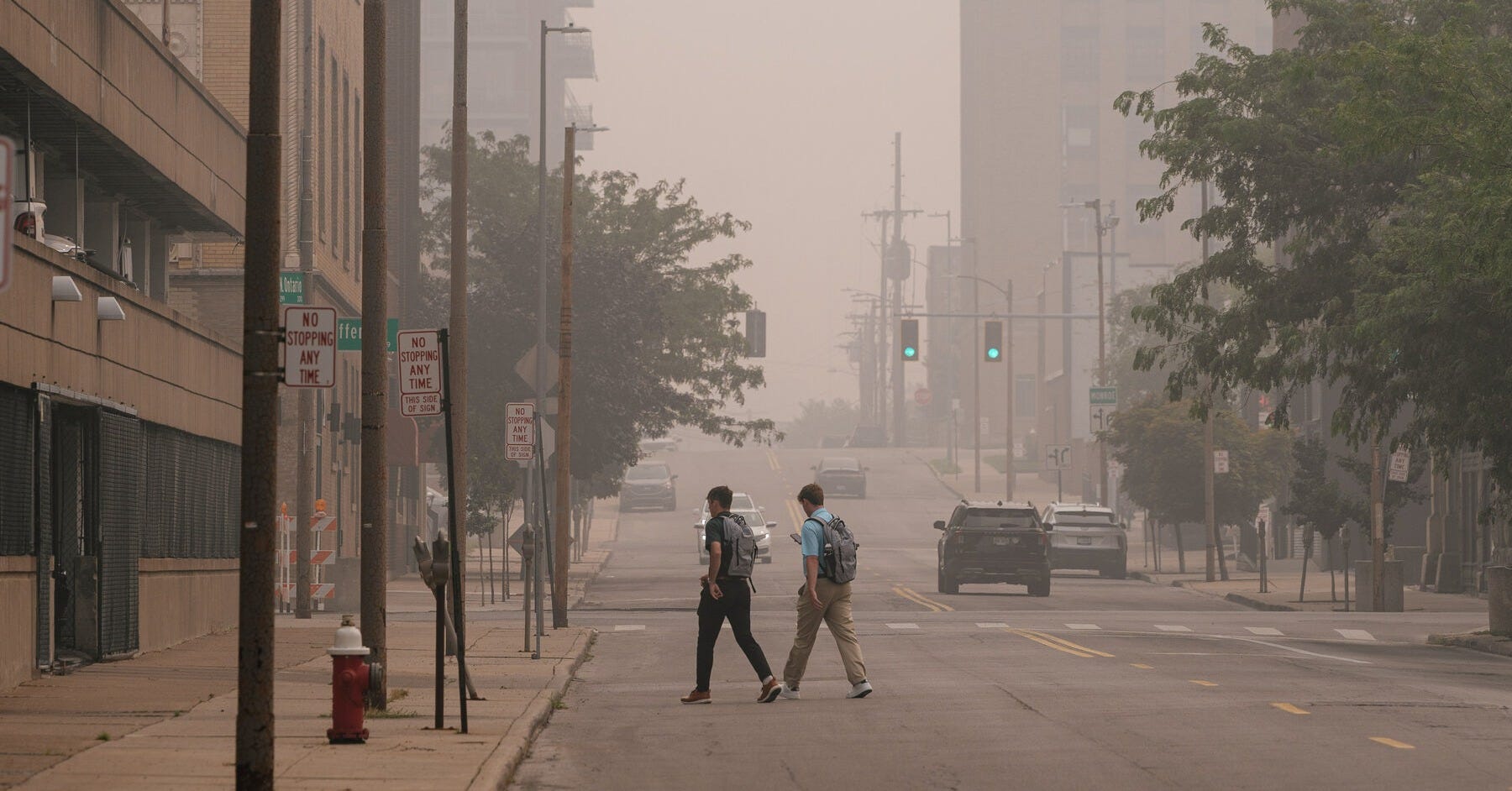
Smoke from Canadian wildfires is creating dangerous air-quality conditions across a wide stretch of the United States, with CBS News reporting that roughly 100 million Americans across 14 states are being affected.
The smoke has moved across parts of the Midwest, Great Lakes, Northeast and Mid-Atlantic, prompting air-quality alerts and public-health warnings. CBS and the Associated Press reported that heavy smoke from fires in Canada and Minnesota was exposing millions of people to hazardous levels of air pollution, with alerts stretching from Minnesota toward the East Coast.
The main health concern is fine particulate pollution, often referred to as PM2.5. These particles can travel deep into the lungs and aggravate heart disease, asthma and other respiratory conditions. CBS reported that experts recommend reducing outdoor activity, wearing an N95 mask if going outside is necessary, and keeping indoor air cleaner by closing windows and using air filtration when available.
Officials are also responding with public-health measures. New York Gov. Kathy Hochul said unhealthy conditions could continue in parts of the state and said more than 100,000 N95-style masks were made available to counties. New Yorkers were urged to check AirNow and take extra precautions, especially people with heart or breathing problems, older adults, children, pregnant people and outdoor workers.
Subscribe free for daily political analysis they won’t broadcast. Join 110K+ readers →
In New York City, emergency officials extended heat emergency operations, kept cooling centers open and made free KN95 masks available as smoke moved into the region. City officials warned that everyone could experience health effects when AQI levels reach unhealthy ranges.
Public reaction online has centered on orange skies, changing AQI readings and frustration that wildfire smoke now feels like a recurring seasonal hazard. On Reddit, Pennsylvania users discussed smoke from Minnesota and Canada, with one commenter asking whether others remembered when local weather forecasts did not need wildfire-smoke graphics.
The next step is local. Residents in affected areas should check current AQI readings, follow local advisories, limit outdoor exertion when air quality worsens and use properly fitting masks when exposure cannot be avoided.
Subscribe free for daily political analysis they won’t broadcast. Join 110K+ readers →
Trump thins tariffs will put out the fires. Crazy POTUS!