


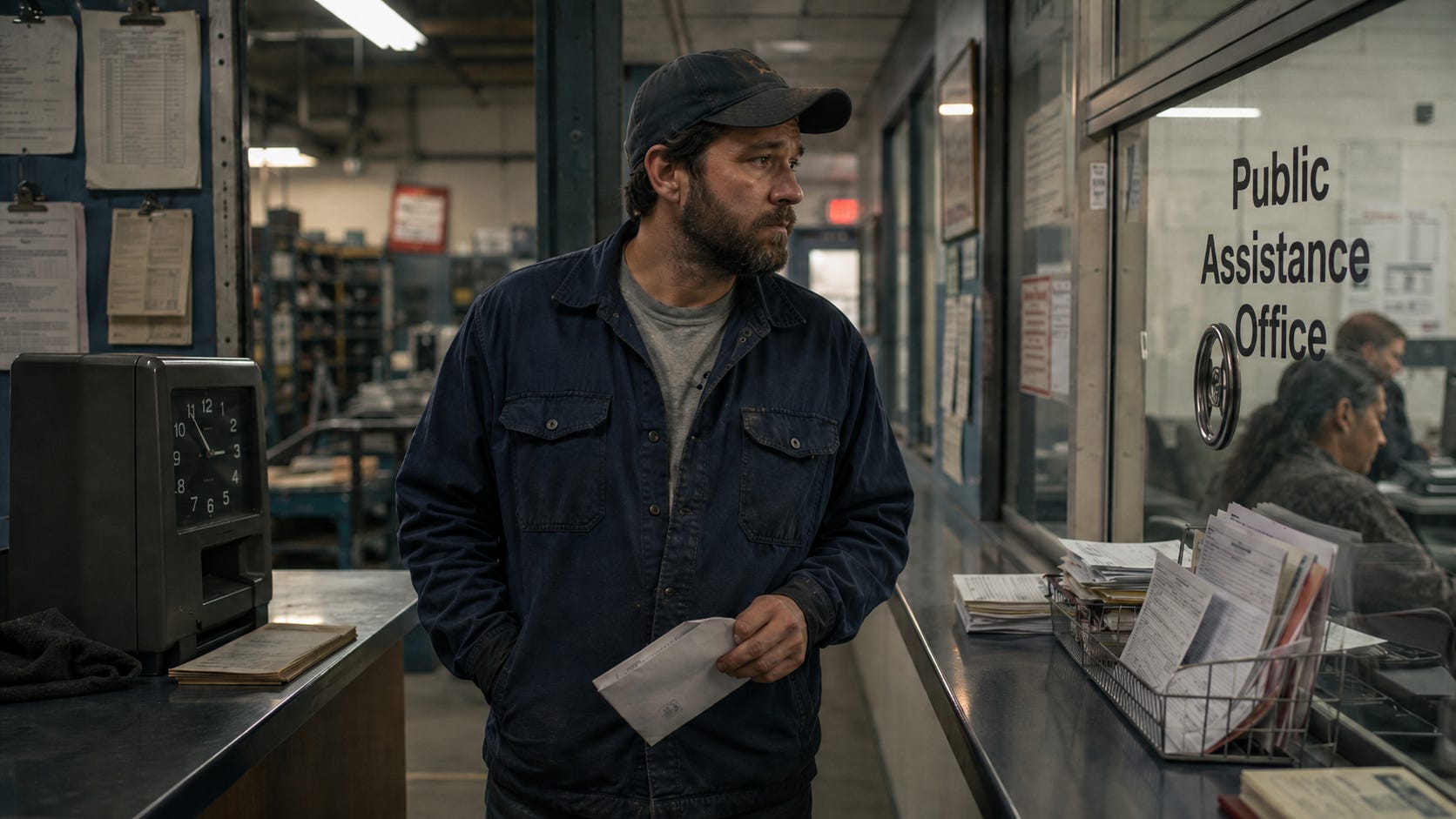
The Wage That Stopped Moving
On July 24, 2026, America’s federal minimum wage turns seventeen years old. A child born the last time Congress raised it is old enough to drive. The wage is still $7.25 an hour. Meanwhile, prices did not remain the same.
The country changed around the wage while the wage remained frozen in place. That freeze did not make work cheaper. It made the unpaid portion of work someone else’s problem. When a paycheck does not cover food, medicine, rent, transportation, child care, or the basic costs of staying alive, the cost does not disappear. It moves.
It moves to the worker who skips meals, the parent who delays care, the food bank, Medicaid, the Supplemental Nutrition Assistance Program (SNAP), and the taxpayer who was never told that part of a private company’s payroll had been placed on the public ledger.
Washington usually asks the question from the wrong end. It asks whether poor workers have proved enough. Did they fill out the forms? Did they meet the requirement? Did they work enough hours? Did they deserve the help?
Good Steward Capitalism asks the question Washington avoids: did the company pay enough, or did taxpayers quietly finish the payroll?
This Community Is Powered by You
What started as a small circle has grown into something much bigger, and it’s all because of readers like you.
Every time you forward this email, post it on socials, or bring someone new into the fold, you’re helping build one of the most passionate, independent political communities out there.
Want to keep the momentum going?
Share this newsletter with someone who should be part of this conversation.
Thank you for being here. It means everything.
The Square New Deal Begins With Stewardship
The Square New Deal begins with a simple idea: America does not need to abolish capitalism to make it answer to the people. It needs rules that reward stewardship and punish extraction.
A private company may own the business. It may keep the profit. It may compete, grow, innovate, invest, and succeed. None of that is the problem. The problem begins when a company calls itself efficient because someone else is carrying part of its cost.
Good Steward Capitalism is not a demand that the government run the store, own the factory, or manage the balance sheet. It is a demand that private power stop sending private costs to the public.
Wages are not only a private line item. They are a public reality. If a company pays too little for workers to live, the consequences do not remain inside that company’s accounting department. They spill into homes, hospitals, schools, food banks, county budgets, and federal programs.
That is where capitalism becomes a question of stewardship. The company may keep the profit, but it should not get to hand the bill to everyone else.
The Payroll Taxpayers Never Agreed to Pay
A low wage does not stay inside the company that pays it. It travels to the apartment where rent eats most of the paycheck before food, medicine, gas, utilities, or child care are counted. It travels to the parent who stretches one grocery trip across too many meals. It travels to the worker who waits too long to see a doctor because missing a shift costs money and seeing the doctor costs more.
Then it travels to the public. It shows up in Medicaid, SNAP, and in school lunch programs, food banks, emergency rooms, housing instability, county assistance offices, and local budgets that were never designed to become the back office of a private payroll system. This is the subsidy that rarely gets named.
The public debate usually treats low-wage work as proof that the worker has failed to rise. It asks why the worker did not get a better job, move to a better place, learn a better skill, or make better choices. However, the worker did not set the wage, design the staffing model, or decide how many hours count as full-time, how benefits are structured, how schedules change, how contractors are used, or how much of the company’s labor costs can be pushed outside the company.
The worker receives the paycheck. The public receives the shortage. The company keeps the difference. When a company pays poverty wages and taxpayers cover the difference, that is not capitalism. That is corporate welfare with a cash register.
New Jersey Asked the Right First Question
New Jersey has already begun asking the question the national debate keeps avoiding. The state is preparing to charge some employers when their workers are covered by Medicaid rather than employer-sponsored health insurance.
The idea is simple enough for any taxpayer to understand. If a company benefits from labor while the public pays for that worker’s health coverage, the public is not outside the business model. The public is helping finance it.
That does not solve the whole problem. It does not answer every question about wages, scheduling, benefits, contracting, franchise structures, or the cost of living. It does not, by itself, create Good Steward Capitalism, but it points the flashlight in the right direction.
For years, the political system has aimed that flashlight downward. It has searched the worker’s pocket, paperwork, hours, habits, and household. It has treated public assistance as a sign that the person receiving help must be examined more closely.
New Jersey’s question moves the light. It asks whether the employer belongs in the frame. That is the beginning of a more honest debate. If a worker is employed and still needs public help to survive, the public should not stop the investigation at the worker. It should look upstream at the wage, the benefits, the hours, and the company that designed them.
Health coverage is only one part of the bill. The larger question is whether the public is being forced to absorb costs that should have been paid through compensation in the first place. If taxpayers are paying for the food, medicine, housing stability, and survival costs that wages do not cover, then taxpayers are already inside the company’s payroll system. They just were not told they had been hired.
Washington Targets the Worker, Not the Employer
That shift in attention is significant because the federal government is moving in the opposite direction. Washington is not building its first response around the employer whose wages leave workers unable to afford the basics. It is building machinery around the worker who needs help after wages fail.
New Medicaid work requirements are being prepared for certain adults. SNAP rules have been tightened as well. The official language is clean and bureaucratic: community engagement, eligibility verification, reporting, compliance, and documentation. Underneath the paperwork sits a familiar assumption. The person receiving help must prove they deserve it.
That is where the national debate keeps returning. It asks whether the worker worked enough hours, filed the right forms, met the right deadline, entered the right portal, satisfied the right requirement, and remained poor in the approved way.
Good Steward Capitalism asks why the question stops there. If a worker has a job and still needs public help to eat, see a doctor or keep a household stable, then the public has a right to examine more than the worker’s paperwork. It has a right to examine the paycheck, the schedule, the benefits, and the business model that produced the need in the first place.
The country has grown comfortable auditing poverty while treating low-wage employment as beyond public judgment. That is backward. Washington keeps asking whether poor workers are working hard enough. Good Steward Capitalism asks whether profitable employers are paying enough.
The Worker Is Not the Problem
The worker is not the failure in this story. American politics has spent decades teaching people to look at poverty as a character defect. If someone needs help with food, health care, or housing, the assumption too often begins with suspicion. What did they do wrong? Why did they not work harder? Why are they receiving something from the public? However, millions of people receiving public help are already doing the thing the country told them to do.
They are working, clocking in, and standing behind counters, stocking shelves, cleaning rooms, preparing food, caring for people, moving packages, answering customers, driving to shifts, wearing uniforms, covering weekends, and trying to hold a household together on wages that do not reach the end of the month.
A Government Accountability Office review found millions of wage-earning adults enrolled in Medicaid or living in households receiving SNAP. It also found that about 70% of adult wage earners in both programs worked full-time weekly hours.
That finding should have changed the national conversation. It should have made Congress ask why full-time work still leaves so many people close enough to poverty that public programs become part of the household budget. It should have made lawmakers ask which industries rely on that arrangement, which companies benefit from it, and how much of the public safety net is being used to support workers whose employers did not pay enough. Instead, the country keeps returning to the easier target: the worker.
That is morally convenient for the company and politically convenient for lawmakers who would rather audit the poor than confront concentrated private power. The worker did not set the wage or design the benefit package. The worker did not cut the hours, classify the job, outsource the contract, or decide that labor costs should be kept low enough for shareholders to celebrate and taxpayers to absorb.
Instead, the worker receives the consequences. The shame does not belong to the worker who needs help. The shame belongs to the business model that needs poverty wages to protect its margins.
This Is Not Anti-Capitalism
This is not an argument against capitalism, but rather against pretending that cost-shifting is capitalism. A country can believe in private enterprise and still demand that it bear its own costs. It can protect ownership, investment, innovation, and profit without letting powerful companies turn the public safety net into a wage supplement.
The entity and the profit can be private, but the unpaid bill cannot be public by default. That is the line.
If a company pays enough for workers to live, provides decent benefits, and carries the real cost of its labor model, then it should be respected for doing business honestly. If, however, a company builds its margins by paying wages so low that workers must rely on public programs to survive, then the public has become part of the financing structure.
Calling that arrangement “free enterprise” does not make it free. It only hides who is paying. That is not anti-business. That is capitalism with a conscience and a receipt.
The Good Steward Tax
Good Steward Capitalism needs more than a slogan. It needs a rule. If a large, profitable company pays wages so low that its workers rely on public assistance to survive, then that company should owe the public a tax, fee, or assessment tied to the cost it has pushed onto everyone else. Call it the Good Steward Tax.
The point is not to punish profit, but to stop pretending that a low wage is cheap when the public is paying the unpaid balance.
The rule should begin where the abuse is hardest to excuse: large companies, major chains, public contractors, subsidy recipients, and employers with enough scale to shape a local labor market. If a company receives tax breaks, grants, public contracts, zoning advantages, or other benefits from the people, then the people have every right to ask whether that company is paying its workers enough to live.
This should not be built around one flat national number. A living wage in rural Pennsylvania is not identical to a living wage in New Jersey, New York City, Mississippi, or California. The principle can be national, but the measurement should be local. The question is not whether a company cleared the lowest legal floor in America, but rather whether its workers can actually live where the company hired them to work.
That gap is where the public subsidy hides. If wages fall below a credible local living-wage standard, and if workers are pushed into public programs because compensation failed, then the employer should owe a public-cost assessment. The more the company depends on underpaid labor, the more it should pay back. The more it raises wages, improves benefits, and carries its own costs, the less it should owe.
That is the rule: reward stewardship and charge extraction. If a company is large enough to shape a local labor market, it is large enough to be accountable for the public costs its wage model creates.
Protect Main Street. Bill Wall Street.
A serious policy has to know the difference between Main Street and Wall Street. The goal is not to crush the local diner, the family garage, the farm stand, the neighborhood repair shop, or the small business owner who is already working beside employees and trying to survive the same economy everyone else is surviving. Good Steward Capitalism should not pretend that every employer has the same power. Some businesses set wages in a market. Others are trapped inside one. The law should be able to tell the difference.
That means any Good Steward Tax should begin with scale, profit, public benefit, and market power. It should focus on large corporations, major chains, public contractors, subsidy recipients, and companies whose employment practices affect entire local economies. It should include phase-ins, hardship protections, and real safeguards for small businesses that are not using poverty wages as a strategy.
Small businesses cannot serve as the shield protecting corporate extraction. When accountability arrives, powerful companies point to the smallest shop in town and ask why anyone would want to hurt it. They wrap billion-dollar balance sheets in the image of a corner store, and turn the family business into camouflage for the national chain.
Congress should not fall for it. A local business trying to survive deserves room to breathe. A giant corporation using low wages as a public subsidy strategy deserves a bill.
Honest Businesses Should Not Be Punished
Good Steward Capitalism is also about the businesses that already try to do the right thing. A company that pays decent wages, offers real benefits, keeps predictable schedules, and treats labor as a responsibility should not have to compete against a company whose workers survive because the public safety net fills the gap. That is not fair competition. That is one business bearing its costs, while another business passes part of its costs on to everyone else.
The responsible employer pays twice. It pays its own workers more honestly, then its taxes help support the public programs that assist workers whose employers did not do the same.
That should offend anyone who actually believes in markets. A market cannot reward good stewardship if bad stewardship is allowed to disguise itself as efficiency. It cannot respect honest employers if dishonest cost-shifting is treated as a competitive advantage.
The good employer should not be punished because the bad employer found a way to make taxpayers subsidize the difference.
The Market Is Not Free When the Public Pays the Difference
The first response will be predictable. Someone will call this socialism. It isn’t. Socialism would mean government ownership or control of the business. Good Steward Capitalism does not require that. The company remains private. The owner remains the owner. The investor remains the investor. The profit remains private. The business still competes in the market. The difference is that the company no longer gets to privatize the profit while socializing the shortage. That is not socialism. That is a receipt.
Others will say prices might rise, but prices already rose. Rent rose. Groceries rose. Health care rose. Utilities rose. Child care rose. Transportation rose. Insurance rose. The only thing some employers want permanently frozen is the wage paid to the person trying to survive those costs.
Others will warn that jobs may disappear. That concern should be taken seriously, which is why the policy should be written carefully. It should include phase-ins, local measurements, hardship protections for genuinely vulnerable small businesses, and credits or reductions for companies that raise wages, improve benefits, and reduce public dependence among their workers. However, caution cannot become surrender.
Then comes the oldest defense: let the market decide. However, the market is not deciding when taxpayers are forced to subsidize the wage gap. The market is not deciding when a company sets the wage, the worker receives the shortage, and the public safety net becomes the silent partner that keeps the arrangement from breaking.
A market is not free when the public is forced to pay costs the company refuses to carry.
Congress Has the Power to Stop Subsidizing Poverty Wages
This is not only an economic question but a governing question. Congress writes the tax code, controls federal spending, sets labor standards, and decides which business models receive public support, which costs are absorbed by taxpayers, and which costs are sent back to the private power that created them. That means Congress cannot pretend to be a spectator.
If public money helps workers survive wages that do not cover the basic cost of living, then Congress has already entered the wage debate. It entered through Medicaid. It entered through SNAP. It entered through housing programs, tax credits, school meals, and every public system that catches workers after their paychecks fail. The only question is whether Congress will admit what it is funding.
Right now, the public safety net is too often treated as a worker problem instead of an employer subsidy. The worker becomes the file to review, the case to audit, the benefit to question, and the expense to reduce. The company that created the shortage remains outside the frame.
That is a choice, and Congress could make a different one. It could say that public money should not serve as a hidden wage supplement for companies large enough to pay better wages. It could require major employers, public contractors and subsidy recipients to disclose how many of their workers rely on public assistance. It could measure the public cost of low-wage labor. It could design a Good Steward Tax that rewards companies that raise wages and penalizes companies that keep passing their costs on to everyone else. That would not make Congress anti-business but rather honest about the bill.
When Congress gives up power, the people lose power. When Congress refuses to govern the economy, concentrated private power governs it instead. And when Congress allows profitable companies to push labor costs into public programs, the people’s branch has chosen to use the people’s money to protect poverty wages.
That should be unacceptable. The people’s branch should not use the people’s money to finish the payroll of companies that refuse to pay enough for workers to live.
Capitalism Should Pay Its Own Bills
The answer is not to punish work or shame the worker who needs help after doing exactly what the country told them to do. It is not to treat Medicaid, SNAP, school meals, housing assistance, or food banks as evidence that ordinary people have failed.
The answer is also not to abolish capitalism. Private enterprise can build, innovate, employ, create wealth, support families, strengthen communities and reward risk. A country does not have to hate capitalism to insist that capitalism practice stewardship.
However, stewardship requires honesty. If a company pays enough for workers to live, bears the real cost of its labor model, and succeeds without making taxpayers cover the shortfall, that company has earned its profit honestly. If a company pays wages so low that the public has to cover food, medicine, housing stability, and survival costs, then the company has not escaped the cost of labor. It has transferred that cost to everyone else.
Profit is legitimate. So are ownership and enterprise. But extraction is not stewardship, and a business model that depends on poverty wages is not made moral by hiding the bill in public programs.
The Square New Deal does not ask America to choose between capitalism and accountability. It asks America to remember that capitalism without accountability becomes another form of concentrated power.
The worker should not be the only one audited. The taxpayer should not be the silent partner. The public safety net should not become the back office of a private payroll system.
If a company wants the freedom to profit from American workers, it should carry the responsibility of paying them enough to live. That is not anti-business. That is not socialism. That is capitalism paying its own bills.
Support Independent Media
If this argument matters to you, share it with someone who still believes the problem is the worker instead of the wage.
The public should not be forced to finish the payroll for companies that refuse to pay enough for workers to live. And if you can afford to support independent work like this, please consider subscribing or sharing The Coffman Chronicle.
Good Steward Capitalism starts with telling the truth about who is really paying the bill.
Sources:
“Medicaid Community Engagement Requirement for Certain Individuals Interim Final Rule with Comment Period (CMS-2454-IFC).” Centers for Medicare & Medicaid Services. June 1, 2026.
“Estimated Effects of Public Law 119-21 on Participation and Benefits Under the Supplemental Nutrition Assistance Program.” Congressional Budget Office. August 11, 2025.
“Public Law 119-21, to Provide for Reconciliation Pursuant to Title II of H. Con. Res. 14: Medicaid.” Congressional Budget Office. October 28, 2025.
Diana, Amaya, Jennifer Tolbert, Alisha Rao, and Sammy Cervantes. “A Look at the Intersection of SNAP and Medicaid as States Implement Medicaid Work Requirements.” KFF. March 4, 2026.
“What Is the Living Wage Calculator?” Living Wage Calculator. Accessed July 21, 2026.
“What Is a Living Wage and How Is It Estimated?” Living Wage Calculator. Accessed July 21, 2026.
Mulvihill, Geoff. “New Jersey Is Set to Charge Companies With Workers on Medicaid. Other States May Follow.” AP News. July 2, 2026.
“Bill A5324: Establishes Fee on Certain Employers That Employ Individuals Who Receive Health Benefits Coverage Through State Medicaid Program.” New Jersey Legislature. June 28, 2026.
“Minimum Wage.” U.S. Department of Labor. Accessed July 21, 2026.
“History of Changes to the Minimum Wage Law.” U.S. Department of Labor. Accessed July 21, 2026.
“Federal Social Safety Net Programs: Millions of Full-Time Workers Rely on Federal Health Care and Food Assistance Programs.” U.S. Government Accountability Office. October 19, 2020.
Trump has unleashed unbridled capitalism among the American people and is fueling the inevitable class warfare.
Thank you. Well done.