


Charlotte wasn’t supposed to be the next front line. For weeks, rumors swirled about federal attention on the city, but until Customs and Border Protection vehicles began appearing in neighborhoods and local leaders started issuing urgent statements, it felt like just another round of speculation. Then the arrests began. The operation was immediately branded “Charlotte’s Web,” and—unlike earlier sweeps in Memphis or the attempted deployments in Chicago—this time the community responded almost instantly.
Within hours, Charlotte’s immigrant-rights organizations were coordinating legal hotlines, faith leaders were showing up at detention sites, and city officials were broadcasting alerts in multiple languages. Residents were posting videos of Border Patrol agents near churches and apartment complexes. While the federal government framed the operation as a targeted effort against “criminal illegal aliens,” the on-the-ground reality looked much broader, with reports of U.S. citizens detained and long-established families swept into the dragnet.
Charlotte is the most current flashpoint, but it’s also something more important: a blueprint. What’s happening there reveals that federal enforcement is not a single, uniform strategy. It morphs depending on where it lands. And as these operations continue to spread across the country, other cities are studying Charlotte and the cities that came before it to understand what determines whether a federal operation arrives as a loud, public spectacle, a quiet undercurrent, or doesn’t happen at all.
Across the national map, three factors consistently shape the outcome: the legal landscape, the strength of advocacy infrastructure, and whether local governments choose cooperation, resistance, or something in between.
Want to Know Your Rights?
Download a free digital copy of the U.S. Constitution—the same document Trump is trying to bulldoze. Learn exactly what he’s breaking… and how to fight back.
50,000 strong — and counting.
This Early Black Friday, become a paid subscriber for just $1 a week and help us keep the truth alive.
Join The Coffman Chronicle — $1/Week Early Access
The Legal Landscape: When Courts Become the First Line of Defense
The sharpest legal contrast to what we’re seeing in Charlotte isn’t Memphis or Atlanta, but Portland (and Illinois), where courts have imposed full-scale blocks on federalized Guard deployments. It’s too soon to know whether Charlotte will see the kind of sweeping judicial rulings that halted Guard deployments in Portland and Chicago. Courts move more slowly than federal agencies, and North Carolina’s legal landscape has not yet been fully tested by the scale of this operation. The absence of a major injunction now doesn’t preclude one later. It simply reflects how new this chapter is.
Earlier this month, a federal judge in Oregon issued a sweeping ruling blocking the administration’s attempt to deploy the National Guard into Portland. Judge Karin Immergut concluded that the situation simply did not meet the legal threshold required for a federalized military presence. Her ruling stretched more than a hundred pages and amounted to a permanent injunction under current circumstances. The Department of Justice has already appealed.
Chicago has been waging a similar legal battle. A federal judge there extended her order indefinitely blocking the deployment of the National Guard to the region while the Supreme Court considers the case. Illinois has an additional layer of protection: a longstanding consent decree known as Castañon Nava v. DHS, which limits warrantless ICE arrests in several Midwest states. When ICE swept through the Chicago area as part of “Operation Midway Blitz,” the judge overseeing the decree ordered the release of hundreds of detainees who were arrested in violation of it. Some were freed outright; others must be evaluated for bond or alternatives to detention.
Together, these rulings demonstrate that federal enforcement is running headlong into the judiciary and not always winning. In states with strong legal protections for civil liberties and immigrant rights, courts are acting as a brake, forcing transparency, scrutinizing arrest procedures, and even halting deployments altogether. In other regions, no such legal infrastructure exists, leaving local communities far more vulnerable to aggressive federal tactics.
The legal landscape doesn’t just determine what the federal government can do; it shapes how much it thinks it can get away with. When a city has a history of judicial intervention, federal agencies tend to tread more carefully. When it doesn’t, the machinery moves faster.
Advocacy Infrastructure: The Local Immune System
Charlotte stands out because its civic networks snapped into action with astonishing speed. Over the past decade, the city has built a dense web of immigrant-rights organizations, legal advocacy groups, community health providers, multilingual media outlets, and faith coalitions. When the operation began, that web instantly activated. Attorneys were on standby. Clergy members were calling emergency meetings. Volunteers were distributing “know your rights” flyers within hours. Local leaders provided real-time updates to schools and community centers.
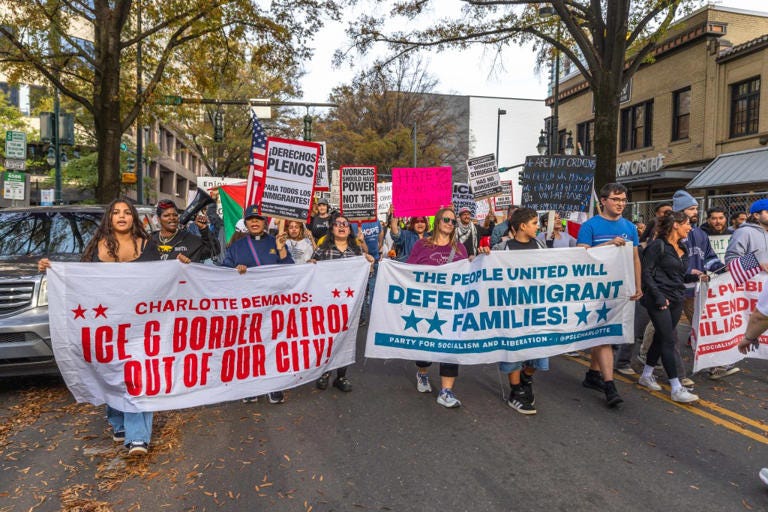
Protesters march through uptown after gathering at First Ward Park for the “No Border Patrol In Charlotte” rally on November 15, 2025, in Charlotte, North Carolina. (Photo by Grant Baldwin/Getty Images)
This didn’t happen by accident. Charlotte learned from the cities that came before it. Memphis, which was one of the earliest sites of increased ICE activity, had far fewer resources when agents began making arrests there this fall. Advocacy groups did their best, but without a well-funded legal network or a politically aligned city council, much of the enforcement took place in the shadows. Many arrests occurred during traffic stops or joint operations with other federal agencies. Reports from residents described a chilling effect: people stopped attending English classes, stopped visiting clinics, and stopped driving unless absolutely necessary. Memphis resisted, but with quieter tools and far less visibility.
Chicago and Portland, by contrast, have decades-old advocacy cultures shaped by long battles over policing, public protest, and civil liberties. Their networks are deep, politically connected, and battle-tested. They mobilize quickly, they generate national media attention, and they know how to pressure local and state leaders into unified action. That infrastructure not only supports residents. It influences courts and politicians who know they will be held accountable.
Advocacy is often treated as a footnote, but in practice, it’s the local immune system. Where it’s strong, federal operations slow down and meet fierce scrutiny. Where it’s thin, the same operations unfold quietly, almost invisibly.
Local Government Cooperation: The Factor That Changes Everything
If the legal landscape sets the outer boundaries of federal power, and advocacy networks generate community resistance, local government determines the day-to-day reality. Nothing illustrates this more clearly than the difference between Charlotte and Memphis.
In Charlotte, city and county officials have been unequivocal. They’ve condemned the operation, reassured residents that local police are not participating, and used public briefings to keep the community informed. That refusal to cooperate forces federal agencies into a loud, high-visibility posture. Without the assistance of local law enforcement, ICE and Border Patrol must conduct larger, more theatrical sweeps to accomplish the same goals.
Memphis is the opposite. The Memphis Police Department has acknowledged cooperating with ICE during joint operations. The Shelby County Sheriff has signed agreements allowing ICE to detain people directly in county facilities. Local officials have not mounted sustained opposition. As a result, the federal presence there looks nothing like Charlotte’s. Instead of dramatic sweeps, Memphis sees unmarked vehicles, traffic-based arrests, and coordinated stings—tactics designed for efficiency and silence, not spectacle. The absence of political pushback makes these operations almost invisible.
Chicago and Portland offer yet another contrast: strong, unified local leadership aligned with state governments. In both cities, mayors, governors, and attorneys general pushed back in sync. That political alignment helped judges feel on firm ground when issuing sweeping rulings against federal actions. By showing that the cities were not spiraling out of control and that local officials were prepared to handle public safety, they undermined the administration’s justification for deploying the National Guard.
Local cooperation isn’t a side issue. It’s often the tipping point that determines how federal enforcement looks, how long it lasts, and how much damage it does.
What Other Cities Can Learn
What’s happening in Charlotte, Memphis, Chicago, and Portland is not a series of disconnected crises. It is a stress test of the entire system: federal authority, state law, local governance, community networks, and civil rights protections.
Charlotte shows what happens when a well-organized community confronts a federal sweep head-on, with rapid-response systems already in place. Memphis reveals the opposite: how quiet and far-reaching enforcement can become when federal agents have the cooperation of local police and little political scrutiny. Chicago and Portland demonstrate the power of courts and state governments to impose legal boundaries that the federal government cannot simply bulldoze through.
For other cities watching warily from the sidelines, the lesson is not fatalistic but practical. Outcomes are not predetermined. They hinge on three factors that can be strengthened long before federal action arrives: legal preparedness, advocacy networks, and the stance of local government. Each of these can shift the balance, slow enforcement, or—in some cases—stop it entirely.
Federal actions will continue. The map will expand. However, the way each city experiences that moment is shaped by choices made now. Charlotte is showing one path. Memphis shows another. Chicago and Portland offer a third. Other communities are already absorbing these lessons, because they may need them sooner than they think.
Don’t let the bastards sneak anything past you. Subscribe and get your daily dose of rage and receipts delivered fresh, before the spin doctors can scrub it.
Sources:
“Dozens reportedly arrested in Charlotte, North Carolina, amid immigration crackdown,” The Guardian
“Federal immigration officers begin sweep in Charlotte, North Carolina,” The Guardian
“Border Patrol official touts North Carolina arrests despite objections of local leaders,” AP News
“The cities Trump is targeting with ICE crackdowns next,” Axios
“Judge rules Trump administration failed to meet legal requirements for deploying troops to Portland,” AP News
“‘Huge victory’ in Portland as judge’s final order bars Trump from sending National Guard,” The Guardian
“Feds appeal ruling permanently blocking Trump Guard deployment to Portland,” Oregon Capital Chronicle
“Judge’s block on deploying National Guard extended indefinitely as Supreme Court weighs case,” Capitol News Illinois
“National Guard deployment in Chicago area temporarily blocked as judge considers extension,” ABC 7 Chicago
“Chicago judge who released over 600 immigrants is slammed by DHS as activist putting lives at risk,” NY Post
“Judge orders release of over 300 ‘Operation Midway Blitz’ detainees,” Politico
“Judge orders DHS to determine if hundreds of immigrants should be released,” Washington Post
“Surge in ICE arrests around Memphis fueled by people who haven’t committed any crimes, advocates say,” MLK 50
“Mayor Young tells Hispanic leaders Memphis Police Department is working with ICE,” Tennessee Lookout
“Shelby County sheriff signs agreement with ICE to hold immigrant detainees,” Commercial Appeal
“DC National Guard Deployment in the Nation’s Capital Ordered by Trump Is Extended to Feb. 28,” Military.com
“Trump administration and lawyers for Illinois and Chicago battle over president’s deployment of National Guard,” SCOTUSBlog.com
“Customs and Border Protection agents expected in North Carolina amid immigration crackdown,” Wall Street Journal
It's great to know that Charlotte has the community support necessary for resistance.
Thank you for spreading the word.