


The Warning Was Already on the Page
The number arrived without sirens. No church doors closed when it was published. No shopkeeper pulled down a metal gate. No parent changed the route home. It appeared inside a federal report, one more total in a government system built to turn threats, assaults, vandalism and violence into rows of data.
In 2016, law enforcement agencies reported 6,121 hate-crime incidents to the Federal Bureau of Investigation. A year later, they reported 7,175. The FBI also reported that approximately 1,000 additional agencies contributed information in 2017, meaning part of the increase may have reflected expanded reporting participation rather than a change in crime alone.
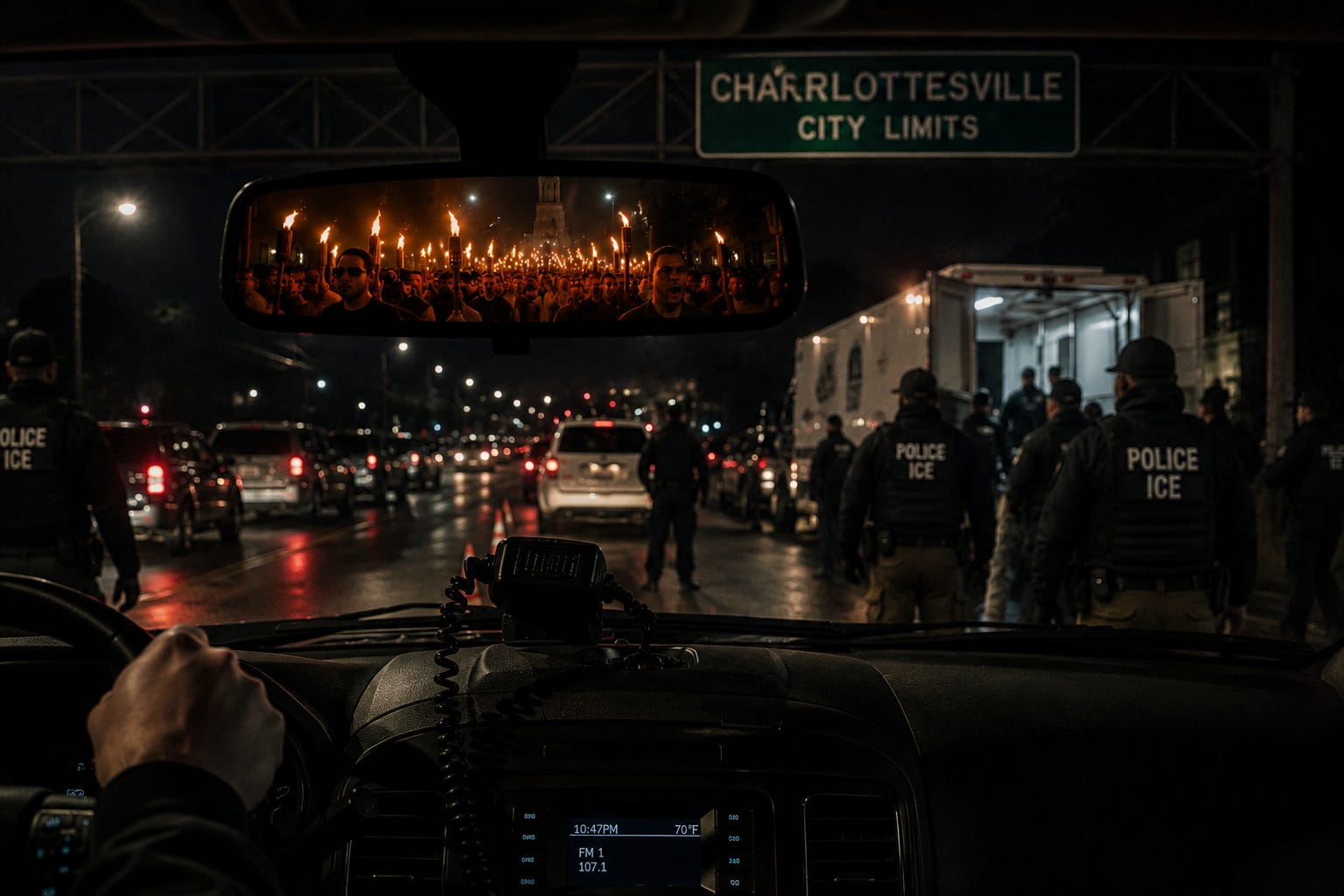
That second number belonged to the year white supremacists and neo-Nazis marched openly through Charlottesville, Virginia. They carried torches, chanted racist and antisemitic slogans and gathered beneath symbols that had once required masks, closed rooms and whispered allegiance.
On August 12, 2017, James Alex Fields Jr. drove his car into a crowd of counterprotesters, killing Heather Heyer and injuring dozens. He later pleaded guilty to 29 federal hate-crime charges.
Charlottesville did not create the hatred. It did not explain every threat, shattered window, assault outside a place of worship or family targeted because of race, religion, national origin or identity. Instead, it revealed a change.
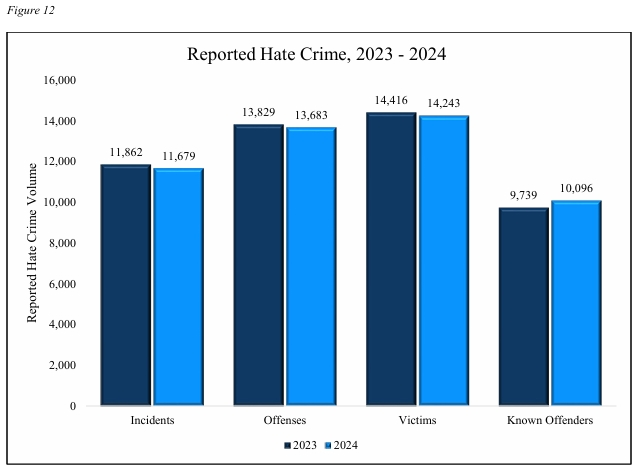
By 2024, law enforcement agencies had reported 11,679 hate-crime incidents to the FBI, slightly below the 2023 total, but roughly 91% above the number reported in 2016.
UCR Summary
That comparison is not a clean national crime-rate calculation. Participation and reporting systems changed. Some agencies submitted fewer than 12 months of data. Victims do not always report what happened, and officers do not always recognize or record the bias behind a crime. The FBI reported that agencies submitting 2024 hate-crime data covered approximately 95% of the population, but it explicitly warned that the publication did not necessarily include a full year from every participating agency.
The numbers are imperfect, but an imperfect warning is still a warning.
By the time the federal government began changing where its investigators looked, the danger was no longer hidden. It was already on the page.
This Community Is Powered by You
What started as a small circle has grown into something much bigger, and it’s all because of readers like you.
Every time you forward this email, post it on socials, or bring someone new into the fold, you’re helping build one of the most passionate, independent political communities out there.
Want to keep the momentum going?
Share this newsletter with someone who should be part of this conversation.
Thank you for being here. It means everything.
The Permission Structure Changed
Hatred does not need permission to exist. It survives inside families, neighborhoods, institutions and political movements long before it becomes visible to the rest of the country. It can remain private for years, restrained less by conscience than by the expectation of consequence.
People stay quiet because they believe others will reject them. They hide symbols because employers may fire them, and avoid public association because communities may condemn them. They understand that certain words, threats, and displays will push them beyond the boundaries of acceptable public life.
That restraint is not law. It is a permission structure: the social environment that tells people what will be condemned, what will be excused, and what powerful people are prepared to tolerate. It does not require a president to order violence or a party to endorse a hate group. It changes through repetition, example and silence.
When immigrants are described as an invasion, prejudice can begin to feel like defense. When religious minorities are treated as collective threats, suspicion can begin to feel patriotic. When racial or ethnic groups are blamed for crime, disease, economic loss or national decline, hostility can begin to feel like common sense.
Most people who hear that language will never commit a crime. Political rhetoric does not transform every listener into an attacker. The narrower question is whether repeated validation moves some people closer to action.
A person already carrying racial resentment may begin expressing it openly. Someone inside an extremist online community may conclude that the country has finally recognized the enemy he already believed existed. A man who once feared public rejection may discover an audience willing to praise his anger and assure him that his target deserves what comes next.
The rhetoric did not manufacture every offender. Instead, it helped some offenders believe that power had finally taken their side.
Charlottesville made that belief visible. The marchers entered a public university town carrying torches, displaying symbols and chanting words meant to be heard far beyond Virginia. They were testing whether the boundary had moved.
The movement behind those torches would not remain so easy to identify.
Hate Became Less Dependent on Membership
The old model of a hate group had a name, a leader, a meeting place, and a list of people willing to be counted. Investigators could map the hierarchy, identify the chapters, and watch the organization move through the world.
That model never disappeared. It just stopped being necessary. A person no longer had to join an organization to enter its political bloodstream. He could watch propaganda alone, move through encrypted channels under a false name, attend one rally, distribute material or train with a local crew that might dissolve before anyone decided what to call it. He could participate without ever becoming an official member.
Formal group counts can therefore create the appearance of decline while the ideas, networks and activity continue spreading. A national organization can collapse while its followers scatter into private chats, local cells, and temporary alliances.
Federal threat assessments have repeatedly described lone offenders, small cells, online radicalization, and mixtures of ideological and personal grievance as central difficulties in detecting developing violence. The government cannot measure the threat only by counting membership cards. It has to recognize participation.
That means connecting a threat in one state to a weapons purchase in another, and recognizing when someone who appears to act alone spent months inside a network that supplied the grievance, the target, and the applause.
Hate became less dependent on membership and more dependent on participation. That made the movement easier to enter and harder to map. It also made the government’s ability to connect scattered pieces more important than ever.
The Government Needed Better Eyes
The first report rarely arrives with the whole threat attached. A broken window may look like vandalism. A threatening message may appear to come from one angry stranger. An illegal gun purchase may seem unrelated to an online channel operating three states away.
Local police usually encounter the first piece. The FBI becomes essential when those pieces cross state lines, when several incidents may belong to the same network, or when threats begin moving toward coordinated violence.
The Bureau of Alcohol, Tobacco, Firearms and Explosives sees another part of the danger through firearms trafficking, illegal weapons, explosives, and arson investigations. The Justice Department’s inspector general has recognized that ATF and other department components contribute to domestic-violent-extremism enforcement even when the FBI carries the principal federal investigative responsibility.
Hate crime and domestic terrorism are not identical legal categories. Domestic terrorism is defined in federal law, but there is no standalone federal crime bearing that name. Prosecutors instead use statutes covering firearms, hate crimes, arson, threats, riots, attacks on officers, and other underlying conduct.
Neither agency may investigate someone merely for holding an offensive belief. The Constitution protects speech and association, including speech most Americans rightly despise. The government’s authority begins with conduct: a credible threat, an illegal weapon, a criminal conspiracy, an act of violence, or evidence that people are preparing to commit one.
The Justice Department’s inspector general reported in 2023 that the evolving threat required more consistent identification, tracking, and coordination across the department. It also emphasized the boundary between extremist viewpoints protected by the First Amendment and true threats of violence, which are not.
The danger does not arrive neatly labeled. Investigators must assemble the pieces before the pieces become bodies.
At the moment extremist networks were becoming more fluid and difficult to identify, the country needed those investigators looking more carefully. Instead, many of them were given another assignment.
Then the Investigators Were Sent Somewhere Else
The change did not arrive as an announcement that domestic extremism no longer mattered. It came through assignments. In March 2025, Reuters reported that FBI leaders had transferred approximately 16 agents and intelligence analysts from the Domestic Terrorism Operations Section, the headquarters unit supporting investigations across the bureau’s 55 field offices.
The bureau also discontinued a practice of tagging investigations connected to domestic terrorism. Sources told Reuters that the tags helped the FBI identify trends and track relevant cases across the country. Joint Terrorism Task Forces were separately directed to assist with the administration’s immigration crackdown.
The FBI did not say it had abandoned domestic terrorism work. It said it remained committed to protecting the country from terrorism, violent crime, drug trafficking, and cyberattacks. In an April 2025 response reported by Reuters, Director Kash Patel said the personnel changes reflected a reprioritization toward national security and violent crime.
By May 2025, FBI field agents had reportedly been instructed to devote approximately one-third of their time to immigration enforcement. After United States strikes on Iranian nuclear facilities increased fears of retaliation, some counterterrorism, counterintelligence, and cybersecurity agents were exempted from the immigration assignment and returned to their specialized missions.
The temporary exemption revealed the tradeoff. When officials believed another danger had become urgent enough, they restored investigators to the work they had been trained to perform.
ATF experienced an even broader redirection. Reuters reported in March 2025 that approximately 80% of its roughly 2,500 agents had been ordered to take on at least some immigration duties. Records reviewed later that year showed that nearly 1,200 ATF agents had spent at least some of their time on immigration instead of gun enforcement. Reuters also found that 219 criminal investigators left the agency between January and October, although the reporting could not determine the agency’s net staffing loss during that period.
The Justice Department rejected the claim that immigration assignments had undermined its ability to investigate and prosecute other crimes. ATF said its agents continued supporting federal, state, and local law enforcement partners and that the administration had authorized additional hiring.
An agent searching for someone accused only of unlawful presence is not simultaneously tracing a gun used by an extremist network. An analyst assigned elsewhere is not comparing threats across field offices.
Every priority has a cost. The cost of looking harder in one direction is seeing less in another.
Statistical Blindness Can Look Like Success
The public record does not establish a causal chain that any later attack occurred because an agent was reassigned or a case lost its tag. It establishes something narrower and still serious: the government altered parts of the machinery used to identify, connect, and measure the threat.
A statistic is not the threat itself. It is the government’s attempt to describe the threat after officers, agents, analysts, and computer systems have decided what belongs in the count. A decline in recorded domestic-terrorism investigations could mean fewer people are preparing political violence. It could also mean fewer investigators were available, fewer cases received a common classification, or related information was no longer assembled in the same place.
Those possibilities are not interchangeable. Hate-crime statistics and domestic-terrorism investigations measure different things. A local department may record an assault as a hate crime without knowing the attacker participated in a wider network. A federal investigation may uncover preparations for ideological violence before anyone completes an offense that could enter a local report.
The Justice Department’s inspector general has already documented why the difference was essential to understand. Its 2023 audit found different FBI classifications, separate prosecutorial tracking systems, and inconsistencies that could obscure the department’s understanding of the threat. It recommended a holistic and consistent process for capturing, interpreting, and reporting on domestic violent extremism case data. The pattern can exist before the government recognizes it.
A government can reduce a statistic in two ways: by reducing the danger, or by reducing the machinery that records it. The second method does not make a synagogue safer, protect a threatened family, or remove an illegal gun from a developing plot. It makes failure harder to measure.
Statistical blindness can look like success when no one is required to explain what the government stopped counting.
The Administration Is Choosing Which Extremism Counts
The administration did not abandon the language of domestic terrorism. Instead, it applied that language selectively. In September 2025, President Trump issued National Security Presidential Memorandum 7, directing Joint Terrorism Task Forces and other agencies to investigate and disrupt organized political violence.
The memorandum described recurring motivations under what it called self-described anti-fascism. It specifically named anti-Americanism, anti-capitalism, anti-Christianity, support for overthrowing the government, “extremism on migration, race, and gender,” and hostility toward traditional views on family, religion, and morality. It directed federal officials to investigate potential crimes, organizations, funders, and networks associated with political violence.
Four days later, Attorney General Pamela Bondi directed Justice Department agencies to deploy officers and agents to defend Immigration and Customs Enforcement facilities, create a temporary ICE Protection Task Force, and pursue people accused of aiding, funding, or conspiring to commit crimes against ICE personnel and operations.
The September memorandum did not formally exempt white supremacists, neo-Nazis or antigovernment extremists from federal law. Agencies retained authority to investigate crimes committed by them, but the priorities the president named were not ideologically neutral. The memorandum identified a political and cultural cluster associated primarily with the administration’s opponents, then ordered the machinery of federal counterterrorism to concentrate on the organizations, people, and financial networks surrounding it.
The standard cannot change with the president’s preferred enemy. A credible threat is a credible threat. An illegal gun is an illegal gun. A criminal conspiracy does not become less dangerous because its participants repeat language the administration uses about immigrants, minorities, or political opponents.
Enforcement attention can shape the calculations extremist networks make. They notice which threats receive personnel, publicity, and presidential urgency, and which investigators are sent somewhere else.
The law did not give them permission. A retreat of investigative attention may still give them room.
A government committed to public safety follows the conduct. A government committed to a political narrative decides where the threat is allowed to exist.
Congress Cannot Accept the Darkness
The president may establish enforcement priorities. Congress decides whether those priorities will be funded without conditions, measured without standards, and exercised without scrutiny. It funds the FBI and ATF, and writes reporting requirements, authorizes inspectors general, and summons officials to explain how public resources were used. Those powers exist because staffing choices determine which warnings are examined, which cases receive personnel, and which dangers the government can recognize.
Congress should require a complete personnel accounting: how many FBI and ATF employees were redirected, from which units, for how long, and with what effect on pending work. Agencies should disclose delayed investigations, transferred cases, gun-tracing backlogs, and changes in analytical capacity.
It should require stable annual reporting categories for domestic violent extremism, accompanied by a public explanation whenever the FBI changes a tag, classification, or methodology. Numbers produced under different systems should not be presented as though they measure the same thing.
The Justice Department’s inspector general should audit whether investigative resources followed evidence of violence or political preferences. Congress should also require advance notification when an administration plans a substantial reassignment of personnel funded for specialized counterterrorism, firearms, explosives, or arson work.
None of those requirements authorizes surveillance of belief. Congress should state clearly that repellent speech, association, and lawful protest cannot alone justify investigation.
Constitutional restraint does not require institutional blindness. Credible threats can be investigated, illegal weapons traced, and criminal conspiracies disrupted without asking whether the offender’s ideology is useful to the president.
Congress cannot fund blindness and then plead ignorance. If lawmakers allow the executive branch to weaken the warning system, they cannot later claim surprise when the warning fails to arrive.
Only the Warning Disappears
A synagogue opens its doors for evening prayer. A Black church prepares for Sunday worship. An immigrant family unlocks its store. The people inside those places do not experience federal investigative capacity as an organizational chart. They experience it as whether someone took a threat seriously—whether an agent connected a name to another case, traced a gun before it reached a doorway, or recognized an online boast as preparation.
The government does not owe citizens surveillance of belief. It owes them competent attention when belief becomes threat, preparation, or violence.
Hate crime had already risen. Extremist networks had already learned to move without membership cards, headquarters, or public rosters. That was the moment for the government to improve its vision. Instead, investigators were redirected, tracking systems were weakened, and the definition of danger became increasingly political.
Congress must determine what was moved, what was lost, and what the government can no longer see, because the threat does not disappear when the government looks away. Only the warning does.
Support Independent Media
If you believe Congress must follow the threat instead of the president’s political narrative, share this article.
Subscribe to The Coffman Chronicle for more independent reporting on power, accountability and the people’s branch.
And if you can afford it, consider becoming a paid subscriber. Your support helps keep this work independent.
Sources:
“2017 Hate Crime Statistics Released,” Federal Bureau of Investigation, November 13, 2018.
“Attorney General Bondi Issues Memo on Ending Political Violence Against ICE,” U.S. Department of Justice, September 29, 2025.
“Audit of the Department of Justice’s Strategy to Address the Domestic Violent Extremism Threat,” U.S. Department of Justice Office of the Inspector General, June 2023.
“Countering Domestic Terrorism and Organized Political Violence,” The White House, September 25, 2025.
“FBI Scales Back Staffing, Tracking of Domestic Terrorism Probes, Sources Say,” Reuters, March 21, 2025.
“FBI Shifts Some Agents Back to Counter-Terrorism Following Iran Strike, People Familiar Say,” Reuters, June 24, 2025.
“How Immigration Swallowed Up Federal Gun Crime Efforts,” Reuters, December 22, 2025.
“Ohio Man Sentenced to Life in Prison for Federal Hate Crimes Related to August 2017 Car Attack at Rally in Charlottesville, Virginia,” U.S. Department of Justice, June 28, 2019.
“Strategic Intelligence Assessment and Data on Domestic Terrorism,” Federal Bureau of Investigation and Department of Homeland Security, October 2022.
“Thousands of Agents Diverted to Trump Immigration Crackdown,” Reuters, March 22, 2025.
“UCR Summary of Reported Crimes in the Nation, 2024,” Federal Bureau of Investigation, August 2025.
“U.S. Senate Democrat Questions FBI on Domestic Terrorism Staff Reassignments,” Reuters, April 8, 2025.
Too bad the Trump regime relies on hate and fear to capture supporters. The uber wealthy will watch us kill ourselves off.