


On October 1, the federal government shut down — again.
Since then, nonprofits, social service agencies, and community networks across the country have scrambled to absorb the impact. For weeks, many of us have warned that key programs like SNAP and LIHEAP — which provide food and heating assistance to millions of low-income Americans — were in danger. Those warnings just became reality.
Late last week, on October 24, the USDA announced it cannot use its $5 billion contingency fund to cover November SNAP benefits. While there had been hope that the USDA might intervene and buy Congress time, the agency’s memo made clear that without an appropriation, the program that feeds 42 million Americans will be cut off as early as next week. States have been instructed not to send out benefit files for November. Families relying on that assistance are now in limbo.
This is no longer theoretical. This is real.
Because democracy doesn’t defend itself, and neither does your sanity. Subscribe here to keep your eyes open and your sarcasm sharp.
One more crack in the safety net
SNAP is the country’s largest food aid program. It supports working parents, seniors, people with disabilities, and children. About 40 percent of its recipients are under 18. When SNAP falters, food banks are expected to catch the overflow. But food banks are already overwhelmed. Shelves are bare, demand is up, and many of the charitable organizations that stepped up during COVID are still recovering from that crisis.
And now, as winter creeps in, the other shoe is dropping: LIHEAP —the Low-Income Home Energy Assistance Program —is faltering too.
In Pennsylvania, officials announced this week that the state’s LIHEAP season — which usually begins November 1 — will be delayed until at least December 3. Other states are expected to follow. LIHEAP helps about 5.8 million U.S. households pay heating and cooling bills each year. The program doesn’t even cover the full bill; it covers only a portion. But for many households, that portion makes the difference between staying warm and losing power.
Here’s what that means on the ground: in many states, including Pennsylvania, the only way some families are protected from winter shutoffs is by being enrolled in LIHEAP. No application, no protection. So when the program is delayed, it’s not just the money that disappears — it’s the legal shield that keeps the heat on.
Imagine applying for help, being eligible, and still having your power shut off because Washington hasn’t sent the funds.
The scenarios we’re afraid to say out loud
Some households will lose power entirely. They live in states without moratoriums, or they don’t meet the requirements, or the utility companies decide to enforce disconnection anyway. Some applied for LIHEAP but won’t receive protection because their applications haven’t been processed.
Others will keep the heat on by racking up debt they can’t pay. They’ll face shutoffs the moment the moratorium ends. They’ll face liens. Collections. Damage to their credit. They’ll fall behind on rent, medicine, or food to keep the lights on.
This isn’t alarmism. It’s the slow unraveling of a system that was never designed to carry this much weight, now pushed to its limit and far beyond.
What we fund instead
To make matters worse, this isn’t happening in a vacuum. It’s happening just months after Congress passed the so-called “One Big Beautiful Bill” — a sweeping legislative package that included a $150 billion increase to the defense budget.
Let that sink in. Just the increase — not the total — is more than enough to fully fund both SNAP and LIHEAP for an entire year. SNAP costs about $100 billion annually. LIHEAP costs about $4 billion. That’s $105 billion combined. We added more than that to the Pentagon.
It gets worse. This week, it was revealed that billionaire Timothy Mellon — heir to one of America’s wealthiest families — donated $130 million to the Department of Defense to ensure troops were paid during the shutdown. He didn’t do it through a nonprofit or a foundation. He wired it straight to the Treasury.
There is no such donor for food. No such donor for heat. Most importantly, it shouldn’t be necessary because troop pay and social safety nets shouldn't be put in danger by political maneuvering.
The myth of community
In rural areas, where many of us live and work, we’re used to stepping up when systems fail. But the truth is, we’re already at capacity. Nonprofits are overstretched. Mutual aid networks are exhausted. The churches that used to help are smaller and poorer than they once were. The families that used to catch one another now live states apart, or are just barely surviving themselves.
There is no cavalry coming. And the government programs that were supposed to be the first line of support — SNAP, LIHEAP — are now either delayed, defunded, or dismantled. That makes local charities and nonprofits the only line left.
The problem is, they were supposed to be the last.
This isn’t about money. It’s about values.
Don’t let anyone tell you the United States can’t afford to help people through this winter. That’s a lie.
We can afford it. We’ve proven that — over and over again — when we fund billion-dollar bombers or bail out banks. We’ve shown that we can move mountains when the powerful demand it. But for the vulnerable? We shrug. We stall. We shut down.
The crisis we’re facing right now isn’t just about food and heat. It’s about a government that has stopped responding to its people. It’s about systems that offload the burden onto families, churches, neighbors, and nonprofits, and then walk away.
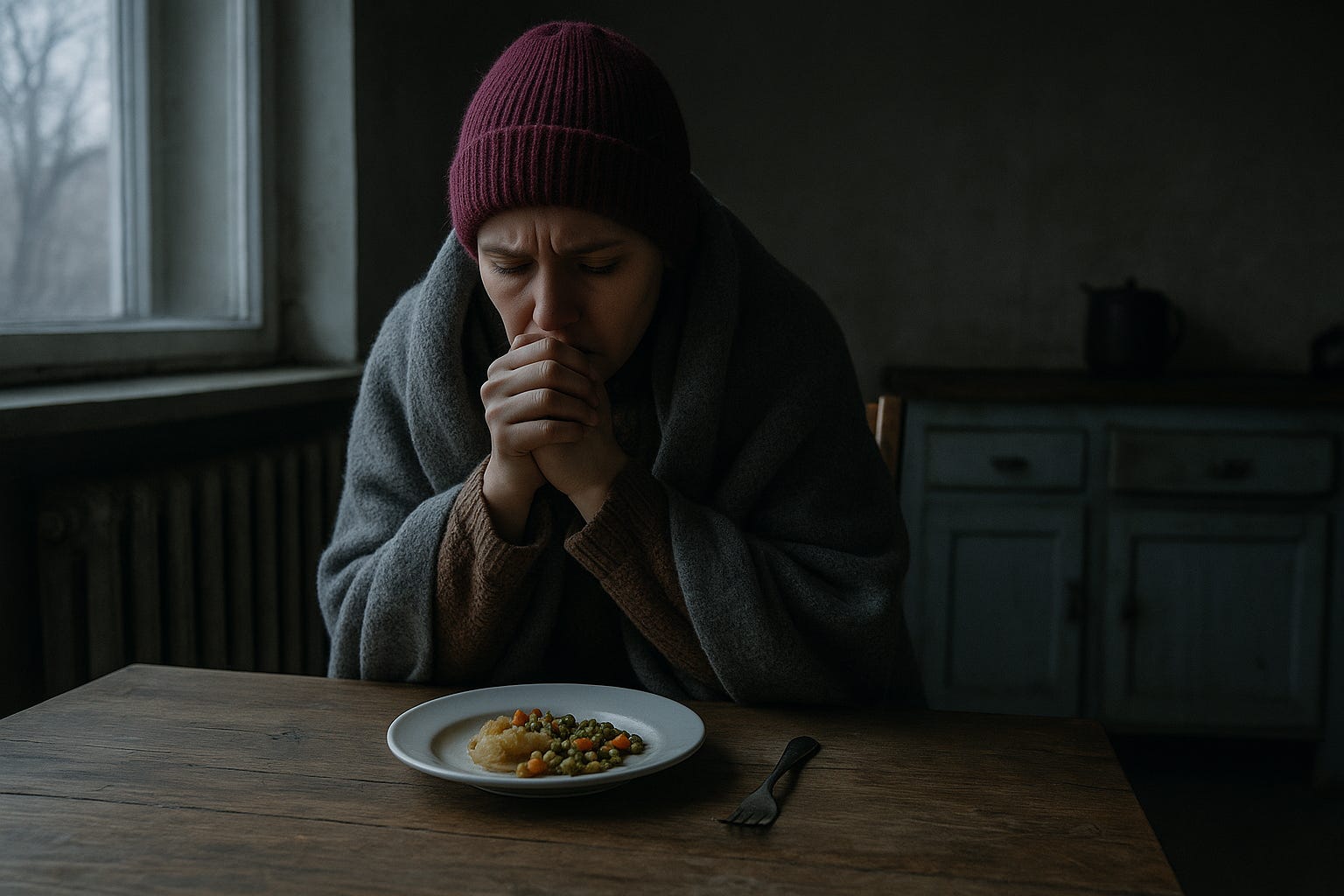
If you’re cold and hungry this winter, you’re not a budget item. You’re a casualty.
Want to help? If you are in a position to do so, consider donating to the nonprofits in your area that provide food and utility assistance. This year in particular, this will be more essential than ever. Organize clothing and food drives. And remind your representatives that their inaction is harming your community. This must stop.
Don’t let the bastards sneak anything past you. Subscribe and get your daily dose of rage and receipts delivered fresh, before the spin doctors can scrub it.
Sources:
“USDA memo says it will not use emergency funds for November food benefits” — Reuters, October 24, 2025
“Trump administration says it won’t tap emergency funds to pay food aid” — Politico, October 24, 2025
“Trump administration won’t tap contingency fund to keep food aid flowing, memo says” — AP News, October 24, 2025
“Due to Federal Government Shutdown, Opening of the 2025‑26 Low‑Income Home Energy Assistance Program (LIHEAP) Season Delayed to December” — Pennsylvania Department of Human Services press release, October 22, 2025
“Heating bill help delayed for low‑income Pennsylvanians amid federal shutdown” — TribLIVE, October 23, 2025
“US states warn food aid benefits will halt if federal shutdown drags on” — Reuters, October 23, 2025
“USDA says it can’t use contingency fund for food stamps” — Roll Call, October 24, 2025

What a cruel and despicable government. You couldn't make it up.
Monsters.