


The Senate did something rare this week. It acted quickly, unanimously, and in the direction of basic public integrity.
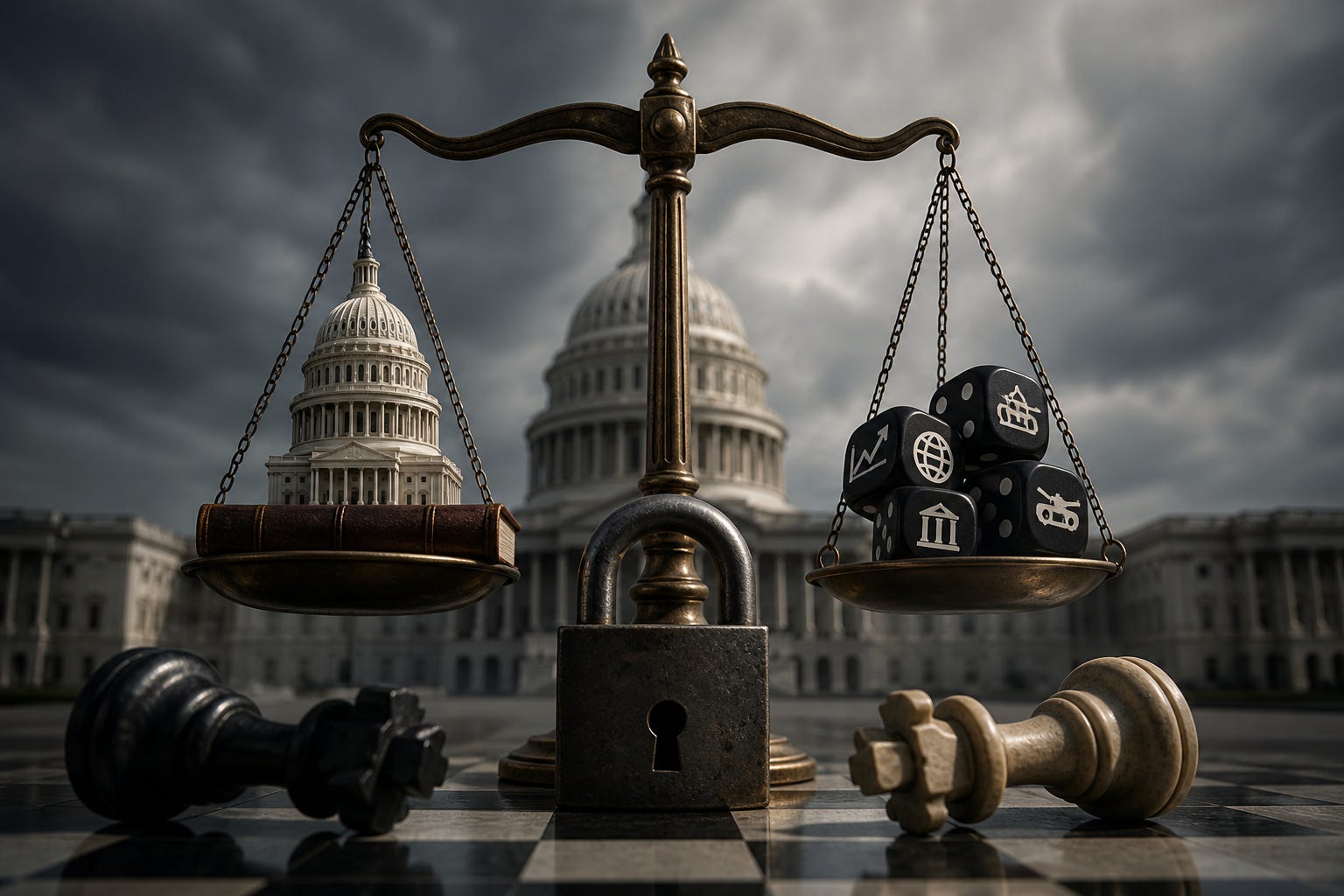
On Thursday, April 30, 2026, the Senate approved a bipartisan resolution by voice vote banning senators, Senate officers, and Senate staff from participating in prediction markets. Because the resolution was written as a change to Senate rules, it took effect immediately.
That is a good step. It is, however, only one step.
This Community Is Powered by You
What started as a small circle has grown into something much bigger, and it’s all because of readers like you.
Every time you forward this email, post it on socials, or bring someone new into the fold, you’re helping build one of the most passionate, independent political communities out there.
Want to keep the momentum going?
Share this newsletter with someone who should be part of this conversation.
Thank you for being here. It means everything.
What Happened
What are Predictive Markets?
Prediction markets allow users to place financial bets on real-world events, such as elections, legislation, geopolitical developments, agency decisions, and other outcomes. In theory, these markets aggregate information. In practice, they can also create a direct financial incentive to profit from privileged access.
The idea is not new. Prediction markets have existed for decades in academic and niche forms. What has changed is their scale, visibility, polish, and proximity to power. Platforms like Kalshi and Polymarket have made event contracts more accessible, more mainstream, and more politically relevant. The markets are no longer just obscure forecasting experiments. They are increasingly visible financial products tied to public events.
What the Rule Does (and Doesn’t) Do
Notably, some of those public events are shaped by people inside government. That leads us to the current Senate action.
The Senate’s new rule applies internally. It bars senators, Senate officers, and Senate staff from participating in prediction markets. It does not apply to House members, House staff, executive branch officials, agency employees, military personnel, contractors, or the general public.
The timing is not accidental. The vote came after a U.S. Army Special Forces soldier, Master Sgt. Gannon Van Dyke, was charged with allegedly using confidential government information to place prediction-market bets tied to the January 2026 capture of Nicolás Maduro. Reuters reported that Van Dyke allegedly wagered $33,000 shortly before the operation and made roughly $400,000. He has pleaded not guilty.
That case turned an abstract ethical concern into a concrete warning. People with privileged access to government information may be able to monetize it before the public even knows what is happening.
The Bigger Problem
This Senate rule is meaningful, but it is not legislation, and the distinction is worth noting.
First, the House would need to pass a similar ethics rule for the same restriction to apply to representatives and House staff. As it stands, the current action is Senate-only. For now, those connected to the House are still free to participate in the predictive markets.
Second, even if both chambers adopted matching internal rules, they would still not cover the rest of the federal government. Agency officials, executive branch staff, military personnel, intelligence officials, political appointees, and regulators also have access to sensitive nonpublic information and can use it to profit in predictive markets. Only federal legislation could address that omission.
Senators Elissa Slotkin, Todd Young, Adam Schiff, and John Curtis have introduced the bipartisan Public Integrity in Financial Prediction Markets Act of 2026. The bill covers the president, vice president, members of Congress, House and Senate employees, political appointees, executive agency employees, and independent regulatory agency employees.
Its strength is that it recognizes the problem is not limited to Congress. It also broadly defines prediction-market contracts, including those offered on platforms, whether or not those platforms are based in the United States.
However, there are limits. As written, the proposal is more clarification than reform.
The bill, as drafted, does not appear to impose a categorical ban on all participation in prediction markets by covered officials. Instead, it prohibits covered individuals from using material nonpublic information obtained through their official positions or duties to profit from prediction-market transactions. It also requires reports for covered transactions valued over $250.
Technically, the STOCK Act already prohibits the use of material nonpublic information for personal financial gain. By specifically calling out predictive markets, the legislation is better than ambiguity, but it still leaves room for the familiar problem of proving what someone knew, when they knew it, and whether they used it.
It also does not appear to directly cover spouses, dependent children, household members, or other family members. As many recent controversies have shown, any ethics rule that stops at the official level can leave a back door through accounts controlled, influenced, or informed by someone close to them.
The Optics Are Almost Too Obvious
Politically, this should be one of the easiest ethics reforms to defend. The good-faith argument against it is hard to find. “Public officials should be able to bet on outcomes tied to government information” is not exactly a winning message.
That is why the Senate vote was so revealing. When the conflict is simple, vivid, and impossible to spin, Congress can act quickly. The same urgency has been harder to find on broader financial-conflict questions, including stock trading by members of Congress.
However, this vote creates a precedent that Congress may find untenable. If it is wrong for public officials to profit from privileged information in prediction markets, then the same principle naturally raises questions about other forms of financial gain tied to government access, influence, and timing. That slippery slope could prevent the legislation needed to ensure an outright ban on participation that extends through the whole of government.
The larger issue is that prediction markets are not the whole problem. They are the newly visible version of a much older one. And increasingly, this government has been unwilling to limit its own opportunity to financially profit from its position.
The Trust Test
Congress now has a clear path.
The House can pass a matching ethics rule. Then both chambers can pass legislation applying a government-wide standard to officials and employees with privileged access to public information.
A stronger version would go even further, prohibiting participation outright for covered officials, including household or control-based restrictions, and reducing the need to prove intent after the fact.
The real ethical standard should be simple: No public official should be able to privately profit from information or influence gained through public service.
The Senate took a step in the right direction. However, restoring trust requires more than one step. It requires closing the loopholes before someone finds a way through them.
Congress may have a clear path, but does it have the political will? That is likely in short supply.
We break down what’s actually happening and what isn’t being said. Subscribe to stay informed without the spin.
Sources:
“Senate bans its own members and staff from betting in prediction markets” — Associated Press, April 30, 2026.
“Senate bans members and staff from betting in prediction markets” — PBS NewsHour, April 30, 2026.
“US Senate bans its members, staff from betting in prediction markets” — Reuters, April 30, 2026.
“Curtis, Slotkin, Young, Schiff Lead Bipartisan Bill to Stop Insider Trading from Government Officials on Prediction Markets” — Sen. John Curtis, March 26, 2026.
“Slotkin, Young, Schiff, Curtis Lead Bipartisan Bill to Stop Insider Trading from Government Officials on Prediction Markets” — Sen. Elissa Slotkin, March 26, 2026.
“Public Integrity in Financial Prediction Markets Act of 2026” — Bill Text PDF via Sen. Curtis, 119th Congress, 2nd Session.
“US soldier charged with making $400000 on Maduro removal bets” — Reuters, April 23, 2026.
“Exclusive: US soldier charged with Maduro bets was blocked from opening account at Kalshi, source says” — Reuters, April 24, 2026.
“US soldier charged over Maduro removal insider bets released on $250,000 bond” — Reuters, April 24, 2026.
“S.2038 -- STOCK Act” — NIH Ethics Program, Official text summary.
“The STOCK Act, Insider Trading, and Public Financial Reporting by Federal Officials” — Congressional Research Service via EveryCRSReport, April 19, 2012.
Now if we can get 67 senators vote to convict, we can stop MAGA
These grifters will cheat by proxy.