


The most viral legal fight of the week is also the most visually absurd. A federal judge is now openly questioning whether the Trump administration could legally demolish part of the White House to make way for a $400 million ballroom. The East Wing is already gone. What remains is a legal argument that, at least in court this week, did not land well.
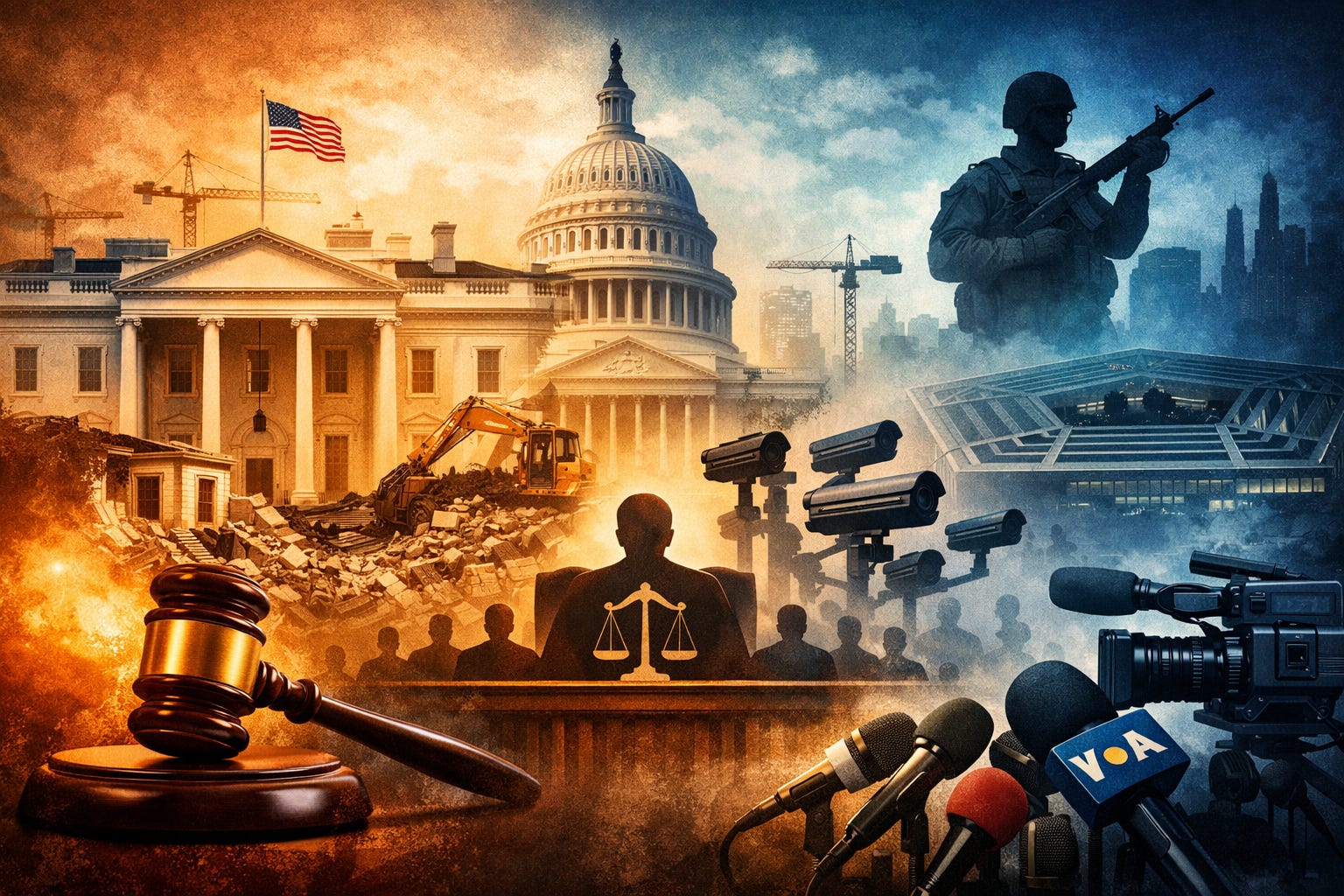
That moment has been widely framed as another bad week in court for the administration. The more revealing way to understand it is as the clearest example yet of a broader pattern. Across multiple arenas, the same instinct keeps surfacing. Control the building. Control the narrative. Control the machinery of power.
The East Wing case is the most visible expression of that instinct, but it is far from the only one.
This Community Is Powered by You
What started as a small circle has grown into something much bigger, and it’s all because of readers like you.
Every time you forward this email, post it on socials, or bring someone new into the fold, you’re helping build one of the most passionate, independent political communities out there.
Want to keep the momentum going?
Share this newsletter with someone who should be part of this conversation.
Thank you for being here. It means everything.
Own the Building
The East Wing fight began with a decision that was as symbolic as it was structural. In October 2025, the administration moved forward with demolishing the East Wing of the White House complex to clear space for a large ballroom. Preservation groups, led by the National Trust for Historic Preservation, filed suit in December, arguing that such a move required congressional authorization and compliance with federal preservation and environmental laws.
See our earlier reporting on the demolition of the East Wing here:
Note: Articles roll into the archive over time. Consider becoming a paid subscriber for full access to our extensive catalog.

The administration’s position has rested on a broad reading of presidential authority over the White House. Its lawyers have argued that the project qualifies as an “alteration,” a term that historically covers renovations rather than full demolition. That distinction has become central to the case.
In late February 2026, U.S. District Judge Richard Leon declined to immediately halt construction, allowing work to continue while litigation proceeds. He signaled at the time that the plaintiffs had raised serious questions. Those questions came into sharper focus at a March 17 hearing.
During that hearing, Leon pressed government lawyers on what he described as shifting justifications for the project. He also questioned whether tearing down an entire wing could plausibly be treated as a routine alteration. At one point, he referred to part of the administration’s argument as “brazen,” a choice of language that quickly circulated beyond the courtroom.
A ruling on whether to pause the project is expected by the end of March. Regardless of the outcome, the hearing clarified what is at stake. This is not simply a dispute about construction. It is a test of how far presidential authority extends over a building that is both a residence and a national symbol.
The East Wing case is the most theatrical version of that question. It is also the easiest to visualize. The same underlying issue appears in less visible but equally consequential contexts.
Own the Narrative
If the ballroom fight is about control over a national symbol, the next set of cases asks who gets to shape the story of the government’s actions.
On March 20th, U.S. District Judge Paul Friedman blocked a new Pentagon press-access policy that had restricted which journalists could attend briefings and maintain credentials. The administration had argued that the changes were necessary for security and logistical reasons. Reporters who challenged the policy contended that it allowed officials to exclude outlets based on coverage, raising First Amendment concerns.
See our earlier reporting on the Pentagon press policy here:
Note: Articles roll into the archive over time. Become a paid subscriber for full access to our extensive catalog.

The First Amendment protects freedom of speech and of the press. Courts have long recognized that the government has some discretion to manage access to secure facilities such as the Pentagon, but that discretion has limits. It cannot be used to discriminate based on viewpoint.
Friedman’s ruling suggests that the plaintiffs’ concerns were not hypothetical. He ordered that credentials be restored, finding that the policy likely violated constitutional protections. The decision transforms what might have been a technical dispute over access into a more fundamental question about whether the government can shape the press corps itself.
That question also sits at the center of the administration’s recent clash with Voice of America, a government-funded international broadcaster with a statutory mandate to maintain editorial independence. Earlier this week, U.S. District Judge Royce Lamberth ruled that the administration’s attempt to dismantle or significantly restructure VOA was unlawful, ordering the organization restored.
See our recent reporting on this case here:

The Pentagon and VOA cases are not identical. One concerns physical access to briefings while the other concerns the structure and independence of a publicly funded newsroom. The connection lies in the same underlying impulse. Both involve efforts to exert greater control over who can ask questions and how information is produced and distributed. They are further linked to ongoing lawsuits brought by Trump against several media outlets.
Taken together, they point to a broader theory of governance in which managing the message becomes a central objective rather than a secondary concern.
Own the Power
The largest set of legal challenges does not revolve around a single building or a specific press policy. It concerns how policy is made, how authority is exercised, and how far the executive branch can go without following established procedures.
These cases are varied, yet they tend to cluster around three recurring patterns.
Bypassing the Process
A number of lawsuits challenge the administration’s efforts to reverse existing policies in areas such as environmental regulation, healthcare, and student debt relief. These cases turn on administrative law, the body of rules that governs how federal agencies create and change policy.
Under the Administrative Procedure Act, agencies must follow a defined process when issuing or rescinding regulations. That process includes providing a reasoned explanation for changes and allowing for public input. Courts do not require agencies to maintain policies. However, they do require that changes be justified and procedurally sound.
In challenges to Environmental Protection Agency rollbacks, plaintiffs argue that the administration failed to adequately justify the reversal of climate-related regulations. In healthcare litigation involving the Affordable Care Act (ACA), courts are examining whether changes affecting coverage and benefits were implemented in compliance with statutory requirements. Student debt cases raise similar questions about whether the reversal of relief programs met the legal standards for agency action.
The common thread is not the substance of the policies. It is whether the administration followed the rules required to change them.
Expanding Executive Authority
Another set of cases focuses on the scope of presidential power itself. These disputes often invoke the constitutional principle of separation of powers, which divides authority among the legislative, executive, and judicial branches.
Litigation over federal election rules, for example, raises questions about how much influence the executive branch can exert over processes that are traditionally administered by states. Other cases test broader claims of executive authority in areas where Congress has historically played a central role.
See a recent update on voting cases here:

Courts tend to approach these disputes cautiously. They recognize that the presidency carries significant and, over the last several decades, increasing authority, particularly in areas such as national security. At the same time, they act as a check when that authority appears to extend beyond statutory or constitutional limits.
The East Wing case also fits within this category. It asks whether control over the White House complex can be exercised without congressional involvement. The answer has implications that extend beyond a single construction project.
Politicizing Government Machinery
A third cluster of cases concerns the structure and independence of government institutions themselves.
Litigation over the revival of “Schedule F,” a classification that would make it easier to remove certain federal employees, centers on whether long-standing civil service protections are being undermined. Those protections were designed to ensure that career officials can carry out their duties without political pressure.
Separate disputes involving the Department of Justice raise questions about prosecutorial independence. The Department of Justice is part of the executive branch; however, it has traditionally operated with a degree of insulation from direct political direction in individual cases. Allegations that prosecutorial decisions are being influenced by political considerations have prompted judicial scrutiny.
See one recent report here:

These cases are less about any single policy outcome and more about the character of the institutions that implement policy. They ask whether those institutions remain independent enough to function as intended.
The Edge of Enforcement
Immigration cases add another dimension. Challenges to expanded detention and deportation policies focus on due process, the constitutional requirement that individuals be treated fairly under the law before being deprived of liberty.
These disputes often involve questions about how quickly and under what conditions individuals can be removed from the country. Courts have historically given the executive branch considerable leeway in immigration enforcement. They have also intervened when policies appear to bypass procedural safeguards.
This area illustrates the most direct use of state power. It also highlights how quickly legal boundaries come into play when enforcement outpaces process. As multiple lawsuits move through the judiciary, anticipate updates on this front in the coming months.
The Pushback Is Taking Shape
Taken individually, each of these cases can look technical or isolated. Viewed together, they describe a consistent approach to governing. Act first. Assert authority broadly. Address legal constraints as they arise.
The response is also becoming clearer. Courts are not moving in lockstep, and outcomes remain uncertain. Yet recent developments suggest that judicial pushback is beginning to take form across multiple fronts.
Judge Leon’s skepticism in the East Wing case signals discomfort with expansive readings of presidential authority over national institutions. Judge Friedman’s ruling on Pentagon press access underscores limits on how the government can treat the press. Judge Lamberth’s decision on Voice of America reinforces the principle that even government-funded media must maintain independence.
None of these rulings settles the larger questions. Many of these cases are in early stages, appeals are likely, and some disputes may ultimately reach the Supreme Court.
What they do suggest is that the legal system is engaging with a recurring set of claims about power, process, and control. The outcome of that engagement will shape not only specific policies, but also the boundaries of executive authority itself.
This week's story is not simply that one case went viral. It is that a pattern is becoming harder to ignore, and that the institutions designed to test it are beginning to respond.
If you want more reporting that connects individual headlines to the broader constitutional questions underneath them, subscribe. That is the focus of this newsletter.
Sources:
US judge questions ‘shifting’ defense of Trump ballroom project, Reuters, March 17, 2026.
Judge questions Trump aides’ ‘brazen’ claims on White House ballroom, The Washington Post, March 17, 2026.
Pentagon’s limits on press access unconstitutional, US judge rules, Reuters, March 20, 2026.
Judge sides with New York Times in challenge to policy limiting reporters’ access to Pentagon, Associated Press, March 20, 2026.
Judge reinstates 1,000 Voice of America employees, deems wind-down illegal, The Washington Post, March 17, 2026.
Judge orders more than 1,000 Voice of America employees to be reinstated, The Guardian, March 17, 2026.
Judge skeptical of Pentagon’s restrictions on press access, Reuters, March 6, 2026.
Judge indicates he might shut down Trump’s $400m White House ballroom plan, The Guardian, March 18, 2026.
Beats me why everyone plays pussy foot with Trump when it’s obvious that he is only interested in money for himself and his friends. He cons his followers along for as long as he can and then moves on to the next con job.
His entire occupation of the WH this time around has been to push beyond the limits of his power. Being surrounded by ass kissers that cannot tell him no doesn't help. We can all thank the Roberts SCOTUS and Mitch McConnell for enabling, protecting and emboldening this monster.