


On the early morning of August 3, 2025, Edward Coristine, a 19‑year‑old ex‑staffer for the Department of Government Efficiency (DOGE), known online as “Big Balls”, found himself at the center of a violent attempted carjacking. Walking near Logan Circle, he and his significant other were confronted by a group of around ten juveniles, who reportedly tried to seize their vehicle. Coristine, according to police and a WIRED‑obtained report, pushed his partner to safety but was then beaten, suffering a concussion, a broken nose, and having his iPhone stolen. Two 15‑year‑olds from Hyattsville, Maryland were arrested, though several suspects remained at large.
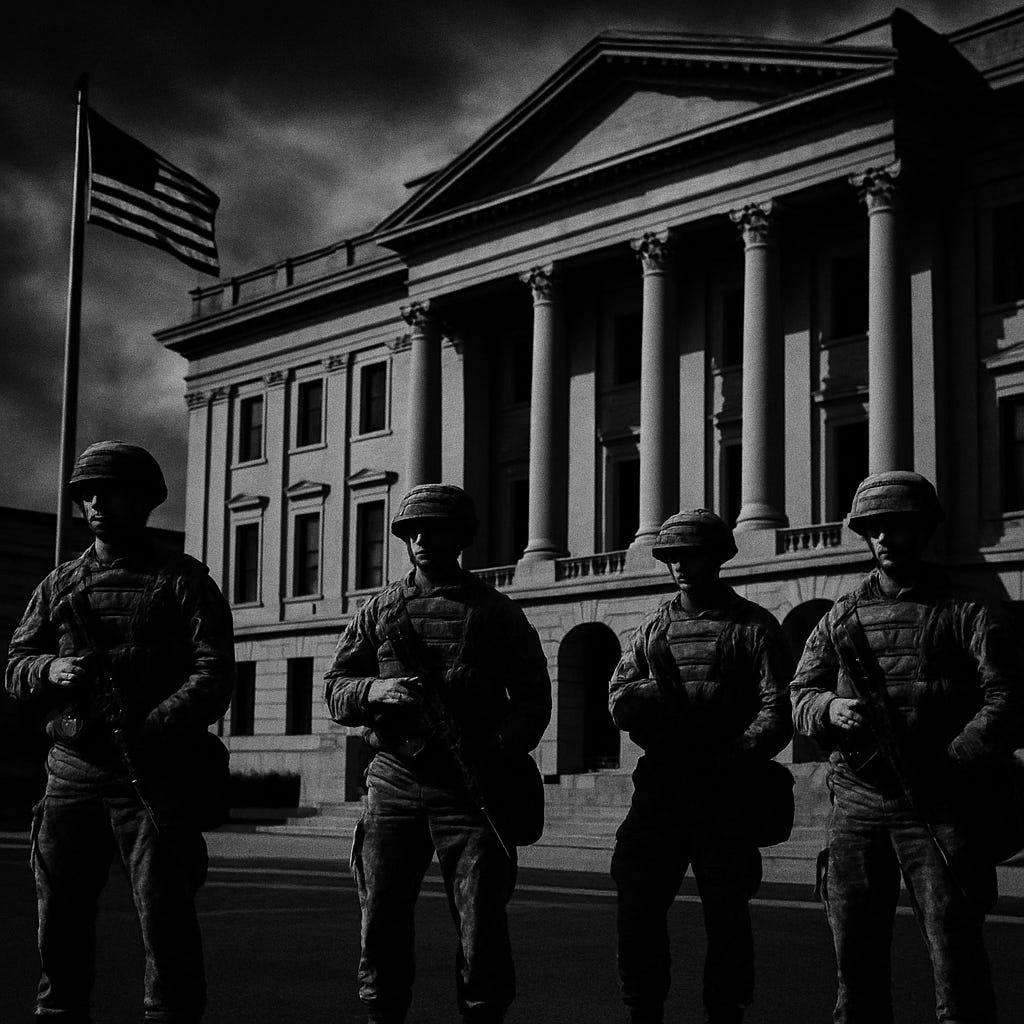
The image of Coristine bloodied and shirtless posted by Trump and amplified by Elon Musk, went viral. A week later, that one assault became the administration’s justification for invoking emergency powers in D.C.: Federalizing the Metropolitan Police Department and deploying up to 800 National Guard troops onto the streets under the Home Rule Act.
The move was paired with another directive: sweeping homeless encampments from high-visibility areas near Union Station, public parks, and federal underpasses. The White House framed both actions as part of a broader push to restore law and order, tackling violent crime, homelessness, and urban decay in one decisive stroke.
But D.C.’s own data told a different story. Violent crime in 2025 is running lower than in 2023, and carjackings, while still troubling, have dropped sharply from last year’s peak. The city’s homeless shelters remain at capacity, meaning the people displaced by federal sweeps have few places to go. To critics, the timing and scale of the intervention look less like a targeted response to real-time crisis and more like a piece of political stagecraft: a show of strength in the capital just days before Trump’s scheduled meeting with Vladimir Putin in Alaska.
Stay Informed. Stay Loud.
Subscribe to The Coffman Chronicle for no-BS political analysis, action guides, and daily truth bombs you won’t get from corporate media.
Story vs. Reality
The White House’s official line is blunt: crime is surging, the streets aren’t safe, and the city’s Democratic leadership has failed to protect residents. In the administration’s telling, deploying the Guard and taking control of local police is a necessary emergency measure, a president stepping in where the mayor and council have supposedly dropped the ball.
The numbers don’t match that picture. Metropolitan Police Department data shows violent crime down in 2025 compared with last year, with homicides, robberies, and assaults all trending lower. Carjackings, the crime that set this whole operation in motion, are down sharply from the record-breaking 959 reported in 2023. That’s not to say the problem has vanished. Carjackings still happen, and they still scare people, but the trendline is moving in the right direction.
Then there’s the question of homelessness. Sweeping encampments can make sidewalks and underpasses look cleaner, at least for a while, but without expanding shelter space or affordable housing, it doesn’t solve the problem. In some cases, it simply shuffles it to a different block. Even some law-and-order advocates quietly admit that deploying soldiers to confront homeless people is less about reducing crime than about changing what the cameras see.
What remains is a widening gap between the stated threat and the government’s chosen response, a gap big enough to invite speculation that the real target here isn’t crime statistics at all, but public perception.
Media Coverage & Framing
In the conservative press, the story lands as proof of decisive leadership. National Guard trucks rolling past the Capitol are framed as the image of a president willing to do what it takes to make the capital safe. Fox News ran a chyron declaring “Trump Restores Order to Lawless D.C.” Talk radio hosts praised the move as a long-overdue correction to “soft-on-crime” Democratic governance.
In the mainstream and liberal press, the tone is almost the opposite. The Washington Post described the action as a political stunt “untethered from the crime data.” MSNBC commentators openly questioned why soldiers were patrolling a city that was statistically safer than it had been a year ago. Some outlets even avoided using the term “emergency” altogether, replacing it with “White House intervention” or “federal takeover” to emphasize the unusual nature of the move.
Then there’s what isn’t getting much coverage at all: the fact that this was legally easy to do because of how D.C. is governed. The capital’s unusual legal status means the president has powers here that would be unthinkable in any of the 50 states. Most coverage treats the deployment as an extreme move in a vacuum, without explaining that in D.C., it doesn’t require breaking any laws or winning a fight with Congress. That missing context leaves many readers assuming this is a constitutional showdown, when in reality it’s a political choice made possible by long-standing and rarely discussed rules.
How D.C. is Governed: The Unusual Legal Setup
To understand how the president can take over Washington’s police force and roll in the National Guard without so much as a congressional vote, you have to start with the fact that D.C. isn’t a state. The Constitution created it as a federal district, a neutral seat of government under Congress’s “exclusive legislation.” That means Congress can override any local law or budget decision, and it also means the president’s powers here are different than anywhere else in the country.
In 1973, the Home Rule Act gave Washington an elected mayor and council, but that local control exists only because Congress allows it. The president doesn’t have to ask the mayor’s permission to deploy the D.C. National Guard, unlike in a state, where governors control their Guard unless the White House federalizes it. In D.C., the Guard is under presidential authority at all times, through the Secretary of the Army.
The Home Rule Act also gives the president the power to assume control of the Metropolitan Police Department in a declared public emergency. There’s no need for congressional approval in the moment; Congress can step in later to reverse it, but by then the operation is already underway. This is why Trump could make his move in less than a week, especially with Congress on August recess. There was no legal gauntlet to run.
It’s a setup that has existed for decades, but it rarely comes up in public debate because it’s rarely used. When it is, it’s usually in the middle of an undeniable crisis, such as riots, mass protests, or terrorism threats. That’s what makes the current intervention stand out: not that it’s illegal, but that it’s being used for something far short of a citywide emergency.
Past Presidential Interventions
Presidents have stepped into D.C. policing before, but usually under far different circumstances. In 1968, Lyndon Johnson federalized the city’s police and deployed troops in response to riots after Dr. Martin Luther King Jr.’s assassination. In 1971, Richard Nixon used federal forces to control massive anti-Vietnam “May Day” protests that blockaded city streets. George H.W. Bush brought in federal help as part of high-profile drug raids in 1989. After 9/11, George W. Bush oversaw an unprecedented security clampdown in the capital.
Even Trump himself used these powers in 2020, when federal forces and the D.C. Guard cleared Lafayette Square of racial justice protesters ahead of his Bible photo op. Each of these moments — whatever one thinks of the politics behind them — was tied to either mass unrest, a prolonged protest movement, or a national security crisis.
That’s why this month’s intervention is so unusual: the trigger wasn’t a riot or a terror alert, but a single carjacking a week earlier. And the irony is hard to miss. On January 6, 2021, when a violent mob stormed the U.S. Capitol itself, Trump did not order the immediate deployment of the D.C. National Guard to restore order. Now, with no uprising and no mass demonstration, the same president has moved faster and more decisively to militarize the city.
International Comparisons
Washington’s status as a federal district makes it something of an outlier among democratic capitals, but it’s not unique in the world. Several nations have carved their capitals out as separate jurisdictions to keep them under tighter national control, often with very different political results.
The closest parallel in a democracy is Canberra, Australia. Like D.C., it sits in a federal district rather than a state. The national parliament can override its laws, but Canberra’s local government still runs day-to-day policing. In New Delhi and Brasília, the arrangement is similar. These capitals exist in special federal territories, but their police forces answer locally except in rare emergencies.
Then there are the less democratic examples. In Moscow, the Kremlin can override the mayor and deploy federal security forces at will, often ahead of major events or in response to protests. Ankara, Turkey’s capital, operates under a similar model, with the central government appointing key security officials and using the city as a stage for visible displays of power.
That’s where Trump’s move in D.C. starts to look less like Canberra and more like the Moscow-Ankara playbook. Deploying soldiers in the capital days before a summit with Vladimir Putin isn’t about securing the site of the meeting. The meeting is, after all, over 3000 miles away in Alaska. It’s about showing command over the symbolic heart of the country. In authoritarian and semi-authoritarian states, that sequence is a familiar one: flex control at home, then sit down at the negotiating table abroad.
Possible Strategic Reasons
If this were about protecting foreign dignitaries, the Guard would be in Alaska. If it were about addressing a sustained crime crisis, it would have come during a sustained spike in crime, not seven days after a single high-profile carjacking. Which leaves the question: why now?
One explanation is symbolism. In the days before sitting down with Vladimir Putin, Trump can point to images of soldiers under his command patrolling the streets of the U.S. capital. It’s a visual statement of control aimed as much at a foreign counterpart as at the voters at home. Strongman leaders from Moscow to Ankara have long used that sequence: demonstrate command over the heart of the nation, then project that confidence into high-stakes diplomacy.
A second is narrative management. By flooding the news cycle with dramatic domestic action, the White House shapes the conversation heading into the Alaska meeting. The pre-summit chatter isn’t about what Trump might concede to Putin. Instead, it’s about his “law and order” posture in Washington. For a political strategist, that’s a cleaner, more controlled backdrop.
And a third possibility is that this is a test. D.C. is the one place in America where the president can flex this kind of power without sparring with a governor or rushing a bill through Congress. If the public reaction is muted — if most Americans shrug at the sight of troops in the capital during peacetime — it lowers the political cost of doing it again, for this president or the next.
What to Look for Next
Whether this moment fades as a political stunt or hardens into precedent will depend on what happens in the next few weeks. The first signal will be how long the Guard stays. If the troops melt away after a couple of news cycles, the message was the point. If they linger, even in reduced numbers, it’s a sign that “emergency” status may be quietly becoming the new normal in parts of the city.
The second is scope. Right now, federal control is focused on policing and targeted homeless sweeps. Watch for mission creep, such as the creation of new security zones, permanent checkpoints, or federal agents taking over routine patrols. These moves rarely happen all at once; they expand inch by inch until they feel ordinary.
Then there’s the reaction. If Congress, especially Republicans from outside the District, pushes back on the grounds of local control, it could rein in the executive’s appetite for similar moves. If lawmakers stay silent and the public shrugs, the lesson for the White House will be that this is a politically safe tool to pull off the shelf again.
Finally, keep an eye on where this model gets exported. Puerto Rico, national parks, and federal courthouses are all federal jurisdictions where the same logic could be applied under the banner of “public safety.” D.C. may not be the end of the story. It may be the testing ground.
For now, the streets of Washington carry a dual message. To supporters, they say the president has seized the wheel and is steering the city back toward safety. To critics, they show how easily the executive can bypass local authority and roll out military force in the capital without meeting the threshold of a true emergency. Both views can be true in the short term. The more important question is what they mean in the long term, and whether Americans notice if the definition of “emergency” quietly changes while no one is looking.
If history is any guide, powers exercised in the name of safety rarely disappear on their own. They linger, waiting for the next “test.” The real measure of this moment will come not in this week’s headlines, but in the months ahead when we see whether the troops leave, the powers recede, and Washington goes back to governing itself.
If you haven’t seen this side of the story in your news feed, share it. And if you want to track how this plays out in D.C. and beyond, subscribe so you don’t miss the next chapter. Because in politics, the first move is rarely the last.
Stay Informed. Stay Loud.
Subscribe to The Coffman Chronicle for no-BS political analysis, action guides, and daily truth bombs you won’t get from corporate media.
Bibliography:
“Trump Says He’s Placing Washington Police under Federal Control and Activating the National Guard.” AP News, August 11, 2025.
“Justice Department Boosts Effort to Crack Down on D.C. Crime.” Axios Local: Washington, D.C., January 29, 2024.
“Carjacking.” Metropolitan Police Department. Accessed August 11, 2025.
“What to Know About Trump’s Washington, D.C., Takeover.” The Cut, August 11, 2025.
“Trump News at a Glance: Epstein Case Haunts Administration Even as Vance Blames Democrats for Mishandling.” The Guardian, August 11, 2025.
“Minors Account for Half of DC’s Carjacking Arrests since 2023 — Including Pint-Sized Perps as Young as 12: Police Data.” New York Post, August 6, 2025.
“Why Trump Is Deploying the National Guard to Washington, D.C.” Time Magazine, August 11, 2025.
District of Columbia Home Rule Act, Public Law 93–198, 87 Stat. 774 (1973). Wikipedia.
“Fact Check: Yes, D.C. Crime Is Out of Control.” White House Official Website, August 8, 2025.
“Edward Coristine, ‘Big Balls,’ Assaulted in Alleged D.C. Carjacking.” WIRED, August 8, 2025.

Trump is desperate, because he is worried about the Epstein Files we won't forget just another distraction!
I’m feeling that this article tries to start the “normalization” of this pure power grab. Trump is going for the low hanging fruit and the move requires immediate pushback from the public.
If allowed to stand without challenge for the weeks or months to see what happens, as you suggest, the situation will become permanent.