


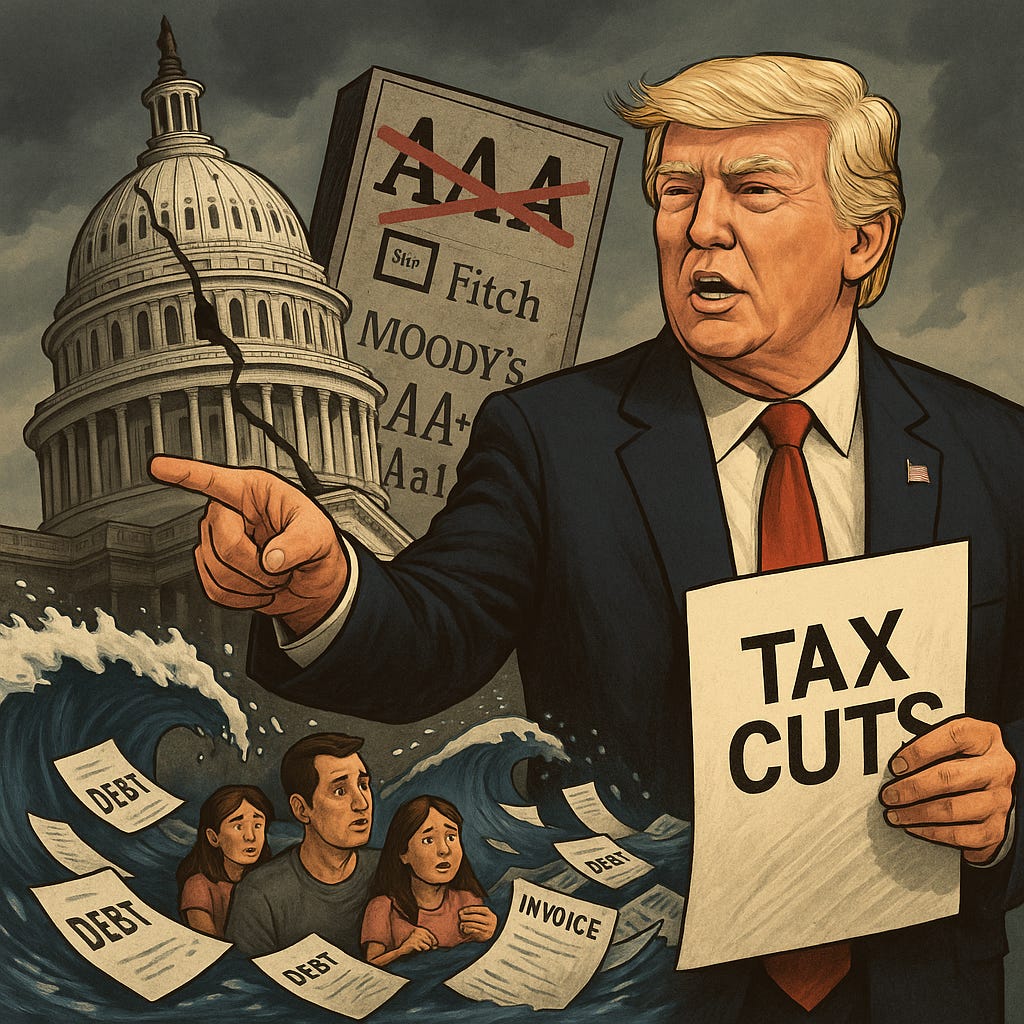
For decades, Republicans have declared themselves the party of fiscal responsibility. They’ve warned about runaway spending, claimed to champion balanced budgets, and vilified Democrats as reckless stewards of the public purse. But the numbers—and the history—tell a very different story. With a new GOP budget proposal poised to deepen the deficit and further destabilize the economy, and all three major credit rating agencies have now downgraded the U.S. for the first time in history, the façade of fiscal conservatism is crumbling. What we’re witnessing is not a one-off misstep, but the latest chapter in a long-running pattern of debt-fueled, politically motivated economic sabotage.
We just hit 13,000 subscribers—thank you! We’re offering full access to The Coffman Chronicle at 50% off to celebrate.
Get exclusive analysis and fearless reporting you won’t find in corporate media.
Budget Theater in the House
The House Budget Committee narrowly advanced President Trump’s “One Big Beautiful Bill” late Sunday night, resurrecting a reconciliation package that had stalled just days earlier. The bill—packed with regressive tax cuts, delayed Medicaid work requirements, and spending boosts for defense and border enforcement—is still far from becoming law. It faces internal GOP resistance, uncertain prospects on the House floor, and virtually no path forward in the Senate.
So why push it at all?
Because, like so much of modern Republican economic policy, this bill isn’t about governing but rather posturing. It’s the latest in a long tradition of fiscal sleight-of-hand, where Republicans preach austerity while enacting policies that do the exact opposite.
A Familiar Playbook: Cut, Inflate, Blame
The bill includes an estimated $3.8 trillion in tax cuts over the next decade. Most of the benefits go to corporations and the wealthy, while the proposed offsets come from slashing safety net programs like Medicaid and housing aid.
Independent analysts estimate the plan would add at least $2.5 trillion to the national debt, likely more once interest costs are included. Yet Republicans continue to market it as “fiscally responsible.”
It’s the same script from Reagan to Trump: slash taxes, spike the deficit, and then declare that we “can’t afford” public programs that serve working Americans.
We’ve covered this budget reconciliation process and it’s many pitfalls and detractors before. See some of it here:


The Downgrade No One Can Ignore
Last week, Moody’s downgraded the U.S. credit rating from Aaa to Aa1, citing rising debt, political dysfunction, and—explicitly—the threat of extending Trump-era tax cuts.
This downgrade is more than symbolic; it’s historic. With Moody’s joining S&P (2011) and Fitch (2023) in lowering the U.S. credit rating, this marks the first time in American history that all three major credit rating agencies have judged U.S. debt less than risk-free. For over a century, U.S. Treasuries were the bedrock of global finance—safe, stable, unquestioned. That status is now gone, not because of external threats, but due to chronic political dysfunction and deliberate fiscal recklessness. It's a milestone no serious economic steward should ever want to reach.
The GOP response has been telling.
Treasury Secretary Scott Bessent dismissed it as a “lagging indicator” and waved it off: “I don’t put much credence in the Moody’s downgrade.” Stephen Moore, Trump’s former economic adviser, called it “outrageous” and accused Moody’s of political bias, ignoring that their concerns mirror warnings from nonpartisan watchdogs and the Fed. These are familiar objections, straight from Trump’s playbook: blame Biden and fake news.
Rep. Andy Harris took a different tack, arguing the downgrade validates calls for deeper spending cuts: “We’ve got to get the national debt under control.”
This internal divide exposes the party’s ongoing schizophrenia: performative deficit hawks vs. supply-side evangelists unwilling to touch tax cuts. Meanwhile, the debt climbs.
Powell’s Alarm Bell & the GOP’s Tariff Turmoil
Late last week, Federal Reserve Chair Jerome Powell warned that the U.S. is entering an era of persistent supply shocks driven by geopolitical conflict, climate instability, and tariffs. He cautioned that these disruptions would make inflation more volatile and economic stability harder to maintain.
However, President Trump has lashed out at Powell for not cutting interest rates faster, declaring: “His termination cannot come fast enough.” In response, Sen. John Kennedy defended Powell’s independence: “I don’t think any president has the right to remove the Federal Reserve chairman.”
Meanwhile, Trump’s trade agenda is already hitting consumers. Under his “Liberation Day” policy, a 10% baseline tariff now applies to all imports, with higher rates looming for countries Trump deems “uncooperative.” A 90-day window for trade talks is set to expire this summer, and Treasury Secretary Bessent confirmed that non-compliant nations will receive formal tariff hike notices.
Even Trump’s own officials have admitted who really pays. Bessent acknowledged that companies like Walmart are passing the costs to consumers.
Retailers aren’t staying silent. Walmart, Target, and Home Depot have all said they’re raising prices due to tariffs. Walmart CEO Doug McMillon was blunt: “We can’t eat all these costs.”
Even Amazon, which reportedly planned to list tariff costs directly on product listings, reversed course after Trump personally called Jeff Bezos to object. This time, unlike in 2019, the backlash from other retailers appears more resolute and grounded in the reality Powell described.
A Personal Blueprint for National Failure
None of this is surprising if you’ve followed Trump’s personal financial history. His business empire, built on branding and borrowed money, collapsed into bankruptcy six times. Trump walked away with a golden parachute each time, while others took the hit.
Now he’s applying the same strategy to the U.S. economy: run up the debt, ignore the consequences, and shift the blame.
The Republican Party, who yell repeatedly about fiscal conservatism, has become a vehicle for Trump’s high-risk economic playbook. And just like his companies, the outcomes are looking grim.
The Real Cost of the GOP Economic Agenda
Put together—the tax cuts, the credit downgrade, Powell’s inflation warnings, and Trump’s escalating tariffs—paint a stark picture:
Rising deficits masked by ideological posturing
Inflation fueled by policy choices, not just global trends
A credit downgrade that the GOP won’t take seriously
Consumers paying more, while the party insists it’s China’s fault
It’s not a bug. It’s the design.
Truth vs. Theater
The House budget bill may die on the floor, and the Senate may never consider it. But it already tells a story of a party more committed to political spectacle than economic stewardship.
We are living in a Trump economy again. And just like his bankrupt businesses, it’s running on borrowed time, bad math, and bold lies.
We’ve Been Here Before
Any student of history or politics can tell you this is not new. Since Reagan, every Republican president has increased debt, and every Democrat president has cleaned up the mess. So while the GOP screams about being the party of fiscal conservatism, the facts speak for themselves.
The Deficit Growth Pattern Since Reagan
Ronald Reagan (1981–1989):
Massive tax cuts combined with military spending exploded the deficit. During his presidency, the national debt tripled from $900 billion to nearly $2.7 trillion.George H.W. Bush (1989–1993):
Continued deficits, although he eventually raised taxes in a politically costly effort to curb them, earning him scorn from within his own party.Bill Clinton (1993–2001):
Raised taxes on the wealthy, enacted bipartisan spending reforms. Ended his presidency with a budget surplus, the last time the federal government ran one.George W. Bush (2001–2009):
Tax cuts (2001, 2003), two wars, and Medicare Part D—all unpaid for—turned surpluses into massive deficits, and the national debt nearly doubled.Barack Obama (2009–2017):
Inherited the Great Recession. Implemented the Recovery Act. Debt rose, but the deficit shrank every year after 2010 until Trump reversed course.Donald Trump (2017–2021):
The 2017 tax cuts were passed without offsets, expanding defense spending and gutting revenue streams. The national debt soared, and deficits were surging even before the COVID crisis.Joe Biden (2021-2024):
Inherited record deficits from the COVID crisis and the Trump-era tax cuts. Passed pandemic relief and infrastructure bills, but paired them with long-term offsets. The deficit fell sharply in 2022 before rising again due to higher interest costs and expiring revenues. Unlike his predecessors, Biden’s primary legislation was projected to reduce the deficit over time.
Donald Trump (2025-)
Returned to the office pushing renewed tax cuts and sweeping tariffs. His budget bill promises trillions in new debt, despite claims of fiscal discipline. Credit rating agencies have now all downgraded U.S. debt for the first time in history.
The GOP’s economic vision is as clear as it is dangerous: slash taxes for the wealthy, inflate the deficit, and pass the bill to working Americans under the guise of “reform.” It’s a strategy that’s been tried and failed under every Republican administration since Reagan. With Trump back in office and doubling down on the policies that triggered past crises, the stakes are even higher. We’re not just reliving a cycle; we’re accelerating it. And unless voters and lawmakers confront this deception head-on, the subsequent collapse won’t be a fluke. It’ll be by design.
We just hit 13,000 subscribers—thank you! We’re offering full access to The Coffman Chronicle at 50% off to celebrate.
Get exclusive analysis and fearless reporting you won’t find in corporate media.
Bibliography:
"Moody's Cuts America's Pristine Credit Rating, Citing Rising Debt." Reuters, May 16, 2025.
"Republicans Split on US Credit Downgrade as Party's Tax Bill Lingers." Reuters, May 17, 2025.
"Fed Chief Jerome Powell Warns That U.S. Could Face 'Supply Shocks'." CBS News, May 16, 2025.
"Trump Says Federal Reserve Chair Powell's 'Termination Cannot Come Fast Enough'." Industrial Distribution, May 17, 2025.
"Trump's 90-Day Tariff Pause with China Is Too Little, Too Late for Some Small Businesses." Business Insider, May 18, 2025.
"Amazon in White House Crosshairs over Report of Displaying Tariff Costs." Reuters, April 29, 2025.
"Bessent: Trump Will Raise Tariffs Again on Nations Acting in 'Bad Faith'." Business Insider, May 18, 2025.
"Trump Tax Bill Passes in Key US House Committee Vote." Reuters, May 18, 2025.
"Trump's 'Liberation Day' Is Here: All the Tariffs He Said He'll Impose." Business Insider, April 2, 2025.
"Moody's Downgrade Intensifies Investor Worry about US Fiscal Path." Reuters, May 18, 2025.

America needs to wake the fuck up!!!!
Hypocrisy abounds. Thanks for exposing it.