


For something with the potential to reshape entire professions, the federal government’s new definition of a “professional degree” arrived with remarkably little fanfare. Instead, there was a quiet update from the RISE Committee—part of the One Big Beautiful Bill—that rewrites who counts as a professional for the purposes of federal student loans.
On paper, it may look like a minor regulatory adjustment. In reality, it’s a tectonic shift.
The new definition determines which graduate programs qualify for higher federal loan limits, and therefore, which careers remain accessible to the average student. It affects whether someone can afford their required degree, whether they can access Public Service Loan Forgiveness, and whether entire fields remain viable.
It tells us whose expertise the federal government considers “professional,” and whose expertise it’s willing to discount.
Unsurprisingly, the pattern this redefinition creates is not subtle.
Want to Know Your Rights?
Download a free digital copy of the U.S. Constitution—the same document Trump is trying to bulldoze. Learn exactly what he’s breaking… and how to fight back.
65,000+ strong — and counting.
This Early Black Friday, become a paid subscriber for just $1 a week and help us keep the truth alive.
Join The Coffman Chronicle — $1/Week Early Access
“Professional Degree,” According to the RISE Committee
Before we can understand who gets counted as a “professional,” we have to look at the criteria the RISE Committee used to define the term. On its face, the definition seems straightforward, almost clinical, a checklist meant to bring some order to the thousands of graduate programs across the country.
According to the committee, a professional degree must meet several conditions:
It must be doctoral level (or the highest graduate degree customarily required in the field).
It must require at least six years of postsecondary education.
It must lead to state licensure in all or most jurisdictions.
And it must share a four-digit CIP code—the federal classification system for academic programs—with one of the example degrees in the regulation.
Each of these criteria sounds neutral, objective, perhaps even reasonable until you examine how they are applied and who they end up excluding.
Take the “doctoral level” requirement. The regulation says a professional degree must be doctoral or the highest degree customarily required in the field. On its face, that should allow master’s-level professions like teaching, social work, librarianship, and many public health roles to qualify. Today, many fields that historically relied on master’s degrees, such as nursing practice, physical therapy, occupational therapy, audiology, teaching, librarianship, now offer doctorates as well, and, in advanced positions, may require one.
However, none of that actually matters in practice. The committee did not evaluate what degree levels these professions require today. Instead, eligibility hinges almost entirely on whether the field’s CIP code aligns with the small set of legacy professions recognized in 1965.
In other words, the modern definition of a professional degree is anchored to a sixty-year-old classification system built around the historical prestige professions—law, medicine, and theology—rather than the actual training, licensure, or clinical standards required in 2025.
If your field wasn’t considered “professional” in 1965, it has a much harder time qualifying as one now, no matter how rigorous or essential the work has become.
In theory, this should have been a functional definition. In practice, it creates a hierarchy.
And that’s where the pattern begins to emerge.
The Fields That Made the Cut: The Protected Professions
Once you look at the fields that qualify as “professional” under the new definition, the pattern becomes unmistakable. The RISE Committee’s protected list reads almost like a time capsule of the mid-20th-century academy, an inventory of the professions that have held social prestige for hundreds of years.
The fields explicitly included are:
Medicine (MD/DO)
Dentistry
Pharmacy
Veterinary Medicine
Optometry
Podiatry
Chiropractic
Law (JD/LLB)
Theology (M.Div., M.H.L.)
Clinical Psychology doctorates (a more recent addition reflecting the field’s evolving recognition)
Dentistry, optometry, podiatry, and chiropractic appear on the protected list separately from medicine because by the mid-20th century, they had already formalized their own doctoral degrees, national boards, and licensure systems. They were recognized as distinct professions early, which meant they were included in the federal professional-degree framework when it was created in the 1960s.
Law, medicine, and theology are the professions that have historically been treated as the pinnacle of specialized knowledge. They are high-status, institutionally anchored, and deeply interwoven with the traditional structures of power: the courts, the medical establishment, and the church. They are the fields the government recognized as “the professions” in 1965, and they remain the fields that qualify for the most generous borrowing limits sixty years later.
Even theology—a master’s-level degree without a universal licensing system—remains on the list, not because its regulatory structure matches modern professional standards, but because it has been part of the “classic professions” for centuries.
This isn’t a list built around contemporary needs, training, or public service, but rather one built around historical prestige.
Understanding who is included makes the next question impossible to ignore: who isn’t.
The Fields That Didn’t Make the Cut: Who’s Excluded or At Risk
If the protected list reads like a time capsule of mid-20th-century professional prestige, the list of fields left out—or hanging in regulatory limbo—reveals something very different. These are the professions that require advanced training, rigorous licensure, and direct responsibility for the public’s well-being. They are essential to the functioning of modern society. Yet, under the new definition, they do not qualify as “professional degrees.”
Based on the RISE Committee’s public communications, reporting from Inside Higher Ed and Newsweek, and reactions from professional associations, the following fields are among those likely to be excluded:
Nursing (RN, APRN/NP, clinical nurse specialists, nurse anesthetists)
Physician Assistant / Physician Associate
Occupational Therapy (OT/OTD)
Physical Therapy (PT/DPT)
Speech-Language Pathology (SLP)
Audiology (AuD)
Public Health (MPH/DrPH)
Teaching and Education (all levels and specialties)
Social Work (MSW/DSW)
Librarianship (MLIS and school librarianship)
School Counseling and Mental Health Counseling
School Psychology (non-doctoral)
Business master’s degrees
Accounting
Architecture
Possibly engineering (as suggested in some reports but not yet confirmed)
What’s striking is not only which fields appear on this list, but why. Nearly all of them require graduate education. Many require state licensure, background checks, ethics exams, continuing education, and adherence to professional codes. Many are mandated reporters. They operate in high-liability environments where errors can have serious academic, medical, or legal consequences. Yet under this definition, none of those degrees count as “professional.”
The common thread is not the rigor of their training or the importance of their work. It’s timing. Most of these fields had not yet formalized licensure systems, standardized graduate programs, or national boards in 1965, when the federal government first codified what counted as a professional degree. Today, they are highly regulated, heavily specialized, and indispensable to public systems. Yet the definition still follows the footprint left by a regulatory framework built in another era.
In practice, that means entire sectors of the modern care, education, and community-support workforce—fields that are every bit as demanding as the protected professions—remain outside the boundary of official “professional” status, not because their work is less rigorous, but because they were not recognized early enough to be written into the foundation of the system.
It is a structural blind spot with sweeping consequences.
The Criteria Contradiction
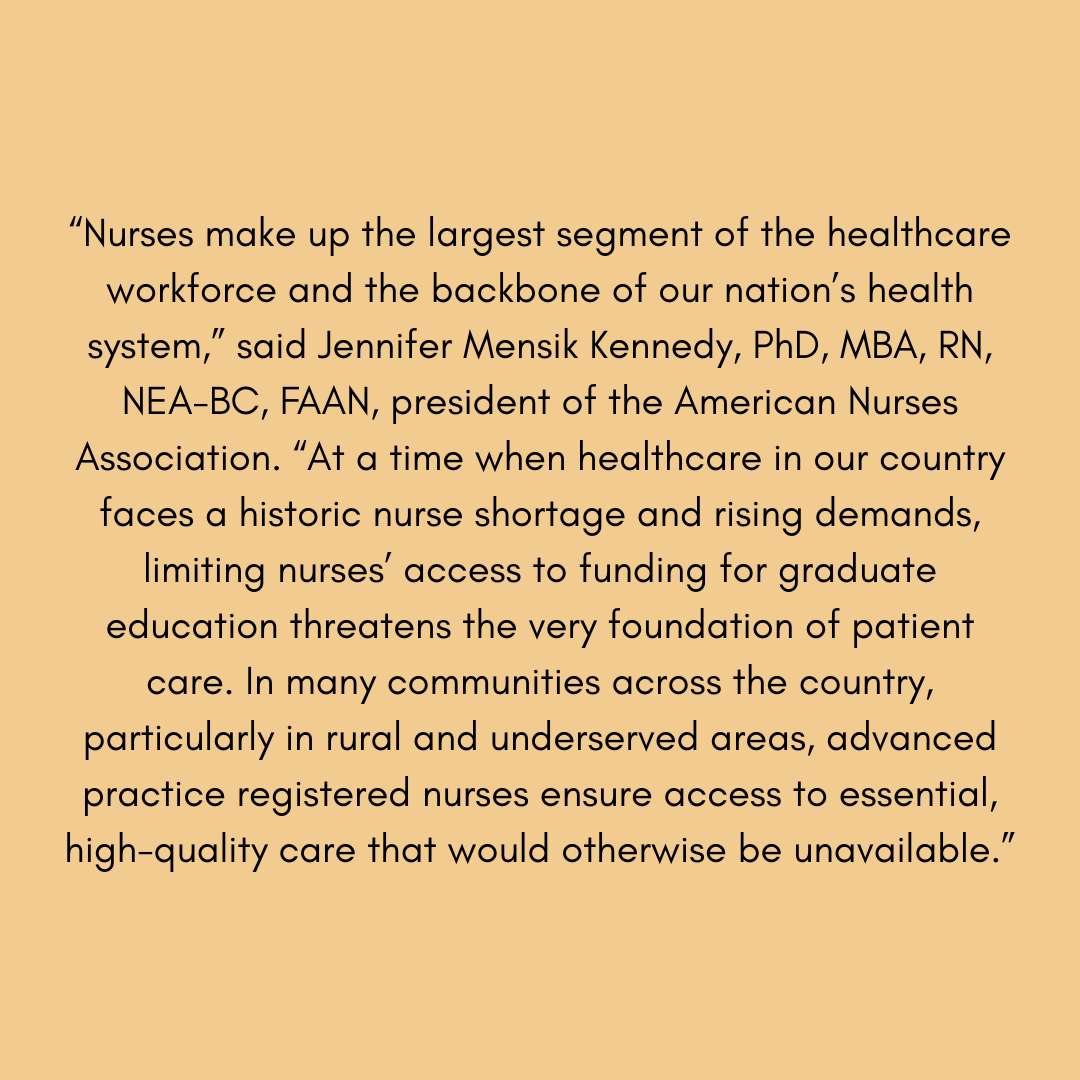
When you compare the RISE criteria to the fields that failed to qualify, the contradictions become impossible to ignore. On paper, the definition requires graduate-level education, licensure, professional accountability, and a pathway into specialized practice. In practice, many of the excluded fields meet or exceed those exact standards.
Consider teaching, social work, and librarianship. These are fields where graduate degrees are the norm rather than the exception. Teachers must earn state licenses in all 50 states, pass exams, and undergo regular background checks and mandated reporter trainings. Social workers must complete accredited master’s programs, accumulate supervised clinical hours, and pass licensing exams that govern everything from mental health interventions to child welfare. Librarianship, though less uniform in its licensure requirements, demands an ALA-accredited master’s degree, specialized coursework, regular background checks and mandated reporter training, and state certification in many jurisdictions.
Allied health professions raise the bar even higher. Physical therapists, occupational therapists, audiologists, and many nursing specialties now require doctorates or master’s degrees paired with national board exams, supervised clinical rotations, malpractice liability, continuing education, and stringent ethical standards. These are roles where clinical judgment carries real-world consequences.
By any contemporary measure, these fields are unquestionably professional.
And yet under the new definition, the only thing that matters is whether they share a CIP code with the legacy professions recognized in 1965. Their licensure systems, ethical codes, clinical standards, training structures, and public impact are all irrelevant if they fall outside that inherited regulatory footprint.
This leaves today’s essential care, education, and community-support professions standing outside the circle, no matter how advanced, licensed, or accountable their work has become.
Who Works in These Fields
Another pattern runs through the fields that lost or never gained professional status under this definition. It’s not about the type of work they do. It’s about who does it.
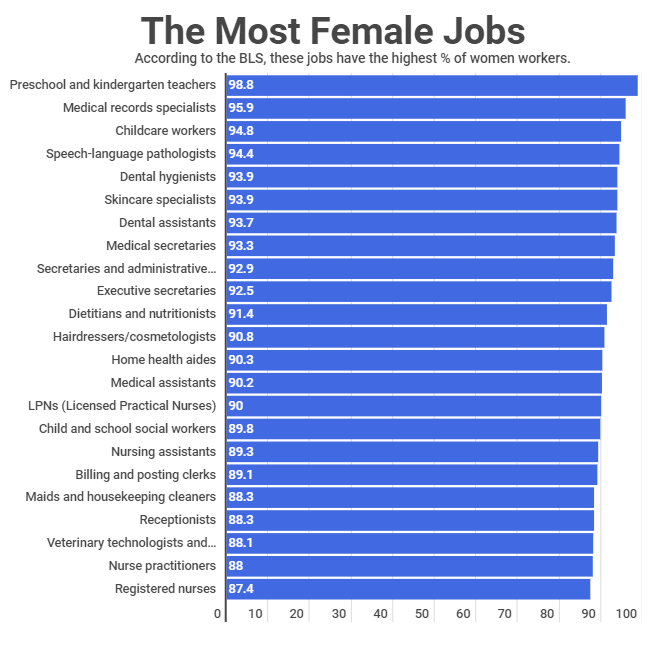
The professions most at risk of being excluded are overwhelmingly staffed by women. Teaching remains roughly 77 percent female, and in elementary grades, that number approaches 90 percent. Similarly, social work programs graduate cohorts that are close to 90 percent women. Librarianship is one of the most female-majority professions in the country. Nursing has long been heavily female, with women making up the vast majority of the workforce. Speech-language pathology, occupational therapy, and many counseling fields are also dominated by women.
These are not marginal patterns. They are defining features of the professions themselves.
They are also fields with growing representation of people of color, particularly in education, social work, and community-based health. Many of the excluded professions serve diverse communities and employ diverse workers, especially compared to the historical core of the protected list.
By contrast, the traditionally protected professions—law, medicine, dentistry, theology—have historically been dominated by white men, even as they diversify slowly over time. Their place in the hierarchy of “the professions” was established long before women or people of color had meaningful access to higher education.
These demographic realities are not incidental. They reflect decades of social stratification across the labor market: prestige fields clustered at the top, care and education fields clustered at the bottom. When a definition reinforces that old hierarchy, it reinforces the gendered and racialized assumptions that produced it.
The modern economy depends on the expertise of the very workers who are being excluded from professional recognition. Yet their labor, their training, and their licensure continue to be treated as somehow less formal, less rigorous, or less “professional” than those in historically male-dominated fields.
It is not the quality of their work that sets them apart. It is the legacy of who has been allowed to do it.
The Salary Divide
The salary patterns tell a parallel story. The professions that remain protected under the new definition tend to be among the highest-earning in the country. Physicians routinely earn well into the six figures, with median salaries around $239,000, and many specialists earn far more. Dentists, pharmacists, and lawyers all occupy similar economic territory. Even veterinary medicine, while less lucrative than human medicine, still sits firmly in the upper tiers of professional pay.
The excluded professions look very different.
Teachers earn around $63,000 nationally, with wide variation across states. Many public school educators, particularly early-career teachers, earn far less. Social workers cluster around $60,000, despite the emotional, legal, and ethical weight of their caseloads. Librarians average in the mid-$60,000s. Nurses and allied health professionals earn more—often between $75,000 and $105,000, depending on specialization—but are still far below the protected fields, with significantly higher patient loads and burnout rates. SLPs, OTs, and PTs fall into similar ranges: solid middle-income salaries, but nowhere near the six-figure median of the legacy professions.
These numbers represent national averages, which means they often overstate what workers earn in underfunded districts, rural areas, and community-based organizations. Many teachers, social workers, and librarians make far less than the national median salaries suggest. Many nurses and allied health staff work in settings where pay lags behind that of larger hospital systems. The gap between headline data and lived experience is often even wider than it appears.
When loan policy is anchored to fields with high lifetime earnings, it assumes that workers can reliably repay large debts. However, the professions most at risk of exclusion are precisely those with modest salaries and high debt loads. These are fields where graduate degrees are required, but lifelong financial mobility is not guaranteed.
These workers are not being left out because they earn too much to justify loan support. They are being left out because they don’t.
And that is the heart of the structural divide: the professions that serve the public are paid like public servants, while the professions that serve the powerful are paid like the powerful. The loan definition simply reflects that hierarchy back at us.
The Mandated Reporter Paradox
There is another striking feature shared by many of the professions excluded under the new definition. In addition to being underpaid and largely female, they are the ones we legally trust with our most vulnerable people. Teachers, social workers, school counselors, librarians, nurses, and many allied-health professionals are mandated reporters. That means the law requires them to report suspected child abuse, neglect, exploitation, trafficking, or imminent harm. They are often the first—and sometimes the only—line between a child and danger.
Mandated reporting is not optional, nor is casual or symbolic. It is a legal duty that carries consequences for failure and emotional fallout, even when done correctly.
To fulfill that duty, these workers undergo:
recurrent background checks
fingerprinting
ethics and reporting training
continuing education on abuse, trauma, and risk factors
strict state oversight
and, for many, legal liability
This is not the profile of a “non-professional” field. It is the profile of a profession entrusted with the safety of children, patients, students, families, and community members. Yet under the new definition, that trust does not translate into professional recognition.
Meanwhile, some fields on the protected list lack universal licensure, mandated reporter obligations, standardized ethics requirements, and regular state oversight. Their inclusion stems from historical placement, not from the responsibilities they carry today.
The paradox is difficult to ignore: the professions responsible for identifying and reporting abuse—people who must hold the public’s safety in their hands every day—are the ones whose degrees are now deemed insufficiently “professional.”
This is not an oversight. It is a window into the values embedded in the system.
Who These Professions Serve
There is another pattern woven through the fields left out of the definition, one that has nothing to do with degree structure or licensing boards, and everything to do with the people these workers serve.
The excluded professions are the ones who work directly with those who have the least power to advocate for themselves, including children, seniors, low-income families, disabled students, the chronically ill, the unhoused, survivors of abuse and violence, and people navigating crisis. They staff public schools, public libraries, public hospitals, community clinics, disability services, mental health centers, and child welfare agencies. They are the face of care for millions of Americans who depend on public systems to survive.
These workers notice the things no one else sees. A teacher sees a child coming to school hungry or dirty. A librarian notices a student who can’t read grade-level text or is showing delayed social interaction. A social worker recognizes the signs of trauma. A nurse catches the subtle shift in a patient’s vitals long before the chart updates. A speech-language pathologist helps a child find their voice for the first time. A community health worker stops an outbreak before it reaches high-income ZIP codes. A counselor prevents a suicide.
This is the quiet, everyday infrastructure of a functioning society. It is not glamorous, not loudly celebrated, but absolutely essential.
Meanwhile, many of the people shaping these rules—legislators, high-income professionals, political donors—rarely interact with public systems. They don’t wait in understaffed ERs. They don’t rely on overburdened school counselors. They don’t need a public librarian to help them apply for benefits or navigate a crisis. Their children attend private schools. Their health care is concierge. Their support systems are paid for, not public.
When you live far from public systems, it becomes easier to forget the people who hold those systems together. It is easier still to treat their training as optional and their expertise as disposable.
However, the irony is that these workers are essential precisely because everyone else’s jobs depend on them. The physician treating a child relies on the teacher who noticed something was wrong. The attorney representing a client relies on the social worker who kept that client alive during a crisis. The medical system relies on the nurses and techs who carry out the daily work that keeps patients safe. Every community relies on librarians, school counselors, and public health workers to provide services that wealthier neighborhoods take for granted.
These workers are not peripheral to society. They are its front line.
And the people they serve are the ones hurt first and worst when the system stops valuing them.
The Pipeline Collapse
The timing of this redefinition could not be worse. Many of the excluded professions are already facing severe workforce shortages. Some of them are at crisis levels. These shortages didn’t materialize overnight. They are the predictable result of high educational debt, low compensation, chronic understaffing, burnout, and increasing responsibilities without corresponding support. The new degree classification threatens to worsen every one of those problems.
Teaching, for example, has seen a steep decline in enrollment in educator-preparation programs over the past decade. Districts across the country report hundreds or thousands of unfilled teaching positions each year, with the shortages most acute in special education, rural areas, and high-poverty schools. Social work agencies—especially in child welfare—struggle with annual turnover rates of 30-40 percent. Public health departments are still trying to recover from the mass burnout and departures that followed the pandemic. School psychology, speech therapy, and occupational therapy positions routinely sit vacant for months because districts cannot find qualified staff.
Healthcare tells a similar story. Hospitals face ongoing nursing shortages, worsened by high patient ratios and low pay relative to the level of education required. Allied-health professionals such as PTs, OTs, and SLPs are in high demand, but long programs and heavy student debt deter prospective students from entering the field. Community mental health centers struggle to hire and retain counselors, often losing staff to higher-paying roles in the private sector.
These shortages directly harm the public. Students lose access to the support they need. Patients wait longer for care. Families experience delays in essential services. Communities face outbreaks that could have been prevented. Every staffing gap translates into worse outcomes for the people who rely on these systems.
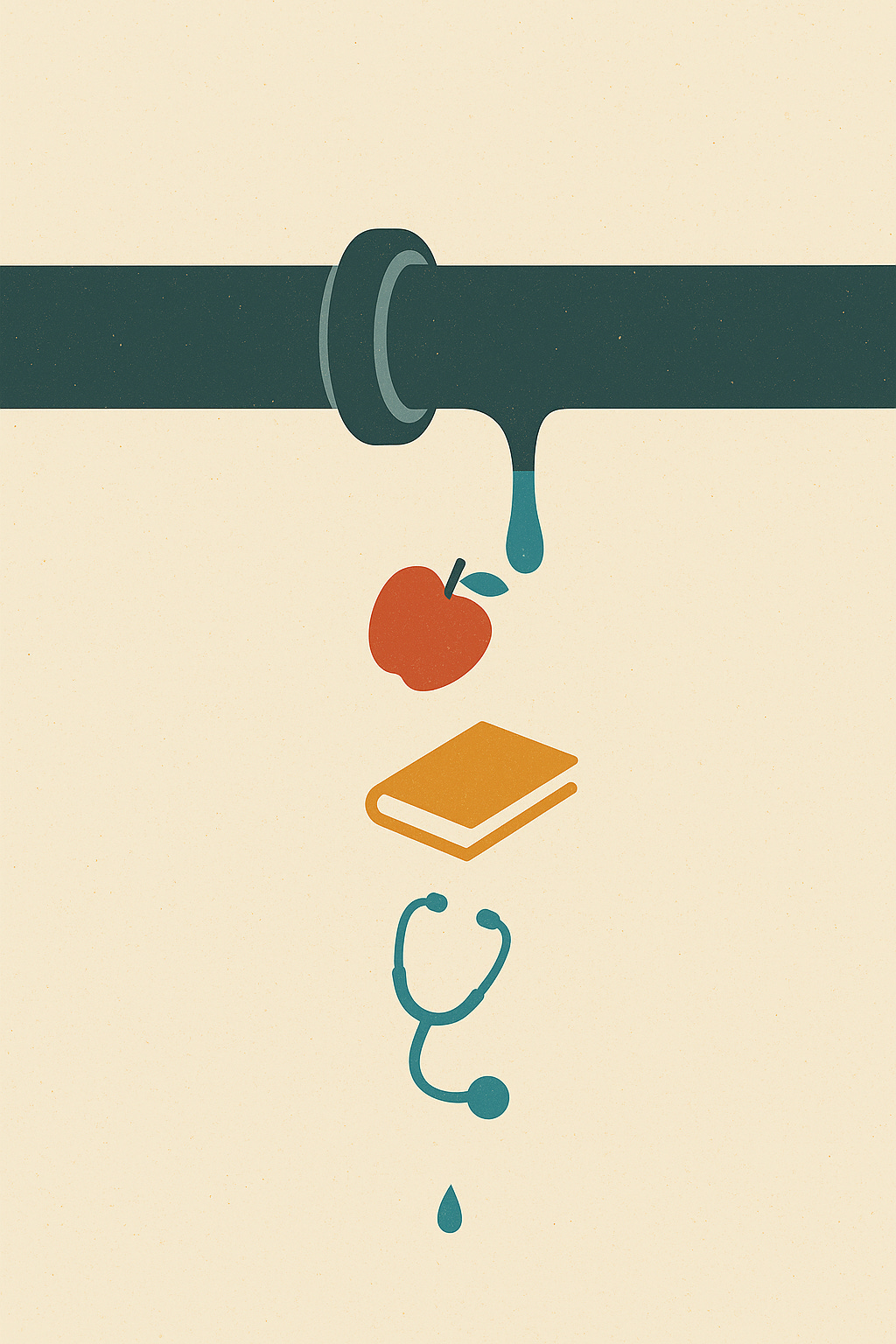
Reducing access to graduate student loans will not just limit individual career options. It will choke off the pipeline into these already-strained professions. Fewer students will be able to afford the degrees required. More early-career workers will leave under financial pressure. Rural and low-income areas will be hit hardest. The systems with the greatest need will see the greatest fallout.
And when these workers vanish—when classrooms go unstaffed, hospital floors run short, clinics reduce hours, libraries cut services, and community programs collapse under the weight of vacancies—some policymakers may finally recognize their value.
But by then, the damage will already be done.
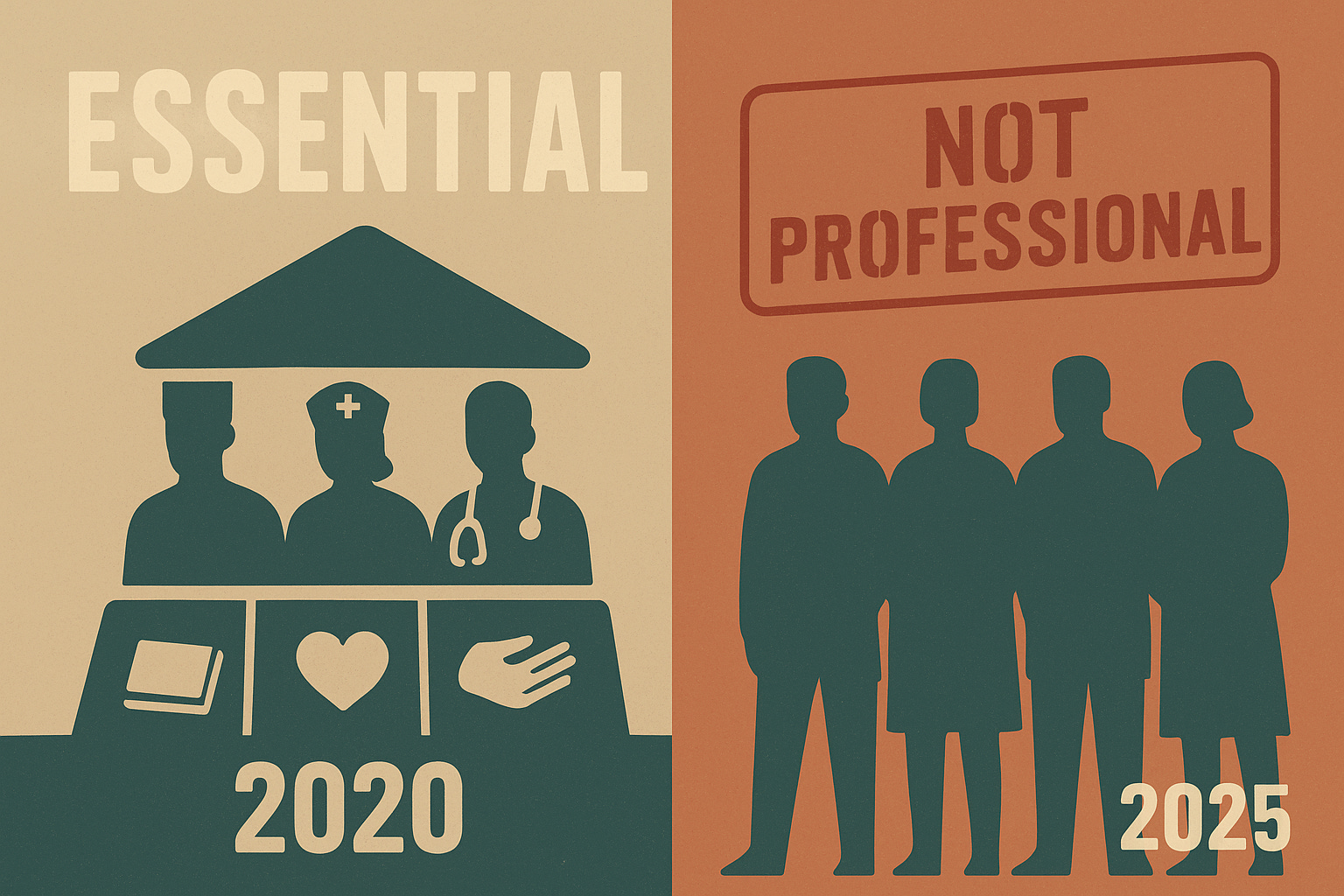
Essential in 2020, “Non-Professional” in 2025
There is a certain whiplash in watching which professions the federal government now considers “non-professional.” Just a few years ago, many of these workers were held up as heroes—teachers adapting overnight to remote instruction, nurses risking their lives in hospitals without enough protective equipment, social workers and counselors trying to hold families together during a national crisis, librarians turning their buildings into community relief centers and internet hubs, public-health departments working around the clock to keep people alive.
They were essential then. Now, their graduate degrees no longer qualify as “professional.”
The shift is not just symbolic. It reflects a deeper truth about how quickly society forgets the labor it relies on, and how easily gratitude dissipates once the crisis passes. When the need is immediate and undeniable, these workers are indispensable. When the emergency fades, their expertise becomes invisible again, their credentials are discounted, and their educational pathways are treated as secondary or optional.
Yet nothing about their work has become less essential. Nothing about their training has become less rigorous. Nothing about their responsibility has diminished.
The only thing that has changed is the level of public attention.
This redefinition captures something uncomfortable about how we treat care, education, and community work in this country. We celebrate it in emergencies and devalue it in ordinary times. We rely on these workers when things fall apart, but we do not invest in them when things are stable. Their professionalism is acknowledged only when it benefits the powerful and forgotten the moment convenience returns.
To declare these fields “non-professional” in 2025 is not a reflection of their value.
It is a reflection of our memory.
The Dependency Problem
There is a final contradiction built into this redefinition, one that goes beyond degrees, licensure, or loan categories. The professions that remain protected under the new definition cannot function without the very workers now being told their degrees are not “professional.”
Doctors do not practice alone. Every shift, they rely on nurses, nurse practitioners, physician assistants, lab techs, respiratory therapists, physical therapists, occupational therapists, speech-language pathologists, radiology techs, and countless allied-health professionals whose training the new definition downgrades. Remove even a few of these roles and the entire system grinds to a halt. Surgeons cannot prep an operating room, manage sterile fields, run anesthesia, monitor vitals, or provide postoperative care without the professionals surrounding them. Hospitals are ecosystems, not hierarchies.
Courts and law offices cannot run without teachers who educate future clients and jurors, social workers who keep families intact, librarians who maintain public access to legal information, counselors who stabilize people in crisis, and public-health workers who prevent disasters that spill into the justice system.
Schools depend on a constellation of roles that are invisible only to those who never enter a school building. Teachers rely on counselors, SLPs, OTs, school psychologists, librarians, paraprofessionals, and social workers to help students learn, communicate, recover from trauma, access services, and stay safe. A teacher without support staff is expected to function as an instructor, therapist, nurse, case manager, crisis worker, mediator, and administrator—all at once. It is unsustainable by design.
Public systems are not a stack of independent professions. They are interdependent networks in which each role supports and reinforces the next.
Yet the new definition treats these “supporting” professions as auxiliary or optional, while elevating the professions at the top of the hierarchy as if they stand alone.
But they don’t, and they never have.
To strengthen only the top of a system while hollowing out the foundation is not growth. It is erosion.
It is like expanding the brain while neglecting the spine, the circulation, and the organs that keep it alive. You can make the top larger, sure—but how long can it stand on its own? How well can it function when the core infrastructure is starved?
Every protected profession depends on the ones excluded from protection. The redefinition obscures that fact. Reality does not.
The Up vs Down Divide Laid Bare
When you pull back from the details, the pattern becomes unmistakable. This redefinition is not simply an administrative choice about loan limits. It is a mirror held up to the deeper structure of how this country values labor, and whose labor it sees as worthy of investment.
The professions that remain protected are the ones historically associated with power, prestige, and high income: medicine, law, dentistry, theology, and the clinical doctorates that fit neatly into that old academic lineage. They are the professions most connected to institutional authority, such as the courts, the medical establishment, organized religion, and the upper tiers of the higher-education system.
The professions excluded are those that do the daily work of supporting the public: teachers, nurses, librarians, social workers, counselors, therapists, public health staff, and allied health practitioners. They are overwhelmingly female, increasingly diverse, and embedded in public systems rather than elite ones. They serve the communities with the least political power, including children, seniors, low-income families, people in crisis, people with disabilities, and people navigating trauma or illness.
When you map these two groups onto your Up vs Down framework, the alignment is exact.
Up: high-status, high-income, historically male, institutionally powerful.
Down: care work, public work, feminized work, community work.
The RISE definition elevates the former and sidelines the latter, not because the former are more rigorous or more essential, but because they have always occupied the top of the hierarchy. The decision reproduces a worldview in which prestige determines professionalism, and the work that holds society together is treated as ancillary to the work at the top of the pyramid.
This is not about standards. It is about status.
It is not about rigor, but rather recognition.
It is not even about what these professions do. It is about who does them and who benefits from them.
Moreover, it is about who matters, and who is expendable.
And when policy aligns so neatly with existing social hierarchies—when it reinforces the same gendered, racialized, classed divisions that shape the labor market—it becomes impossible to pretend that the outcome is neutral.
This definition doesn’t just classify degrees. It reveals priorities.
What We Choose to Value
The redefinition of “professional degree” will be discussed in technical terms—loan caps, CIP codes, regulatory language, and implementation timelines. However, for the people whose lives and careers it touches, the meaning is far more human. It draws a bright line through the workforce, placing prestige on one side and care on the other. It reinforces an old hierarchy at the exact moment the country cannot afford to lose another teacher, nurse, librarian, counselor, therapist, or social worker.
A society is not held together solely by its surgeons and attorneys. It is held together by the people who teach children to read, who de-escalate a crisis at 2 a.m., who notice the bruise a child tries to hide, who deliver medication on an understaffed floor, who bring a family into shelter during a storm, who help a patient speak again, who keep public libraries open so communities can breathe.
These workers do not become less professional because a regulation fails to recognize their expertise. They do not become less essential because policymakers forget the crisis that proved it. They do not become less vital because their degrees fall outside a 1965 taxonomy.
However, the consequences of failing to invest in them are real. If we make it harder to join these professions, fewer people will. If we make it financially impossible for them to stay, more people will leave. When they do, the entire public infrastructure built around their labor will bend, then crack, then fail.
A definition may seem like a small thing, but definitions shape budgets, priorities, and the future of entire fields. They tell us who we trust, who we believe, and who we choose to support. They tell us whose work we see as central and whose we see as replaceable. They tell us, in plain language, which parts of society we are willing to let crumble.
This one tells us that the most indispensable workers in our schools, hospitals, clinics, libraries, and community programs are being treated as expendable, and it forces us to ask a question that should make every policymaker, every voter, and every employer pause: What happens to a country when the people who hold it together are the first people it lets go?
The answer is not abstract. We will feel it in classrooms. We will feel it in ERs. We will feel it in public health, in libraries, in mental-health care, in child welfare, in every place where care meets crisis.
We will feel it everywhere that matters.
And by the time we do, it may be too late to rebuild what hollowing out these professions will destroy.
Don’t let the bastards sneak anything past you. Subscribe and get your daily dose of rage and receipts delivered fresh, before the spin doctors can scrub it.
Sources:
“You Have Questions, We Have Answers: Making Sense of the Student Loan Changes from OBBBA’s RISE Committee.” NASFAA (National Association of Student Financial Aid Administrators), 2025.
“Classification of Instructional Programs (CIP): 2020 Edition.” National Center for Education Statistics, U.S. Department of Education, 2020.
Jasmine Laws, “Nursing Is No Longer Counted as a ‘Professional Degree’ by Trump Admin,” Newsweek, Nov. 20, 2025.
Jessica Blake, “What to Know About Crucial Changes to Student Loans,” Inside Higher Ed, Nov. 18, 2025.
“Full List of Degrees Not Classed As ‘Professional’ by Trump Admin,” Newsweek, Nov. 21, 2025.
“Occupational Employment and Wage Statistics,” U.S. Department of Labor, May 2023.
“Characteristics of Public School Teachers.” NCES, U.S. Department of Education, 2023.
“Diversity Counts Report.” ALA, 2017.
“2023 Annual Report: Social Work Student and Graduate Data.” CSWE, 2023.
“Nursing Workforce Fact Sheet.” AACN, 2024.
“The Teacher Shortage Is Real, Large, and Growing: Here’s Why.” Learning Policy Institute, 2023.
“Workforce Data: The Nursing Shortage.” ANA, 2024.
“Addressing Allied Health Workforce Shortages.” AAMC, 2024.
This infuriates me. I am a retired home health psych RN. The responsibilities of a nurse, a teacher, therapists—PT, OT, ST, mental heath therapists, RN practitioners, far outweigh some of the others on that list. All of those require licenses, renewals, many of the medical professionals (yes I am using that word) require insurance, ongoing education to maintain licenses, and above all these professions are responsible for others’ LIVES. The fact that traditionally these have been women’s professions is indicative of the way sexist way of thinking. My whole family has been involved in these professions for generations, my immediate family—father, college professor, mother, librarian; younger sister, child welfare, younger brother, high school history teacher (and yes, he teaches civics) so I appreciate the value of the work, responsibilities of
those careers, and the basic and ongoing education and commitment necessary. These careers are all responsible for others’ LIVES. Does Shitler want a non-professional starting and monitoring an IV or catheter? Or a heart monitor? Would you? I’d love to insert a urinary catheter in him!
Excellent article Marie. This regime seems focused on doing as much harm as possible to the most vulnerable among us. Cruelty and greed seem to be the most evident reasons for these actions. Unthinkable less than a year ago.