


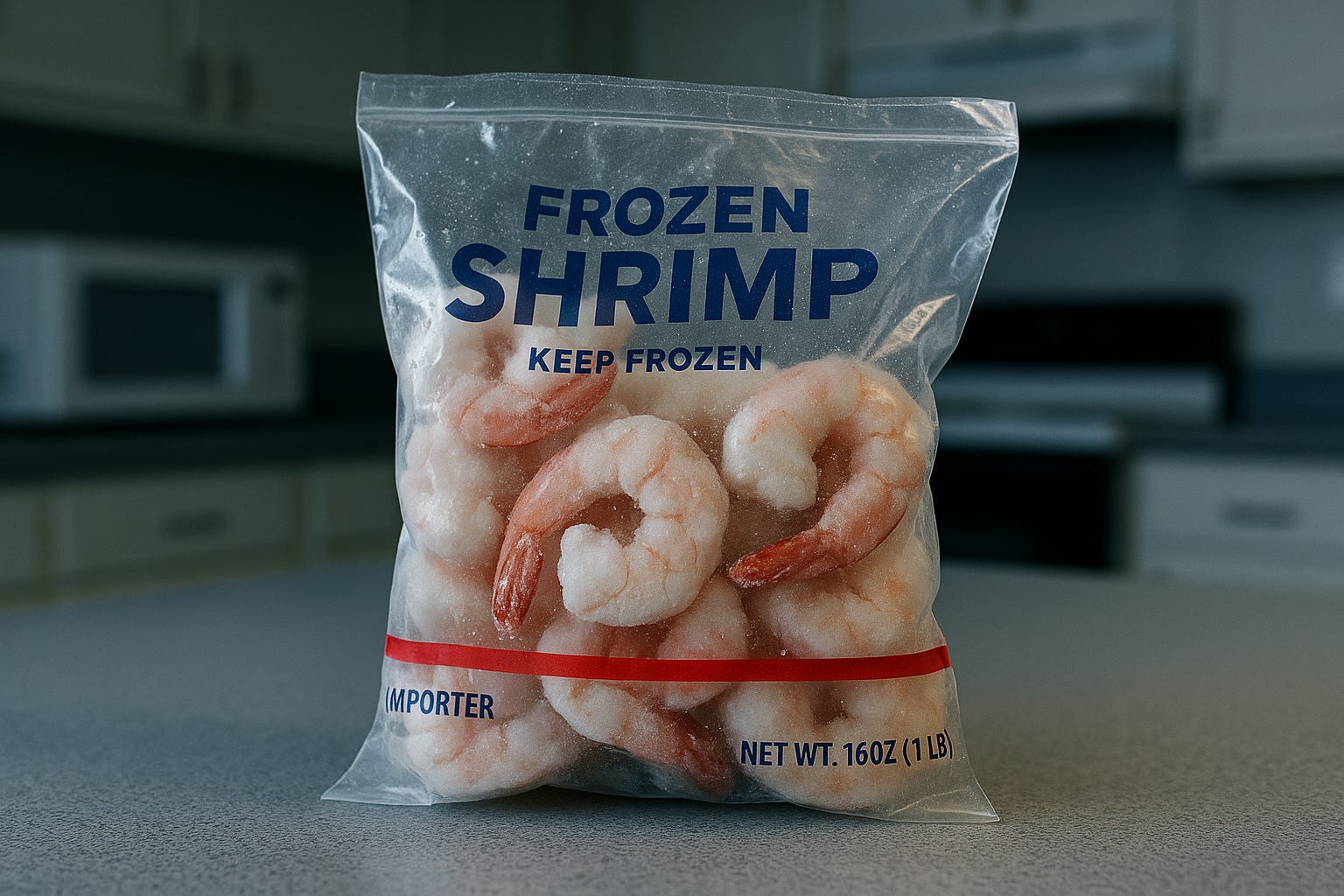
The Shrimp That Never Got Checked
That shrimp sitting in your freezer probably never saw an American inspector. It was peeled, packaged, and shipped halfway around the world before landing in your grocery cart with a smiling label that says “safe,” “premium,” “imported.” What it doesn’t say is that the factory it came from hadn’t been checked by the U.S. government in years.
50,000 strong — and counting.
This Early Black Friday, become a paid subscriber for just $1 a week and help us keep the truth alive.
Join The Coffman Chronicle — $1/Week Early Access
Want to Know Your Rights?
Download a free digital copy of the U.S. Constitution—the same document Trump is trying to bulldoze. Learn exactly what he’s breaking… and how to fight back.
Earlier this fall, the Food and Drug Administration issued a “Do Not Eat” warning for frozen shrimp from an Indonesian supplier after inspectors found “insanitary conditions” and possible contamination (FDA 2025 advisory). It wasn’t headline news. It should’ve been, because that shrimp is the story of a country that’s quietly stopped looking.
Nine out of ten seafood dinners in America now come from overseas. Yet this year, the FDA’s foreign facility inspections have fallen to historic lows (ProPublica). Inspectors have been grounded, budgets gutted, and oversight hollowed out. The watchdogs didn’t quit. They were starved.
And while Washington congratulates itself for “cutting red tape,” Americans are cutting into meals that may never have been checked for safety. The deregulators call it efficiency. Everyone else calls it dinner.
How the Safety Net Was Built and How It’s Being Gutted
The law that was supposed to keep our food safe was born out of crisis. Back in 2011, after a string of deadly outbreaks — E. coli in spinach, Salmonella in peanut butter — Congress passed the Food Safety Modernization Act (FSMA). It was a bipartisan promise: never again would tainted imports slip through unchecked. The law required the FDA to ramp up foreign facility inspections to 19,200 per year by 2016. That was the safety net: inspect the plants that feed America before the food ever leaves foreign soil.
However, the follow-through never came. Even before Trump took office, the agency was behind. Then the cuts hit. Budgets were frozen. Vacant jobs stayed vacant. Travel funds dried up. By 2025, one out of every five staff positions in the FDA’s foreign-inspection unit had vanished. Inspectors were told to buy their own plane tickets, then wait months to get reimbursed. Others were grounded altogether. You can’t inspect seafood factories in Thailand or Indonesia when your travel card has been canceled.
The numbers tell the story. According to a ProPublica analysis, the FDA averaged roughly 110 foreign inspections per month in 2023. By March 2025, that number was cut in half. By mid-summer, the total was 30 percent lower than the previous two years combined. The watchdog that was supposed to expand its reach has been crawling backward ever since.
They didn’t repeal the law. They just starved it until it couldn’t do its job. And for families eating dinner in every kitchen across America, that’s the quietest kind of betrayal there is.
Inside the Numbers
Numbers don’t lie, but they can be buried.
When the Food Safety Modernization Act became law, the FDA pledged to inspect nearly 20,000 foreign food facilities a year. By 2025, that goal might as well be on the back of a milk carton.
That drop matters because of scale. The United States now imports:
90 percent of its seafood,
60 percent of its fresh fruit, and
35 percent of its vegetables.
Those aren’t luxuries; they’re weeknight groceries. Every percentage point in inspection loss represents millions of pounds of food entering the country without an FDA official ever seeing the plant it came from.
And the cost of prevention isn’t high — roughly $40,000 per foreign inspection, including travel and testing. To put that in perspective: one nationwide food-borne illness outbreak costs taxpayers and hospitals hundreds of millions. The math doesn’t add up, unless the goal is to make sure it never does.
They call it “streamlining.” What it really is is surrender —a slow, bureaucratic collapse wrapped in buzzwords and quarterly cuts.
The Faces Behind the Collapse
For decades, America’s food-safety inspectors were the quiet backbone of trust. They were the people who caught the bad shrimp before it hit the shelves, the ones who saw the rats scurrying behind conveyor belts and wrote the reports that made companies clean up their act.
Now, many of them are grounded.
One former FDA inspector told ProPublica he was told to book his own travel to Asia on a personal credit card, then wait months to get reimbursed. Others described being reassigned to desk duty because the agency’s travel account had been “temporarily suspended.” The inspectors didn’t quit; they were stranded. One said it felt like “being told to watch the fire from across the street.”
These are career public servants — chemists, microbiologists, field agents — who used to spend 200 days a year overseas checking factories in China, Vietnam, and Indonesia. Today, they’re filing paperwork from cubicles. “It’s a joke,” one said. “You can’t smell bacteria through a screen.”
They didn’t lay off the corrupt. They laid off the careful. And somewhere, in the gap between the empty desks in Maryland and the uninspected plants in Jakarta, the food chain snapped.
Who Benefits from a Broken FDA
When the inspectors went quiet, someone was listening — the corporations that had been begging for silence.
Every cut to the FDA’s travel budget, every hiring freeze, every “streamlining” memo was a gift to the import giants that wanted less friction and more profit. The companies moving shrimp, salmon, berries, and spice by the ton don’t see inspection as safety; they see it as a delay. A grounded inspector is good for business.
The lobbyists knew how to sell it: efficiency, modernization, self-certification. Behind those buzzwords sits an open invitation for the industry to police itself. A seafood conglomerate in Bangkok or a frozen-fruit supplier in Mexico can now upload digital paperwork to an FDA portal and call it oversight. No flight. No questions. No smell of the factory floor.
And while inspectors were waiting on reimbursement checks, the Finance Führers — the billionaire donor class who bankroll deregulation — were cashing in. They don’t want agencies that investigate; they want agencies that sign off.
Follow the money:
Agribusiness PACs poured millions into campaigns promising to “rein in the FDA.”
Trade associations pushed for “risk-based inspections,” a loophole big enough to sail a cargo ship through.
The same political appointees who gutted the agency are now landing on corporate boards.
They didn’t just gut the FDA. They sold the watchdog, leased the leash, and called it freedom.
The Public Health Risk
The lettuce looked fine until it didn’t. Last spring, an E. coli outbreak sickened more than eighty people across six states. The CDC traced it to imported greens that hadn’t been inspected on-site for years.
That’s what happens when oversight collapses. The risk doesn’t vanish; it migrates to your dinner plate.
In the past year alone, the FDA has issued dozens of food recalls tied to imported products: shrimp from Indonesia, herbs from Egypt, frozen fruit from Mexico. Each one tells the same story — corners cut, inspections skipped, paperwork rubber-stamped.
Here’s the brutal math: the U.S. imports nearly $200 billion worth of food every year, but fewer than 1 in 100 shipments is physically inspected. When foreign-facility checks drop by half, that’s millions of meals slipping through unseen.
The deregulators say Americans should trust the market to regulate itself. However, the market doesn’t carry the IV bag, or the medical debt, or the quiet dread that comes from not knowing whether tonight’s dinner is safe.
This isn’t a distant risk. It’s in your fridge.
The Pattern of Neglect
The FDA didn’t fall apart in isolation. It’s part of a larger pattern: a government hollowed out from the inside, one agency at a time.
The FAA is short thousands of air-traffic controllers. The EPA has fewer field investigators than it did twenty years ago. OSHA now has fewer inspectors than in 1975, even though the workforce has doubled. Every time an agency loses capacity, the same politicians call it proof that government doesn’t work, then use that “proof” to cut it again.
That’s the game: break it, point to the wreckage, and say, “See? Government fails.” It’s not ideology anymore; it’s strategy.
The people doing this don’t want a government that works for everyone; they want one too weak to stop the few who already have everything. A starved regulator can’t check a factory, but a fat donor can still buy a senator.
When every agency meant to protect you is starving, who’s really being fed?
The Cost of Looking Away
Every system collapses the same way — first slowly, then all at once. We don’t notice the missing inspector or the grounded flight. We notice the recall, the hospital bill, and the silence from an agency that used to answer questions.
The cost of looking away isn’t abstract. It’s paid in emergency-room visits, in kids curled over with food poisoning, in the quiet dread of families who can’t trust what they buy. Every time oversight is cut, risk is privatized. The profits stay public; the pain stays personal.
But history doesn’t remember the lobbyists; it remembers the people who finally said “enough.” It remembers those who kept watching even when they were told not to.
We can’t eat accountability, but we can demand it, because this isn’t just about shrimp or lettuce or any one agency. It’s about whether we still believe in a government built to protect the people who built it.
Support Independent Journalism
Stories like this rarely make the evening news. They don’t come with flashy headlines or government briefings, but they reveal how power really works, and what happens when the watchdogs are told to stay home.
Independent media exists to tell the stories that get buried, the ones that start at the kitchen table and ripple through the country. Every article, every investigation, every verified receipt takes time, resources, and the freedom to speak without corporate filters.
If you believe stories like this matter, share them. Talk about them. And if you can, become a paid member to help sustain the work. Paid subscriptions keep this reporting independent, ad-free, and focused on what truly affects your family, your community, and your country.
Because the only thing more dangerous than a government that stops watching… is a public that stops paying attention.
Receipts:
“FDA Advises Public Not to Eat, Sell, or Serve Certain Imported Frozen Shrimp from Indonesian Firm PT Bahari Makmur Sejati.” U.S. Food and Drug Administration, October 7, 2025.
“Foreign Food-Safety Inspections at Historic Lows after Trump-Era Cuts.” ProPublica, November 6, 2025.
“U.S. FDA Suspends Food-Safety Quality Checks after Staff Cuts.” Reuters, April 17, 2025.
“FDA Hiring Contractors to Replace Fired Staff Who Supported Safety Inspections.” Associated Press, April 18, 2025.
“E. Coli Outbreak Sickened More than 80 People, but Details Didn’t Surface for Weeks.” Washington Post, May 26, 2025.
Centers for Disease Control and Prevention. “Estimates: Burden of Foodborne Illness in the United States.” March 19, 2025.
“Analysis Shows FDA Foreign Facility Inspections Hit Historic Low after Trump-Administration Cuts.” Food-Safety Magazine, November 6, 2025.
"self-certification. Behind those buzzwords sits an open invitation for the industry to police itself"
They've learned well from the plastic people...this horror story reflects what has been going going on for decades with great success by the petrochemical (and other industries) who put bottom line over public health, and by the politicians - of all stripes - who benefit from the game.
Now the public health/safety protection agencies we have to be able to rely on have been deliberately castrated with full knowledge of the dangers that will unleash - known by the industries themselves, and by their tame political patsies.
Food safety? how about known poisons allowed to pollute every one of us, as we rage about on
Our New Reality The Plasticine.
And he's mad over fentanyl?