


This Deep Dive is part 4 of our ongoing series: Deregulation Nation.
In the American economy, labor is supposed to be protected—by unions, oversight, and law. However, under Donald Trump’s second term, the last remaining guardrails for workers are being ripped out.
Through sweeping executive orders, agency gutting by DOGE, and encouragement of state-level deregulation, Trump has unleashed a new era of exploitation. Wage theft goes uninvestigated. Child labor restrictions are rolled back. Union protections are stripped away. And entire classes of workers—from federal employees to gig contractors—are being pushed outside the safety net.
This isn’t an accident. It’s a feature of the plan.
Trump and his allies have sold deregulation as freedom. But for millions of workers, it means freedom from basic safety, dignity, or fairness. And in a labor market reshaped by mass deportations, corporate consolidation, and inflation, the power imbalance has never been more dangerous.
This article explores how Trump’s labor policy isn't just breaking unions or trimming budgets; it's legalizing exploitation, one rollback at a time.
Independent News. Just $1/Week.
We just hit 10,000 subscribers—thank you! We’re offering full access to The Coffman Chronicle for just $1 a week ($52/year) to celebrate.
Get exclusive analysis and fearless reporting you won’t find in corporate media.
Support truth. Stay informed.
Department of Labor: Enforcement Evaporates
The U.S. Department of Labor (DoL) was created in 1913 to promote the welfare of workers and improve working conditions across America. But under Trump’s second term, the agency’s mandate has been redefined, not as a protector of labor, but as a passive observer.
The Department of Government Efficiency (DOGE) has slashed enforcement budgets across the board, resulting in:
A steep decline in wage theft investigations
A freeze on new workplace safety regulations
A rollback of overtime protections for salaried workers
A weakening of penalties for employers who violate labor laws
Inspectors have been laid off or reassigned. Tip-line calls go unanswered. Labor law violations increasingly go uninvestigated, and even repeat offenders face little or no consequence.
“It’s open season on workers,” said a former DoL investigator who resigned in protest earlier this year. “The agency exists on paper. That’s about it.”
One of the most quietly devastating rollbacks has been the redefinition of “independent contractor” status, which allows companies like Uber, DoorDash, and Amazon to legally classify their workers as contractors instead of employees. This move strips millions of workers of their right to minimum wage, overtime pay, and benefits.
At the same time, DOGE has shown little interest in regulating the rise of AI-driven labor platforms, which are now used to schedule, surveil, and sometimes terminate workers without human oversight.
While the administration claims this “boosts flexibility,” labor economists warn that it’s a return to Gilded Age precarity, where corporations hold all the cards and workers take all the risk.
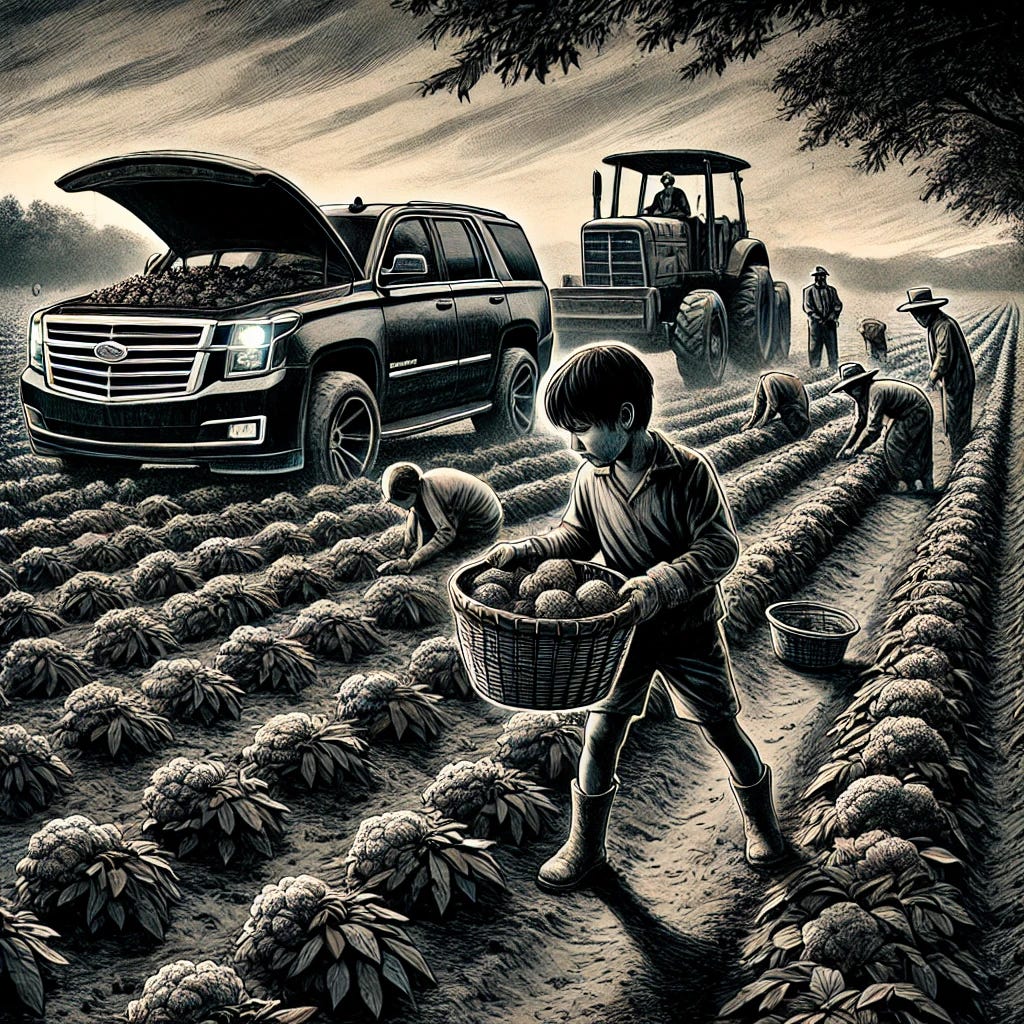
However, the collapse of labor protections doesn’t just affect full-time workers. Across the country, children—some as young as 13—are being pulled into the workforce to fill the void left by policy failures and deportations.
Child Labor Deregulation: The Kids Are Not Alright
As immigration crackdowns hollow out the low-wage workforce, Republican lawmakers in states like Florida have introduced bills to loosen child labor restrictions with full-throated support from Governor Ron DeSantis.
“Why do we need to import foreigners when teenagers used to work at these resorts?” DeSantis asked in a recent press conference, defending legislation that would allow 14-year-olds to work overnight shifts on school days, and remove limits on how many hours 16- and 17-year-olds can work during the school week.
Critics have called it what it is: a move to replace deported adult workers with children.
Worker advocates warn that this not only puts teens at physical and emotional risk, but also directly undermines their education. Studies show that increased work hours among minors are associated with lower academic performance, higher injury rates, and elevated stress and fatigue. Meanwhile, labor inspectors—already thinned out by federal cuts—are struggling to monitor the influx of underage workers in high-risk industries like food service and construction.
Note: While federal child labor laws set a baseline under the Fair Labor Standards Act, states can pass stricter laws or attempt to weaken protections, especially when federal enforcement is gutted. The Trump administration’s rollback of oversight has emboldened states like Florida to push the limits, gambling on lax enforcement and political cover from Washington.
By contrast, Pennsylvania has moved in the opposite direction, doubling fines for child labor violations and reaffirming work-hour limits. But with DOGE sidelining federal regulators, enforcement now depends on which state a child happens to live in.
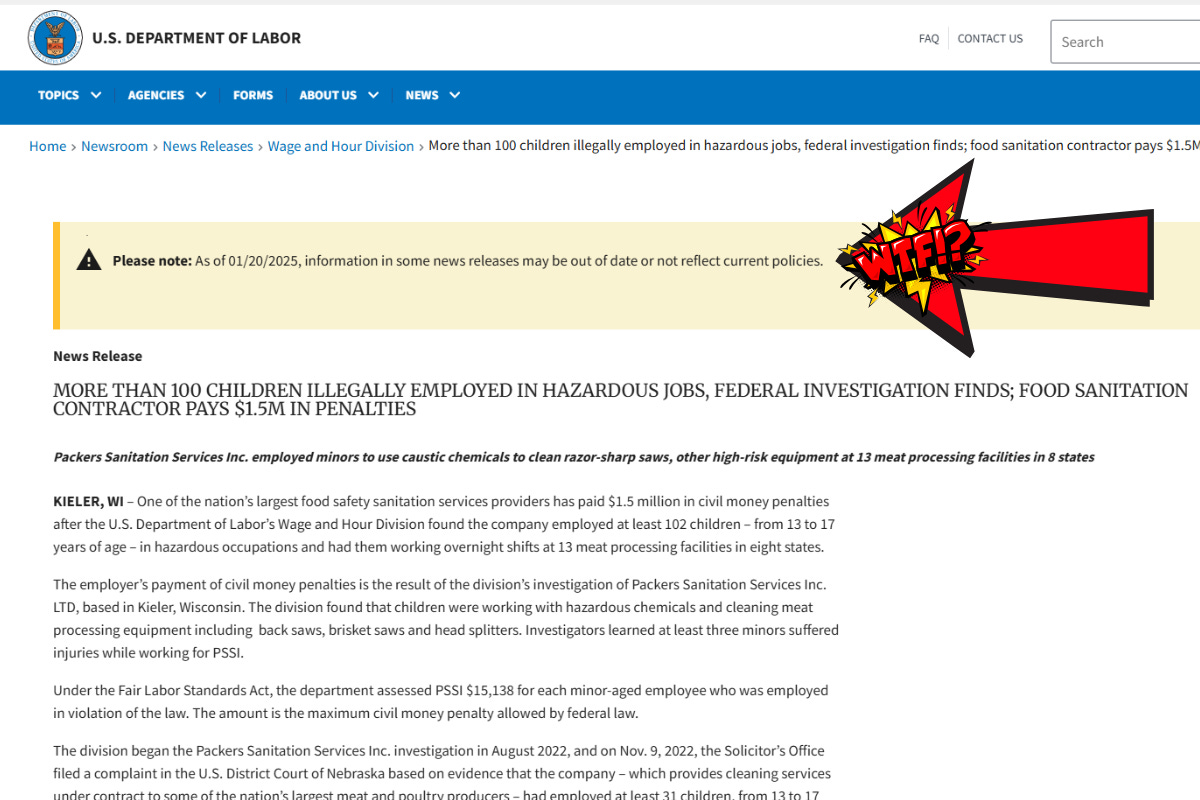
And this isn’t new. In 2023, well before the current labor shortage narrative took hold, the Department of Labor found that over 100 children were illegally employed by Packers Sanitation Services Inc. to clean dangerous meatpacking equipment across eight states, including Wisconsin and Minnesota. Some were as young as 13, working overnight shifts with hazardous tools like back saws and head splitters. The company paid $1.5 million in fines, just over $15,000 per child. Even then, critics warned that the penalty was just the cost of doing business for corporations exploiting minors to maximize profit.
We explored the long battle to end child labor and how deregulation threatens to undo that progress in our archival piece:

Note: since this article is over 45 days old, it is now in our archive. To view, please consider becoming a paid subscriber for $1/week.
This isn’t labor reform. It’s generational exploitation.
Union-Busting by Executive Order: Silencing the Federal Workforce
President Trump signed an executive order in March 2025, terminating collective bargaining rights for hundreds of thousands of federal workers in a sweeping move that caught even seasoned labor leaders off guard.
The justification? “National security.”
The reality? Retaliation, plain and simple.
Under the order, collective bargaining is banned across multiple agencies, including:
Department of Defense
Department of State
Department of Veterans Affairs
Department of Justice
Department of Health and Human Services
Department of Homeland Security (border security units)
The order cites the Civil Service Reform Act of 1978, which allows for limits on bargaining in national security roles. But critics point out that the Trump administration is now defining nearly every major federal agency as “national security critical”, a blanket designation designed to silence dissent and disempower unionized federal employees.
“It’s a calculated purge of worker voice,” said one union leader with the American Federation of Government Employees (AFGE). “Many of our members are veterans. They serve this country twice over. And this is their thanks.”
AFGE and the National Treasury Employees Union (NTEU) have both filed lawsuits to block the order, arguing that it violates labor rights and the Constitution. But the administration isn’t stopping at negotiation bans. It’s also:
Ending payroll deductions for union dues
Restricting union access to worksites
Requiring reauthorization of existing contracts
These moves are designed not just to hinder unions, but to starve and structurally dismantle them financially, all while DOGE budget cuts and reassignments are already eroding federal worker protections.
This is more than union-busting. It’s an attempt to remake the federal workforce so that it serves the executive without question.
While workers are being silenced on the job, their right to safety is also under direct threat.
OSHA Under Siege: Safety Optional
When the Occupational Safety and Health Administration (OSHA) was created in 1971, it was a response to an American workplace that routinely killed and maimed its workers. In 1970 alone, over 14,000 people died on the job, an average of 38 deaths per day. Born from labor union pressure and signed into law by President Nixon, OSHA became one of the most significant public health protections in modern U.S. history.
Under Trump’s second term, those protections are under open assault.
While DOGE has quietly slashed OSHA’s budget and staff, Republican extremists are pushing for more dramatic outcomes. In early 2025, Rep. Andy Biggs (R-AZ) introduced the Nullify Occupational Safety and Health Administration Act (NOSHA Act), legislation designed to abolish OSHA entirely.
“This isn’t just deregulation,” said one union rep. “It’s a corporate license to kill.”
Workplace injuries are already trending upward with weakened enforcement and fewer surprise inspections. Warehouse and construction workers are being pushed to extremes with little to no recourse. And in states where worker protections were always thinner, the absence of OSHA would be devastating.
We explored what’s at stake and why this fight echoes the worst chapters of American labor history in this archival piece:

The Gig Loophole: Freedom Without Protections
One of Trump's second term's most quietly devastating labor rollbacks has been reinstating loopholes for gig economy giants. Under pressure from companies like Uber, Amazon, DoorDash, and Instacart, the administration has revived Trump-era rules that reclassify millions of workers as “independent contractors.”
At first glance, it’s sold as flexibility, the freedom to work when and how you want. But the reality is a system where workers don’t qualify for minimum wage, overtime, health benefits, or even basic protections from retaliation.
“Flexibility doesn’t mean freedom when you can’t afford to take a day off or get sick,” said a former Instacart worker who now delivers food 60 hours a week to make rent.
“This isn’t flexibility—it’s just a loophole,” said a labor organizer with Gig Workers Rising. “Tech companies are using 21st-century tools to deliver 19th-century working conditions.”
The reclassification model mirrors California’s controversial Proposition 22, which codified contractor status for app-based workers despite court challenges. Nationally, gig work now accounts for more than 36% of U.S. employment, yet most of these workers have no benefits, no bargaining power, and no legal recourse when things go wrong.
DOGE has also rolled back federal oversight of algorithmic scheduling, allowing platforms to push workers into high-risk hours or dangerous conditions without consequence. Complaints to the Department of Labor have spiked, but investigations have plummeted.
With union protections already eroding, this shift is part of a larger agenda: to turn labor into a commodity without responsibility, where the workforce can be scaled up, burnt out, and replaced without the burden of rights or benefits.
Conclusion: Exploitation by Design
This isn’t deregulation. It’s dehumanization.
Under Trump’s second term, the federal government is no longer a steward of worker protections; it’s a weapon wielded against them. Every agency gutted, every law rolled back, every “efficiency” measure implemented by DOGE serves a singular purpose: to shift the balance of power entirely toward corporations, and away from the people who make this country run.
It’s not just that unions are being silenced. Or that teens are being pulled out of classrooms to work overnight shifts. Or that federal employees are being told their voices don’t matter. The system is being rebuilt to codify exploitation as the new status quo.
There is no longer even the pretense of balance. This is class warfare in the regulatory code waged from boardrooms, rubber-stamped by Congress, and enforced by a government that views workers not as citizens to protect, but as liabilities to be minimized.
We examined how these attacks on labor fit into Trump’s broader class war, where corporate freedom trumps worker survival, in:

Workers built this country. They fought, bled, and died for the protections we’re watching vanish in real time. To dismantle those protections isn’t just a policy shift. It’s a betrayal.
We just hit 10,000 subscribers—thank you! We’re offering full access to The Coffman Chronicle for just $1 a week ($52/year) to celebrate.
Get exclusive analysis and fearless reporting you won’t find in corporate media.
Bibliography:
"Florida legislation would relax restrictions on the working hours of teenagers," Associated Press, March 25, 2025.
"More than 100 children illegally employed in hazardous jobs, federal investigation finds; food sanitation contractor pays $1.5M in penalties," U.S. Department of Labor, February 17, 2023.
"Sizing the Gig Economy: New Estimates of Contingent Workers," Pew Research Center, March 25, 2025.
"Trump signs executive order to end collective bargaining at agencies involved with national security," Associated Press, March 27, 2025.
"Congressman Biggs Introduces Bill to Abolish OSHA," Office of Congressman Andy Biggs, November 2, 2021.
DoD just put out that they are going to undertake a big reduction in force (RIF) outside of OPM. They just offered up a second round of the deferred resignations and Voluntary Early Retirement Authoruty (VERA). These are the first steps in moving forward with the RIF. Couple that with the EO that straps bargaining rights from workers, DoD employees are going to be traveling down a rocky road.