


El Paso has spent decades learning how to survive on less water. The city cut daily use by nearly half over a generation, turned sewage into drinking water before most Americans had even heard the phrase “toilet-to-tap,” and built the largest inland desalination plant in the world to stretch every drop.
Now, in the middle of August — the hottest month of the year — the federal government is moving the first detainees into a sprawling tent camp on the edge of Fort Bliss. The site will grow from 1,000 beds to 5,000 in the coming months. It will sit in a desert city already fighting water scarcity, on a military base where PFAS contamination in the groundwater is well-documented, under conditions that can turn a 104°F day into a 120°F heat trap.
The official opening date is August 17. But detainees began arriving on August 1, just as the temperature hit triple digits and stayed there. Video shot near the site shows heat shimmering over the ground, the air itself bending in the midday sun. Inside those tents, the air will be hotter still, the humidity from hundreds of bodies stripping away the one advantage of desert heat: the ability to sweat and cool.
El Paso’s residents have been told for years to cut back, conserve, and live within strict water limits. Yet a federal detention center is about to add thousands of people in conditions that will demand more water per person than the city average, and in a place where every drop already counts.
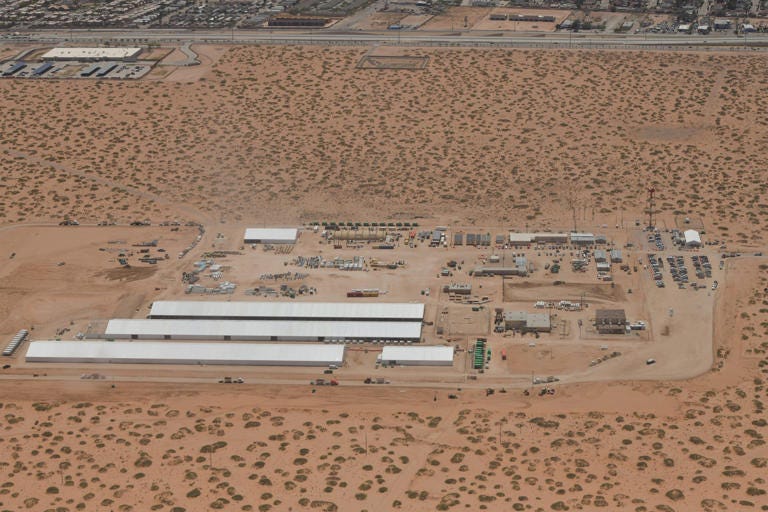
© Brian Kanof / Special to El Paso Times
Stay Informed. Stay Loud.
Subscribe to The Coffman Chronicle for no-BS political analysis, action guides, and daily truth bombs you won’t get from corporate media.
Current Facility Facts
The new detention site, officially named Camp East Montana, is being built on the Fort Bliss military base, just east of El Paso city limits. ICE will operate the facility under Department of Homeland Security oversight, on land controlled by the Department of Defense.
The contract, reportedly worth $232 million, went to Acquisition Logistics LLC, a Virginia-based firm with no prior experience managing detention facilities. The plan calls for an initial capacity of 1,000 detainees, expanding to 5,000 beds in the coming months. The structures are “soft-sided” — industry language for large, semi-permanent tents — designed for what ICE calls “short-term” processing, but large enough to hold people for weeks or months.
ICE says the camp will hold people in removal proceedings and those with final deportation orders. Officials have not provided a breakdown of who is currently being detained there, nor has ICE disclosed what percentage of detainees will be children, elderly people, or medically vulnerable individuals. The facility’s location on an active military base, combined with ICE’s policy of withholding names and case numbers, makes independent verification nearly impossible.
While the official ribbon-cutting is set for August 17, local reporting confirms that detainees have been held at the site since August 1, 2025, the height of the summer heat.
Yes, this setup is very similar to Alligator Alcatraz in the Florida Everglades, and it is being built on a similarly startling timeline. Like Alligator Alcatraz, weeks before the official opening, detainees are already being housed there. Additionally, transparency has been far from ideal, and there are serious concerns about the conditions.
See some of our reporting on Alligator Alcatraz here:


Water Scarcity
El Paso is a desert city that has built its survival on conservation. Annual rainfall averages less than nine inches. The Rio Grande, once a primary water source, now runs so low that its share of the city’s supply has dropped from nearly 40% in the past decades to as little as 14% in recent years.
Faced with permanent drought conditions, El Paso has pushed conservation to the point of engineering breakthroughs. In 2007, the city opened the Kay Bailey Hutchison Desalination Plant, the largest inland desalination facility in the world, capable of treating 27.5 million gallons of brackish groundwater a day.
Even more striking, El Paso pioneered a direct potable reuse program decades before most cities would even consider it — the so-called “toilet-to-tap” approach. Wastewater is treated to meet or exceed drinking water standards, then fed directly back into the municipal supply. A city only adopts a program like this when there are no other options.
Layered on top of these engineering feats are decades of aggressive conservation rules: restricting lawn irrigation, mandating water-efficient fixtures, and using tiered pricing to reward low consumption. Per capita daily use has fallen from over 200 gallons in the 1990s to around 128 gallons today, with a goal of 125 gallons by 2030.
That hard-earned balance is fragile. Adding 1,000 to 5,000 people to the local water system, especially in living conditions that will push water needs well above the city average, threatens to undo years of progress. Inside the tents at Fort Bliss, detainees will need more water to stay hydrated, to manage heat stress, and to run evaporative cooling systems. In a city that plans water use down to the gallon, the strain will be immediate and measurable.
PFAS Contamination
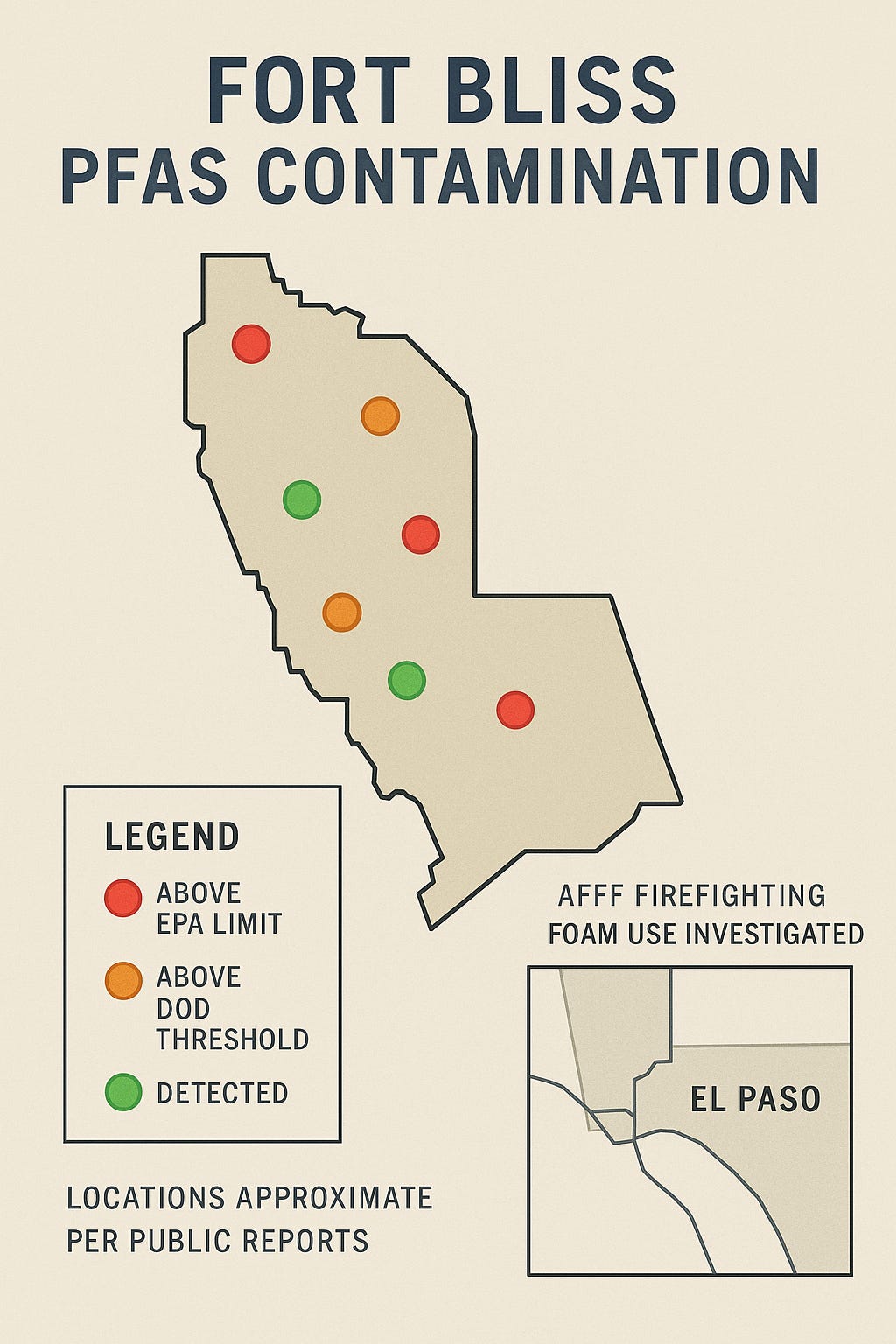
Water scarcity isn’t the only issue at Fort Bliss. The available water comes with its own risks. A June 2023 site inspection found elevated levels of PFAS — so-called “forever chemicals” — in multiple locations on the base, including fire stations, training areas, and sites of historical fuel spills. These readings were above the Department of Defense’s own risk screening levels, and far above the new enforceable limits set by the EPA in 2024.
PFAS contamination on military bases has a clear and well-known source: aqueous film-forming foam (AFFF) used for decades in firefighting training and emergencies. This foam contains high concentrations of PFAS, which seep into soil and groundwater. At Fort Bliss, years of routine fire-suppression drills, aircraft maintenance, fuel storage, and waste disposal have left a legacy of contamination. Once in the groundwater, PFAS compounds don’t break down naturally. They persist for decades and accumulate in the human body, where they have been linked to cancers, immune suppression, hormone disruption, and developmental problems in children.
The EPA’s new limit for PFOS and PFOA — two of the most common PFAS chemicals — is 4 parts per trillion. For years, the DoD’s action threshold has been significantly higher, meaning water considered “safe” by the military might still violate civilian health standards.
Fort Bliss’s water system does benefit from the Kay Bailey Hutchison Desalination Plant, whose reverse osmosis process can remove some PFAS compounds. However, effectiveness depends on the specific chemical form and the age and maintenance of the filters. Blending desalinated water with untreated sources can also reintroduce contamination.
The Army began a Remedial Investigation into Fort Bliss PFAS in 2022, but full cleanup is not expected before 2027. In the meantime, anyone living or working on the base, including detainees, may be drinking, cooking, and bathing in water that the EPA says is unsafe.
Heat + Tent Microclimate
August in El Paso is relentless. Average highs run well over 100°F, and this year has been no exception, topping 104°F and 106°F on multiple days since detainees began arriving at Fort Bliss on August 1. Overnight lows in the mid-70s offer little recovery.
This tent facility is different than just adding households to a struggling grid. The structures themselves will increase the need for water, meaning each person housed there will require more potable water than the citizens living nearby in more permanent structures.
In the open desert, that heat is punishing but survivable with shade, airflow, and plenty of water. Inside the “soft-sided” structures at Camp East Montana, the physics changes. Sunlight passes through the tent material, heating the air inside. You may know this process as the greenhouse effect. Studies on similar structures show interior temperatures can run 16–25°F hotter than outside. That means a 104°F day can become 120–129°F inside the tent if cooling is inadequate.
The Human Factor
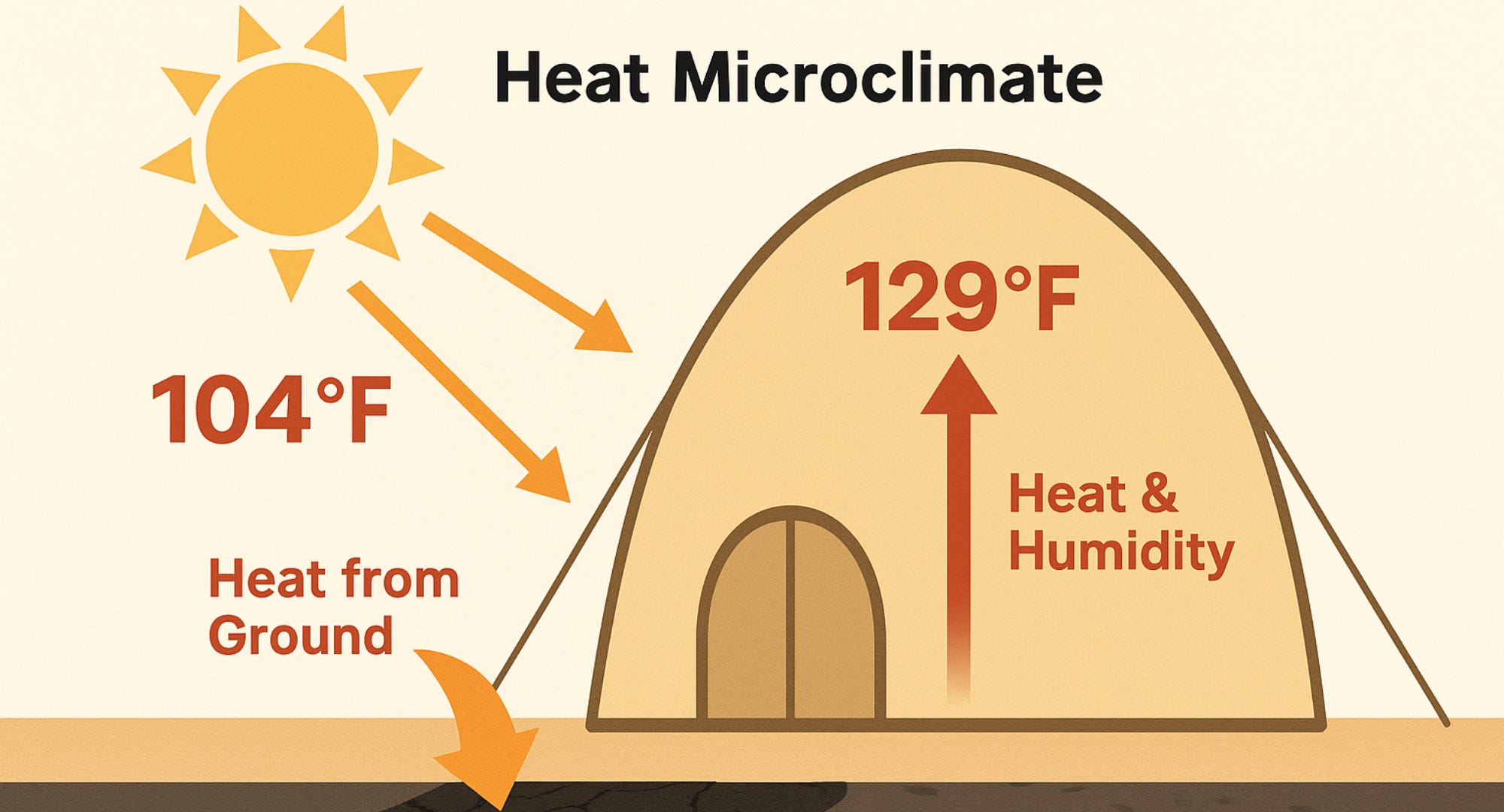
Crowding compounds the problem. Each person exhales about half a liter of water vapor a day just from breathing, and more from sweating. In a sealed or semi-sealed tent, that moisture raises humidity levels. In desert air, sweat normally evaporates quickly, cooling the body. But in a humid tent, that process slows, making the heat feel more oppressive and reducing the body’s ability to cool itself.
The base surface may make things even worse. Asphalt or concrete pads, the most common substance for stability in large tent setups, can reach 130–160°F in full sun, radiating heat upward into the living space. Even compacted soil can exceed 120°F. The result is a constant flow of heat from both above and below, with little escape.
The danger is highest for children, the elderly, medically fragile individuals, and anyone taking medications that impair heat tolerance. In these conditions, heat exhaustion can develop in under an hour, and heat stroke can follow quickly if people can’t cool down or hydrate.
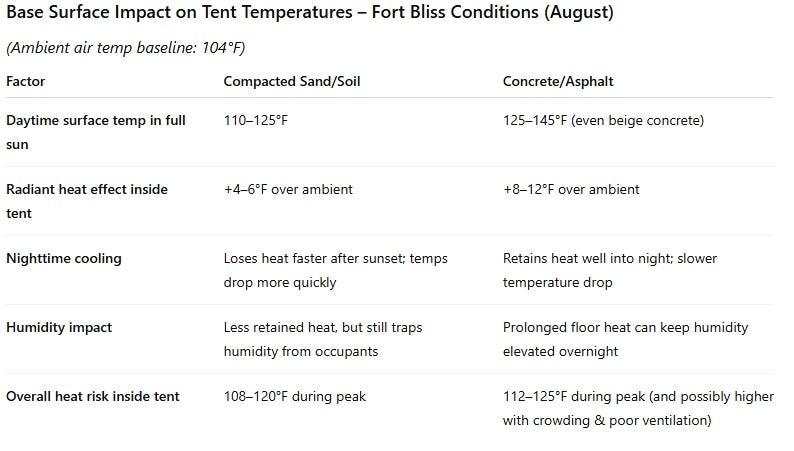
Takeaway: Even with a sand base, tents in the Fort Bliss sun can exceed safe temperature thresholds within an hour. With a concrete or asphalt base, those same tents can approach lethal indoor conditions faster and stay hot longer into the night.
Visual Evidence
From the perimeter roads near Camp East Montana, you can see the air itself moving. In video footage shot by KLBK Lubbock and shared via MSN, the ground over and around the tent area ripples with heat distortion, the shimmering waves you normally see above a hot highway in summer.
That shimmer is more than a visual curiosity. It’s caused by light bending as it passes through layers of air at different temperatures, a clear sign that the air right above the ground is much hotter than the official air temperature. On asphalt or concrete in full sun, that surface heat can exceed 130°F and radiate upward for hours, even after sunset.
It’s impossible to confirm from the footage whether the tents sit on asphalt, concrete, or compacted soil. However, the visible heat distortion tells its own story. Whatever the surface, it’s radiating enough heat to warp the air from a distance. Inside the tents, that heat combines with solar gain from above and body heat from hundreds of people to create an environment far more dangerous than the outside conditions alone suggest.
Local Political Pushback
Not everyone in El Paso is willing to accept Camp East Montana without a fight. On August 8, El Paso County Commissioner Jackie Butler introduced a formal resolution opposing the new detention facility.
The resolution highlights the lack of transparency in the approval and operation of the camp. It raises concerns about the contractor’s inexperience in running large-scale detention centers, the absence of clear protocols for detainee care, and the strain the facility will place on local infrastructure. It also demands immediate answers from ICE, DHS, and Fort Bliss leadership, including a full operational briefing, disclosure of staffing and training plans, and guaranteed access to the site for elected officials, legal advocates, and human-rights observers.
The Commissioners Court is scheduled to vote on the resolution on August 11. While the county has no direct power to shut down a federal facility on military land, an official resolution of opposition would send a public signal and could increase pressure for oversight.
For Butler, the issue is about more than federal jurisdiction. “We have a right to know who is being detained in our community, under what conditions, and with what safeguards,” she told local reporters. The questions are straightforward: How will thousands of people survive El Paso’s August heat in tents? Where will their water come from? And who will be watching to make sure the answers match reality?
Humanitarian & Ethical Concerns
The government has framed Camp East Montana as a “short-term” processing center for people in removal proceedings or with final deportation orders. However, ICE has not provided a breakdown of who is actually being detained there. Without names, case numbers, or public rosters, there is no way to know how many are children, elderly, medically fragile, or otherwise vulnerable.
What we do know is that this is not a purpose-built humanitarian facility. It is a military base, a controlled environment designed for defense operations. The same fences and access restrictions that make it secure also make it isolated. The same culture of chain-of-command discipline that keeps a base running can make it intimidating, even hostile, for people with no military background. And on a base like Fort Bliss, there will be armed soldiers everywhere.
For someone fleeing persecution or violence, often from a country where armed men in uniform were the source of that trauma, this is not a neutral setting. It is one more layer of fear and psychological stress on top of the physical strain of desert heat and uncertainty.
The combination of remoteness, anonymity, and military oversight is a powerful barrier to transparency. Lawyers and advocates can’t simply walk in. Families can’t drop by to visit. Journalists can’t casually photograph the conditions. Without outside eyes, detainees become invisible, and invisibility is the first step toward dehumanization.
Federal Accountability Is Unavoidable
When controversy surrounded Alligator Alcatraz, federal officials were able to distance themselves. It was a county-run facility, funded through a web of intergovernmental agreements. Within days of touring the site and even praising it as a “national model,” the administration claimed it had no direct role in its funding or operation.
That kind of deflection won’t be possible at Fort Bliss. Camp East Montana is on federal land, inside the boundaries of an active U.S. military base. It is funded through a $232 million federal contract awarded by ICE, a DHS agency, to a private company. The Department of Defense controls the property, and the federal government holds direct operational authority.
If conditions at the camp result in heat illness, unsafe water exposure, or abuse allegations, the chain of accountability leads straight to Washington. There is no local government to hide behind, no county sheriff to absorb the criticism. Fort Bliss is a federal creation, built with federal money, and operated under federal oversight. The responsibility — and the blame — will be federal, too.
What to Watch
The federal government insists that Camp East Montana will be a short-term detention facility, a place to hold people briefly while paperwork is processed and deportations arranged. It’s the same framing officials used for Alligator Alcatraz, the Glades County site this publication has reported on extensively. That facility was also pitched as a “hours-not-days” holding center, yet detainees have spent nights, weeks, even months inside.
The infrastructure going up at Fort Bliss tells its own story. These are not bare intake rooms. They are climate-controlled tents with sleeping quarters, food service, and capacity for 5,000 people. You don’t build that scale for a few hours. You build it for sustained detention, especially when the site is remote, access is restricted, and there’s little public oversight.
In the coming weeks, the key things to watch will be:
Capacity expansion: How quickly the site moves from 1,000 to 5,000 beds.
Length of stay: Whether “short-term” holds remain the exception or become the norm.
Water sourcing and safety: Whether ICE discloses how it will address El Paso’s water scarcity and Fort Bliss’s PFAS contamination.
Climate control: Details on cooling systems, ventilation, and heat mitigation inside the tents.
Resolution outcome: How the El Paso County Commissioners Court votes on August 11, and whether it sparks broader political pushback.
El Paso has spent decades bending technology, policy, and personal habit toward one goal: survival in the desert. Residents have cut their water use nearly in half, embraced desalination, and even agreed to drink purified wastewater because there were no other options. That hard-earned balance now faces a federal project that will house thousands in tents during peak desert heat, on a military base with documented PFAS contamination, and in conditions that will require more water per person than the city average.
Officials call it a “short-term” facility. We’ve heard that before at Alligator Alcatraz, where “hours, not days” became weeks and months. We know that soft-sided structures built for thousands are not designed for hours; they are designed for mass, sustained detention. And we know that secrecy, remoteness, and military oversight make it harder to see what’s happening inside, let alone hold anyone accountable.
If you believe people — no matter their immigration status — deserve humane treatment, transparency, and basic survival in U.S. custody, now is the time to act.
What You Can Do
Call the Congressional Switchboard at (202) 224-3121. Ask to be connected to your senators and representative.
Sample script:
“I’m calling to demand immediate oversight of the ICE detention facility at Fort Bliss. The combination of extreme desert heat, tent housing, PFAS-contaminated water, and a lack of transparency is a humanitarian crisis in the making. I want my member of Congress to push for independent access to the site and full public disclosure of conditions.”
Support watchdog groups monitoring detention conditions, such as the ACLU, Human Rights Watch, and Detention Watch Network.
Back grassroots organizations in El Paso providing direct aid and advocacy for migrants and asylum seekers, including Las Americas Immigrant Advocacy Center and Border Network for Human Rights.
Stay informed and amplify. Share verified reporting, speak about the issue in your own networks, and resist the normalization of mass detention in extreme conditions.
Silence is what makes this kind of facility possible. Visibility and public pressure are what make them answer for it.
Stay Informed. Stay Loud.
Subscribe to The Coffman Chronicle for no-BS political analysis, action guides, and daily truth bombs you won’t get from corporate media.
Bibliography:
“ICE to Open Fort Bliss Detention Camp on August 17.” KLBK Lubbock via MSN, August 7, 2025.
“County commissioner introduces resolution against Camp East Montana.” KVIA ABC-7 El Paso, August 8, 2025.
“El Paso County Commissioner Demands Transparency for New Fort Bliss Detention Center.” KFOX14/CBS4 Local, August 8, 2025.
“ICE detention facility at Fort Bliss opens Aug. 17 under Trump-era executive order.” El Paso Times via MSN, August 6, 2025.
“Migrants to be housed at new Fort Bliss detention center.” Military Times, August 8, 2025.
“Texas' Fort Bliss Set to Host 5,000-Bed Immigrant Detention Camp.” Military.com, July 23, 2025.
“Texas Border: Migrant Mega-Prison Planned at Fort Bliss.” USBorderNews.com, July 24, 2025.
“Trump administration wants $1.2 billion tent city at Texas Army base, country’s largest immigration detention center.” The Independent, July 23, 2025.
El Paso Water Utilities. “Kay Bailey Hutchison Desalination Plant.” EPWater, accessed August 2025.
“What Federal Lawsuit Reveals about the Inner Workings of Alligator Alcatraz.” WFLX West Palm Beach, August 8, 2025.
U.S. Army Environmental Command. “Final Preliminary Assessment and Site Inspection of PFAS, Fort Bliss, Texas/New Mexico (June 2023).”
U.S. Environmental Protection Agency. “Key EPA Actions to Address PFAS.” April 2024.
“Toilet to tap: El Paso is about to embark on a whole new way to save its limited water supply.” Texas Tribune, April 10, 2025.
“Feeling Salty: Regulating Desalination Plants in the United States.” Cornell International LJ 48, no. 2 (2015).
“As Rio Grande Shrinks, El Paso Plans for Uncertain Water Future.” Yale E360, October 11, 2022.
The Daily Climate. “New El Paso facility will recycle toilet water into drinking water to fight looming shortages.” April 15, 2025.
National Oceanic and Atmospheric Administration / NOAA. “How Hot Does Pavement Get in Summer?” UGA Extension, May 12, 2022.
“Summer Thermal Challenges in Emergency Tents.” MDPI Buildings, 2024.
“Thermal Comfort Performances of Temporary Shelters." MDPI Buildings 11, no. 12 (2021): 655.
"Using Cool Pavements to Reduce Heat Islands." EPA, March 18, 2025.
“Daily Climate Report: El Paso International Airport, TX — August 1–August 10, 2025.” NWS Climate Data.
“El Paso, TX Climate Normals (1991–2020).” NWS Climate Data.
“Drought Information Statement.” NWS Climate Data.

I can’t believe that this is happening in a so-called civilized country. This is cruelty and dehumanization, this is an attack on humanity.
I don’t know toilet to drinking water. Desalination plants are powerful.