


I was an honors student. I thought I knew American history.
I knew about the Trail of Tears. I knew about the Civil War, the Civil Rights Movement, and Watergate. I even learned a bit about IranContra. I knew enough to be skeptical. I knew history gets shaped by the victors.
But it wasn’t until college that I learned about the Japanese American internment camps.
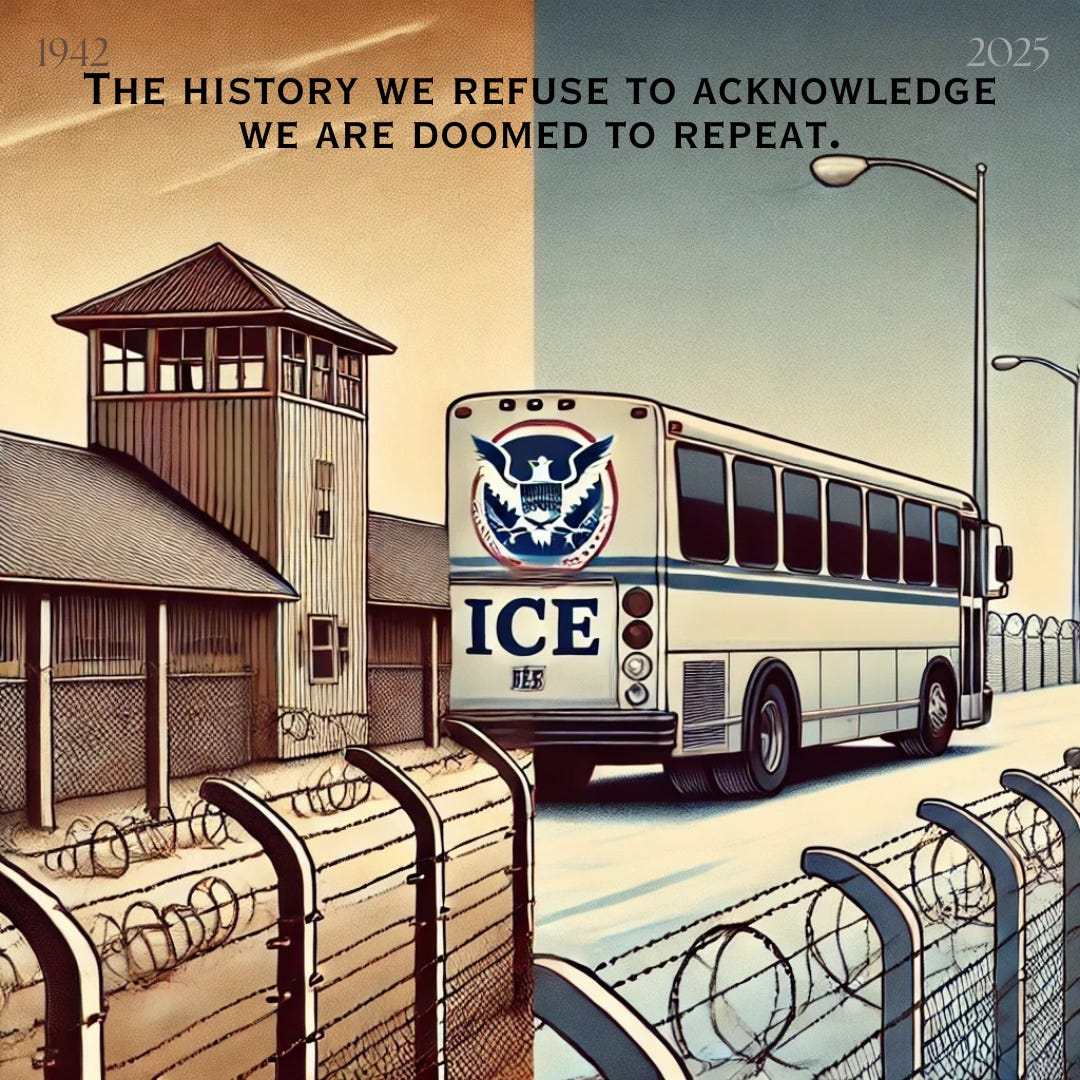
Not as a footnote. Not as some justified wartime “measure.” But as it actually was: an open-air incarceration of over 120,000 people—two-thirds of them U.S. citizens—based on nothing more than ancestry and fear. No trials. No charges. Just fences, desert, and silence.
When I found out, it felt like a knife to the chest.
Not just because of what we did, but because I had never been told.
That moment—realizing my own education had covered up mass internment—shattered something. And it taught me something I never forgot: if we don’t fight to remember the truth, it will be erased.
And now, I’m watching it happen again.
Independent News. Just $1/Week.
We just hit 10,000 subscribers—thank you! To celebrate, we’re offering full access to The Coffman Chronicle for just $1 a week ($52/year).
Get exclusive analysis and fearless reporting you won’t find in corporate media.
Support truth. Stay informed.
Today, in the United States, nearly 50,000 people, many with no criminal record, are locked in immigration detention centers. Some are in federal facilities. Many are in privately run prisons. Most are held without due process. Some have been deported to third countries, even when courts said they shouldn’t be.
Earlier this year, migrants were detained at Guantánamo Bay—yes, that Guantánamo—under a Trump executive order expanding its use for border operations. When a group of senators visited and publicly condemned the move, the administration quietly backed down. But it didn’t stop the detentions. It just moved them inland and offshore.
Now, we’re seeing:
Detainees in Florida and Louisiana, held in squalid, overcrowded conditions
International students targeted and detained for pro-Palestinian speech
A father with protected asylum status “mistakenly” deported to El Salvador, now locked in a mega-prison. Meanwhile, DHS Secretary Kristi Noem smiles for the cameras outside it.
This isn’t about border security. This is a blueprint.
What We’ll Be Covering in This Series:
How Guantánamo Bay was quietly revived for migrant detention and why the administration backed down
What’s happening inside ICE’s sprawling network of detention centers across Florida, Louisiana, and beyond
Why deportees are being sent to third-country prisons with no legal recourse
How privatized prison contractors are profiting from mass incarceration in legal gray zones
And how students, activists, and even U.S. residents are being caught in a crackdown that targets dissent as much as immigration
This isn’t just immigration policy. It’s racial control. It’s political suppression. It’s authoritarian power cloaked in bureaucracy.
We’ve seen this play before.
And if we don’t stop it, it will be history’s next erasure.
This series builds on our previous reporting, including:

ICE raids, court failures, and the racialized expansion of mass detention

The reopening of Guantánamo Bay and the profit motive behind migrant incarceration

How free speech, political dissent, and even academic critique are being criminalized at the border
Note: Articles more than 45 days old are now in the archive. To access, please consider becoming a paid subscriber.
Follow for updates. Share widely. If you have a story from inside the system, send it to us.
We just hit 10,000 subscribers—thank you! We’re offering full access to The Coffman Chronicle for just $1 a week ($52/year) to celebrate.
Get exclusive analysis and fearless reporting you won’t find in corporate media.
I come from an agricultural area in Oregon where many of the orchards are owned by the Japanese. During that horrid part of our history of internment, their neighbors throughout the valley stepped up to the plate and farmed their orchards so that when they returned, they still had their homes and farms, fully intact and thriving.
I lived in the city of garden grove in 1973.