


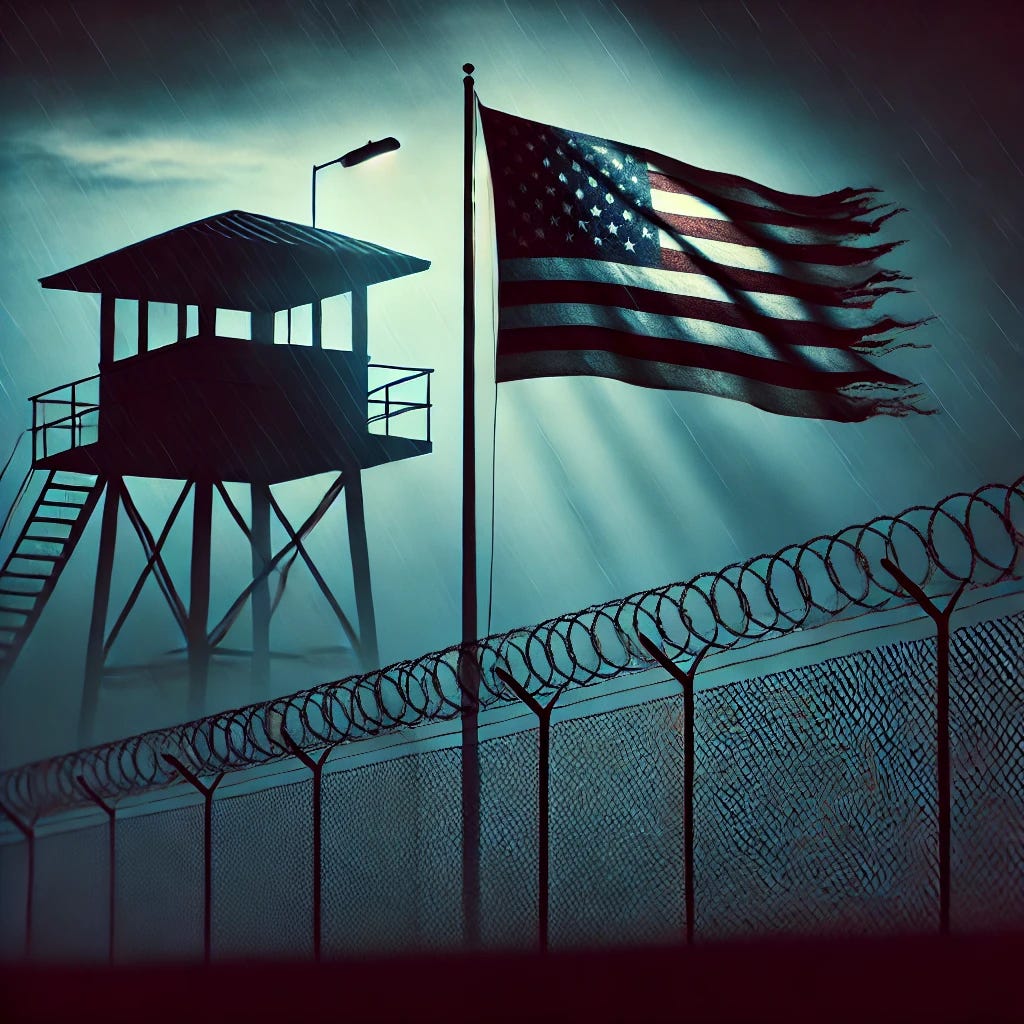
Guantánamo Bay, a U.S. naval base in Cuba, became infamous after 9/11 as the site of a detention camp where hundreds of men were held indefinitely without trial, many subjected to torture and “extraordinary rendition,” a practice in which detainees were secretly transferred to other countries for interrogation, often outside the bounds of U.S. law. Its very name has become shorthand for the erosion of legal norms in the name of national security.
As of 2025, several men remain detained at Guantánamo on terrorism charges from the post-9/11 era, although those cases have dwindled.
What most Americans don’t know is that Guantánamo has also long served as a migrant holding site. Since the early 1990s, the Migrant Operations Center on the base has housed Cuban and Haitian nationals intercepted at sea. Though always controversial, its footprint was small and largely overlooked.
Independent News. Just $1/Week.
We just hit 10,000 subscribers—thank you! We’re offering full access to The Coffman Chronicle for just $1 a week ($52/year) to celebrate.
Get exclusive analysis and fearless reporting you won’t find in corporate media.
Support truth. Stay informed.
That changed on January 29, 2025, when Trump signed a presidential memorandum titled "Expanding Migrant Operations Center at Naval Station Guantanamo Bay to Full Capacity," directing the Department of Homeland Security and the Pentagon to expand Gitmo to full operational capacity, preparing it to hold up to 30,000 migrants. The directive stunned even military officials, who were unprepared for the logistical and financial scale of the project. Cost estimates quickly ballooned into the hundreds of millions of dollars, and new detention structures were rapidly erected on a previously unused portion of the base.
For more on the policy’s origins and profit motives, see our earlier reporting: “Trump’s Migrant Prison Won’t Fix Crime—But It Will Make Millions.”

Note: This article is more than 45 days old and is now in our archive. Please consider becoming a paid subscriber to enjoy full access, exclusive reporting, and occasional early access.
By March, at least 87 migrants—many of them Latin American asylum seekers—had already been transferred to the site. Forty-two were classified as “low risk.” And yet, they were flown to a facility synonymous with indefinite detention and human rights abuses. The message was unmistakable: this wasn’t just immigration enforcement. It was a statement of intent.
The First Transfers and Initial Operations
In the weeks following Trump’s executive order, construction teams and military personnel were flown to Guantánamo Bay under urgent orders. Temporary barracks, fencing, and processing areas were set up in a newly designated portion of the base, distinct from both the old migrant center and the high-security terrorism compound.
The first known transfer of migrants occurred in early March. Eighty-seven individuals, mostly from Latin American countries, were flown in under the supervision of Immigration and Customs Enforcement (ICE) and Department of Defense personnel. These weren’t migrants intercepted at sea; they had been apprehended at or near the U.S. southern border and rerouted to Guantánamo as part of the administration’s aggressive new enforcement strategy.
According to internal reports later cited by congressional staffers, forty-two of the detainees were classified as “low risk”, raising alarm about the criteria being used to justify such extreme measures. The migrants were not given legal counsel before the transfer, nor were they informed of where they were being taken.
Their arrival marked a symbolic escalation.
Civil immigration enforcement had now merged with the extrajudicial legacy of the War on Terror.
The Senate Visit and Fallout
On March 5, 2025, a delegation of U.S. senators traveled to Guantánamo Bay for an unscheduled inspection of the newly repurposed migrant detention compound. The group included Senators Jack Reed (D-R.I.), Jeanne Shaheen (D-N.H.), Gary Peters (D-Mich.), Alex Padilla (D-Calif.), and Angus King (I-Maine)—all members of the Senate Armed Services or Homeland Security Committees.
Notably, no Republican senators joined them.
What they saw disturbed them.
The senators observed migrants being held in a remote, militarized facility staffed by armed personnel and surrounded by fencing. Many detainees had not seen a lawyer. Some had been flown in without knowing their destination. The lack of legal infrastructure—no immigration courts, appointed counsel, or interpreters—was a glaring indictment of the administration’s intentions.
Upon returning to Washington, the delegation issued a joint statement condemning the operation as “likely illegal and certainly illogical.” Senator Alex Padilla called the policy “a ready-fire-aim approach to immigration enforcement,” blasting the administration for wasting taxpayer dollars and sidestepping the U.S. legal system.
Senator Jon Ossoff followed with a letter to Defense Secretary Pete Hegseth, warning that using military resources for civil immigration detention raised constitutional concerns and threatened military readiness.
The administration’s Gitmo experiment faced public scrutiny for the first time, and the optics weren’t survivable.
The Quiet Retreat
Less than two weeks later, the operation collapsed in silence.
By March 11, all 87 migrants had been transferred to ICE facilities on the U.S. mainland. No further transfers were made. The hastily built detention compound remained, but its purpose had been abandoned.
There was no press release. No pivot plan. Just a quiet, unceremonious reversal.
Behind closed doors, defense officials expressed unease. Legal threats were mounting. And DHS insiders hinted at growing concern over public perception. What had begun as a show of force now looked like a legal and logistical liability.
The administration didn’t explain the drawdown. But they didn’t need to. The spectacle had already served its purpose.
Conclusion: A Plan Shelved, Not Abandoned
For a moment, it looked like something had been stopped. Senators spoke out, the headlines flared, the detainees were moved, and Guantánamo, once again, went quiet.
But this wasn’t a victory. It was a redirection.
The Trump administration didn’t abandon its goal of mass detention without oversight. It simply shifted to facilities better hidden from view: domestic black sites operated by private companies, buried in the swamps of Florida and the backroads of Louisiana.
Guantánamo was too visible.
Too historic.
Too symbolic.
It reminded Americans what happens when the rule of law is suspended in the name of security.
And that’s the truth the administration needed to bury.
Guantánamo may have emptied, but the detentions didn’t stop. They just got harder to see.
In our next installment, we expose what came next: overcrowded ICE jails in Florida, silent suffering behind privatized fences, and the true scale of a system designed not to process migrants, but to disappear them.
We just hit 10,000 subscribers—thank you! We’re offering full access to The Coffman Chronicle for just $1 a week ($52/year) to celebrate.
Get exclusive analysis and fearless reporting you won’t find in corporate media.
Bibliography:
"Expanding Migrant Operations Center at Naval Station Guantanamo Bay to Full Capacity" The White House, January 29, 2025.
"'Misguided mission': Senators blast detaining migrants at Guantanamo" Los Angeles Times, March 29, 2025.
"U.S. sending nonviolent, 'low-risk' migrants to Guantanamo, despite vow to detain the worst there" CBS News, March 2025.
"After Visiting Guantanamo Bay, Senators Blast Trump Admin for Wasting Taxpayer Dollars & Misusing Military Resources" Senator Alex Padilla's Official Press Release, March 29, 2025.
"Pentagon reviewing plans to cut troops handling migrants at Guantanamo" Marine Corps Times, March 20, 2025.
"Trump to prepare facility at Guantanamo for 30,000 migrants" Reuters, January 29, 2025.
"Trump orders opening of migrant detention center at Guantánamo Bay"
The Guardian, January 29, 2025."What to know about Guantánamo Bay, the base where Trump will send 'criminal aliens'" Associated Press, January 29, 2025.
This is a black stain that will come to light.