


Note: This article is part 3 in our Disposable America series regarding healthcare.
For all the pageantry—flags on porches, parades in the streets, “thank you for your service” stitched into every ceremony—this is what many veterans come home to: silence, struggle, and abandonment.
They are told they are heroes. But when they seek help, the doors are locked. The clinics are closing. The funding is gone. Their trauma is politicized. Their pain is seen as weakness. And their very lives are weighed against a budget line—and found expendable.
This is the quiet war we’re not fighting—the war at home—a war of policy over compassion, of indifference disguised as reform, of systems that celebrate service but strip away care.
Veterans didn’t stop serving. America did.
We just hit 13,000 subscribers—thank you! To celebrate, we’re offering full access to The Coffman Chronicle at 50% off.
Get exclusive analysis and fearless reporting you won’t find in corporate media.
Support truth. Stay informed.
Life After Service: The Fragile Transition
For many veterans, the most brutal battles begin after they’ve come home.
Nearly half of post-9/11 veterans say readjusting to civilian life was difficult. The reasons are layered and systemic. Only about half say they felt prepared for the transition, leaving them to navigate a new world of capitalism, resume writing, and healthcare red tape, often with invisible wounds.
Combat veterans are especially vulnerable. They’re significantly more likely to struggle with the shift, and those with PTSD face steep psychological, relational, and economic cliffs.
“Transitioning out of the service is probably one of the most challenging things an individual could do,” said retired Army Lt. Col. Sam Andrews. “We lose our sense of purpose, we lose our sense of tribe, we lose our sense of meaning.”
Employment is one of the biggest hurdles. Despite the public narrative that veterans are “highly employable,” those aged 18–24 actually face unemployment rates of 12.3%, well above the civilian average. Many can’t find jobs that recognize their skills or value their experience. Transitioning from a duty- and team-oriented military culture to a market-driven, individualistic civilian economy is jarring and alienating for some.
“I didn't realize it was even happening—it had become part of my personality,” recalled Adam Ramsey, a U.S. Army veteran reflecting on his struggle with PTSD.
Marriage and family life are also strained. Combat veterans are 62% more likely to experience divorce, and female veterans face an even higher divorce rate than their male peers. These breakdowns don’t happen in a vacuum; they’re the collateral damage of trauma, dislocation, and a support system that ends at discharge.
But for many, the difficulties of civilian life extend far beyond employment and identity. Even basic survival becomes uncertain.
Nowhere to Go: Housing Instability and Homelessness
The promise of a stable return home is often a mirage for veterans. And without secure housing, mental health recovery becomes nearly impossible.
In the wealthiest country on Earth, homelessness has been on the rise. But the story, at least until now, has been different for veterans.
Over the past decade, homelessness among veterans has dramatically declined, thanks largely to the Supportive Services for Veteran Families (SSVF) program launched in 2011. This federal initiative provided targeted housing assistance paired with mental health counseling, job training, and wraparound support designed specifically for veterans.
It worked.
On a single night in January 2024, 32,882 veterans were experiencing homelessness, a 55.6% drop since 2010, and the lowest level ever recorded. At its peak, 88,000 veterans were under lease through the HUD-VASH program, and more than 83,000 veteran households were permanently housed or prevented from becoming homeless.
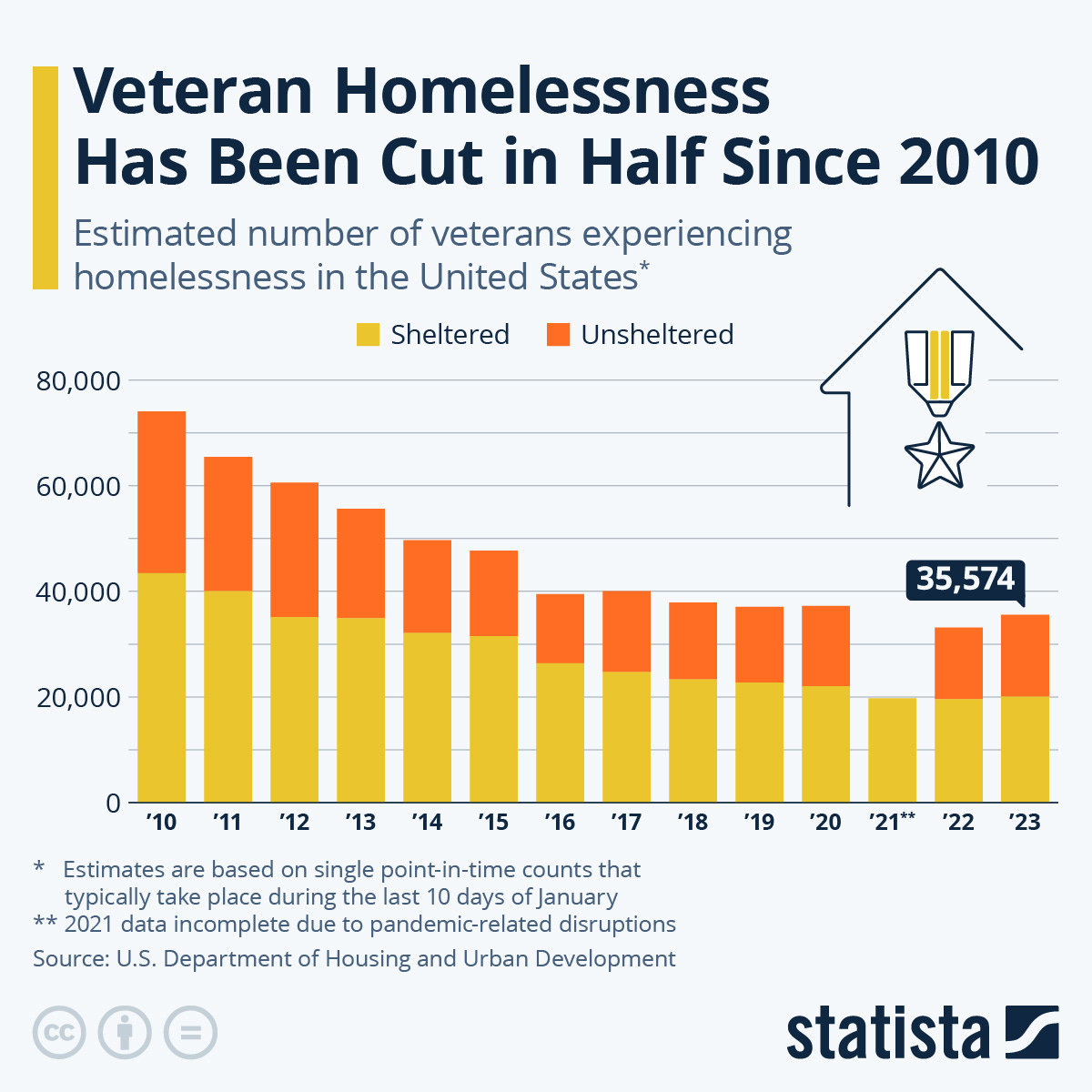
But that success is fragile.
Despite these gains, veterans remain disproportionately affected by housing insecurity. Factors such as unemployment, untreated trauma, and the evaporation of transitional supports contribute to ongoing risk. Shelters are not designed to handle complex mental health or PTSD cases. And VA housing programs—once a rare example of wraparound federal support—are now under pressure from budget cuts and workforce reductions.
These aren’t isolated incidents. They’re part of a systemic unraveling: without stable employment, without therapy, without medication, and now without a roof, more veterans are falling into cycles of crisis, addiction, and displacement.
The emotional impact is just as devastating as the practical. Many veterans already feel unseen by the very system they served. Homelessness cements that perception, not just as a policy failure, but as a form of erasure.
As the care infrastructure is dismantled, the chance to intervene before crisis disappears.
When housing collapses and care is out of reach, the next stop isn’t treatment; it’s often a jail cell.
From Uniform to Inmate: The Criminalization of Trauma
When the safety nets fail, the cage often follows.
For some veterans, the untreated effects of trauma—PTSD, substance use, impulsivity, and dissociation—don’t lead to therapy. They lead to arrest. Increasingly, what begins as a cry for help ends in a cell.
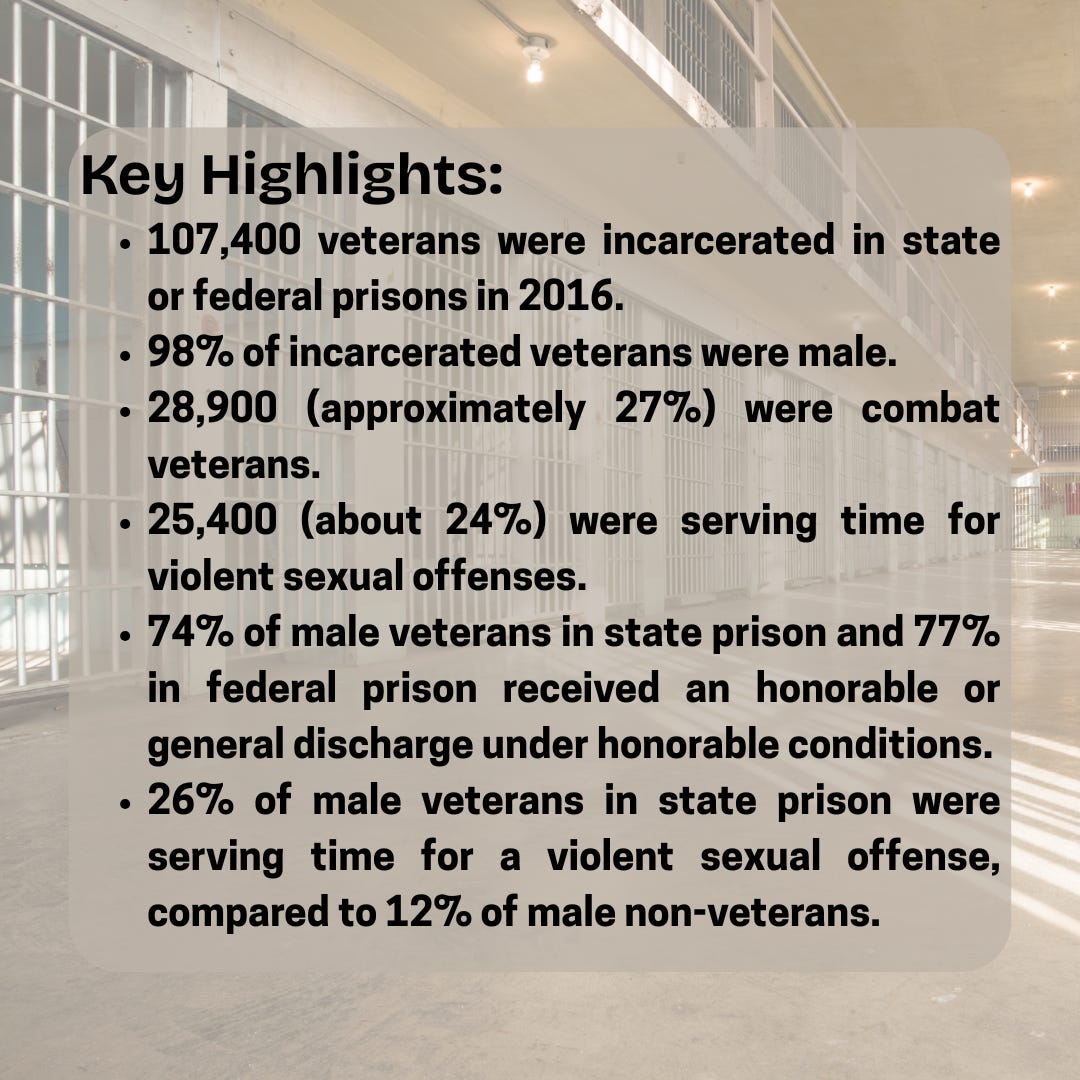
Veterans are overrepresented in the U.S. criminal justice system. As of 2016, approximately 107,400 veterans were incarcerated in state or federal prisons, accounting for nearly 8% of the state prison population and over 5% of the federal prison population, despite veterans comprising about 6.5% of the U.S. adult population.
The offenses vary, but a significant portion involves violent crimes. Male veterans in state prisons were twice as likely as non-veterans to be serving time for violent sexual offenses (26% vs. 12%). Additionally, veterans often receive longer sentences; in state prisons, veterans had an average sentence length of about 22 years, compared to 15 years for non-veterans.
And now, as the VA’s mental health infrastructure is gutted, the path back to treatment narrows even further. Veterans who might have once been diverted to rehab or trauma therapy are instead being funneled into overburdened jails with no psychiatric resources, just cement, bars, and stigma.
This isn’t justice. It’s a policy failure by another name.
These veterans aren’t threats. They’re symptoms of a system that made service sacred, but suffering shameful.
And that system is crumbling.
Silence as Strength: Cultural Pressures and Stigma
For many veterans, especially men, asking for help isn’t just hard. It feels like betrayal.
Military culture instills discipline, endurance, and mission-first thinking. In combat, that saves lives. But back home, that same conditioning can become a barrier to healing. Vulnerability is seen as weakness, therapy as indulgence, and medication as defeat.
Older veterans, especially from the Vietnam and Gulf War eras, often internalized a code of silence. But even younger veterans, despite growing openness around mental health, face a new set of cultural threats: “alpha male” culture, social media glorification of stoicism, and influencers who equate therapy with moral failing.
It’s a dangerous cocktail. The veteran who’s drinking too much, struggling to sleep, or quick to anger isn’t told, “You need help.” They’re told, “Man up.”
“I was in charge, so I didn't want to look weak,” admitted Marine veteran Desmond Cook, describing why he hid his symptoms.
And that message is amplified by political rhetoric that mocks mental illness, discredits psychiatric care, and cuts the very programs that provide it.
It’s no wonder so many veterans suffer in silence.
“It isn't about what's wrong with you, it's about what happened to you,” said one VA counselor, reframing the conversation on trauma.
Invisible Wounds: Sexual Trauma and Stigma Among Veterans
While mental health struggles in the military are often associated with combat, many veterans carry wounds inflicted by those they served beside.
Military Sexual Trauma (MST)—which includes both assault and harassment—is more prevalent in the military than most civilians realize. Nearly 1 in 3 women and almost 2% of men in the military report having been sexually assaulted during their service. These rates are higher than in the civilian population and are likely far underreported.
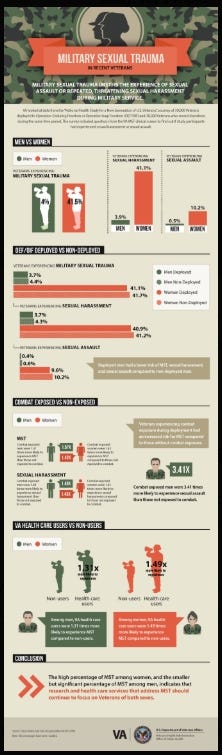
For men, stigma is often internal: shame, fear of emasculation, disbelief. For women, the pressure is external and cultural. They are still navigating a military structure that has only recently accepted them as equals. Many feel compelled to prove they are strong, self-sufficient, and “not a distraction.” Reporting sexual harassment or assault can feel like confirming stereotypes that they are liabilities, not leaders.
Silence, in this context, isn’t just about fear. It’s about survival. About keeping rank. About staying in the fight.
And the cost of that silence is immense. MST is closely linked to PTSD, substance use, depression, and suicide. These veterans aren’t just fighting stigma in the civilian world. They’re still fighting it within the very institutions they served.
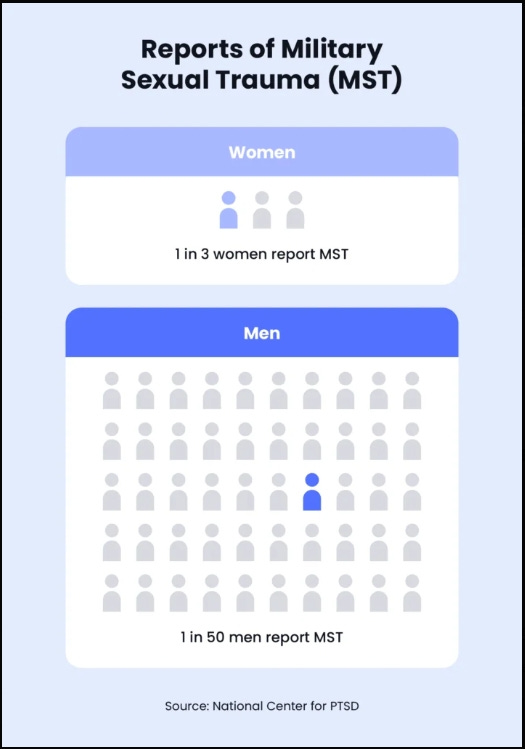
Now, with trauma-informed VA programs underfunded and community resources collapsing, MST survivors are losing what little support they had. Not only are their experiences being dismissed, but they are also being erased.
The Numbers Don’t Lie
The depth of this crisis isn’t just anecdotal—it’s quantifiable.
In 2022 alone, 6,407 veterans died by suicide, an average of 17.6 per day. Suicide remains disproportionately high among male veterans, but what’s often overlooked is that female veterans are at greater risk than their civilian counterparts, and historically have had fewer tailored support services.
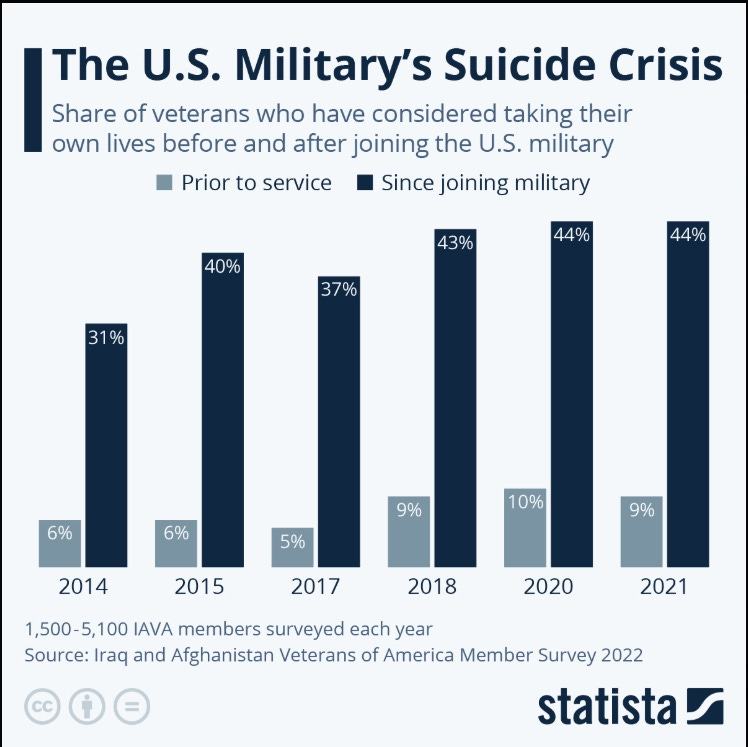
Some progress had been made. From 2021 to 2022, female veteran suicide rates dropped by 24.1%, and rates for younger veterans (ages 18–34) also saw small but meaningful declines. These gains were not accidents; they were the product of increased access, targeted VA initiatives, and federally supported programs.
But that progress is now in jeopardy.
The Department of Veterans Affairs has already projected staff losses of 83,000 employees, including mental health professionals, peer support staff, and caseworkers. This comes as veterans’ dependence on the VA for behavioral health care has grown—nearly half of VA patients receive mental health services, according to internal reports.
And it's not just the VA. With the elimination of SAMHSA, many veterans lose access to community-based programs, Narcan distribution, and block grants that funded addiction recovery, peer-led trauma groups, and suicide prevention initiatives.
Meanwhile, private care is often financially or geographically out of reach, especially for veterans in rural areas. Telehealth—once a solution—is crumbling under policy instability and broadband gaps.
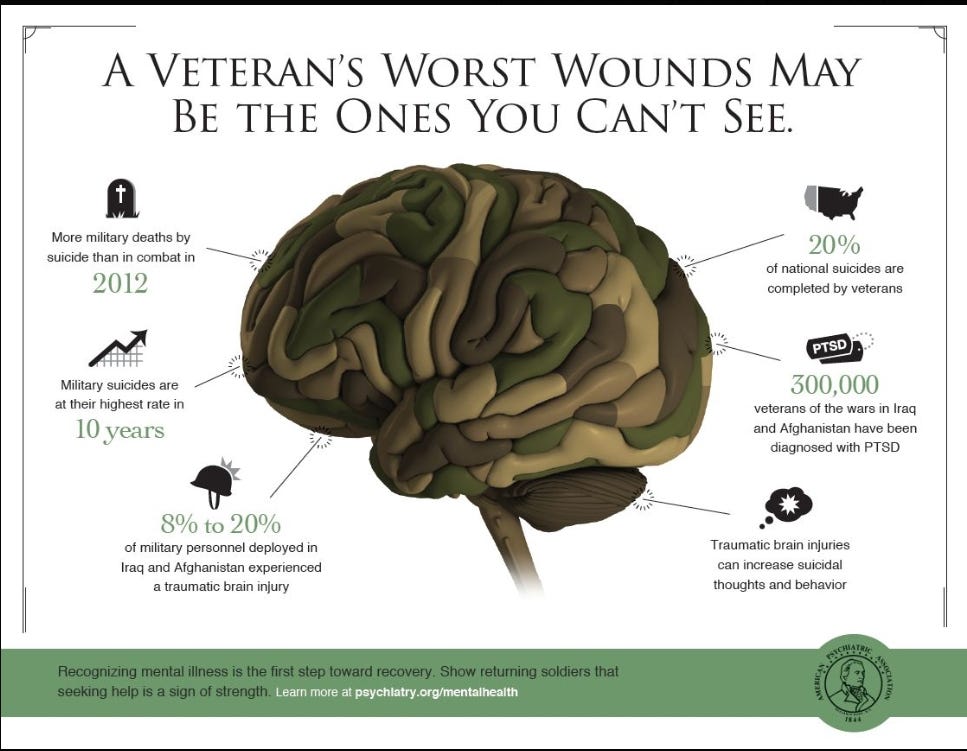
What the data makes clear is this: the need hasn’t diminished. But the resources have.
You cannot heal a lifetime of pain overnight; be patient with yourself. It takes as long as it takes to rebuild yourself.
Conclusion: The Silent War
For all the pageantry—flags on porches, parades in the streets, “thank you for your service” stitched into every ceremony—this is what many veterans come home to: silence, struggle, and abandonment.
They are told they are heroes. But when they seek help, the doors are locked. The clinics are closing. The funding is gone. Their trauma is politicized. Their pain is seen as weakness. And their very lives are weighed against a budget line and found expendable.
This is the quiet war we’re not fighting—the war at home—a war of policy over compassion, of indifference disguised as reform, of systems that celebrate service but strip away care.
Veterans didn’t stop serving. America did.
And the toll is counted not in speeches, but in suicides. In shelters. In prison cells. In overdoses. In estranged families. In silence.
This isn’t just neglect. It’s a national betrayal.
If You’re Struggling
If you are a veteran—or someone who loves one—and you're struggling, please know: you are not alone. You should not have to bear this alone. There is help. There is still hope.
Veterans Crisis Line – Call 988, then press 1. Or text 838255 to speak with trained VA responders 24/7.
988 Suicide & Crisis Lifeline – Dial or text 988 for immediate support, day or night, for anyone in crisis.
National Sexual Assault Hotline (RAINN) – Call 800-656-HOPE (4673) or visit rainn.org for confidential support, including for MST survivors.
Veterans Affairs Mental Health Services – Visit www.mentalhealth.va.gov to explore care options.
The Trevor Project – LGBTQ+ veterans and youth can text START to 678-678 or call 1-866-488-7386 for crisis support.
Your life has value. Your story matters. You are not disposable.
We just hit 13,000 subscribers—thank you! To celebrate, we’re offering full access to The Coffman Chronicle at 50% off.
Get exclusive analysis and fearless reporting you won’t find in corporate media.
Bibliography:
Maruschak, Laura M., Jennifer Bronson, and Mariel Alper. Veterans in Prison: Survey of Prison Inmates, 2016. Bureau of Justice Statistics, March 2021.
"Veteran Homelessness Reaches Record Low in 2023." U.S. Department of Veterans Affairs, December 2023.
"The State of Veteran Homelessness 2024." U.S. Department of Veterans Affairs.
"Homeless Problem in the United States: Record Unsheltered Veterans." Business Insider, December 2024.
Panetta, Leon E. "Too Many U.S. Veterans End Up Behind Bars. It's Time to Break the Cycle." Time, November 11, 2022.
Cook, Desmond A. A Broken Mind of a Marine. Newman Springs Publishing, 2025.
Wikipedia contributors. "Don Ritchie." Wikipedia, The Free Encyclopedia.
Bravo Zulu House. “Press Release: Sam Andrews Joins Board of Directors.” December 14, 2023.
McCarthy, Naill. “Sharp Increase In Sexual Assaults In The U.S. Military.” Statista, May 6, 2019.
“Appendix_C_Metrics_and_Non-Metrics_on_Sexual_Assault.” Department of Defense, 2018.
“Facts on Military Sexual Trauma and Statistics.” Hill & Ponton, P.A., June 29, 2023.
Military Sexual Trauma in Recent Veterans - Public Health
Sexual Violence in the Military: Infographic- National Sexual Violence Resource Center (NSVRC)
“Military Sexual Trauma Statistics.” Charlie Health, June 20, 2024
"Veterans Affairs Mental Health Services." U.S. Department of Veterans Affairs.
"988 Suicide & Crisis Lifeline." https://988lifeline.org
"National Sexual Assault Hotline." RAINN.
"The Trevor Project." https://www.thetrevorproject.org
"Veterans Crisis Line." U.S. Department of Veterans Affairs.

As bad as what happened to Vietnam Vets. They were reviled by society, but (I think) they still got their healthcare. My late husband was retired USAF, he would be devastated and infuriated by the abysmal treatment of his brothers and sisters in service.
We promised we wouldn’t forget…
“Veterans didn’t stop serving. America did.”
This hits hard.