


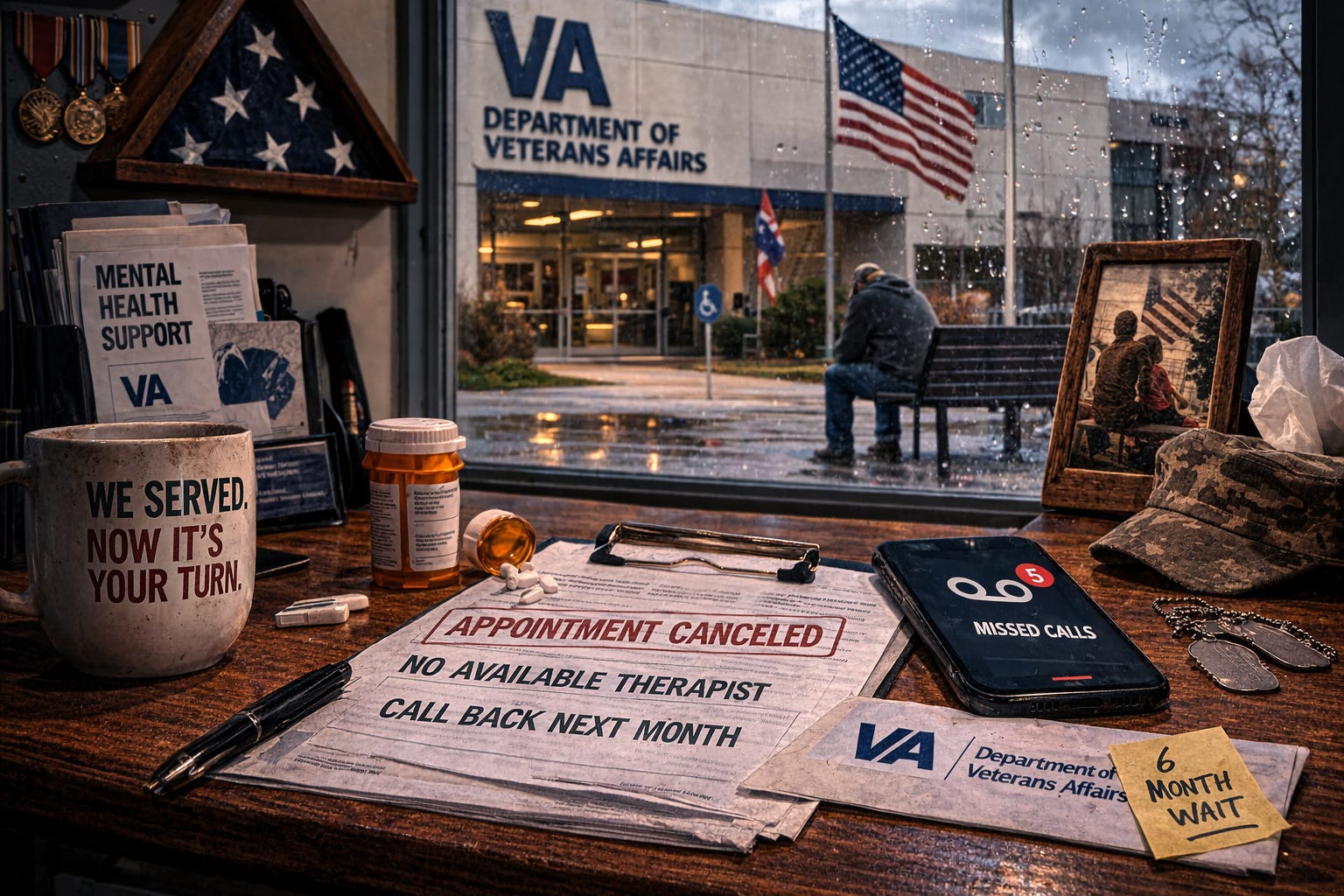
America loves to say it supports the troops. It says it at football games, in campaign speeches, and on every holiday that calls for a flag and a promise. But a promise is only real if it survives contact with reality, and right now that reality looks a lot less like gratitude than abandonment.
Inside the Department of Veterans Affairs, hundreds of mental-health professionals have left since President Donald Trump took office, according to ProPublica. Veterans told the outlet they are losing trusted therapists, struggling to get callbacks, and in some cases waiting as long as six months for care. Reuters had already reported in March 2025 that broader VA upheaval was disrupting mental-health services, creating confusion, cancellations, and strain inside a system that was never built to absorb chaos lightly.
That would be alarming enough on its own. Mental-health care is not a warehouse slot you can leave empty for a while and fill later. It depends on continuity, trust, and the fragile willingness of a person in pain to keep showing up. VA research says PTSD prevalence among veterans who served in Iraq or Afghanistan is about 11% to 20%, and the VA’s National Center for PTSD says that among the 5.8 million veterans served by VA care in fiscal year 2024, about 14% of men and 24% of women were diagnosed with PTSD.
And this crisis is unfolding as the United States is fighting an ongoing war with Iran, one that Reuters reports is still underway and without a clear exit. A country willing to send people into harm’s way has an obligation to protect the system meant to care for them afterward. Instead, it is letting that system erode in plain sight. That is not support for veterans. It is patriotic language covering for institutional neglect.
This Community Is Powered by You
What started as a small circle has grown into something much bigger, and it’s all because of readers like you.
Every time you forward this email, post it on socials, or bring someone new into the fold, you’re helping build one of the most passionate, independent political communities out there.
Want to keep the momentum going?
Share this newsletter with someone who should be part of this conversation.
Thank you for being here. It means everything.
What is happening inside the VA right now
The clearest way to understand this story is to stop talking about veterans in symbols and start looking at what they are being told when they ask for help. According to ProPublica, hundreds of mental-health professionals have left the VA since Trump took office. Veterans told the outlet they lost therapists they trusted, struggled to get return calls, and in some cases waited as long as six months for therapy. Staff described a system pushed toward a breaking point, where departures were not isolated disruptions but part of a wider erosion in care capacity.
That matters because mental-health care rarely collapses all at once. It breaks in pieces. It breaks when a veteran finally decides to ask for help and finds out the provider they opened up to is gone. It breaks when a call is not returned, when an appointment is pushed back, when the burden shifts to overextended staff trying to hold together a service that is losing the people required to make it work. A system can still look intact on paper long after it has started failing the people inside it. The reporting suggests that is exactly what is happening here.
This did not begin with one investigation. Reuters reported in March 2025 that a broader VA shake-up was already disrupting mental-health services for some veterans. That report described confusion tied to layoffs and restructuring, canceled appointments, strain on crisis-support functions, and added pressure on employees trying to maintain access to care during a period of instability. Reuters also reported that VA employees described uncertainty over crisis-line staffing, telehealth visits conducted in makeshift rooms, and canceled appointments tied to return-to-office changes.
Why mental-health care cannot be treated like interchangeable staffing
One of the easiest ways to minimize what is happening at the VA is to describe it as a simple workforce issue, as if mental-health care were no different from any other vacancy chart in a giant federal department. But therapy is not plug-and-play. The relationship is part of the treatment. For many veterans, especially those dealing with PTSD, depression, or moral injury, progress depends on trust built slowly over time with one provider, not just access to a slot on a calendar. VA research says PTSD prevalence among veterans who served in Iraq or Afghanistan is about 11% to 20%, and the VA’s National Center for PTSD says that among the 5.8 million veterans served by VA care in fiscal year 2024, about 14% of men and 24% of women were diagnosed with PTSD.
That is why clinician loss hits differently here. When a therapist leaves, the system does not just lose labor hours. A veteran may lose the one person they were finally willing to talk to honestly. They may have to start from the beginning with someone new, retell the worst parts of their life, and gamble all over again on whether this next person will understand them, stay long enough, or have room on the schedule. In mental-health care, instability is not a side effect. Instability is the harm.
That conclusion is reinforced by the broader facts. Reuters reported that the Veterans Health Administration has experienced severe staffing shortages since 2015, especially among mental-health professionals, citing a VA inspector general report. Reuters also noted that the share of veterans receiving mental-health services rose to 31% in 2022 from 20% in 2007, while suicide among veterans is twice the rate of Americans overall.
The real scandal: public honor, private neglect
This is what makes the story harder to excuse. The United States does not have a shortage of public language about loving veterans. Politicians of both parties wrap themselves in it. Ceremonies repeat it. Campaigns perform it. Every institution in American public life knows how to speak the grammar of gratitude. But gratitude that stops at the microphone is not support. A promise to veterans is only meaningful if it shows up in the systems they depend on when the applause is over.
That is the real scandal. The country still wants the emotional reward of calling itself pro-veteran while tolerating the slow deterioration of the institutions veterans actually need. It wants the flag, the anthem, the reunion on the tarmac, the yellow ribbon on the SUV. But when it comes time to protect the clinics, retain the therapists, and maintain the conditions required for continuity of care, the commitment suddenly becomes negotiable. The language stays sacred. The infrastructure becomes expendable. The staffing losses and service disruptions reported by ProPublica and Reuters make that contradiction difficult to deny.
Bureaucratic neglect is politically convenient because it does not appear to be an open attack. No one has to stand at a podium and announce that veterans matter less than the slogan built around them. The damage can be spread across attrition, vacancies, delayed hiring, restructuring, and official reassurances that essential services are protected. But veterans do not experience neglect in the abstract. They experience it as silence after a voicemail, a canceled appointment, a longer wait, a new face in the room, and the exhausting realization that the system asking for their patience may not be stable enough to deserve their trust. That lived experience is the through-line of the reporting.
Iran makes this story bigger, not smaller
If this were only a story about a care system already under strain, that would be damning enough. But it is unfolding at the same time the United States is engaged in a widening war with Iran. Reuters reports the conflict is still ongoing, with no clear exit and competing factions inside the administration arguing over how to contain the political, military, and economic fallout. In other words, the government is not just failing veterans already inside the system. It is participating in a war likely to create a greater future need for exactly the kind of care that the system is struggling to deliver.
Wars do not end when the bombs stop falling or when a president declares success. They continue for years, sometimes decades, in the minds and bodies of the people sent to fight them. The trauma tail of war comes home. It shows up in therapy rooms, crisis lines, marriages under stress, sleepless nights, substance abuse, depression, and the slow work of reintegration. That is why Iran belongs in this story. Not as a detour, but as a warning. Washington is willing to accept the costs of war in theory, while neglecting the institutions that bear them in practice. The final sentence is an inference from the reported war and the documented stress on VA mental-health capacity.
This is how a future crisis gets built in plain sight
The most dangerous failures in government are often the ones that arrive slowly enough to be renamed something gentler. A backlog becomes a challenge. Staff loss becomes attrition. Delayed care becomes a transition issue. But when enough of those softer words pile up in the same place, they stop describing a manageable problem and start describing a crisis under construction. That appears to be what is happening here. Veterans are already losing therapists and facing long waits, while the broader VA system has already shown signs of disruption and strain.
Mental-health demand does not vanish just because the system has grown less capable of meeting it. The need is durable. VA’s own figures show PTSD remains a significant burden among veterans who use VA care. The risk is not only that today’s patients wait longer. It is that tomorrow’s veterans enter a system already thinned out, overextended, and more brittle than officials admit. When a country is willing to expand war while allowing trauma-care capacity to erode, it is not just failing to solve a problem. It is laying the groundwork for the next one. That final point is an inference from the ongoing Iran conflict alongside the documented VA disruptions.
A promise is only real if it survives contact with bureaucracy
The United States has never struggled to find the words. It knows how to praise veterans, how to thank them, how to drape public life in symbols of sacrifice and service. What it is struggling to do is the harder thing: maintain the institutions that make those words mean something. ProPublica’s reporting that hundreds of VA mental-health professionals have left since Trump took office, alongside veterans’ accounts of lost therapists, poor follow-up, and waits that can stretch for months, is not a side story to the politics of war. It is the test of whether this country means what it says.
That test is being failed in two directions at once. Veterans already in the system are being asked to navigate a care structure that ProPublica and Reuters both describe as strained and disrupted. At the same time, the United States is engaged in a war with Iran that Reuters reports has no clear exit, meaning the government is accepting the likelihood of more future trauma-care demand while the system built to absorb that demand is already under pressure.
A nation cannot keep calling itself pro-veteran while treating veterans’ mental-health care as something that can be hollowed out quietly, explained away bureaucratically, and repaired later if the politics become inconvenient. Veterans who need help now should not be told, implicitly or explicitly, that patriotic language is a substitute for continuity of care. VA’s National Center for PTSD says that among the 5.8 million veterans served by VA care in fiscal year 2024, about 14% of men and 24% of women were diagnosed with PTSD.
If America is going to keep sending people into harm’s way, then it has to do more than honor them in public. It has to build a system strong enough to care for them when the war comes home with them. Anything less is not support. It is ceremony standing in for obligation.
Support Independent Media
If you’re tired of watching patriotic slogans cover for institutional failure, subscribe to The Coffman Chronicle. We follow the paper trail after the applause fades, and we tell the truth about who pays when government neglect gets wrapped in a flag.
Support The Coffman Chronicle and consider becoming a paid subscriber!!!
Sources:
“Veterans Who Depend on Mental Health Care Keep Losing Their Therapists Under Trump.” ProPublica, March 12, 2026.
“With Iran War Exit Elusive, Trump Aides Vie to Affect Outcome.” Reuters, March 13, 2026.
“VA Shake-Up Hits Mental Health Services for US Veterans.” Reuters, March 20, 2025.
U.S. Department of Veterans Affairs, Office of Research and Development. “Posttraumatic Stress Disorder (PTSD).”
U.S. Department of Veterans Affairs, National Center for PTSD. “How Common Is PTSD in Veterans?”
The Fapweasel (Trump) is incredibly myopic.
I am the daughter of a Vietnam veteran and the mother of four disabled veterans from Iraq and Afghanistan. In all three of these wars there was no clear, articulated end-goal and no plan for how to get there and the casualty counts and monetary costs never fully accounted for the longterm damage to our soldiers and their families. War is a hell that never really goes away, even after the bombs stop falling.
https://danismart.substack.com/p/opposing-this-war-is-the-most-patriotic