


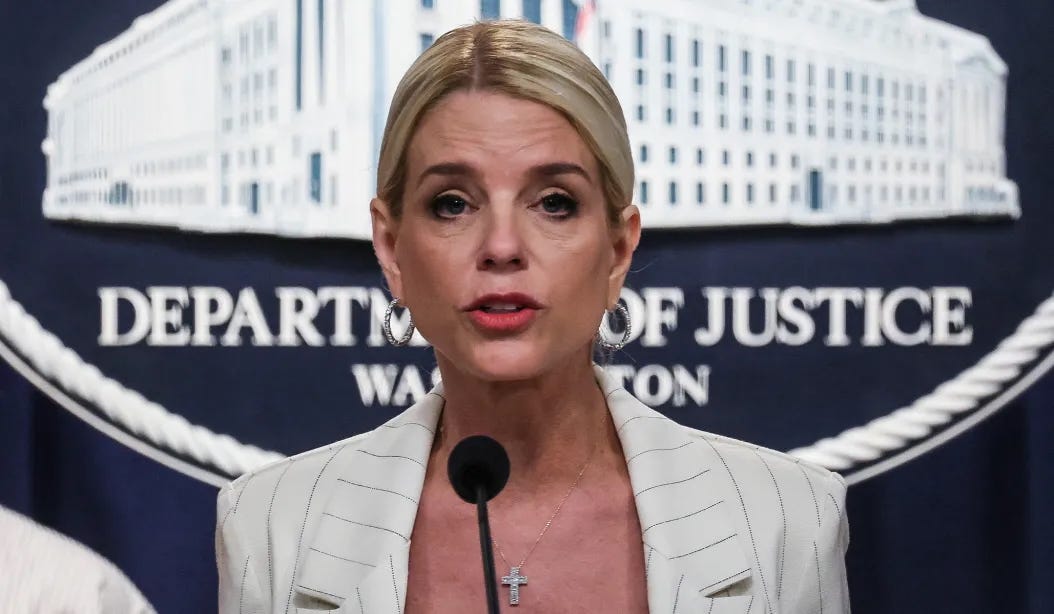
A leaked memo reportedly authored by U.S. Attorney General Pam Bondi and distributed to federal law enforcement appears to launch a sweeping effort to classify and track certain protestors, activists, and dissidents as “domestic terrorists.” According to reporting from independent journalist Ken Klippenstein, the directive orders the DOJ and FBI to compile a “list of groups or entities engaged in acts that may constitute domestic terrorism.”
The memo’s criteria for inclusion are strikingly broad: not only violence or threats, but also speech and political views. Targets include people or organizations that express what the document calls “anti-Americanism, anti-capitalism, anti-Christianity,” or support for “mass migration and open borders” or “radical gender ideology.”
Bondi reportedly instructs prosecutors and enforcement agencies to refer suspected cases of domestic terrorism to the FBI’s Joint Terrorism Task Forces (JTTFs) and to reexamine incidents over the past five years, including doxxing, protests, civil-disobedience and unrest for possible terrorism-related prosecution.
This effort builds on NSPM-7, a national security directive signed by President Donald Trump on September 25, 2025, which called for a government-wide strategy to “investigate, disrupt and dismantle” organized political violence.
Yet legal experts caution that the “terrorist organization” label has no basis in existing U.S. federal law. There is no statutory mechanism for designating domestic groups in the way foreign terrorists are labeled. That means while law enforcement can investigate or surveil, the memo itself doesn’t automatically confer legal status on any group as a domestic terrorist organization.
Still, critics warn the directive threatens free-speech rights: by linking protected political beliefs with “terrorism,” the memo could open the door to broad surveillance and criminal scrutiny of dissent. What remains uncertain because the full memo hasn’t been publicly released, is how many groups or individuals will be targeted, whether the list will lead to prosecutions, and how courts would respond.
What happens next: If the DOJ and FBI begin compiling a list and referring cases to the JTTFs, the impacts could be far reaching, potentially chilling political activism, shaping who is subject to federal law-enforcement scrutiny, and raising new questions about the boundaries of civil liberties in the United States.
Follow The Coffman Chronicle on NewsBreak for daily breaking political coverage.