


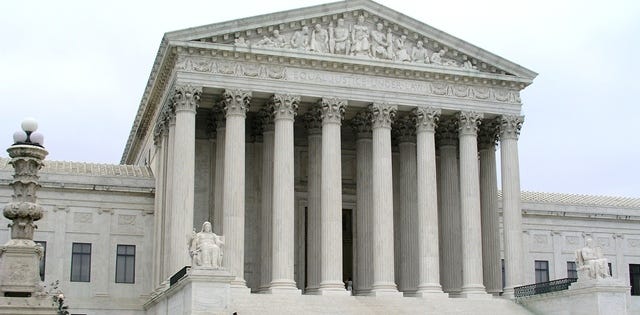
The U.S. Supreme Court has agreed to hear the high-stakes case NRSC v. FEC, which could upend longstanding federal campaign-finance limits — and dramatically reshape how political parties support their own candidates. The challenge, brought by the National Republican Senatorial Committee, the National Republican Congressional Committee and Republican candidates including J.D. Vance, argues that caps on coordinated spending between parties and campaigns violate the First Amendment.
Follow The Coffman Chronicle on NewsBreak for daily breaking political coverage.
Under current law — encoded at 52 U.S.C. § 30116(d) — such coordinated party expenditures are capped. In 2025, limits range from roughly $127,200 to nearly $3.95 million for Senate races, depending on the state’s population.
These limits were upheld in 2001 by the Supreme Court in FEC v. Colorado Republican Federal Campaign Committee (Colorado II), which treated coordinated expenditures as functionally equivalent to direct contributions and thus subject to contribution-limit doctrine.
But plaintiffs argue the legal and political context has changed. They cite later rulings — most notably Citizens United v. FEC (2010) and McCutcheon v. FEC (2014) — that bolstered First Amendment protections around political spending. They contend coordinated-spending caps now impose undue burdens on party-candidate political speech.
In an unusual move, the U.S. Department of Justice refused to defend the law. The Solicitor General argued that the limits infringe on political parties’ and candidates’ core First Amendment rights, indicating the federal government agrees the restrictions are constitutionally suspect.
Meanwhile, major advocacy groups — including the Brennan Center for Justice, Campaign Legal Center, and Law Forward — filed amicus briefs urging the Court to preserve the limits, warning that striking them down would open the door to unchecked influence by wealthy donors masquerading as party spending.
If the Court overturns those limits, political parties could start pumping unlimited funds into coordinated ads, bypassing traditional individual contribution caps. That could substantially amplify the role of wealthy donors or large interest groups — and potentially drown out smaller donors and grassroots support. In the wake of prior decisions like Citizens United and McCutcheon, this case may represent a next major step in weakening the legal safeguards that once constrained “big money” in federal campaigns. What happens next: the Supreme Court is expected to hear oral arguments in its 2025–2026 term. Its decision could reshape the 2026 midterm election landscape — and beyond — by changing who holds real influence in U.S. elections.