


When a federal judge ruled last week that Texas A&M’s drag show ban violated the First Amendment, it was more than a win for campus performers; it was a defiant stand against creeping authoritarianism. This ruling marks another data point in a vital trend: in 2025, as right-wing executive overreach accelerates under Trump’s second term, the courts are emerging as an essential last line of defense for civil rights and democratic norms.
Judge Lee Rosenthal didn’t mince words. “Drag performances are a form of expressive conduct protected by the First Amendment,” she wrote. “Executive orders cannot nullify constitutional guarantees.” Her ruling blocked a policy rooted in a broader Trump-era crusade against so-called "gender ideology," designed more to provoke outrage than to serve any coherent legal purpose.
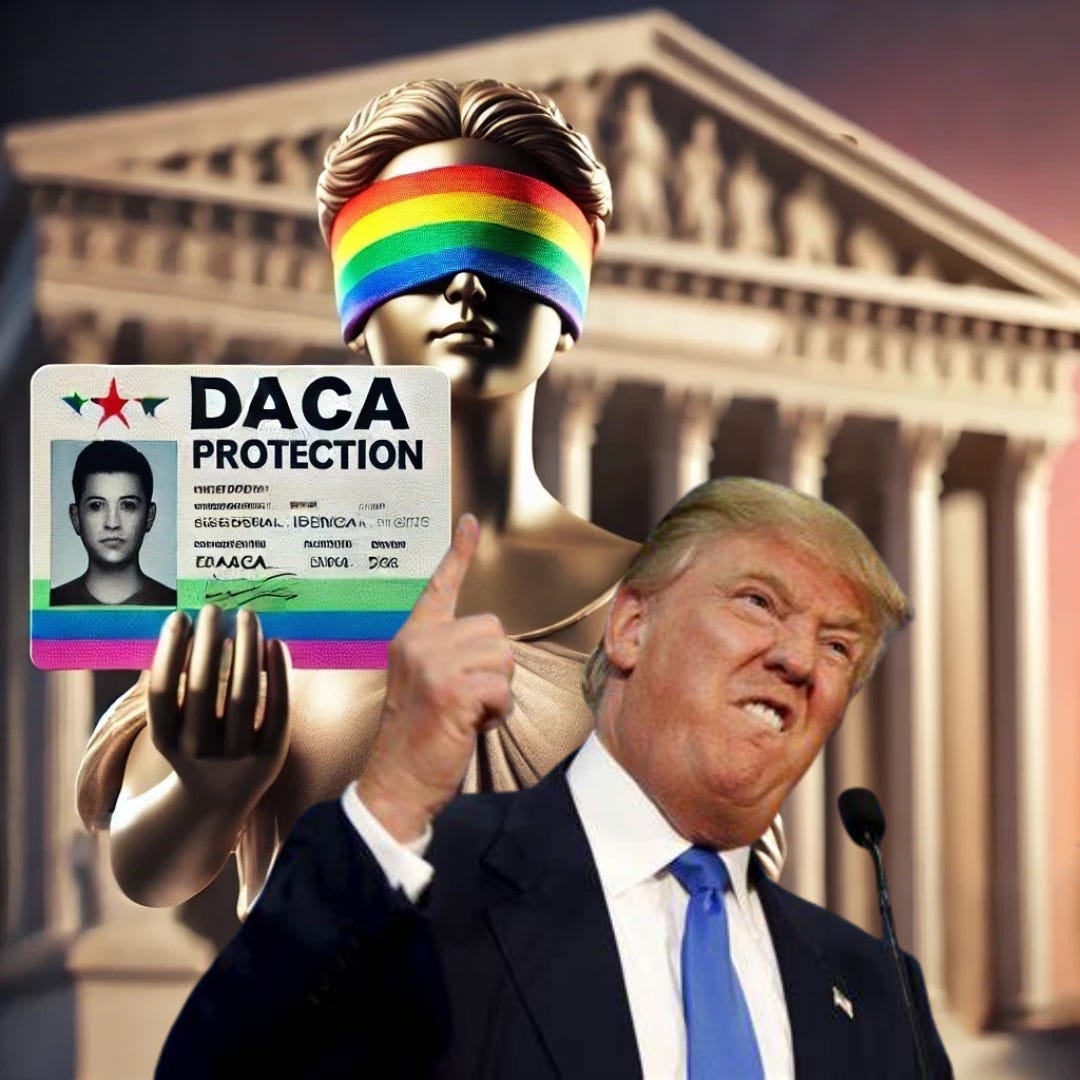
But this isn’t a one-off. From DACA to birthright citizenship, from DEI programs to bans on drag and trans military service, courts are consistently batting down executive actions that trample rights, ignore due process, or target marginalized communities.
Independent News. Just $1/Week.
We just hit 10,000 subscribers—thank you! To celebrate, we’re offering full access to The Coffman Chronicle for just $1 a week ($52/year).
Get exclusive analysis and fearless reporting you won’t find in corporate media.
Support truth. Stay informed.
A Pattern of Judicial Pushback
In this moment of rising autocracy, the judiciary is quietly asserting itself as a critical counterweight to executive overreach, especially when identity and dignity are on the line. Here’s how:
DACA Rescission (2020): On June 18, 2020, the Supreme Court ruled in Department of Homeland Security v. Regents of the University of California that the Trump administration's attempt to end the DACA program was "arbitrary and capricious" under the APA. The Court demanded accountability, logic, and humanity in governance.
Trump’s Muslim Ban (2017): On January 27, 2017, Trump issued Executive Order 13769, barring entry from seven Muslim-majority countries. Federal courts swiftly blocked it, citing religious discrimination and procedural irregularities.
Trans Military Ban (2025): In March 2025, a federal court issued a preliminary injunction blocking Trump’s renewed effort to ban transgender people from military service, once again resisting government attempts to erase identity through executive fiat.
Sanctuary Cities Funding Cuts (2017): On November 20, 2017, a federal judge permanently blocked Trump’s executive order to defund sanctuary cities, citing constitutional violations around federalism and separation of powers.
Birthright Citizenship Order (2025): In February 2025, a Maryland federal court issued a nationwide injunction against Trump’s executive order attempting to restrict birthright citizenship, affirming that a decree cannot rewrite citizenship rights.
DEI Program Restrictions (2025): Also in February 2025, a federal judge halted parts of a Trump executive order curtailing diversity, equity, and inclusion programs, warning against vague legal standards and viewpoint discrimination.
See our previous reporting on these cases:


What the Courts Are Really Saying
The message from the bench is clear: presidential power cannot bulldoze constitutional rights. The judiciary isn’t just weighing in on policies. It’s defending process, reason, and precedent.
DACA’s preservation wasn’t just a policy win but a judicial demand for empathy, deliberation, and procedural integrity. This ethos runs through every case: when executive power is weaponized against identity, the courts require more than headlines; they demand substance.
Symbolism vs. Structure
What many of these executive orders have in common is a stunning lack of replacement frameworks. These are policies driven by ideology, not governance:
Repeal DACA with no plan?
Ban drag shows with no definition of “gender ideology”?
End DEI with no proposal for equality?
This isn’t policymaking. It’s posturing. And it’s why the judiciary is stepping in.
Courts as the Constitutional Firewall
At a time when Congress remains paralyzed and the executive branch is increasingly used as a cudgel of ideology, the courts have become the most reliable guardians of the democratic process.
This isn’t a sustainable model. But for now, the judiciary is doing the hard work of calling bluffs, rejecting chaos, and protecting constitutional guarantees. The Texas A&M drag case is the latest proof: even in a storm of political theater, the Constitution has shelter.
Why This Moment Matters
This fight isn’t just about drag, DACA, or DEI. It’s about whether executive fiat will hollow out America’s democracy or hold it together by the rule of law.
Who will protect the constitutional process if the judiciary falters, is packed, intimidated, or is sidelined? We cannot afford to wait and see.
Whether or not you’ve ever attended a drag show or know someone affected by DACA, this is about all of us. This is about who holds power, and who checks it.
Subscribe to our newsletter for progressive legal breakdowns, political accountability, and stories that connect the dots between policy and power. The fight isn’t over. Knowledge is resistance.
We just hit 10,000 subscribers—thank you! We’re offering full access to The Coffman Chronicle for just $1 a week ($52/year) to celebrate.
Bibliography:
Department of Homeland Security v. Regents of the University of California, Supreme Court of the United States, June 18, 2020.
Rosenthal, Lee. “Texas A&M Drag Show Ban Violates First Amendment, Federal Judge Rules,” Houston Chronicle, March 28, 2025.
“Friends of George’s v. Mulroy,” Wikipedia Overview of 2023 Tennessee Drag Show Case.
“Protecting the Nation from Foreign Terrorist Entry into the United States,” Executive Order 13769, Federal Register, February 1, 2017.
“Court Clarifies That DEI Executive Orders Are Temporarily Blocked for All Federal Agencies,” Employment Law Watch, March 2025.
“Administrative Procedure Act (APA),” Legal Information Institute, Cornell Law School.
Emiliana. “DACA and My Life: Stories from Recipients,” ProCon.org / Britannica, 2023.
Angela. “Economic Impact of DACA Recipients,” Coalition for the American Dream, 2022.
“DACA Gave Me Life: Recipient Reflections,” National Immigration Law Center, 2022.
It's about humanity, decency. "We hold these truths to be self-evident, that all men are created equal, that they are endowed by their Creator with certain unalienable Rights, that among these are Life, Liberty and the pursuit of Happiness." from the Declaration of Independence