


In July 2023, a 27-year-old Latiné farmworker collapsed in a sun-scorched field in California’s Central Valley. He had no access to shade, no water breaks, and no heat protection. His death was not an accident. It was a policy failure. And it wasn’t the only one.
His story is not unique. Across the country, similar tragedies unfolded with alarming frequency. That year, nearly 5,300 workers died on the job in the United States, the highest fatality count in a decade. But the toll wasn’t evenly shared. Latiné and Black workers died at significantly higher rates than white workers, a pattern that has held steady—and in some years, widened—for over a decade.
These disparities aren’t just statistical noise. They reflect a dangerous truth about the American labor system: your race still shapes your risk of death at work. And far from being addressed, this crisis has been deepened by deregulation, neglect, and a political system willing to look the other way.
We just hit 13,000 subscribers—thank you!
Get exclusive analysis and fearless reporting you won’t find in corporate media.
The Racial Risk Gap
Not all workers face equal danger. The data is clear: Black and Latiné workers are dying on the job at higher rates than their white counterparts and have been for years.
In 2023, the overall U.S. workplace fatality rate stood at 3.7 deaths per 100,000 full-time workers. But that number obscures sharp racial disparities:
Latiné workers: 4.5 deaths per 100,000
Black workers: 4.0 deaths per 100,000
White (non-Hispanic) workers: 3.5 deaths per 100,000
These gaps aren't new. They are part of a long-standing pattern of racial disparity in workplace safety. Between 2015 and 2019, workplace deaths increased by 28% for Black workers and 20% for Latiné workers, compared to just 1.7% for white workers.
Black and Latiné workers are overrepresented in construction, agriculture, warehousing, and transportation industries, which have the highest rates of injury and fatality. These jobs are often:
Non-union
Under-inspected
Physically punishing
Frequently outsourced or temp-based
Language barriers, fear of retaliation, and lack of legal protections compound the risk. In other words, structural inequality doesn’t stop at the hiring gate; it follows workers onto the job site and, too often, into the emergency room.
And yet, the narrative remains muted. Politicians tout job creation. Corporations praise productivity. Meanwhile, the workers who clean, build, ship, and harvest—many of them Black and Brown—continue to die at rates that should be unacceptable in any civilized economy.
Where It’s Worst: The Southern Factor
The map of workplace fatalities in America doesn’t just show danger zones. It outlines a region of deregulation, weak oversight, and racialized labor. That region is the South.
States like Texas, Florida, Alabama, and Mississippi consistently rank among the worst for workplace deaths. In these states, Black and Latiné workers make up a significant portion of the labor force, especially in agriculture, construction, trucking, and meatpacking, and face compounding vulnerabilities:
Less access to union protection
Fewer OSHA inspections per capita
Weaker labor laws and right-to-work statutes
Higher proportions of immigrant and undocumented labor
Take Texas, where Latiné workers accounted for 45% of all workplace deaths in 2023. Or Florida, where Black workers die on the job at a rate significantly above the national average. These are not coincidences. They’re consequences of deregulated labor markets, politically weakened worker protections, and policies prioritizing profits over people.
In “right-to-work” states, union membership is low by design. Without union representation, workers are less likely to receive safety training, report violations, or access whistleblower protections. Southern OSHA offices—chronically understaffed and underfunded—inspect far fewer worksites than their Northern counterparts.
The result? A permissive environment for employers and a perilous one for workers, especially those who are Black or Brown. The South is not only a political battleground; it’s a workplace safety battlefield. And the bodies keep piling up.
We’ve previously reported on the erosion of OSHA. See that article here:
Note: These articles are over 45 days old and now live in our archive. Consider becoming a paid subscriber for our nearly 600 article archive, exclusive content, and occasional early access.


Disposable Labor: Temps, Immigrants, and the Precarious
Behind the racial disparities in workplace deaths lies another harsh truth: the more disposable your labor is considered, the more danger you’re in. And no workers are treated as more disposable than temporary, contract, and undocumented workers, many of whom are Black, Latiné, or immigrants.
In 2023, over 11 million Americans worked as independent contractors or temp laborers, a disproportionate number of them people of color. These workers are:
Less likely to receive safety training
Often denied protective equipment
Routinely excluded from employer-sponsored healthcare
Unprotected by federal safety laws in practice, even when legally eligible
Among Latiné worker deaths in 2021, 64% were foreign-born. In industries like construction, warehousing, and agriculture, employers often rely on staffing agencies or subcontractors to insulate themselves from liability. When someone dies, the paperwork blurs responsibility. The worker disappears from the news cycle, and the system rolls on.
Language barriers also heighten the risk. Many immigrant workers can’t understand English-only safety materials. Others are afraid to speak up, fearing termination, or, for undocumented workers, deportation. The message is clear: you can be replaced.
This isn’t a bug in the system. It’s a feature of a deregulated labor market that profits from precarity. By keeping a workforce divided, temporary, and fearful, companies minimize accountability and maximize productivity, at the expense of human life.
And in a political climate where the term “essential worker” has lost its moral weight, these deaths become the invisible cost of doing business.
Policy by Neglect: How Deregulation Endangers Marginalized Workers
This crisis didn’t emerge in a vacuum. It was shaped by policy. During his time in office, Donald Trump has made deregulation a cornerstone of his administration. That agenda wasn’t just about slashing bureaucratic red tape; it had very real consequences for workplace safety, especially for Black and Latiné workers in high-risk jobs.
In early 2017, Trump signed Executive Order 13771, which required federal agencies to eliminate two regulations for every new one proposed. This set off a cascade of stalled safety rules, including many under the jurisdiction of the Occupational Safety and Health Administration (OSHA). A second order, issued in 2025, expanded that ratio to ten-for-one, making it virtually impossible to enact new protections.
Among the most consequential casualties was OSHA’s Heat Injury and Illness Prevention rule, which was paused indefinitely. The rule was designed to protect outdoor and manual laborers—farmworkers, construction crews, and warehouse staff—who are disproportionately Latiné, Black, and immigrant. In states like Texas, where summer temperatures routinely exceed 100°F, the lack of mandatory rest, shade, and hydration has proven fatal.
These regulatory freezes were paired with a sharp decline in OSHA inspections. Trump’s budgets repeatedly slashed enforcement funding, and inspections dropped, especially in Southern “right-to-work” states. The result: a dramatic reduction in oversight at the very workplaces where deaths were most likely to occur.
What emerges is not just negligence but a pattern of engineered vulnerability. When the federal government withdraws from worker protections, it’s not CEOs or lobbyists who pay the price. It’s the people doing the hardest jobs for the lowest pay, often with the least power to complain.
What’s Killing Them & Who’s Held Accountable?
The leading causes of workplace death haven’t changed much in decades: transportation incidents, falls, equipment failures, and exposure to harmful environments. What has changed is who’s dying, and how little is done about it.
In 2023:
Transportation incidents were the #1 cause of death for both Black and Latiné workers.
Construction-related falls remained a top killer, especially for Latiné workers in non-union jobs.
Heat exposure deaths—almost entirely preventable—disproportionately affected outdoor laborers, many of them undocumented.
These are not freak accidents. They are foreseeable, repeatable, and often the result of employers cutting corners or ignoring warnings. And when workers die? Accountability is the exception, not the rule.
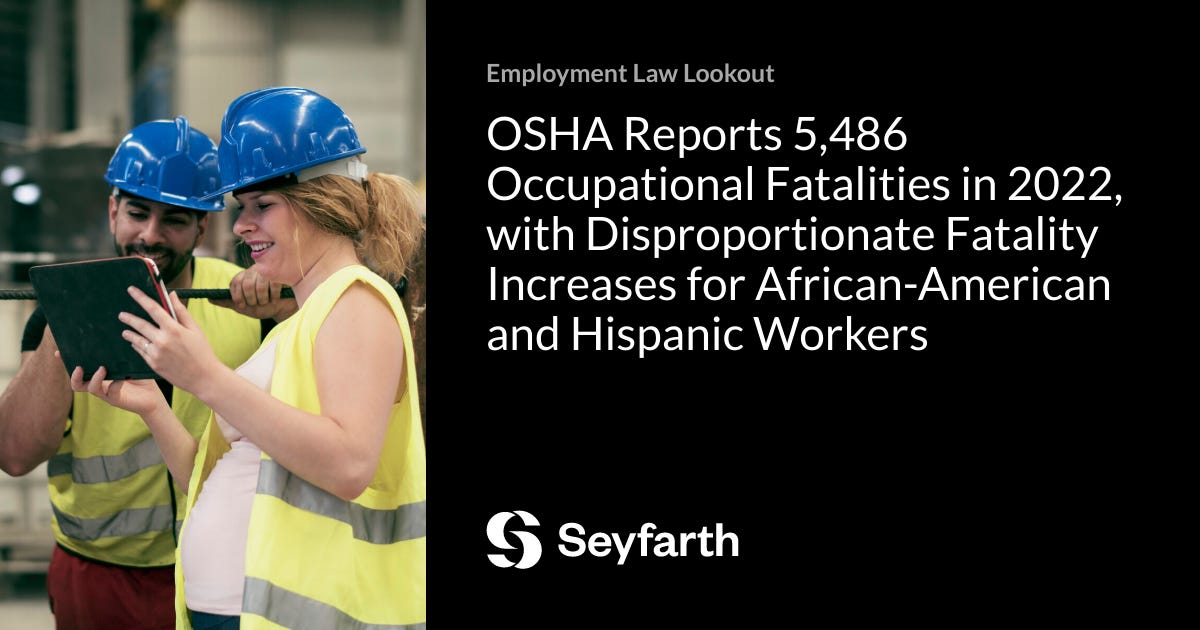
The Occupational Safety and Health Administration (OSHA) can issue fines, but even for willful violations that result in a death, penalties max out at $165,514 per citation—often reduced on appeal. Most employers see these fines as the cost of doing business. Criminal charges are almost unheard of.
In effect, the law treats a worker’s death not as a criminal act, but as a regulatory misstep, like a mislabeled shipment or a missed tax filing. And when those deaths disproportionately affect workers of color, the message becomes even starker: some lives matter less than others in the American workplace.
Systemic Neglect and the Pattern of Indifference
By now, the pattern is impossible to ignore. Black and Latiné workers aren’t dying more often because they make bad choices or take unnecessary risks. They’re dying because the systems meant to protect them have chosen not to.
We see it in the dangerous, underregulated, and low-paid industries where they work. We see it in the regions where they’re concentrated, states with weak labor laws, limited union power, and gutted inspection regimes. We see it in the employment structures, contract gigs, temp work, and layered subcontractors that shield employers from liability. And we see it in the political decisions, from executive orders that delay life-saving rules to budgets that hollow out OSHA’s capacity to enforce them.
This isn’t accidental. It’s a hierarchy of harm, baked into how labor is divided and devalued. It’s why some workers are called “essential” in headlines but treated as expendable on job sites. It’s why the death of a white-collar worker sparks a lawsuit, and the death of a Latiné roofer gets a footnote.
The truth is, we already know how to stop these deaths. We have the rules. We have the data. We have the means. What we lack is the political will to value all workers equally and the courage to demand that accountability.
Until then, the system will keep turning, just as it did for that young farmworker in California and thousands of others whose names never made the news.
Call to Action: Demand That Every Life at Work Counts
No one should die for a paycheck. Yet across the country, Black and Latiné workers are doing just that, caught in a cycle of dangerous jobs, weak oversight, and government indifference. These deaths are preventable. What’s missing isn’t knowledge. It’s action.
Here’s how you can fight back:
1. Call Your Members of Congress.
Tell them to:
Fully fund OSHA and expand its enforcement power
Pass the Protecting the Right to Organize (PRO) Act
Reintroduce and enforce the Heat Illness Prevention Rule
Close subcontractor loopholes that protect bad employers
U.S. Capitol Switchboard:
(202) 224-3121
“Hi, I’m a constituent. I want you to support stronger workplace safety protections, especially for Black and Latiné workers. OSHA needs enforcement power, and we need criminal penalties for employers who knowingly endanger lives.”
2. Support Worker-Led Movements:
3. Share the Data.
Talk about it, write about it, organize around it. Until every life counts, the system won’t change.
We just hit 13,000 subscribers—thank you!
Get exclusive analysis and fearless reporting you won’t find in corporate media.
Bibliography:
Bureau of Labor Statistics. “Census of Fatal Occupational Injuries Summary, 2023.”
AFL-CIO. Death on the Job: The Toll of Neglect, 2023.https://aflcio.org/reports/death-job-toll-neglect
National Employment Law Project. “REI Workers Speak Out on Racial Discrimination and Inequity.” May 13, 2025.
BLS. “Workplace Fatalities Among Foreign-Born Hispanic Workers.” October 2023.
OSHA Enforcement Summary (FY2023).
Trump Executive Order 13771. Wikipedia.
Project Censored. “Thousands Injured on the Job Amid Racial Disparities.” December 3, 2024.
Saul Ewing LLP. “Trump Administration Pauses Heat Hazard Rule.” March 12, 2025.
Weil, Elizabeth. “We Looked for Some of the Hottest Places in California. We Found Climate Injustice in a Nutshell.” ProPublica, August 24, 2021.
Unfortunately, this is the case all over the world. And the idea of white supremacy is also very much alive in Europe, even if it is not called that. To be honest, it is deeply ingrained in the subconscious of Europeans, albeit for different reasons. Greece invented democracy, Italy has culture, Roman history and the Pope. And we don't even need to talk about Germany.
Deregulation means more profits. The people in the $hadow$ have been pushing this for years.