


In Charles Dickens’ A Christmas Carol, Ebenezer Scrooge is famously a miserly villain who learns to embrace the true spirit of Christmas: community, generosity, and goodwill. But here’s the twist: Scrooge didn’t hate Christmas because he was cold-hearted—he hated it because it was about people, not profits. Back in Victorian England, Christmas wasn’t yet a full-blown capitalist enterprise. It was about coming together, sharing what little you had, and focusing on human connection. Scrooge saw no profit margin in that
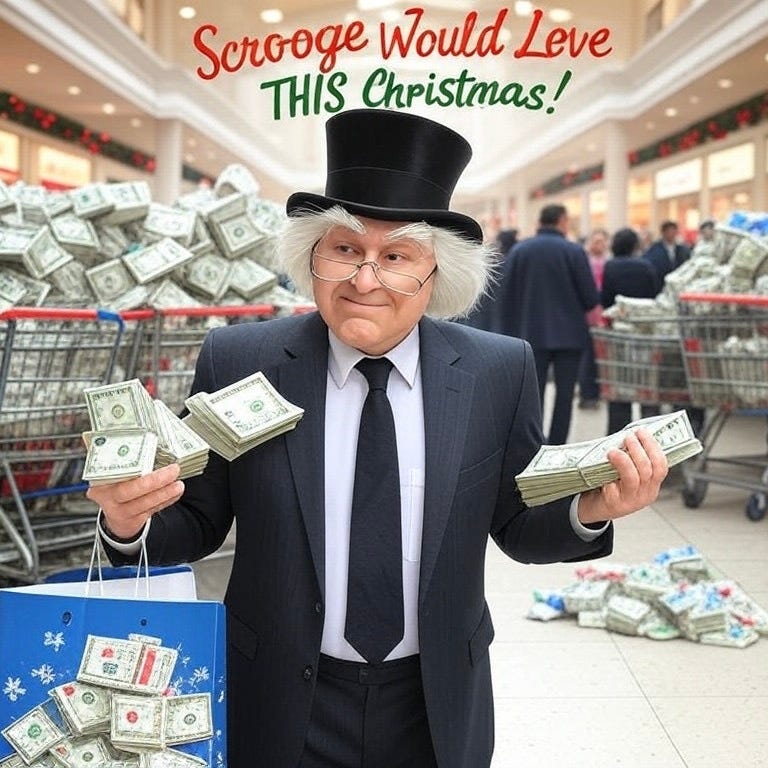
Now, fast-forward to 2024. The world has transformed Christmas into a capitalist free-for-all, complete with billion-dollar ad campaigns, record-breaking retail sales, and credit card debt galore. And you know what? Today’s holiday is exactly the kind of Christmas Scrooge would love. Gone are the pesky notions of goodwill toward men. Instead, we’ve built a holiday empire of materialism and corporate greed. This is the capitalist dream Scrooge was waiting for.
Victorian Christmas vs. Modern Christmas: A Tale of Two Holidays
When Dickens wrote A Christmas Carol, Christmas was a smaller, simpler affair. It was about family dinners, small tokens of love, and communal celebrations. Scrooge saw this as frivolous. Why waste a perfectly good workday on a feast? Why stop the gears of industry to gather in candlelit homes and sing songs? Scrooge hated Christmas because it emphasized relationships over revenue.
But look at Christmas now: It’s an economic juggernaut. Entire industries rely on the holiday season to stay afloat. Retailers make 20-30% of their annual revenue in the last quarter of the year, and consumers are encouraged to spend money they don’t have on things they don’t need. This isn’t the Christmas Dickens celebrated—it’s the Christmas Scrooge would have dreamed of.
Imagine the grin on Scrooge’s face as he scrolls through online ads for $2,000 handbags or hears news of Black Friday shoppers trampling each other for the latest TV. He’d toast to the efficiency of it all: profits maximized, humanity minimized.
The Ghost of Christmas Capitalism
Here’s the real kicker: The modern Christmas machine doesn’t just encourage greed—it depends on it. Billion-dollar ad campaigns are designed to manipulate us into believing that love equals expensive gifts. Companies exploit underpaid workers to stock warehouses and deliver packages in time for December 25th. Meanwhile, corporate profits soar, and the richest among us—our modern Scrooges—pocket the difference.
It’s not goodwill fueling this holiday season; it’s marketing budgets and supply chain logistics. Community and generosity? Those are just quaint stories we retell to feel better while checking out with our Amazon carts.
If the Ghost of Christmas Past visited Scrooge today, it wouldn’t show him joyful Victorian gatherings—it would show him malls, mega-corporations, and debt collectors. And you know what? He’d be thrilled.
A Redemption Arc for the Rest of Us
Let’s be honest: A Christmas Carol ends with Scrooge’s redemption, but it’s a redemption on Dickens’ terms. Scrooge gives away money, buys a turkey for the Cratchits, and joins the community he once spurned. It’s a touching moment, sure, but it’s also a surface-level fix. Scrooge’s transformation doesn’t address systemic poverty or inequality—it just makes him a nicer boss.
If Scrooge were alive today, would he even need redemption? After all, we’ve normalized his values. He wouldn’t be a villain; he’d be a CEO handing out holiday bonuses while raking in profits. His disdain for human connection would be reframed as "business efficiency." His obsession with profit margins would be celebrated on the cover of Forbes.
But for the rest of us, stuck in this endless loop of buying, spending, and striving to meet holiday expectations, maybe it’s time to write a new redemption arc—one that reclaims Christmas from Scrooge’s corporate grip.
What Would Dickens Say About This?
If Dickens could see Christmas today, he might write a different kind of story. Instead of three ghosts visiting a single man, they’d visit all of us. The Ghost of Christmas Past would show us simple gatherings and heartfelt traditions. The Ghost of Christmas Present would show us the stress and debt of keeping up with modern expectations. And the Ghost of Christmas Yet to Come? Well, let’s just say it might look like an empty Amazon warehouse staffed entirely by robots.
Dickens wrote A Christmas Carol as a critique of greed and inequality, but the world has taken his story and flipped it on its head. We’ve built a holiday that rewards the very behaviors Dickens warned us about. And if we’re not careful, we might lose the spirit of Christmas entirely—except this time, no ghosts will come to save us.
The Scrooge Within Us All
Maybe it’s time to ask ourselves a hard question: Are we the Scrooges now? Not the grumpy old men counting coins, but the willing participants in a holiday system built on consumption, profit, and endless work. If we want to reclaim Christmas, it’s not about buying fewer gifts or opting for “thoughtful” purchases. It’s about rejecting the idea that the holidays are defined by spending in the first place.
Because if we don’t, Scrooge’s dream of a materialistic, profit-driven Christmas will be our reality for generations to come. And the saddest part? We’ll have handed it to him on a silver platter, wrapped in a bow, with a gift receipt included.
If you read Stephen Nissenbaum's The Battle For Christmas, you will find that Dickens' story was instrumental in changing Christmas from 'Mardi Gras on steroids' to heartfelt domestic 'traditions'. 'Have a merry Christmas' was the call for alcohol abuse. Callithumpian bands led to the creation of municipal police forces.
Industrialism started in 1780 with the first cotton mills, which were insanely profitable because one skilled worker could generate the same amount of textiles as 10 weavers. Compare the current cost of cotton to silk to see the result. Industrialism has changed our life ways, not always for the better (there was no type 2 diabetes before the automobile). 'Christmas' has become a way to express our sense of what we have lost to Industrialism, rather than an honest account of the past. By starting his career in a warehouse, Scrooge represents the industrialism that was expanding the reserve army of unemployed workers. Notice Dickens didn't convert Scrooge into a revolutionary. That's because Dickens was riding industrialism to his personal enrichment.
Noam Chomsky famously doesn't believe in conspiracy theories; instead, he believes it is business as usual. Dickens used sentimentality to sell a counter-revolutionary Christmas. It worked, and joined a tide of other social changes that Nissenbaum describes.
This would have to happen one family at a time.