


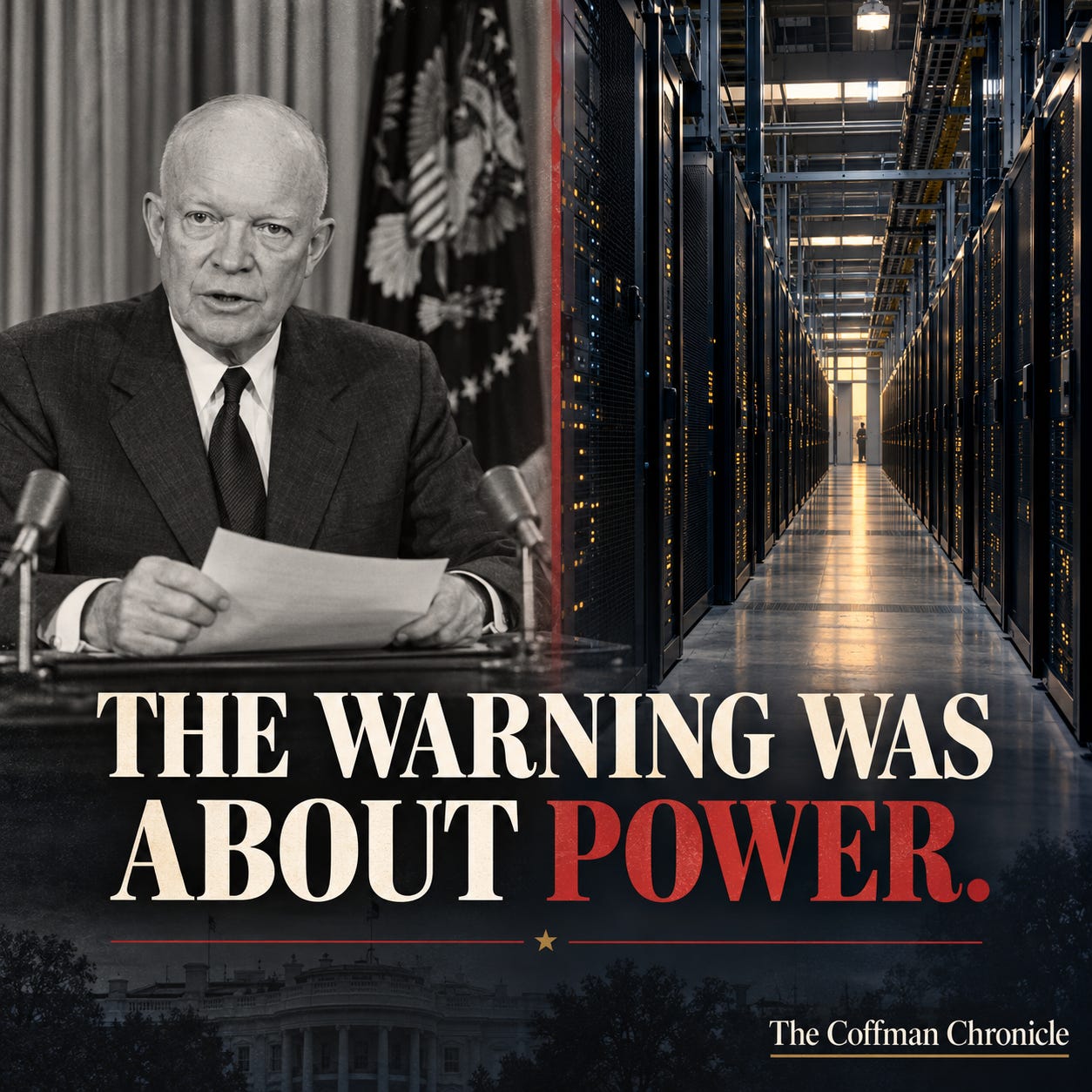
The General Who Warned America
On January 17, 1961, President Dwight D. Eisenhower addressed the American people from the Oval Office for the final time. Three days later, John F. Kennedy would become president. Before leaving, the five-star general who had commanded Allied forces in Europe during World War II wanted to warn Americans.
Two world wars and the Cold War had transformed the United States into a military and industrial power unlike anything it had maintained during peacetime. Factories, laboratories, military installations, and private corporations had become essential to national defense. America could no longer afford to rebuild its military capacity from scratch whenever another threat emerged.
Eisenhower understood why the system existed. He wasn’t calling for America to abandon its defenses or stop investing in technology. Few presidents had greater experience with the relationship between military strategy, industrial production, and national security. But he knew that institutions created to protect a country could accumulate enough economic and political influence to begin shaping the decisions they were supposed to serve.
He named that relationship the military-industrial complex. In his farewell address, Eisenhower warned, “In the councils of government, we must guard against the acquisition of unwarranted influence, whether sought or unsought, by the military-industrial complex.” Those words became the defining legacy of his speech, repeated by generations concerned about defense spending, corporate influence, and permanent war. But the warning came from a president who had helped oversee the very defense system he was describing. He was asking Americans to distinguish the strength needed to defend a republic from the influence that strength could accumulate over the republic itself.
Yet Eisenhower delivered another warning in the same speech. He described how scientific research had become increasingly dependent on government funding, large institutions, and specialized expertise. Then he warned that public policy could become captive to a scientific-technological elite.
Eisenhower was not suspicious of science simply because it was advancing. He feared what could happen when those controlling essential technology, specialized knowledge, and enormous financial resources acquired disproportionate influence over public decisions. The danger didn’t require a conspiracy. It could develop through ordinary relationships among government officials, businesses, military planners, and scientific experts, each pursuing seemingly reasonable goals.
Over time, the nation might become dependent on institutions it could no longer easily challenge, regulate, or replace. Who ultimately makes decisions when national security, corporate interests, scientific expertise, and government authority become inseparable?
Sixty-five years later, Americans are confronting that question again. Now, the technology at the center of the conversation is artificial intelligence (AI).
This Community Is Powered by You
What started as a small circle has grown into something much bigger, and it’s all because of readers like you.
Every time you forward this email, post it on socials, or bring someone new into the fold, you’re helping build one of the most passionate, independent communities out there.
Want to keep the momentum going?
Share this newsletter with someone who should be part of this conversation.
Thank you for being here. It means everything.
The Warning We Remember. The Warning We Forgot.
Most Americans who recognize the phrase military-industrial complex associate it with defense contractors, enormous Pentagon budgets, and politicians protecting military spending. However, reducing Eisenhower’s argument to companies making money from war misses the deeper concern.
Military commanders needed equipment, manufacturers needed contracts, workers needed jobs, and members of Congress cared about their districts’ economies. Each could pursue a legitimate objective while contributing to an arrangement that became difficult to challenge. That is why Eisenhower warned against unwarranted influence, whether deliberately sought or accumulated through the system's ordinary workings.
Consider a major weapons program embedded in several communities. Factories hire workers, suppliers build businesses, and local governments depend on the resulting activity. Questioning whether the military still needs that system becomes a debate about jobs, tax revenue, corporate profits, and political consequences. Congress may face pressure to preserve it even when a less expensive or more effective alternative deserves consideration.
That does not prove the program is unnecessary or its supporters dishonest. It shows why government needs enough independence to judge military requirements on their merits. If economic dependence makes canceling an unnecessary program politically impossible, the problem extends beyond the defense budget. The public is entitled to ask whether a program exists because it serves a continuing need or because ending it would impose costs that elected officials would rather avoid explaining. Both questions deserve an answer, but only one can establish a national-security requirement.
Eisenhower’s scientific warning described a relationship that ran in both directions. Government funding could shape which discoveries researchers pursued. Meanwhile, increasingly specialized technology could make officials dependent on a small group of experts to explain what was possible, necessary, or affordable.
Scientific knowledge is essential to competent government. Engineers can explain systems, commanders can describe operational requirements, and executives can explain costs. But technical expertise and democratic authority serve different purposes. Their expertise alone does not give them the authority to decide what risks citizens should accept, how much taxpayers should spend, or which protections remain in place. Government must hear competing technical assessments rather than rely on the same vendor to define a problem, propose a solution, and judge whether it worked.
The danger grows when agencies have few alternatives to their suppliers. A contractor may operate systems government employees cannot replace or control information necessary to evaluate performance. Even without improper conduct, that dependence can shape which choices officials consider realistic.
Here Eisenhower’s warnings converge. One concerns economic influence over national-security decisions; the other, concentrated technological expertise influencing public policy. When private institutions develop essential technology, receive government funding, and supply critical defense capabilities, both concerns can operate at once.
Government needs private innovation and capable partners, but partnership must not mean surrendering the ability to make independent decisions. Washington has decided that America cannot afford to fall behind in developing artificial intelligence.
Washington Declares an AI Race
Washington has chosen a word for artificial intelligence: race. It is not simply another industry, but a competition the United States believes it cannot afford to lose. When national security and economic dominance are at stake, speed begins influencing nearly every policy decision.
On January 23, 2025, President Donald Trump signed an executive order titled Removing Barriers to American Leadership in Artificial Intelligence. Six months later, the White House released America’s AI Action Plan, identifying more than ninety proposed federal actions involving innovation, infrastructure, and international leadership. The administration argued that unnecessary restrictions could slow American companies while strategic competitors, particularly China, advanced.
There are legitimate reasons to prioritize AI. It has potential applications in medicine, manufacturing, research, cybersecurity, transportation, and defense. Military planners see opportunities to analyze information and improve logistics and operations. Allowing a strategic competitor to gain overwhelming advantages in technologies essential to national security could create risks of its own. Every delay is not necessarily evidence of government failure. Security testing, competitive bidding, and clear contracting rules can prevent larger failures later. A national strategy should explain which requirements slow progress without producing public value and which safeguards keep rapid progress from becoming an expensive mistake.
Eisenhower would have understood that argument. His concern wasn’t whether America should advance technologically, but whether urgency might substitute for independent judgment. A military requirement still needs examination, a contract needs justification, and an essential supplier needs accountability. National security explains why government may invest, not automatically how much it should spend or what protections it should require.
The administration’s agenda reaches beyond software to data centers, electricity infrastructure, semiconductor manufacturing, and American technology exports. It also emphasizes reducing regulatory barriers and consulting industry about restrictions companies consider unnecessary. Industry expertise can identify obsolete requirements, but companies also have financial interests in the outcome. Government must distinguish needless obstacles from safeguards that protect the public. When industry asks government to move faster, the question is not simply whether faster approval would benefit the companies involved. It is whether the public receives a better result and whether oversight can keep pace with what is being built.
The administration has sought greater national consistency in AI regulation. Its March 2026 legislative framework proposed federal approaches to child safety, workforce development, and community protections while seeking to displace certain state restrictions. Consistency can help businesses operating across state lines, but citizens still need to know whether federal rules preserve protections states currently provide.
The administration has not ignored technological dependence. A June 2026 national-security memorandum set objectives for reliability, accountability, and government control of essential AI systems. In October, the administration established a task force to examine AI-related risks and coordinate federal policy. Those measures deserve examination, including whether their protections work in practice rather than only on paper.
This question extends beyond President Trump. Government’s relationship with technology companies predates this administration and will outlast it. America needs rules durable enough to survive changes in political leadership, corporate ownership, and technical capabilities. AI may demand urgency, but urgency does not relieve Congress of its responsibility to provide oversight.
Once Washington identifies an industry as essential to national security, public money flows to companies that can supply it. That is where Eisenhower’s warning becomes more than history.
Follow the Contracts
On July 14, 2025, the Pentagon’s Chief Digital and Artificial Intelligence Office announced agreements with Anthropic, Google, OpenAI, and Elon Musk’s xAI. Each carried a $200 million ceiling, for a combined potential value of $800 million, to accelerate military adoption of advanced AI across national-security missions. A contract ceiling is neither money already spent nor a guarantee that a company will receive the full amount, but these agreements establish formal purchasing relationships with developers of some of the world’s most advanced AI systems.
The Defense Department wants to explore technology that can perform multistep tasks, analyze information, support logistics, and improve efficiency. Successful applications could save money and strengthen defense. Working with several suppliers may also preserve competition rather than placing every requirement in one company’s hands.
However, competition at the outset does not guarantee independence later. Who controls the data the software processes? Can government specialists test its performance? What happens when a supplier changes the technology, raises prices, or discontinues service? Can another contractor take over without forcing an agency to rebuild its operations?
Traditional military procurement has faced similar problems. Weapons can require proprietary software, replacement parts, or maintenance available only from the manufacturer. AI adds complications because government may purchase an ongoing service rather than equipment it can run independently. Updates can change the system, and the supplier may retain control of critical infrastructure. That makes the right to inspect performance, export data, document changes, and continue operations after a disagreement central to national security, not fine print left entirely to purchasing officers.
In April 2026, the Government Accountability Office (GAO) reported that agencies struggled with AI acquisition costs, technical expertise, and data rights. The Departments of Defense, Homeland Security, and Veterans Affairs, along with the General Services Administration, were not systematically collecting lessons learned from their AI acquisitions, limiting their ability to improve contracts and avoid repeated mistakes.
One example involved the Federal Emergency Management Agency. Officials using an AI-based damage assessment system said they could not share certain outputs with federal and state partners because they had not obtained the necessary rights when the agreement was awarded. Technology intended to support disaster response came with contractual limits on sharing information among public agencies. No conspiracy was required; a procurement omission created a practical barrier.
The GAO findings do not prove that the Pentagon’s four agreements have those weaknesses or that any named company did anything wrong. They show identifiable procurement problems affecting costs, performance, competition, and public control. All four agencies agreed to GAO’s recommendations to improve their practices.
Companies have legitimate reasons to develop technology, compete for contracts, and earn profits. Government must obtain useful capabilities at defensible prices while retaining the ability to assess and replace suppliers. A government contract can buy access to extraordinary technology, but it cannot replace the government’s responsibility to control its use. That raises a difficult question: What happens when government becomes a customer that cannot realistically leave?
When the Government Becomes the Customer That Cannot Leave
Buying technology from a company differs from relying on that company to fulfill an essential public responsibility. If an agency can replace an unsatisfactory supplier, it retains leverage. If switching would disrupt operations, the contractor gains bargaining power beyond what its original agreement might suggest.
Imagine an agency adopting an AI system, training employees on it, integrating it with other software, and building procedures around its capabilities. After several years, switching providers might require extensive retraining, transferring sensitive information, conducting security reviews, and rebuilding other systems. The purchase may have been sensible, but leaving becomes expensive.
A company need not act improperly to benefit from this position. It may provide excellent service at a fair price. Nevertheless, responsible government must anticipate changes in prices, technology, corporate ownership, and the public’s needs rather than relying entirely on goodwill.
A real-world example involves satellite communications, not AI. In May 2026, Reuters reported a disagreement between the Pentagon and Elon Musk’s SpaceX over pricing for Starlink connections used in military drone operations. According to the report, SpaceX argued that a higher-priced service category applied, and Pentagon officials ultimately agreed to the increased fees. Musk and a Pentagon spokesperson disputed that account, while the Pentagon emphasized its pursuit of competition in military satellite communications.
The contested account does not establish wrongdoing. SpaceX has provided communications capabilities with genuine national-security value. But the dispute illustrates why access, pricing, service continuity, and alternative suppliers become operational issues when essential activities rely on a private network.
AI can create comparable dependence on proprietary models, computing infrastructure, specialized employees, and continuously updated software. Even when an agency owns its data, it may not be able to move an established system elsewhere without serious disruption. A contractual right to terminate is not the same as a functioning replacement. Government may need staff who understand its systems well enough to supervise vendors, validate claims, and manage a transition. That capacity costs money, but so can losing the ability to make an independent choice when a contract comes up for renewal.
The administration’s June 2026 memorandum addresses this risk by directing agencies to use multiple vendors and to protect against private entities disabling, degrading, or materially altering mission-dependent AI systems without federal knowledge and approval. Those are meaningful objectives. Enforcing them requires enforceable agreements, technical expertise within government, independent testing, and credible alternatives.
Congress can investigate whether those protections operate in practice, including data rights, contractor competition, and continuity plans. Some information must remain classified, but that requires protected oversight, not no oversight. The relevant test is whether government can exercise its contractual rights under difficult conditions, not just whether a document says those rights exist.
Government does not have to own every satellite, computer, or AI model it uses. Private partners can deliver capabilities agencies could not efficiently develop alone. The point is to ensure the government retains practical control, not merely formal authority. And as the industry grows, that question reaches households far from Washington or Silicon Valley.
The Bill Still Comes to the Kitchen Table
The family opening its electric bill may never have heard of Eisenhower’s military-industrial complex or know which companies have Pentagon contracts. They understand what happens when keeping the lights on costs more. Their household budget shrinks, no matter how impressive the technology being developed elsewhere.
AI depends on data centers packed with specialized computers that consume electricity, generate heat, and require supporting infrastructure. In June 2026, Lawrence Berkeley National Laboratory projected that data centers could use approximately 11.8% of America’s electricity by 2030, with scenarios ranging from 9.5 to 15.3%. Those forecasts include activities beyond AI and are not guaranteed outcomes, but they illustrate the scale of the challenge.
Meeting demand can require transmission lines, substations, transformers, and new generating capacity. Utilities generally recover approved costs through customers’ rates. If infrastructure is built mainly to serve an enormous new industrial customer, who should pay: the company creating the demand or the households and businesses already connected? An ordinary household cannot negotiate a special utility contract or relocate when a major industrial project changes the local energy outlook. Regulators must consider customers without a seat at the corporate negotiating table.
Electricity prices reflect fuel costs, weather, aging infrastructure, and many other factors. Not every increase can be blamed on AI; large customers can sometimes help finance improvements that benefit everyone. But when equipment is built around demand that fails to materialize, the public should know who remains responsible for the cost.
There are benefits. Data-center construction employs electricians, engineers, construction crews, and equipment manufacturers. Communities may receive tax revenue and infrastructure improvements. But temporary construction jobs differ from permanent staffing, and promises of investment do not automatically justify public subsidies or infrastructure commitments.
In March 2026, seven major technology companies signed the Trump administration’s Ratepayer Protection Pledge, committing to secure electricity supplies and cover data center-related infrastructure expenses rather than passing those costs to households. The principle is sensible: companies creating extraordinary demand should take responsibility for meeting it.
However, a voluntary pledge is not the same as an enforceable utility agreement. Regulators need to examine costs, set rates, and decide who pays if a project uses less power than expected or shuts down before its infrastructure is paid for. The public needs a way to verify that promises are kept. That means looking beyond a company’s press release to rate structures, infrastructure commitments, and financial guarantees approved by utility regulators. A project may bring genuine benefits while still requiring safeguards against cost shifting.
Virginia offers one approach. Its State Corporation Commission-approved provisions require certain large electricity customers, including data centers, to accept long-term service obligations and minimum payments. Beginning in 2027, new qualifying large-load customers generally face a 14-year service commitment. Covered customers must pay minimum charges based on 85% of contracted transmission and distribution demand and 60% of generation demand, even when usage falls short, subject to specified exemptions. The goal is to limit costs shifted to everyone else.
Communities must also consider water use, land use, public services, and environmental conditions. A town should be able to welcome investment without surrendering its authority to question the consequences. Federal policy, state utility regulation, and local planning each have a role in assigning responsibilities fairly.
This is government and corporate stewardship in practice. Businesses can innovate and earn profits while accepting responsibility for burdens they create. Government can encourage investment without transferring avoidable costs to citizens. The Square New Deal asks whether benefits are real, costs are fairly assigned, and affected people have meaningful protection. Americans should not have to learn that those obligations were neglected by opening their next electric bill.
Congress Cannot Outsource Its Responsibility
The Constitution gives Congress the power of the purse because controlling public money is one way the people control government. That authority does not belong exclusively to the president, military leaders, or companies selling public institutions technology. It belongs to the legislative branch, whose members must answer to voters for spending decisions.
Article I authorizes Congress to raise and support armies, provide and maintain a navy, and establish rules for the armed forces. Federal money cannot be drawn from the Treasury without appropriations. The president is commander in chief and directs executive agencies under the law, but Congress retains constitutional authority over military commitments and spending.
AI does not change that. Congress need not design models or negotiate every contract. It must establish legal boundaries for government purchases and uses of AI, appropriate funds, and examine whether safeguards work. Technical complexity and national-security urgency do not suspend those duties. Congressional committees can call agency officials and contractors to account, review records under appropriate security procedures, and use appropriations and legislation to correct weaknesses. That work is less dramatic than presidential announcements, but it builds durable oversight.
Lawmakers can require safeguards for government data, independent testing, contingency plans if contractors fail, and evidence that agencies can switch suppliers. They can demand explanations of costs, service interruptions, and procurement decisions rather than accepting assurances that everything is under control.
The GAO’s April 2026 findings offer an immediate starting point. Congress can require the agencies identified to document corrections, measure progress, and explain whether new legislation is necessary. Oversight should identify weaknesses before they become expensive failures.
Industry experts belong in that process. Engineers and executives understand capabilities government officials need to evaluate. But expertise does not confer democratic authority. Companies can explain what their systems do, what they cost, and what they require; Congress must determine the obligations that accompany public use.
Those obligations should survive changes in presidents, executives, and technologies. States, communities, and regulators also retain responsibilities within their authority, particularly when federal ambitions create local costs. Congress should not substitute executive promises or corporate assurances for durable rules.
The Square New Deal brings together government, corporate, and citizen stewardship. Private companies may own AI. The American people must own the rules. Businesses that take public money must meet enforceable obligations, and elected institutions must protect citizens from risks and costs they should not bear.
Congress has tools to do its part. Whether it uses them effectively is a question the people writing contracts or developing technology alone cannot answer. Eisenhower understood who ultimately had to ask.
Eisenhower Was Warning the Citizens, Too
One final part of Eisenhower’s farewell address is worth remembering. After describing concentrated military and industrial power, he placed responsibility for holding it accountable on an alert, knowledgeable citizenry. Democratic institutions could protect the nation only if the people stayed engaged enough to hold them to their purposes.
That is demanding. Most Americans lack the time or expertise to evaluate weapons systems, AI models, or federal contracts. They have jobs, families, and bills. However, citizenship does not require knowing how to build a technology. It requires knowing who governs its use and insisting that those officials answer for their decisions.
Americans can ask whether agencies received what taxpayers bought, whether contractors met their obligations, and what happens when essential systems fail. Communities can demand explanations of infrastructure commitments and local costs. They do not need an engineering degree. They need representatives willing to provide meaningful answers. Citizen stewardship is not a demand that households personally audit federal code or classified contracts. It is an insistence that elected institutions do the examining for them and make enough of the results understandable for the public to judge their performance.
National security sometimes requires secrecy, and businesses deserve appropriate protection for legitimate proprietary information. Neither should become a blanket excuse for avoiding accountability. Congress can inspect classified programs through established procedures, conduct independent reviews, and report responsibly to the public.
That expectation must be consistent across political parties. Americans cannot demand scrutiny of a contract awarded by a president they oppose and abandon it when their preferred administration makes the same decision. Constitutional responsibility does not change depending on who benefits.
Near the end of his farewell address, Eisenhower spoke about the civic responsibilities he would carry after leaving office. The general who had commanded Allied armies was returning to private life, but his obligation to the country did not end with his authority to govern.
Sixty-five years later, the machinery created to defend a free society increasingly includes AI, private infrastructure, and corporations whose capabilities may become essential to government. The technology has changed, but the constitutional responsibility has not.
Eisenhower’s warning was never just about the powerful. It was about whether the rest of us would remain powerful enough to hold them accountable.
Help Keep Independent Journalism Alive
Eisenhower understood that democracy depends on an informed and engaged citizenry. That responsibility hasn’t changed, even as the technology and institutions shaping our lives have grown more complicated. The Coffman Chronicle examines those institutions, follows the public money, and reminds Americans that government answers to the people, not the other way around.
If you value independent journalism that puts the Constitution above ideology, please consider becoming a paid subscriber if you can afford it. Your support helps keep this work going. If a paid subscription isn’t possible, reading, sharing, and joining the conversation matter just as much.
Because an informed citizenry isn’t something we inherit. We have to keep building it together.
Sources
Eisenhower, Dwight D. “Farewell Address.” National Archives and Records Administration. January 17, 1961.
Jeans, David. “Pentagon Spars with SpaceX over Starlink Price Hike during Iran War.” Reuters, May 26, 2026.
Rozen, Courtney. “Trump AI Task Force Leaders to Meet on Thursday, Vice Chair Says.” Reuters, October 8, 2026.
Smith, Sarah Josephine, Alex Hubbard, Alexander Newkirk, Mohan Ganeshalingam, Billie Holecek, Dale A. Sartor, Michael Mills, and Arman Shehabi. United States Data Center Energy Usage Report: 2025 Update. Lawrence Berkeley National Laboratory, June 2026.
United States. Constitution of the United States. 1787. National Archives and Records Administration.
United States Department of Defense, Chief Digital and Artificial Intelligence Office. “CDAO Announces Partnerships with Frontier AI Companies to Address National Security Mission Areas.” July 14, 2025.
United States Government Accountability Office. Artificial Intelligence Acquisitions: Agencies Should Collect and Apply Lessons Learned to Improve Future Procurements. GAO-26-107859. April 13, 2026.
Virginia State Corporation Commission. “In Biennial Review Ruling, SCC Creates New Class for Large-Scale Energy Users.” November 25, 2025.
White House. “Fact Sheet: President Donald J. Trump Advances Energy Affordability with the Ratepayer Protection Pledge.” March 4, 2026.
White House. National Security Presidential Memorandum/NSPM-11: Artificial Intelligence in the National Security Enterprise. June 5, 2026.
White House. “President Donald J. Trump Unveils National AI Legislative Framework.” March 20, 2026.
White House. Removing Barriers to American Leadership in Artificial Intelligence. Executive Order 14179. January 23, 2025.
White House. “White House Unveils America’s AI Action Plan.” July 23, 2025.
Yeah, y’all ignored us. We told you that the military industrial complex would eat you if no controlled. We marched in the streets in protest of the Vietnam War. We chanted “Tax the rich feed the poor”, and that women and minorities had rights. You called us drug crazed hippies, and forgot what we said.
...the short version of this lengthy article is that, w/ the help o/t Supreme Court we have evolved a political system designed to hand power, responsibility for decision making, to the wealthiest, individual & corporate, who, no surprise, make self serving decisions using $$ dependent politicos to overwhelm & discredit less funded opponents...attack ads, lack of critical skills have proven dangerous...